Хочете будувати кар’єру в Data Science та AI? Vodafone Big Data Lab відкриває новий набір —>
Ігор Вишневський Увійти в ІТ
11 May 2026, 09:00
2026-05-11
Breaking through the door in IT with a sledgehammer. A June Switcher from Zaporizhzhia looked for a new job for seven months, but had been working towards the role of a developer for over 10 years. What helped her not to give up
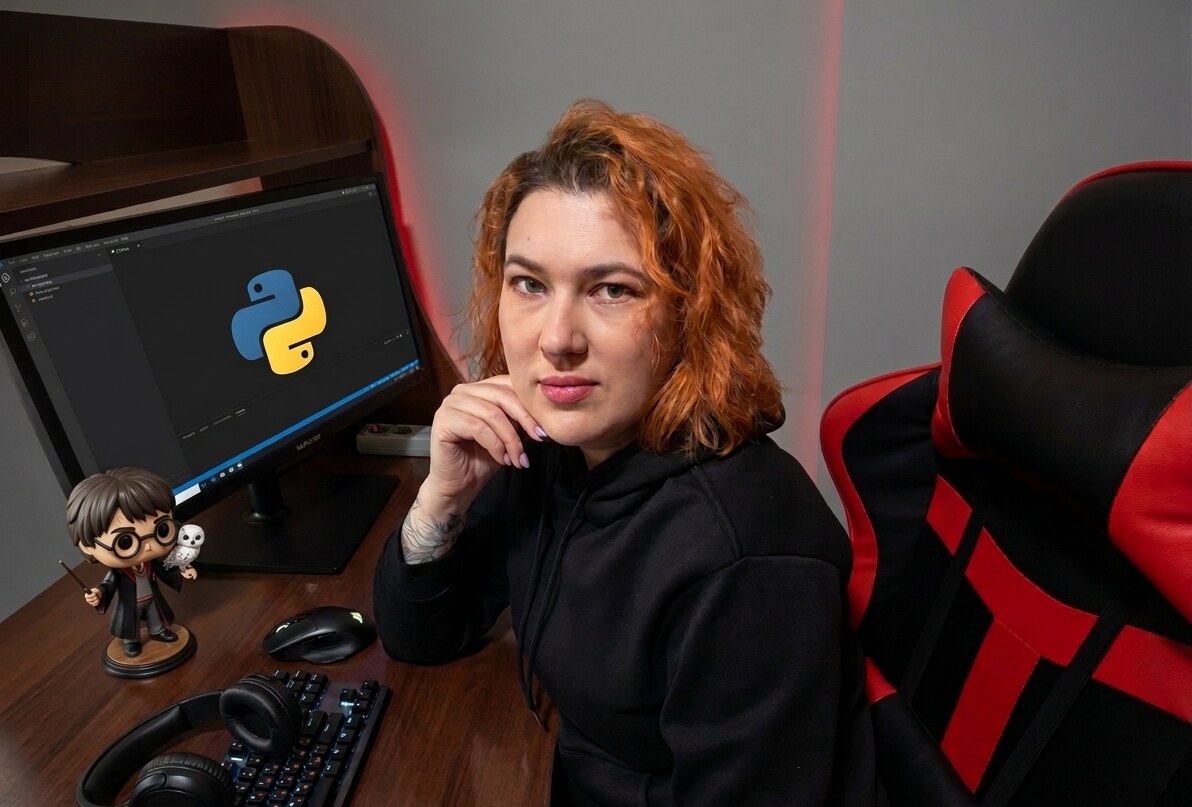
Junior Python Developer Olga Magerya did the incredible thing — she finally got a job after more than six months of searching. Her post on this occasion gained a crazy reach and number of likes, as for her page, which caused sincere surprise even for the IT-star herself. It would seem that it is a completely banal thing — a person simply found a new job, so what’s the big deal? But given how difficult it is now for a young person with little experience to break through and gain a foothold in IT, this has already become equated to a slight variation of a miracle.
Junior Python Developer Olga Magerya did the incredible thing — she finally got a job after more than six months of searching. Her post on this occasion gained a crazy reach and number of likes, as for her page, which caused sincere surprise even for the IT-star herself. It would seem that it is a completely banal thing — a person simply found a new job, so what’s the big deal? But given how difficult it is now for a young person with little experience to break through and gain a foothold in IT, this has already become equated to a slight variation of a miracle.
Olga started a new chapter as an Intern Python Developer and her entire experience at the time of employment was less than a year at Computools. So finding a new job for the IT professional from Zaporizhzhia was truly a «star-studded» task.
In a conversation with dev.ua, Olga Magherya talked about how she finally decided to major in IT finance, even though she could have done it more than 10 years ago, and what helped her get an offer and not lose faith in herself over the past six months. What follows is her direct speech.
Losing your first job and finding a new one
Of course, I didn’t plan on going anywhere with Computools, but the project I was working on ended. In the future, the company had a hard time finding a client who wanted a newbie.
The company is not obligated to support me for life, so I had no choice but to look for another job. It took me about seven months, starting in early October last year.
During this period, I had three technical interviews. As for the first one, I was probably to blame myself — I didn’t prepare very well and didn’t answer all the questions well. Although it was a little disappointing, because they got the impression that I didn’t know anything. And when I teach something, on the contrary, I try to understand in detail how it all works. Sometimes it’s just hard for me to tell — it’s easier to show myself. Anyway, after the first technical one, I was rejected.
I passed the second technical interview. I was accepted and everything was fine. But it was already in December, before the New Year. And, unfortunately, the company where I almost got a job revised its plans for the year and simply decided to cancel this vacancy. It was very disappointing, because I was one step away from getting a job. And, finally, after the third technical interview, I was offered an offer.
Of course, during those seven months, there were periods of despair. At some point, I stopped counting the number of resumes I sent out. I sent out everything that had the word Python in it.
I tried different approaches and different ways of looking for a job so that at least something would work — if not one, then another. In total, I had over 100 responses and about seven interviews with recruiters.
«Shocking» changes and unexpected questions
I would call the first few interviews with recruiters adaptations. But it was just a shock for me how the selection process changed while I was still looking for my first job.
At the end of 2024, when I found my first job in IT, interviews with recruiters took place in a fairly classic format: the recruiter talked about the company, and I was asked about my experience, skills and abilities, some general points, what frameworks I know. And now, when we talked about all this, the recruiter tells me: «And now there will be technical questions.» I have my first interview and I am shocked, because I was not warned that there will be technical questions from the recruiter. After all, to answer technical questions, you need to prepare separately, repeat something, learn something anew. These questions were very specific, and most importantly, unexpected.
I also want to say that it is very difficult to answer technical questions specifically from recruiters. Because, in fact, the person opposite does not understand the essence of your answer and how it all works. It is easier to explain everything at a technical interview with a specialist in this field, even if you speak English. Because the things that you say are not directly «according to the textbook», they understand and can suggest, direct, discuss something, being aware of the issue. I thought — well, this is some kind of strange recruiter, they drove by. But they schedule another interview — and the same thing happens, again the technical questions were from the recruiter, and again I was not warned about it.
I think — yes, stop. These are probably some new trends. And then I started seeing a lot of posts on LinkedIn from other developers who are also going to interviews. It turns out that recruiters also ask them technical questions and they even collect «piggy banks» from these «especially fun» questions.
So, already at the interview stage with the rectors, I started making a large list of technical questions and re-reading it just in case.
What’s most triggering is that they don’t warn you about it in principle — I’m not asking for a list of questions you’ll ask. But just say that we’ll talk about your experience, check your English, and ask a few technical questions. That’s all, that’ll be enough for me to be ready for it! I didn’t appreciate such surprises — as if a person doesn’t have enough stress at an interview!
AI vs. Juni. Who will work when the seniors retire?
Now everyone is «saturated» with artificial intelligence. Everyone has become very confident in it and is feeding themselves with the illusion that they can fire all the developers, leaving only one, who will start 150 chatbots and they will write all the code.
The vast majority do this now, but at some point people will see that it is inefficient, and as a result of such code, a lot of errors will appear. The business will only lose from this.
I hope that at some point everyone will cool down a little and understand that, after all, without human potential — nothing. AI is an assistant to the developer, not his replacement. This is — firstly, and secondly, sorry, but the signors will retire someday! Who will work instead of them if the juntas do not have the opportunity to gain the necessary experience? Machines cannot completely replace people, and machines will not control machines, so this is a path to nowhere.
It is very difficult for a beginner to break through the wave of AI euphoria and stay in IT. The only way out is to look for vacancies such as «intern», «trainee», agree to any salary and do not expect that you will receive $1000 per month from the start, as promised by IT schools.
Some people go into IT to make a lot of money, but that’s the wrong path for a beginner. I went because I liked the development itself and the whole process of writing code, creating applications, and so on.
Anyone who wants to hold on and get a job must make concessions, be prepared for a low salary and a long search.
As for the use of AI during interviews by candidates themselves, many recruiters specifically warn against doing this. Because, as I understand it, many people try to use AI to provide hints when answering questions. I have never used AI during an interview. The only thing is that when preparing for an interview, I turned to AI to practice spoken English with it. It is more convenient than attending speaking clubs.
As for English itself, I’ve been speaking it for 20+ years, but speaking practice is, of course, a separate topic. I watch most movies and TV shows in English, I read both technical and fiction, but being able to speak is a separate skill. That’s why AI has really come in handy for me to practice with.
Where to look for a job in June: personal experience
I mainly looked at vacancies on Djinni. As for me, on Djinni there is still a very high percentage of you getting at least some kind of answer. Plus, there is a convenient chat for correspondence.
There are many interesting vacancies on DOU, and as I understand it, there is also the possibility of private messages, but for some reason none of the recruiters ever wrote back to me. You respond, and in return there is silence. So, when I responded to a vacancy and did not receive a response within a few days, I went to LinkedIn, found this company and their recruiter there, added them to my connections and wrote directly to the recruiter with a proposal to chat.
At the same time, sites like work.ua and robota.ua are completely non-working stories for me. The first one is more or less, and robota.ua only sends some kind of fraudulent spam.
You must provide your mobile number, and in my opinion, 99,99% of employers on this resource are scammers who simply hang up the phone. You try to find any information about these «employers», but there is no link to the company’s website or description at all. When you take the name of the company and just type it into Google, it only throws up two results — robota.ua and OLX. That is, these are clearly fake «offices» with one goal — to hang up your phone in order to somehow later gain access to your banking. They are very easy to distinguish even by how stingy and standard the requirements are in the vacancies — «we take without experience», «we will teach everything», salary 45,000-50,000 UAH. These are conditions that are divorced from reality and are used to lure gullible people.
A goal lasting more than 10 years: why money is not the main thing
For me, the issue of salary is not at the top of my list yet — the main thing was to find a project that I liked and a decent company that would allow me to gain experience and develop.
I changed my career not to earn a million dollars a month, but to do what I love.
I wanted to shine in IT back in 2014, when I was also looking for a job for six months. But I still changed one job in the finance sector for another.
My own «impostor syndrome» got in the way at the time, because I would open vacancies, read the requirements, and see that I didn’t meet these requirements. Although in fact, it was much easier to find a job in IT for beginners back then, and there were many more offers.
This «impostor syndrome» still exists in me, but it’s small — somewhere in the corner. And in 2014, it was very big. I said to myself — where are you going to write? Can’t you see that you don’t meet all the requirements?
Now people from the industry are already sharing their experience that back then, to enter IT, minimal knowledge was required, because they recruited, roughly speaking, everyone in a row, and then they trained them. And if I had responded to at least two or three vacancies back then, and just at least talked to a recruiter, maybe I would have understood it myself. But I didn’t respond to any of them and went on to work in the economy. If I could turn it back, I would probably have already been a Senior with over 10 years of experience.
But this time, when I left the country in 2022 due to shelling, and then returned in 2023, I had already firmly decided to go into programming.
On the other hand, I’ve read a lot of reviews from senior developers who, by the age of 30-35, have hit a ceiling and don’t know where to go next. And I think: «God, how wonderful that I’m just starting out, and that I still have time, and I’m not burned out yet.»
Why did you decide to return to Zaporizhia and not stay in Europe?
We left the city in September 2022, when Zaporizhia began to be shelled with S-300s. At that time, there was a lot of shelling and it was very close to us.
My nervous system couldn’t handle it, everyone’s is different, so my parents and I left. But first, we moved to Kyiv and then it seemed like we weren’t going anywhere. But our friends, who had previously left for France, invited us. There was an opportunity to live with them.
We went there, but we returned: it’s trivial because sitting for eight months in a row and just «staring at the ceiling» is not an option. We lived in a village, we didn’t even have Wi-Fi. That is, I didn’t have the opportunity to fully start studying at the same IT school and look for a job. I didn’t have the opportunity to engage in any work activities. I also started having health problems, which were quickly resolved upon returning to Ukraine.
The main reason for returning was that I wanted to do something, not just sit still.
Why do we continue to live in Zaporizhia? The economic factor is definitely not the last one here — in order to live in another city, you need an apartment. You either have to buy an apartment or rent one. For both, you need money. So if I had an unlimited money limit, then I would probably change my location within Ukraine. But not now.
Where to «buy a ticket» to a profession?
What helped me «get into IT»? Stubbornness! That’s the main thing.
Of course, I studied at an IT school, but IT school itself is just the beginning. Why IT school and not higher education? For an adult switcher, five years of studying at an institute is a very long time. I already have two higher educations, I don’t want a third.
I needed some kind of foundation, a framework that I would deepen on my own. Because it’s a bit difficult to build a training program on your own in a field in which you don’t know anything at all. And once you’ve been given some kind of foundation, then you take each topic on your own and deepen it. That’s how you build your knowledge.
My «ticket» to the profession is my stubbornness not to give up this path of search. Even though I wanted to, and more than once.
Can I advise switchers to do the same thing I went through? Before moving somewhere and changing the field, first of all, you need to understand whether this is really what you like and whether you are ready to make efforts in this direction. Now there are a lot of lessons on YouTube, and you can try to write something yourself if you are going into development. Just to understand for yourself whether this is it or not.
IT switching is, of course, stimulated by the marketing of IT schools. But in my experience, I’ve seen 250 people come in and 30-40 graduate.
For some reason, people believe that they will come and in a short time they will be given some exhaustive knowledge, as if this knowledge «lies in a box». Like, I will come, take this «box of knowledge», take it to the worker, and he will say — you have $1000 from the start. But you need to understand that this will not happen. You need to like what you do. Coming just for the money is not an option, it will not work at all. Because no one pays money just like that, and in order to have pumped up skills, you need to be interested in it.
This is a difficult path, there will be many moments of disappointment. You also need to understand that this path may not be short. Because even people with 2-3 years of experience look for a job for a year. So I would say that I personally had to take a sledgehammer to break through the door in IT.
«If there are six seniors in the team and there are no tasks suitable for training, there is no point in hiring a junior.» The CTO of Ukrainian OBRIO told what percentage of beginners are in the company