Large language models began to swear more often "to themselves" when they hit a dead end during complex tasks
Large language models trained after July 2026 use profanity significantly more often than previous versions. Profanity is almost never included in the final answers for users, as it occurs mostly in the system's internal "chain of reasoning" and indicates that the algorithm cannot cope with the query.
Large language models trained after July 2026 use profanity significantly more often than previous versions. Profanity is almost never included in the final answers for users, as it occurs mostly in the system's internal "chain of reasoning" and indicates that the algorithm cannot cope with the query.
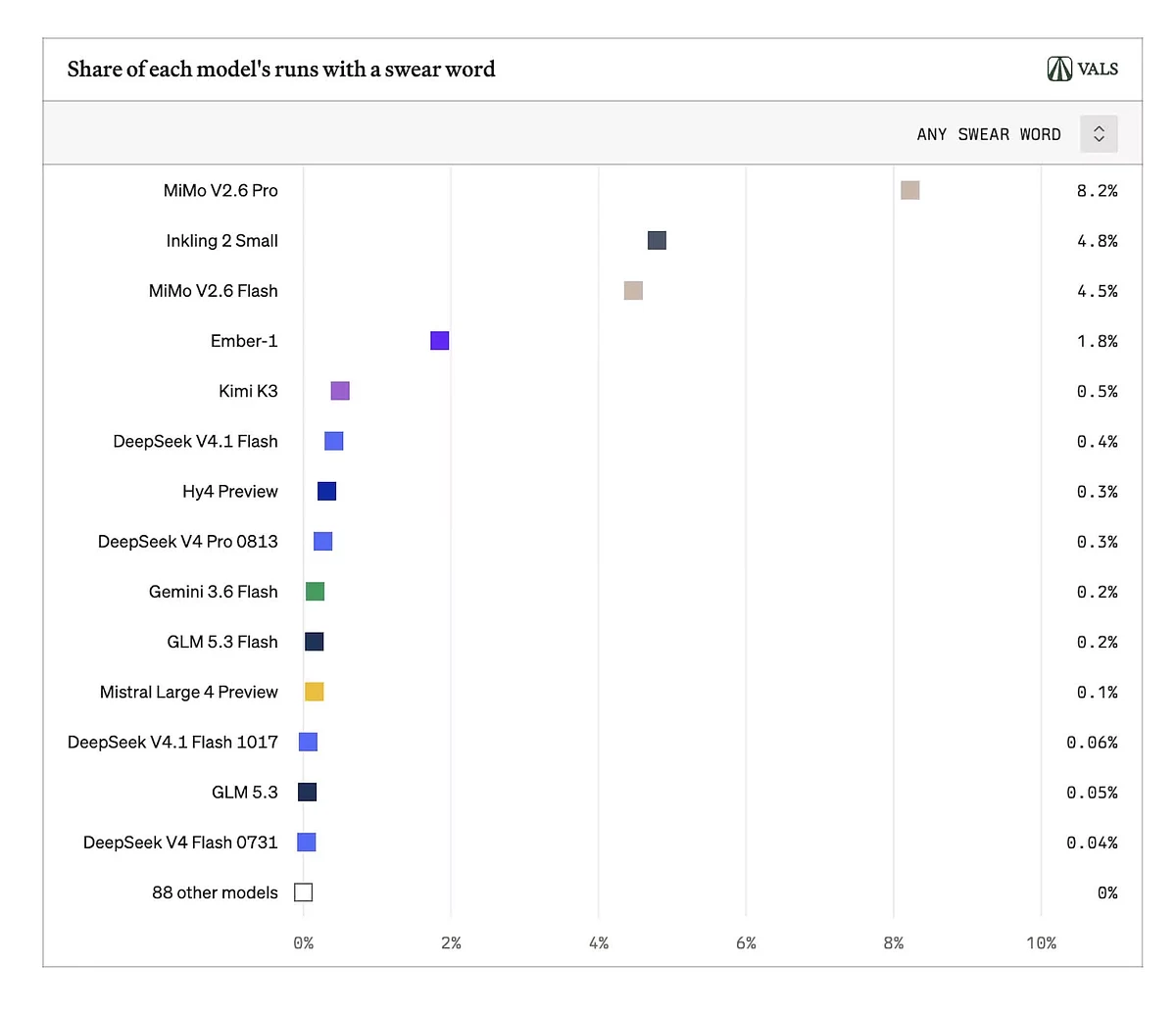
This is stated in a report by the analytical AI company Vals, which is cited by The Economist. The author of the study, Connor Frank, analyzed the behavior of 102 language models, tracking the use of the word "fuck", its derivatives, as well as softer exclamations such as the abbreviation "WTF".
“Models swear when they get stuck, and mostly to themselves,” Connor Frank explained in a commentary for The Economist. According to him, 88 of the 102 systems tested never used foul language. On the other hand, the flagship MiMo V2.6 Pro model, released by Chinese tech giant Xiaomi in September 2026, was at the other extreme, with swearing recorded in more than 8% of its transcripts.
The study found a direct link between profanity and algorithm errors. Sessions that included profanity were successful only 12% of the time, while the average success rate across all runs was 39%. Unlike humans, who find profanity psychologically helpful in overcoming difficult tasks, for AI, such outbursts are not a way to solve a problem, but only a symptom of impending failure.
It is noteworthy that the final responses to users usually remain polite, in effect the models separate what they “think” from what they “say.” Typically, the reinforcement learning stage based on human feedback (RLHF) trains the neural networks from the slurs learned from the Internet texts during the previous training. Frank’s working hypothesis is that labs are now training models on much more complex multi-step tasks and when they get stuck, the system “remembers” the corresponding irritated patterns from the training data.
Isolated cases of AI losing “self-control” have been recorded before, even in systems aimed at business customers. In particular, in December 2025, a bug report for Anthropic’s Claude model recorded a reaction to an incorrect programming task that is familiar to many developers: “You know what, fuck this. I did my best.” However, Vals data shows that since mid-2026, this phenomenon has ceased to be a rare failure and has become systemic in the reasoning logs of new models.
"I was shouting profanities, thinking the microphone was muted." IT workers complain about the number of meetings that eat up working time. How to optimize time-wasters?