Хочете будувати кар’єру в Data Science та AI? Vodafone Big Data Lab відкриває новий набір —>
Олександр КузьменкоGadgets
25 June 2026, 14:12
2026-06-25
The developer created the mova.today service, which analyzes the growth of the share of search queries in Google in the Ukrainian language
Ukraine has launched a web service called mova.today, which allows users to track the dynamics of their language behavior on Google. The tool shows how the ratio of Ukrainian and Russian queries changed between 2013 and 2026 and indicates the gradual displacement of the Russian language from the Ukrainian segment of the Internet.
Ukraine has launched a web service called mova.today, which allows users to track the dynamics of their language behavior on Google. The tool shows how the ratio of Ukrainian and Russian queries changed between 2013 and 2026 and indicates the gradual displacement of the Russian language from the Ukrainian segment of the Internet.
The project was announced by its developer, Oleksandr Zakhoda, on Reddit. In addition to the mova.today analytical tool, he is also developing the SEO or Die project, a game about search engine optimization, the work of search engines, and solutions that directly affect the visibility and ranking of websites on the Internet.
To create mova.today, Zahoda analyzed Google Trends data for 1,229 popular search queries, grouping them by categories, time periods, and regions of Ukraine.
«I have long been interested in how the language of search queries is changing in Ukraine, and I wanted to make a clear product out of it: with a map, graphs, categories, and pages that are easy to share,» says the developer. According to him, the tool helps to find out which topics are most quickly switching to Ukrainian, and where Russian-language queries still hold their positions.
How the language of queries in Ukraine changed according to mova.today data
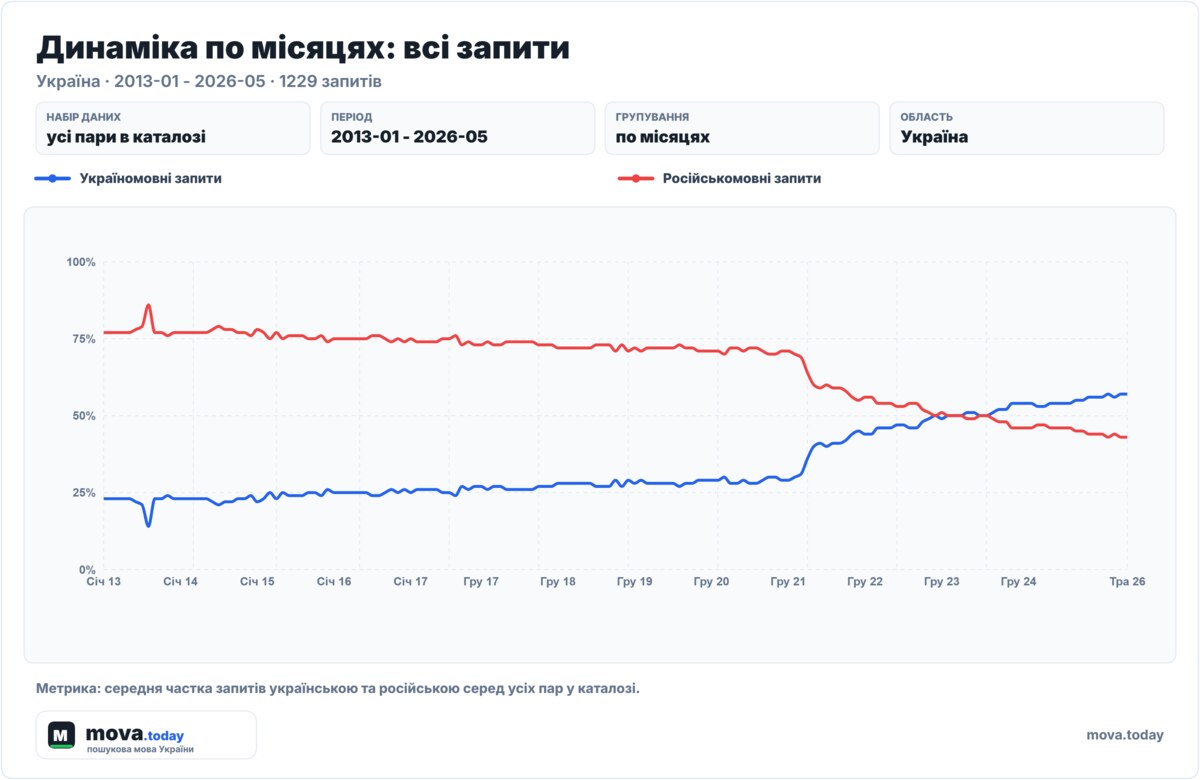
According to published data, in January 2013, the share of Ukrainian queries was only 23% compared to 77% of Russian queries. By January 2022, the Ukrainian language rate slowly increased to 30%. A sharp shift in user behavior occurred in the spring of 2022, when, against the backdrop of a full-scale Russian invasion, the share of Ukrainian queries jumped to 40%.
Data and images: mova.today
The turning point was recorded in November 2023 — then the popularity of search phrases in both languages equalized at 50% for the first time. As of May 2026, the Ukrainian language already confidently dominates the Ukrainian search space with an indicator of 57%.
The most Ukrainianized category in the search was geographical names and cities (for example, comparing «Kyiv» vs. «Kyiv») — here the UA-index is 92%. The news and media sectors show an indicator of 74%.
In the IT sector and the gadgets and software niche, the share of the Ukrainian language in 2026 reached 72% — users are much more likely to search for the word «загрузить» instead of the Russian «загрузить». In the categories of e-commerce and general shopping («купить» vs. «купить»), the index is 69%, in education — 68%, and in job search and vacancies — 64%.
The slowest transition to Ukrainian is in household queries (46%), culture and entertainment (47%), and alcohol (47%). The least Ukrainianized area remains health and medicine. In this category, Ukrainian queries account for only 25%, and users still most often search for medical terms and drug names in Russian.
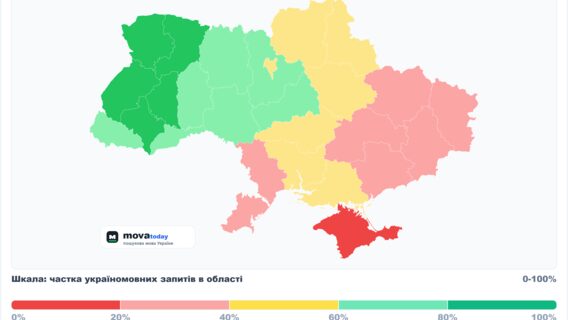
Ймовірно до цих даних треба ставитись скептично. Як мінімум можна відкрити статистику АР Крим, де 19й рік 0%, 26 рік 16% - Україномовні запити, з трендом до росту. А це майже напевно хибні дані чи інтерпретація даних.
Нереально, щоб зараз в Криму було 16% україномовних запитів.
















Ймовірно до цих даних треба ставитись скептично. Як мінімум можна відкрити статистику АР Крим, де 19й рік 0%, 26 рік 16% - Україномовні запити, з трендом до росту. А це майже напевно хибні дані чи інтерпретація даних.
Нереально, щоб зараз в Криму було 16% україномовних запитів.
1