Хочете будувати кар’єру в Data Science та AI? Vodafone Big Data Lab відкриває новий набір —>
Валентин ШнайдерStartup
3 October 2025, 13:28
2025-10-03
“We just wanted to do something that would change the lives of as many people as possible for the better”: how startup Cardio.AI uses AI to “catch” heart problems
Ukrainian medtech startup Cardio.AI has combined medicine and artificial intelligence. The company uses disposable sensors for long-term heart rate monitoring, and deep learning algorithms mark each heartbeat. Dev.ua spoke with co-founder Maksym Dyachenko about how the idea came about, how the technology works, and why a doctor only comes into play when it’s really necessary.
Ukrainian medtech startup Cardio.AI has combined medicine and artificial intelligence. The company uses disposable sensors for long-term heart rate monitoring, and deep learning algorithms mark each heartbeat. Dev.ua spoke with co-founder Maksym Dyachenko about how the idea came about, how the technology works, and why a doctor only comes into play when it’s really necessary.
Cardiac monitoring is one of the most important areas of medicine. Cardiovascular diseases claim about 17.9 million lives each year and are the leading cause of death in the world. It is difficult to detect arrhythmias at an early stage: this requires long-term ECG recording. It is this problem that the founders of Cardio.AI drew attention to.
Maksym Dyachenko says that they were not waiting for a pandemic or war, but simply wanted to make a product that would help many people:
«We just wanted to do something that would change the lives of as many people as possible for the better.»
The project started in 2017 as an experimental black-box technology, but the team saw the potential and decided to develop it into a full-fledged diagnostic solution.
The founders see Cardio.AI as a way to mass-screen the population and reduce mortality from arrhythmias. This is only possible with a high level of automation.
«AI should know all existing arrhythmias at the level of a professional arrhythmologist… you need to perform 95–99% of such screenings completely automatically, without the participation of a person who appears in the cycle only if you need to confirm significant rhythm disturbances,» explains the CEO.
How Cardio.AI works
The technology consists of two key components: disposable sensors and artificial intelligence algorithms.
Sensors
Each patient receives a small biosensor that resembles a patch. It is attached to cleansed skin, and in a minute it is ready to work. «Literally in a minute or two: the biosensor is attached to cleansed skin, it turns on — and that’s it, the patient can go about their usual life. They can wash, play sports, do anything,» says Maksym. The sensor records a continuous electrocardiographic signal from one day to a week.
The team opted for disposable sensors so that they could serve thousands of patients without logistical confusion. «Disposability on the one hand increases the cost of each test, on the other hand allows you to scale to (hundreds of) thousands of tests per day, which is practically impossible with conventional reusable devices,» the founder notes. The inexpensive sensor can be safely sent by mail and not worry about its return.
AI
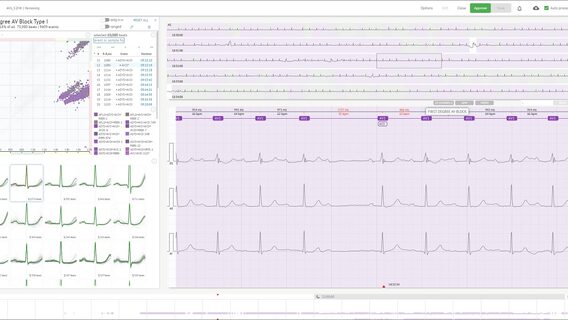
After the test is completed, the patient brings the sensor to the clinic or sends it by mail. Near the reception desk there is a small computer based on Raspberry Pi, which automatically downloads all the data. Then the deep learning algorithm comes into play. It analyzes the full recording, finds each heartbeat and marks it with the corresponding arrhythmia class. «AI should know all existing arrhythmias… the doctor appears in the analysis cycle only if it is necessary to confirm significant rhythm disturbances and generate/sign a diagnostic report,» adds Dyachenko.
This relieves the cardiologist of the routine work of decoding. The doctor opens the finished markup, checks and, if necessary, corrects the classification. Instead of monotonous analysis, he can concentrate on the clinical aspects of the patient’s condition.
Who needs such a service?
Cardio.AI currently works mostly with private clinics. The founders dream of eventually including public health institutions, which would be a step towards nationwide screening programs. The team also plans to allow patients to choose the most convenient way to receive the service, a feature they plan to add early next year.
The startup also has an interesting future in the insurance market: remote monitoring of heart conditions could reduce treatment costs. However, for now, the main focus is to help hospitals and patients quickly receive diagnostics without depending on local shortages of specialists.
How Cardio.AI differs from Holter and smartwatches
There are many monitoring devices on the market. Smart watches can capture a short segment of an ECG, but only when a person puts their hand on it. «A smart watch ‘sees’ an ECG only when you put your hand on it, and it’s quite short. This is not a solution for constant monitoring, and in general, it’s unlikely that you will ‘catch’ something at that very moment,» explains Dyachenko.
A classic holter gives a more detailed signal thanks to wires and several channels, but it is inconvenient to wear it for a long time: the cables interfere with sleeping, washing, and exercising. «Try wearing a device with wires for a week,» jokes Maksym. Cardio.AI offers a compromise: the sensor works for up to 7 days and does not interfere with activity, and the AI processes the data just as effectively, regardless of the length of the recording.
The company processes data from both its own sensors and traditional holters (if they export records in EDF format). The doctor can choose which method of collection seems more appropriate to him. The point is that the duration of monitoring no longer affects the complexity of the analysis: the report takes the same time for both one day and one week.
Team and finances
The Cardio.AI team consists of engineers, data scientists, developers, and cardiologists. The founders are focused on AI and business, but practicing physicians are actively involved in the work. They help train the neural network and check the accuracy of the labeling.
Maksym admits that one of the biggest challenges is the language barrier between doctors and programmers.
«Doctors have a fairly superficial understanding of how software products are created, so the team management has to be a translator from medical to development. This was one of the main challenges,» he says.
The startup’s funding is based on grants and internal resources. Cardio.AI has received support from the Seeds of Bravery/EIC program and the Ukrainian Startup Fund, but avoids attracting a large number of small investors.
«When your cap table is very evenly spread out into dozens of small stakes, then at a key moment it can go against you. And this is not greed, this is just rational thinking,» the founder explains.
Medical products require years of development and testing, so the company keeps capital flexible for future strategic deals.
Where does the service work and what next?
Cardio.AI has already received EU certification and is preparing for registration in the USA. In Ukraine, the service was launched in private clinic networks and is available to anyone. Patients note the comfort of use, and doctors note the ability to quickly receive a high-quality report. The team is preparing pilot projects in several EU countries and beyond.
During the full-scale war, development did not stop. «Difficulties like everyone else. But we believe in what we are doing, so we continue to work,» the CEO answers when asked about the challenges. The team even helped military battalions monitor vital signs during evacuation.
The plan is to bring the system to full automation, so that humans will only intervene in isolated cases. Test screenings have started:
«This year, we tested more than 400 relatively healthy people for free… Several pacemakers have already been installed based on the results of this monitoring,» shares Dyachenko.
Several dozen more have been advised to see doctors, and they plan to monitor the others.
Looking ahead
Cardio.AI is a story about Ukrainian engineers and doctors who took the risk of combining disposable sensors and artificial intelligence to make cardiac diagnostics more accessible and effective. The startup has already proven that long-term monitoring without discomfort can detect hidden arrhythmias. Next is scaling to new countries and bringing AI to the level where doctors will connect only to confirm the most complex cases.
Despite the war and the long regulatory road ahead, Cardio.AI demonstrates that Ukrainian developers can create innovative medical products with the potential to change the lives of millions. And if the team’s plans come true, continuous home screening could become a routine part of our healthcare service and arrhythmia will cease to be a «silent killer.»
Previously, dev.ua wrote about how Ukrainian developers created an AI- MedTech startup, Tayra.ai, that records medical information right at the reception.
«Ми не можемо дозволити путіну захопити Україну. Це божевілля». 20 тез Ілона Маска з великого інтерв’ю Business Insider
Мільярдер Ілон Маск дав відверте інтерв’ю виданню businessinsider.com, де торкнувся теми вторгнення рф в Україну, космічних подорожей та речей, що роблять людей особливими.
Наводимо тезисно адаптований переклад тексту.