Хочете будувати кар’єру в Data Science та AI? Vodafone Big Data Lab відкриває новий набір —>
Олексій ДзюбаІсторії
3 January 2025, 13:58
2025-01-03
Why Jimmy Carter was the first US president to install solar panels on the White House. In memory of the head of state who lived to be 100 years old
Jimmy Carter, the 39th president of the United States, died on December 29 at the age of 100. He served from 1977 to 1981. Before becoming president, Carter served one term as governor of Georgia. A former naval officer and engineer who later became a peanut farmer, he convinced voters that he had good intentions and would act honestly after the Watergate scandal, in which Republicans spied on Democrats.
President Carter had both ups and downs in his biography. One of the details of his tenure is that he ordered the installation of solar panels on the roof of the White House. Why did the president do this, how did it fit into the historical context and where the president's solar panels are now, read on.
Jimmy Carter, the 39th president of the United States, died on December 29 at the age of 100. He served from 1977 to 1981. Before becoming president, Carter served one term as governor of Georgia. A former naval officer and engineer who later became a peanut farmer, he convinced voters that he had good intentions and would act honestly after the Watergate scandal, in which Republicans spied on Democrats.
President Carter had both ups and downs in his biography. One of the details of his tenure is that he ordered the installation of solar panels on the roof of the White House. Why did the president do this, how did it fit into the historical context and where the president's solar panels are now, read on.
Thrifty president
Carter faced serious challenges in 1977. Americans hoped he would restore the United States' standing on the international stage, overcome a stubborn economic recession, and reduce unemployment and inflation at a time when industrialized nations around the world were struggling. Carter was also expected to revive national morale that had plummeted after the Watergate scandal.
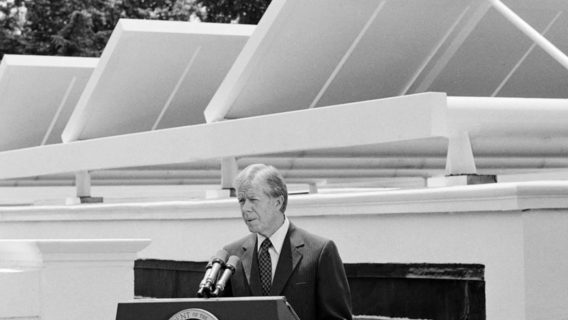
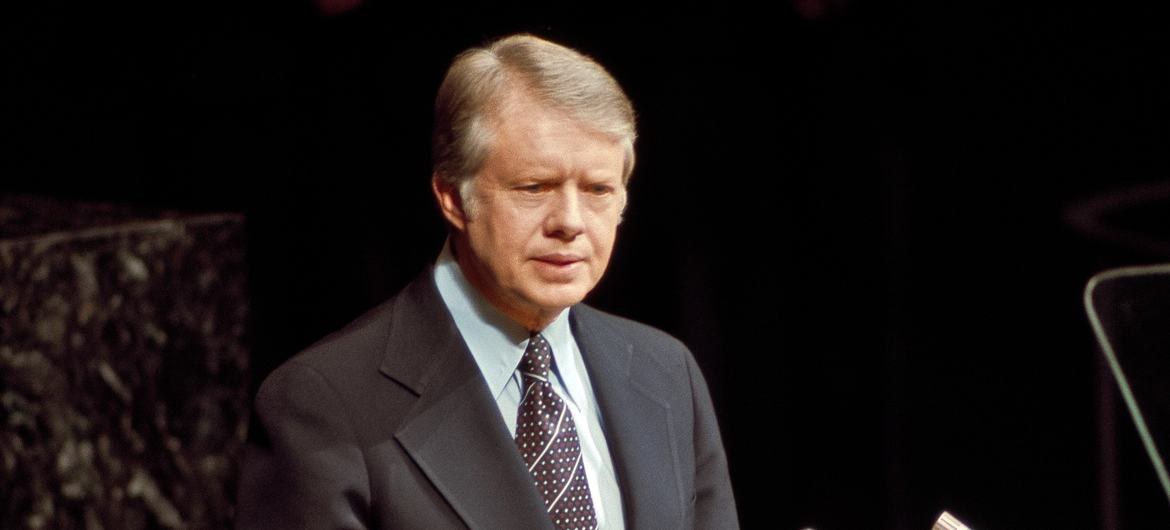
Photo — Jimmy Carter
“I’m a pretty tough guy,” Carter admitted. He and his closest aides (“the Georgia mob”) arrived in Washington confident that they could clean up the “mess” that politicians and bureaucrats in the federal government had made.
In his first two years as president, Carter achieved several successes, both symbolic and real. To show everyone how frugal he was, he took the symbolic step of selling the presidential yacht. Carter also cut the White House staff by a third, told administration employees to give up their official cars, and installed solar panels on the roof of the White House.
Solar panels
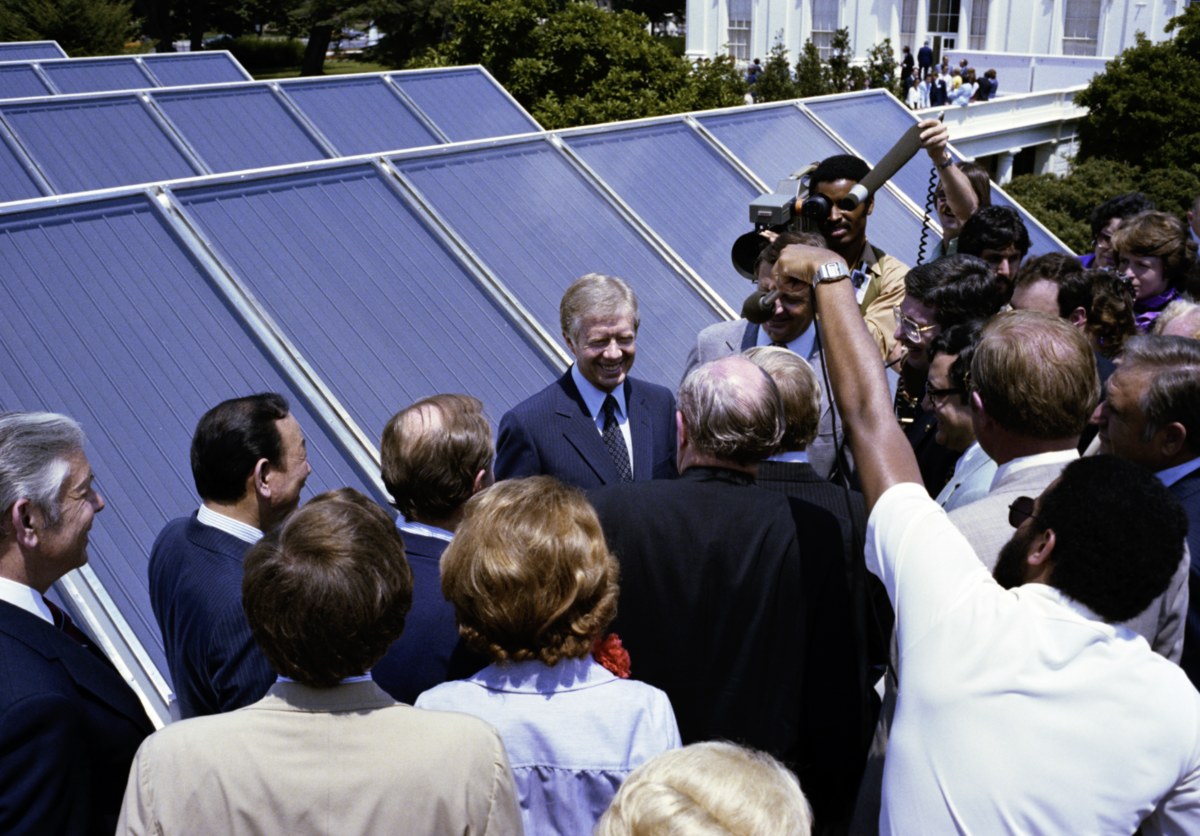
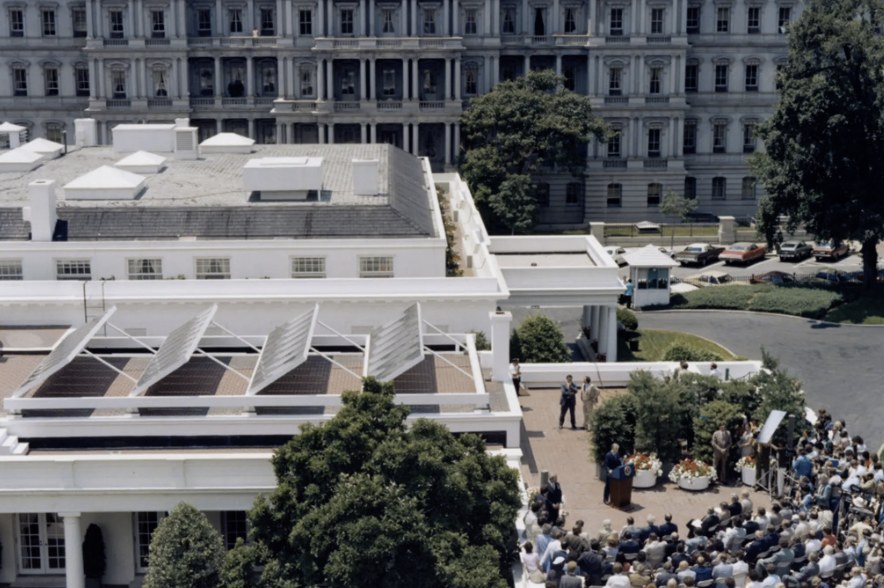
In 1979, President Jimmy Carter installed 32 solar panels on the roof of the White House. When the panels were first installed on the West Wing roof, energy independence was a major issue in America. The oil embargo imposed by Arab countries in 1973, partly to pressure the United States for its support of Israel in that year's brief war, had shaken the American economy.
Arab oil exports were cut by 5% each month, and prices rose sharply. By the end of 1973, the price of oil had quadrupled from $3 to $12 per barrel. The embargo on the United States was the most severe, as it was Israel's main ally. The United States faced fuel shortages, leading to long lines at gas stations, rising energy and commodity prices, and an economic recession.
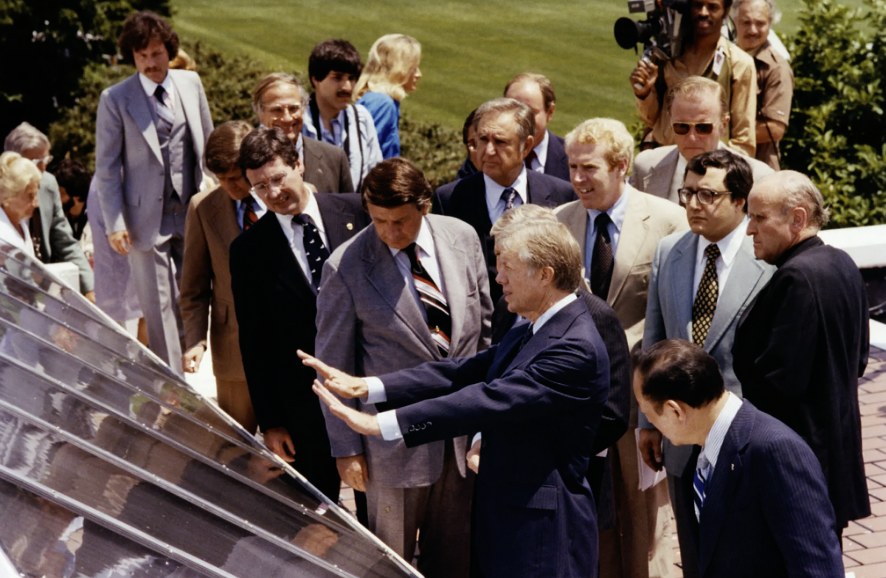
Photo — Jimmy Carter demonstrates the operation of solar panels
"This dependence on foreign sources of oil is a great concern for all of us," Carter said during the solar panel presentation. "No one can ever ban the sun or interrupt its delivery to us."
The panels were primitive but serviceable and heated water. They cost about $28,000 to install. According to the man who convinced Carter to install the panels, George Sego, the panels were what he called industry models.
It was a decade between the installation of the solar panels and the first congressional hearings on climate change. “There’s no doubt that Jimmy Carter was way ahead of his time,” said Ernest Moniz, executive director of the Energy Futures Initiative, a nonprofit group focused on renewable energy.
Ambitious plans
Carter spent nearly three years fighting for clean energy. After a long stint in introducing "green" tax breaks and creating the Department of Energy, he clashed with Congress and his political enemies over "green issues."
Aware of his idealism, the president at one point expressed doubts about solar panels: “Generations from now, this solar heater may be either a curiosity, or a museum piece, or an example of a path not taken, or it may be a small part of one of the greatest and most exciting adventures ever undertaken by the American people.”
“The point of it all was simple,” Carter said. America was to harness “the power of the sun to enrich our lives as we move away from our destructive dependence on foreign oil.” A year later, he had his own solar panels.
Carter, in his State of the Union address the year the panels were installed, laid out an ambitious plan to put America on a clean energy path: 20% of its energy from renewable sources by the year 2000. Part of his idea was to direct government research funds toward developing photovoltaic cells that could feed power into the grid.
The future of solar panels
In 1986, the Reagan administration removed the panels during work on the White House roof. They were never reinstalled. The defective panels were shipped to a Washington, D.C. suburb, where they languished for years in a warehouse in Virginia.
In 1991, Peter Marbach, the principal of Unity College in Maine, was trying to pull the school out of a financial hole. He saw a picture of Carter's solar panels in a magazine and decided he wanted to bring them back to life.
“It was a combination of complete disbelief and anger that Reagan had destroyed them, and the crazy idea of getting the panels and bringing attention to Unity’s mission as an eco-friendly college,” Marbach said. He wrote a letter to Carter to ask for his blessing. The former president immediately responded with a handwritten note saying he would be very happy to see the panels back in use.
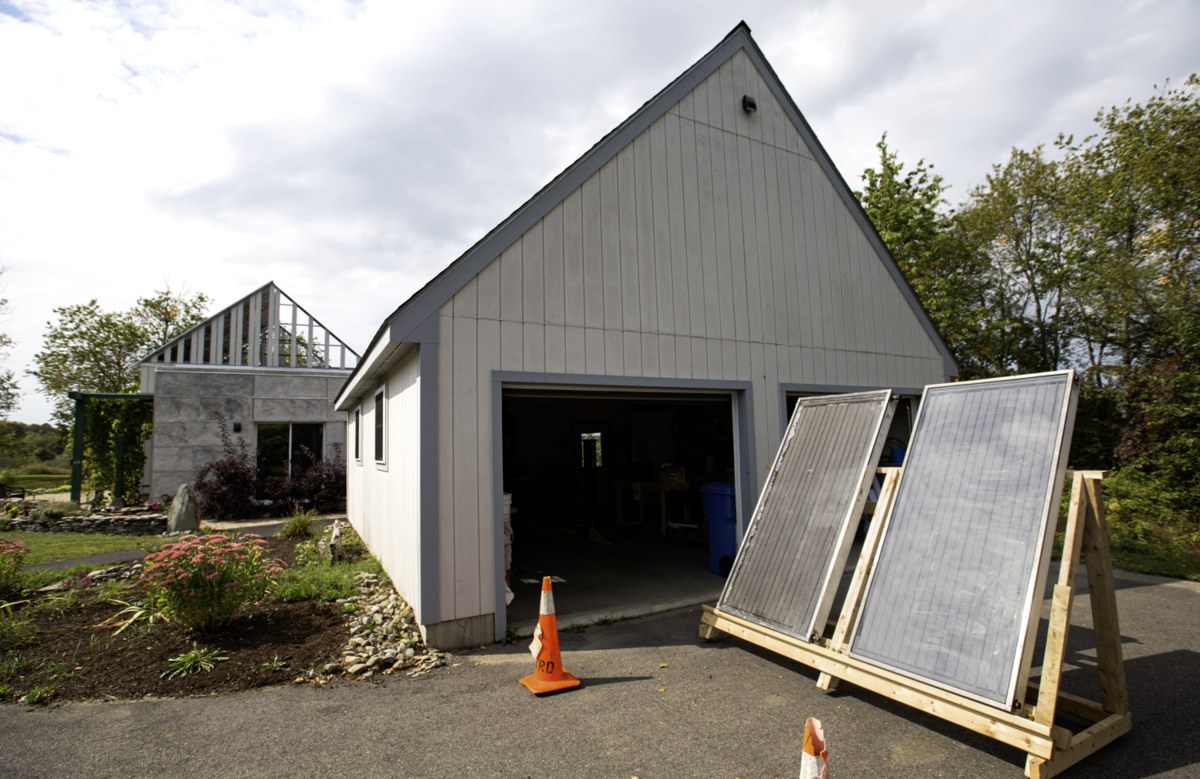
Peter Marbach found the panels, haphazardly stacked in a corner among a pile of boxes and extra furniture. Some were broken. He brought the panels home to Maine. Unity College paid the U.S. government a $500 administrative fee for the panels, which cost about $28,000 after they were first installed.
Half of them ended up on the roof of Unity College’s dining hall to heat water. The other half, which didn’t fit on the building, was stored in a former chicken coop and used as spare parts. While the purchase of the panels was “more symbolic,” Mr. Marbach said, they helped the college save money. They remained in place until 2010, when their useful life ended.
Photo — Carteri solar panels purchased by Unity College
The Solar Science and Technology Museum in Dezhou, China, acquired another panel in 2010. Another was donated to the Solar Energy Industry Association that same year. Others are owned by NRG Systems, Inc., a Vermont-based clean energy producer, the U.S. Department of Energy, and the rest are still owned by Unity College, which has changed its name to Unity Environmental University.
“This was fundamental to the development and growth of solar energy use in the U.S.,” said Frederick Morse, CEO of SolStor Energy, a solar energy development company.
Bashar al-Assad's wife is a "technofury." Here's how she raised money for the dictatorial regime thanks to her investor skills, "squeezed" a mobile operator from a relative, and used social media to promote her "measured life"