Хочете будувати кар’єру в Data Science та AI? Vodafone Big Data Lab відкриває новий набір —>
Олександр КузьменкоGadgets
3 December 2024, 18:26
2024-12-03
Intel unveiled its next-generation graphics cards to compete with Nvidia's RTX 4060 and AMD's Radeon 7600
The company Intel showed its second-generation Xe2 Arc graphics processors, which will compete with analogues from Nvidia and AMD in the price category up to $250. Intel believes it can give gamers better performance for less money.
The company Intel showed its second-generation Xe2 Arc graphics processors, which will compete with analogues from Nvidia and AMD in the price category up to $250. Intel believes it can give gamers better performance for less money.
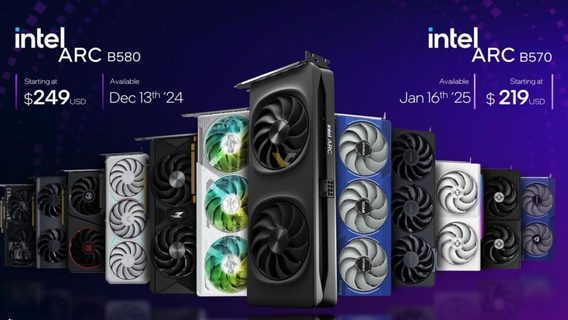
According to Engadget, the company introduced the B580 Arc B580 model for $249 and the slightly less powerful B570 for $219 — both aimed at games with a resolution of 1440p. They feature new XeSS2 AI capabilities (which will also appear on older Arc cards), including Super Resolution scaling (as in the original XeSS), frame generation, and low-latency modes.
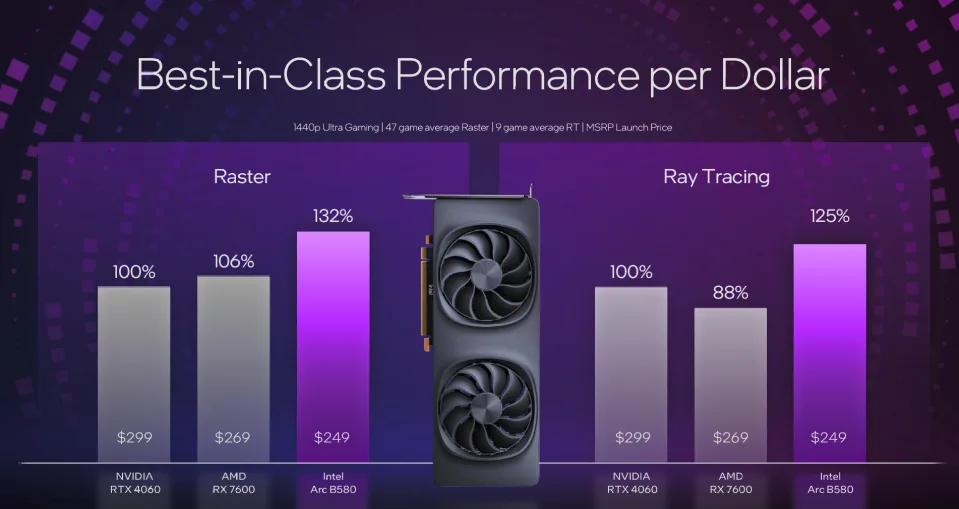
The goal, Intel says, is to deliver more performance per dollar compared to Nvidia’s $299 RTX 4060 and AMD’s Radeon 7600.
A new generation of Intel video cards. Image: Engadget
The publication notes that although the first generation of Intel video cards was generally not bad, and the company diligently supported it with driver updates, it failed to win back significant market share from competitors. Many gamers did not want to risk the new hardware from Intel, when the proposals of Nvidia and AMD were already tested, albeit somewhat more expensive.
The company now claims that the B580 is on average 24% faster than its previous A750 Limited Edition GPU at 1440p with ultra graphics settings, and also has a 10% advantage over the RTX 4060 from. Intel’s own benchmarks show that the B580 is 43% faster than the RTX 4060 in Cyberpunk 2077, but at the same time it’s almost 20% slower when playing RoboCop: Rogue City.
Intel’s new GPUs should meet the demands of 1440p-oriented gamers. The B580 has 20 Xe cores, 20 ray tracing units, 12 GB of VRAM, and a clock speed of 2,670 MHz. The B570 has slightly less: 18 Xe cores, 10 GB of RAM and a clock speed of 2,500 MHz.
«With XE2, we have a new hardware platform, and this allows us to deliver greater utilization, improved work sharing and lower software overhead. «Ultimately, it’s about making software more efficient so we can take advantage of the hardware we’re building», — Intel Scientist Tom Petersen said.
Intel’s new XeSS AI features are said to be at least competitive with Nvidia’s DLSS3. According to Intel, the B580 GPU can double the performance of Diablo IV when using XeSS, and the new frame generation feature should push the fps even higher.
Like DLSS, it not only upscales graphics from lower resolutions, but also interpolates entirely new frames. XeSS2 low latency technology, or XeLL, also improves response speed by 45%. Intel claims the B580 outperforms the RTX 4060 in AI LLM performance, achieving around 20 tokens per second more in the Llama 2 and Llama 3.1 workloads.
The Arc B580 cards will be available on December 13th for $249, while the Arc B570 models will arrive next month on January 16th for $219. Intel will release its own limited edition Arc B580, but leaves the B570 cards up to its partners, which include Acer, ASRock and Sparkle.
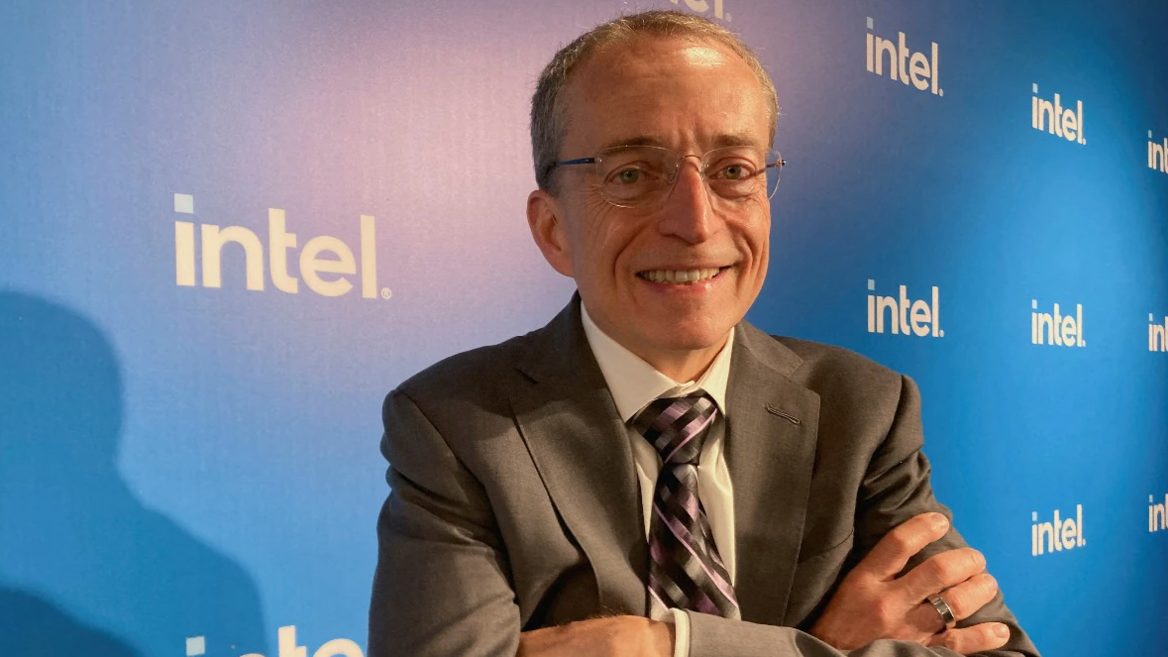
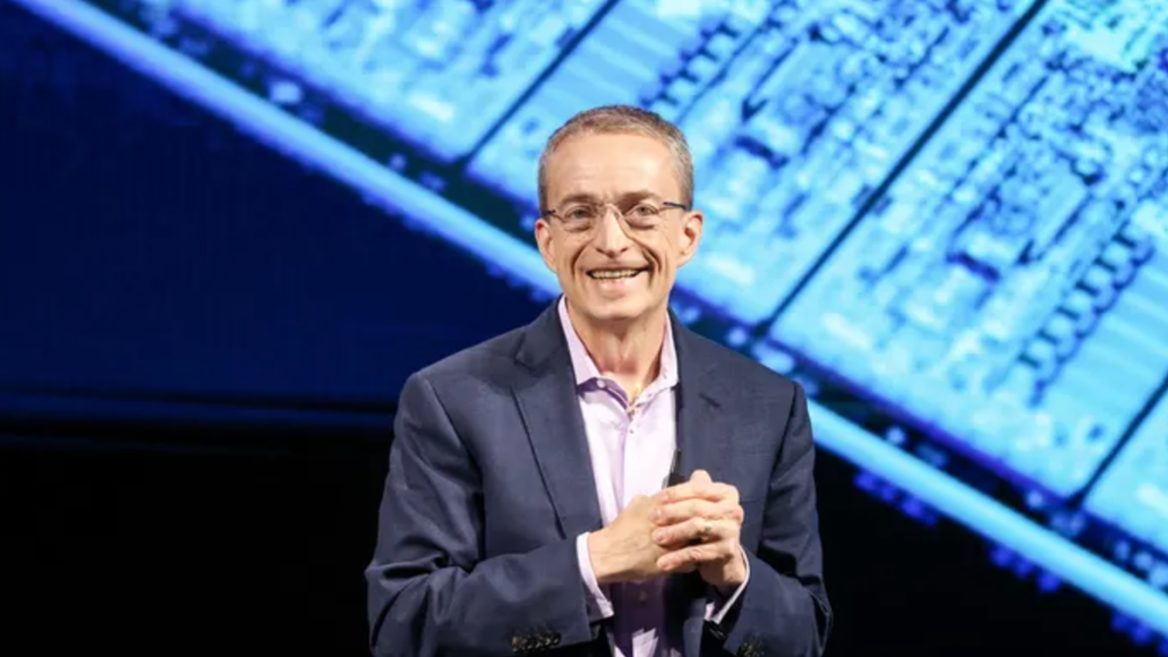
We will remind that the other day the CEO of Intel Pat Gelsinger resigned after more than 30 years of work in the company, and also left the board of directors from December 1, 2024. Recently, Intel has been going through a deep crisis that has led to the layoffs of tens of thousands of workers, a significant drop in the stock and talk of selling the company to competitors.
We told what Gelsinger is known for, and how his company ended up in such a situation. One of the reasons is the dispersion of Intel’s attention in several areas, in particular, the production of its own video cards.
Pat Gelsinger, who worked on the creation of Wi-Fi and USB technologies, was supposed to pull Intel out of a deep crisis, but failed and resigned as CEO. How did the company end up in this position