Хочете будувати кар’єру в Data Science та AI? Vodafone Big Data Lab відкриває новий набір —>
Марія БровінськаStartup
2 September 2026, 09:00
2026-09-02
“We never had the intention to ‘launch a startup’.” A couple of IT professionals sold their apartment in Kharkiv and invested the proceeds in the Cibo calorie-counting app. What came of it?
Selling an apartment to create your own product is a decision that is difficult to explain in an Excel spreadsheet or a presentation to investors. But that is exactly what Ukrainian IT professionals did when they decided to put all their savings into their own idea.
In 2022, the war forced Orest and his fiancée Maria to leave Kharkiv. They first moved to Kyiv, then to Warsaw. To start a new life, the couple sold their apartment in Kharkiv and decided to invest all the proceeds not in new real estate, but in their own IT product.
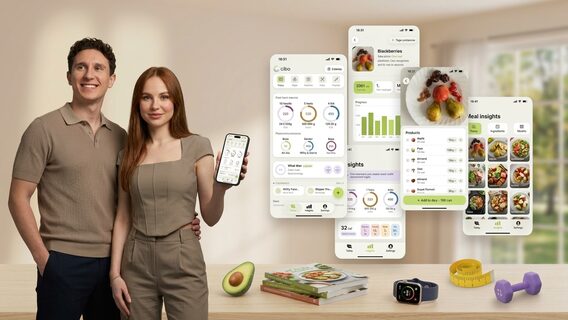
This is how Cibo was born, a food tracking app that the developers created primarily for themselves. Maria, a Java developer, was responsible for the technical part and design, and Orest, with ten years of experience in game development, was responsible for the idea and product development.
Today, Cibo has 140 users, 15 paid subscriptions, and is growing exclusively organically so far. The team plans to launch its first paid marketing on September 1st.
dev.ua talked to Orest about how to sell an apartment and put everything on their own product, why they decided to create another calorie tracker, and whether it is possible to build a global application, starting virtually from scratch in Warsaw.
Selling an apartment to create your own product is a decision that is difficult to explain in an Excel spreadsheet or a presentation to investors. But that is exactly what Ukrainian IT professionals did when they decided to put all their savings into their own idea.
In 2022, the war forced Orest and his fiancée Maria to leave Kharkiv. They first moved to Kyiv, then to Warsaw. To start a new life, the couple sold their apartment in Kharkiv and decided to invest all the proceeds not in new real estate, but in their own IT product.
This is how Cibo was born, a food tracking app that the developers created primarily for themselves. Maria, a Java developer, was responsible for the technical part and design, and Orest, with ten years of experience in game development, was responsible for the idea and product development.
Today, Cibo has 140 users, 15 paid subscriptions, and is growing exclusively organically so far. The team plans to launch its first paid marketing on September 1st.
dev.ua talked to Orest about how to sell an apartment and put everything on their own product, why they decided to create another calorie tracker, and whether it is possible to build a global application, starting virtually from scratch in Warsaw.
Startups
My name is Orest Rodkin. I have thirteen years of experience in development and business, ten of them in game development and ten years spent in Kharkiv, where I met Maria. She is a Java developer, originally from Tokmak, Zaporizhia, and she is the second founder of the project we will be discussing. Then there was Kyiv, and now Warsaw, where the two of us are making Cibo.
Maria and Orest The entire Cibo team is in this photo.
The idea was born over a chicken fillet
About a year ago, I decided to conduct a simple experiment on myself: I started eating more fruits and vegetables, reduced the amount of less healthy foods, and monitored my diet more closely. I did this more out of curiosity than for the result.
After a month, I subjectively began to feel that my constant weakness had disappeared and I had more energy. I didn’t do any measurements and I’m not saying that it was the diet that was the problem. But it was enough to keep me from giving up on the experiment.
For Maria, food control has been a part of her life for a long time. At 21, long before Cibo, she lost almost 25 kilograms thanks to a change in eating habits. So we both knew well both the advantages of this approach and the main problem: counting everything manually quickly gets boring. Weighing the product, finding it in the database, indicating the grams, writing down proteins, fats and carbohydrates, and repeating this several times a day, every day.
One evening in the kitchen, I was once again weighing a chicken fillet and asked out loud: if AI has already learned to understand photos, why can’t we show it a plate? That’s how the idea came about. The name is simple, cibo means «food» in Italian.
Nine months to develop
The advertisement for the sale of the Kharkiv apartment has been hanging since 2023. We only met the buyer in the summer of 2025, and this money was not our starting capital, but a cushion for a rainy day.
We decided to invest part of it in registering the company and developing it. This is not a story about courage. We calculated how many months we would last if nothing worked out, and consciously agreed to this figure.
And then there was a failure that is uncomfortable to write about. Nine months passed between the money in the summer of 2025 and the first commit in the spring of 2026. Formally, they went to Polish registration, taxes, and withdrawal from previous obligations.
In fact, we were just dragging it out for a while: an unwritten product is convenient because it’s impossible to fail. This is the most expensive mistake we made. It cost us nine months in a market where everything changes every three.
The development itself took about three months. And the application appeared in the App Store on June 3, 2026.
How it works
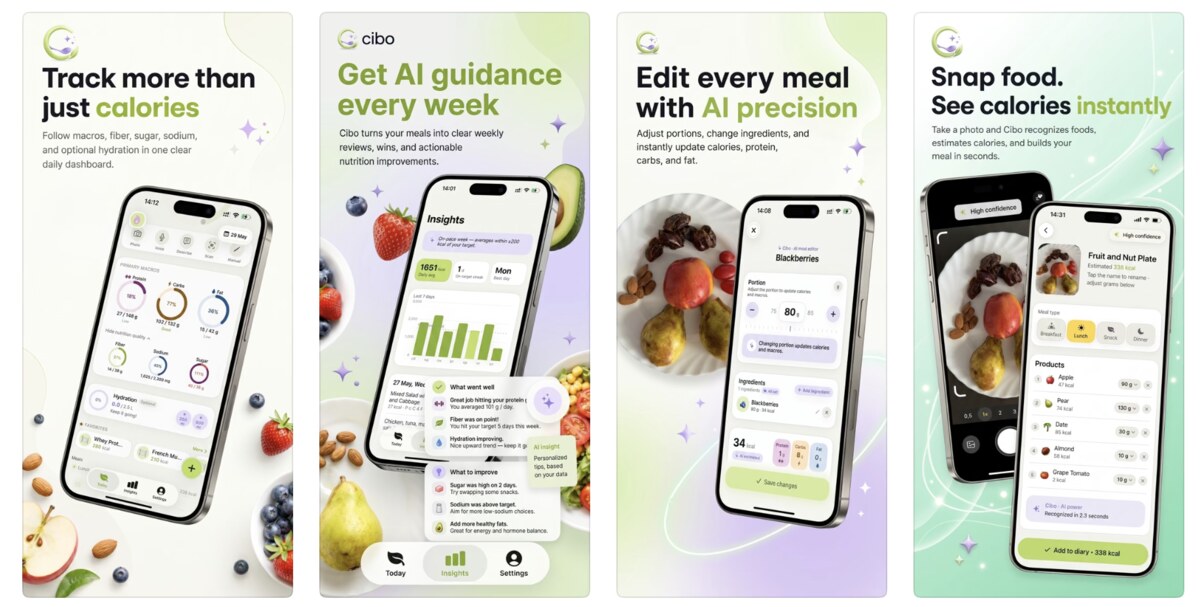
We formulated the main principle right away: the fewer actions a person has to take, the better. The user takes a photo of the food, the application analyzes the image and in a few seconds shows calories and macronutrients. There are five ways to record food: photo, text, manually, by barcode or voice.
Home screen. Five ways to record food, of which photos remain the most popular.
The behavior of the first users confirmed the hypothesis: more than half of all meals are recorded by people with a photo. In total, more than two thousand recorded meals have already passed through the application.
How much does it cost to recognize a plate?
Now the numbers that are usually not written. Recognition works on an external model: gpt-4.1 with vision, the picture is in detail:high at 1024 pixels. We have not trained our own neural network and do not see any sense in this on our scale.
One photo costs 2492 prompt tokens plus 770 response tokens, which is approximately $0.0114 in money. For comparison: text recording costs $0.0005, voice recording costs $0.0015, and barcode scanning is free.
The most interesting thing is in the structure of this check. The picture itself takes up only 14%, the text prompt another 31%, and 55% is the model’s answer. That is, the intuitive «let’s compress the photo to make it cheaper» gives almost nothing, you have to cut the answer scheme. We lost time until we looked at the token layout instead of guessing.
Our monthly bill for the model is about $5.6, and the VPS costs $20. Model calls are cheaper than the hardware running the backend. One monthly subscription, even after the store fee, covers over four hundred recognitions.
We don’t mention the percentage of accuracy on principle: we don’t know how to honestly measure it on live plates, rather than on a prepared dataset, yet. Where the model makes mistakes, it makes mistakes predictably: soups, mixed dishes, and a portion taken without a scale reference nearby.
We used the most predictable technologies: FastAPI with Postgres on the server and native clients for both mobile platforms. When there are two of you, exoticism turns into a risk, because there is no one to be on duty at night.
Two mistakes that cost money
Our own metric was 5.7 times off. For several months, the internal dashboard showed the cost of a photo at $0.002. When I checked the price on the product page and compared it with the actual supplier invoice, it turned out to be $0.0114. The reason is simple: the metric didn’t see all the calls and was counting based on the old price list. The worst thing is not the figure itself, but the fact that we were already planning a free tariff based on it.
Conclusion: you can trust your own dashboards until you have at least once compared them with the supplier’s account.
The paywall on Android didn’t show up at all. We’re both on iPhone, we test the product every day and catch bugs in an hour. And on Android, the client didn’t process the server’s response about the limit being exhausted for several months: the user was stuck in silence instead of the subscription screen. The conversion to payment there was exactly zero with live active users. I discovered this by accident, during a review, by simply searching the code base.
Two lessons: your own experience with the product is no substitute for testing, and the absence of an event in analytics is also data. A zero where there can be no zero should glow red.
A market that is already crowded
Let me be honest: the calorie counter niche has been empty for a long time. MyFitnessPal, Cal AI, Yazio, and dozens of others can already recognize food from photos, and Cal AI is built on exactly the same idea. Beating them in banana recognition speed is useless, and uninteresting.
We bet on something else. Almost all trackers are built as if a person eats in a vacuum, although habits rarely change alone.
Circle in Together. Each participant sees exactly as much as they allow to be shown.
The Together feature allows you to create your own circle and share progress as much as you want. A couple, adult family members, friends, or a trainer with a client. For a trainer, it’s a way to avoid collecting photos of a client’s food from dozens of messages. For a couple, it’s mutual support, not control: instead of an intrusive «You didn’t write down your food,» you can send a virtual wave of your hand.
The privacy issue here is acute: nutritional information is very close to medical information. By default, nothing is visible in the circle, the participant decides what to show and leaves the circle with one touch. We do not knowingly collect children’s nutritional data. We do not transfer or sell nutritional data to third parties.
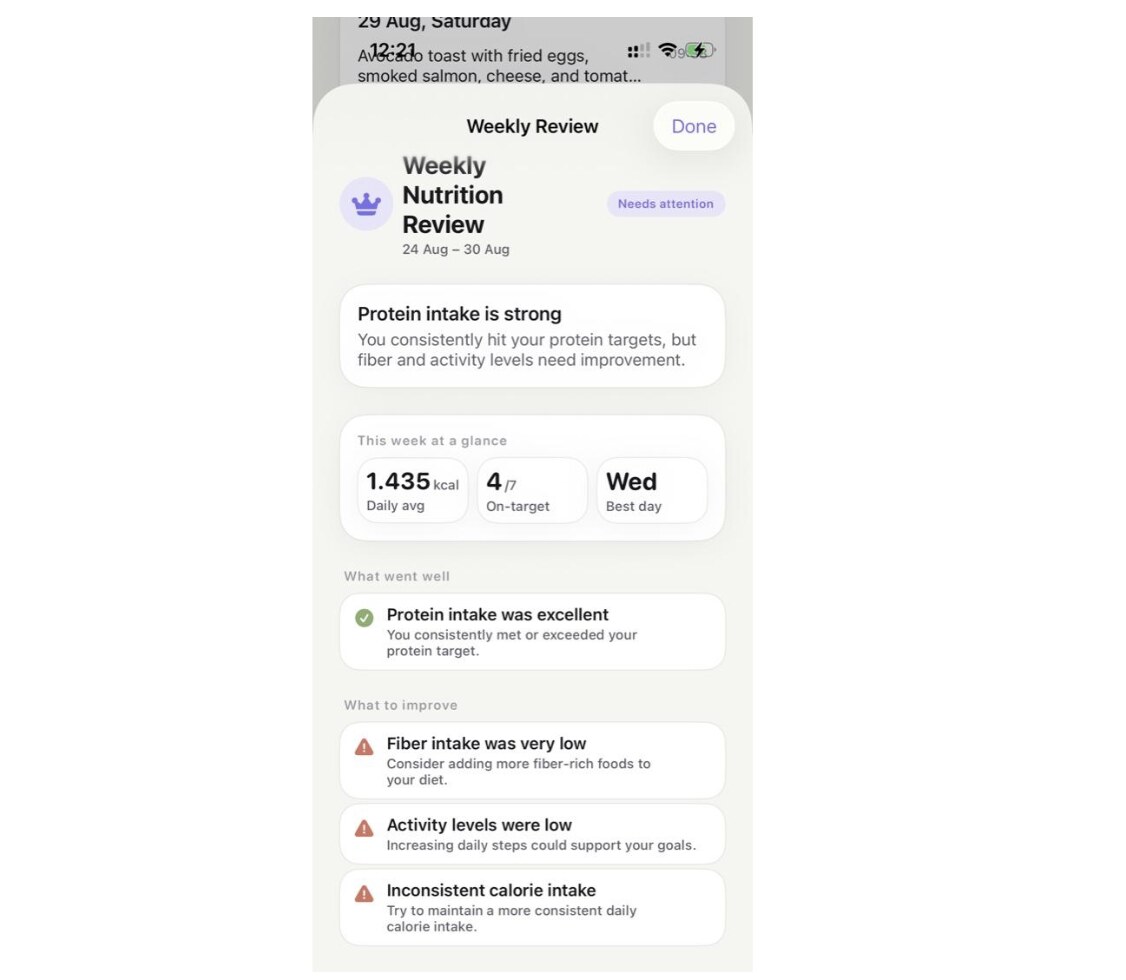
Weekly analysis of the diet: what worked, what failed, and what to do about it.
Figures after three months
Almost 80% of the current audience has joined in the last month, and this growth has happened without paid advertising: through app pages in stores, catalogs, content and recommendations from people. Let’s not mislead anyone about the scale: the bill is in the hundreds of users, not thousands, we’re just getting started.
The largest number of users is in Kyiv and Warsaw, followed by Los Angeles and New York. Other cities include Rome, Chicago, Berlin, Auckland, London, Manila, Singapore and Sydney.
People are already paying us from eight countries spread across three continents: Ukraine and Poland, Switzerland, France and Britain, Serbia, as well as the USA and Brazil.
For a product made by two people and that hasn’t yet launched a large-scale advertising campaign, this is an important signal. Not because we’ve reached a large scale, but because the problem from our kitchen turned out to be understandable to people thousands of kilometers away.
What I have learned this year
Three things I wish I knew at the start.
First: Money doesn’t launch a product, it launches the decision to launch. We had funding for nine months and didn’t move, because an unwritten product can’t fail. That’s the most expensive way to preserve self-esteem.
Second: check your own dashboards with the vendor’s account. An error in a metric doesn’t stay in the metric, it moves into your plans.
Third: a team of two people sees exactly what they use themselves. Everything else needs to be checked intentionally, according to a list, and not hoping to be noticed.
We never had the intention to «launch a startup.» There was a daily inconvenience that we were solving for ourselves, and then we saw that people all over the world were living with it.
There is a lot of work and mistakes ahead, and in about a year I would like to come back here with a second text and honestly tell you what came of it. Cibo is available in the App Store and Google Play, the website cibo.health. The company is registered in Warsaw, the publisher’s name is TUNARIVPN sp. z oo, this is our Polish legal entity, under which we previously ran another product.
Вас також кусають комарі? Розповідаємо про пристрій від українських стартаперів, який може цьому зарадити
Як зауважив нещодавно один військовий, якой побажав залишитись невідомим, орки, може, й не поцілять, а комарі точно зʼїдять. І від них потерпають зараз багато українців.
Позбавитись від комарів назавжди ефективно й екологічно допоможе гаджет Mosqitter. Цей стартап заснували дві українки — Анастасія Романова та Ольга Дьячук.
Ми вирішили нагадати, що може Mosqitter, про принципи його роботи та особливості, на злобу дня.
(текст від 21 жовтня 2021 року)
Кнопка здоров'я. Українці розробили систему, яка рятує пацієнтів стаціонару від смерті. Вони - переможці IT Arena Lviv 2022
Медичний психолог, який переїхав в Україну з Москви в 2014 році, Іван Осадчий, придумав систему, яка допомагає медсестрі і пацієнтові не втратити один одного в стаціонарі. Його стартап knopka вже працює в декількох лікарнях понад три роки не лише в Україні, а й у Польщі.
Повторюємо історію стартапу-переможця IT Arena Lviv 2022. Текст від 28 вересня 2022 року.