Хочете будувати кар’єру в Data Science та AI? Vodafone Big Data Lab відкриває новий набір —>
Ігор Вишневський AI Eng
18 January 2026, 14:47
2026-01-18
Paradoxically, Americans use AI less often than people in Nigeria and India, according to a major new survey
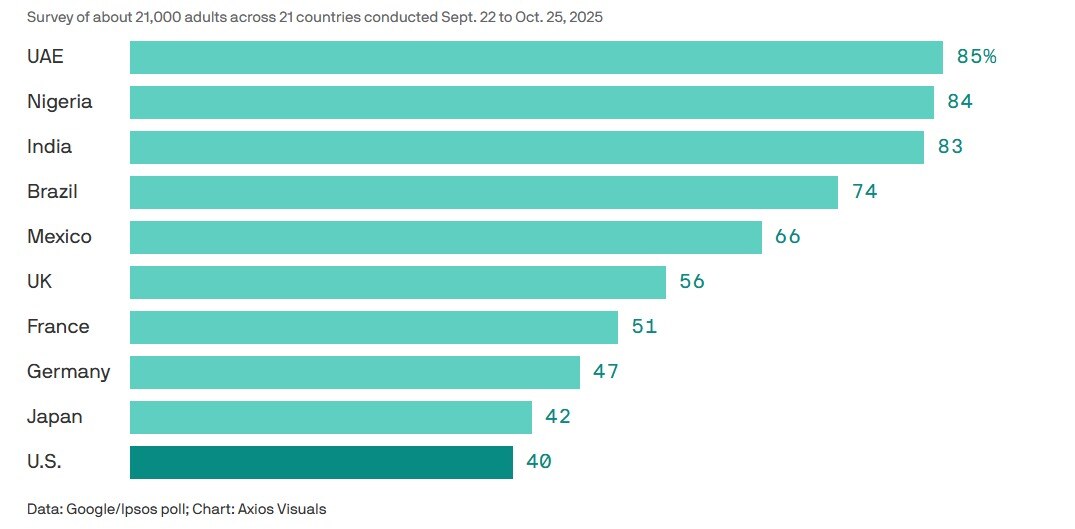
According to a new survey by Google and Ipsos, the global perception of artificial intelligence is improving, but residents of a technologically advanced country like the United States remain skeptical about AI — only 40% of them have used artificial intelligence in the past year.
According to a new survey by Google and Ipsos, the global perception of artificial intelligence is improving, but residents of a technologically advanced country like the United States remain skeptical about AI — only 40% of them have used artificial intelligence in the past year.
As Axios writes, citing the research data in a separate chart, Americans lag behind most of the world in the use of AI.
In turn, Google claims that the new survey shows three big changes in the use of artificial intelligence over the past three years:
artificial intelligence has moved from experimental to everyday use;
learning something new and understanding complex topics has overtaken entertainment as the main use case for AI;
Global optimism about the impact of artificial intelligence on people has grown, especially among those who actually use these tools.
At the same time, the survey shows that almost 70% of people who have used artificial intelligence are more excited about its possibilities than concerned about the risks.
The report says that in the most developed countries, especially English-speaking ones such as the US, UK and Canada, the adoption of artificial intelligence, enthusiasm for the technology and optimism about its economic impact lag behind the global average.
For example, residents of the US, Canada and France are less likely to say that students and teachers benefit from artificial intelligence than residents of the rest of Europe, the Asia-Pacific region and developing countries.
As part of this study, Google, in partnership with Ipsos, conducted 21,000 interviews in 21 countries to understand public attitudes towards artificial intelligence.
As dev.ua wrote, Google introduced TranslateGemma — a new family of translation models based on Gemma 3 with support for 55 languages.
Як нейромережі бачать вільну та незалежну Україну? Тест dev.ua
Нейронні мережі для генерації зображень бачать світ по-своєму, їхню логіку зрозуміти часом зовсім неможливо. Але таки хочеться. На честь Дня Незалежності України редакція dev.ua вирішила провести невеликий експеримент.
Ми задали чотирьом різним нейронним мережам п’ять однакових запитів: «прапор України», «День Незалежності України», «український Крим», «перемога України» та «українці». Отриманими результатами ми ділимося з вами нижче.
У TikTok тепер можна генерувати фон за допомогою нейромережі. Ми протестували її та ділимося результатами
У TikTok з’явилася нова функція «Розумний фон». З її допомогою як фон для тіктоків можна підставляти згенеровані нейромережею зображення. Редакція dev.ua протестувала цю технологію і ділиться своїми враженнями.