Хочете будувати кар’єру в Data Science та AI? Vodafone Big Data Lab відкриває новий набір —>
Марія БровінськаStartup
1 November 2026, 23:38
2026-11-01
"Nuclear Alert" and street fighting in Kyiv: the "Air Alert" application has been subjected to a suspected cyberattack. What is known
On the evening of November 1, users of the official Air Alert app began receiving fake notifications about radiation and chemical hazards, as well as street fighting in Kyiv. The Air Force of the Armed Forces of Ukraine stated that the app was likely compromised and assured that there was no radiation threat.
On the evening of November 1, users of the official Air Alert app began receiving fake notifications about radiation and chemical hazards, as well as street fighting in Kyiv. The Air Force of the Armed Forces of Ukraine stated that the app was likely compromised and assured that there was no radiation threat.
The false messages have now disappeared, but users continue to report errors in the application. The service developers have not publicly explained what exactly happened as of late evening.
What messages did users receive?
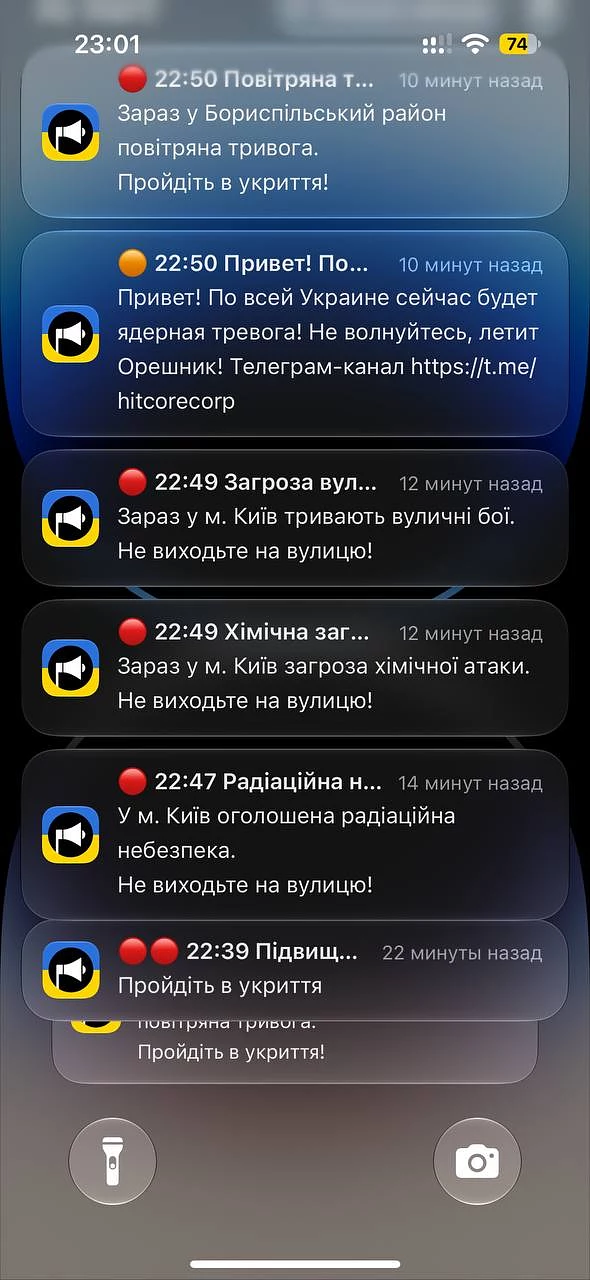
The incident occurred on the evening of November 1. At approximately 10:48–10:49 PM, application users began receiving unusual notifications that did not correspond to the real situation.
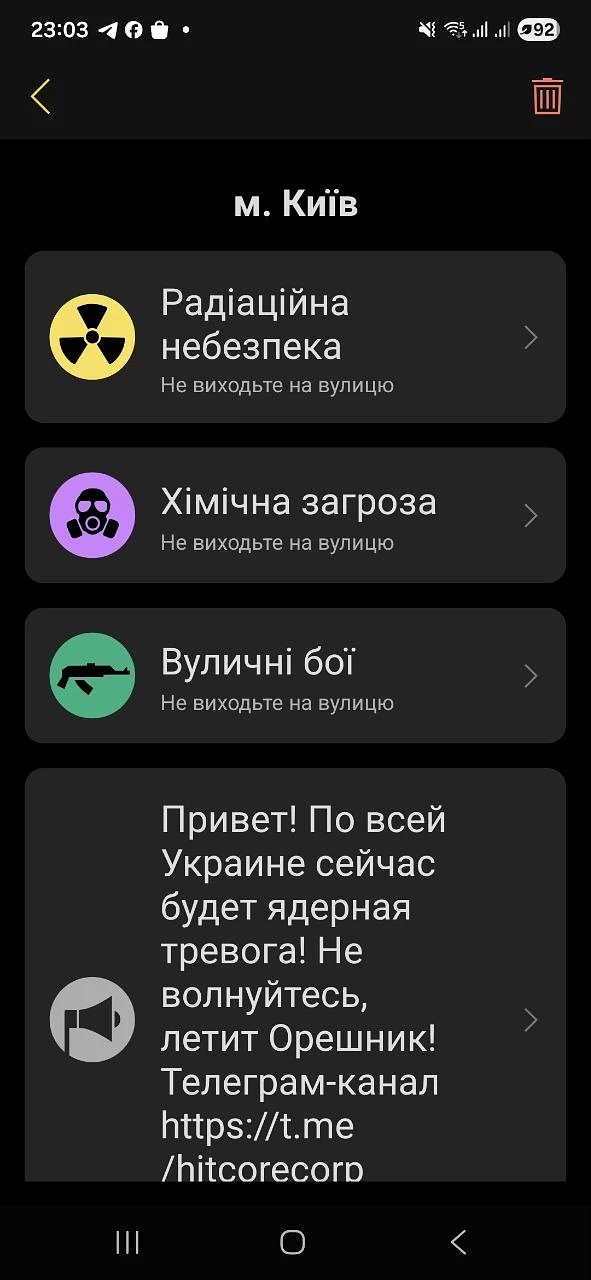
In particular, the reports mentioned radiation hazards, chemical threats, and street fighting in Kyiv. The app’s map for the capital simultaneously displayed markers for several types of hazards.
One of the notifications was written in Russian: “Hello! There will be a nuclear alert across Ukraine now! Don’t worry…”.
Another message looked like a standard danger warning: "Threat of street fighting! Street fighting is currently underway in Kyiv. Do not go outside!"
Screenshots of these messages began to spread on social media.
What did the Air Force respond to?
At 11:02 p.m., the Ukrainian Air Force commented on the situation on its Telegram channel. They stated that the application was likely compromised and that the information about the radiation hazard was false.
"The Air Alert app has probably been exposed to hostile influence. There is no radiation threat! Stay calm, follow our messages on our channel!", the military said in a statement.
Thus, the Air Force confirmed the occurrence of false messages and warned of possible third-party interference in the service’s operation. At the same time, their statement did not mention the established source of the attack or a specific method of penetration into the system.
An important nuance: at this very time, a real air alert was in effect in the Kyiv region due to the threat of jet drones. Therefore, false reports of a nuclear or chemical threat did not mean that a regular air alert signal could be ignored.
Who reported the possible break-in?
Even before the Air Force’s official statement about possible third-party interference, blogger Serhiy Sternenko wrote. At 10:49 p.m., he reported on his Telegram channel: "The Trivoga application is hacked. I think it will be restored soon."
The former head of the Center for Countering Disinformation at the National Security and Defense Council, Andriy Kovalenko, also suggested that the cause of the incident could have been unauthorized access.
"There may have been unauthorized access to the air alert application. There may be a cyberattack, wait for official announcements," he wrote.
Media reports also suggested a hacker attack. However, as of late evening on November 1, no technical details had been released that would allow us to establish the mechanism of the intervention, its scale, or the individuals involved.
What is known about the application state?
After the false alerts appeared, messages about radiation, chemical hazards, and street fighting disappeared. At the same time, users continued to report errors while using the application.
As of approximately 11:30 p.m. on November 1, the developers of Air Alert have not issued a separate public explanation for the incident. Therefore, it is not yet known whether this is a compromise of the server infrastructure, unauthorized notification management, or some other type of interference.
There is also currently no confirmation that attackers have gained access to users' personal data.
Where to check information during a crash
In light of the incident, the Air Force urged users to rely on their official messages. In particular, the military continues to inform about air threats via Telegram, WhatsApp, and Viber.
Earlier, on November 1, the Air Force separately reminded that the Air Alert application allows you to track the approximate movement of strike drones, but does not reflect the threat of the use of ballistic missiles and the direction of their movement. This information is published by the military on its official channels.
Users are advised not to rely on a single source of alerts, to verify unusual messages through official channels, and not to ignore confirmed air alerts.
At the time of publication, the causes of the incident, the technical mechanism of the possible intervention, and its ultimate scale remain unknown.