Марія БровінськаMoney
30 April 2025, 15:09
2025-04-30
Raif's IT team has created the YES platform electronic document management system, which has already attracted the attention of foreign colleagues. What are the benefits of this development?
How to revolutionize the document flow of a large financial institution in a way that makes life easier not only for the business, but also for hundreds of thousands of clients. The answer is simple: replace paper documents with electronic ones, combine them into a single digital system, and move from outdated monolithic platforms to modern solutions based on cloud technologies and flexible architecture.
How to revolutionize the document flow of a large financial institution in a way that makes life easier not only for the business, but also for hundreds of thousands of clients. The answer is simple: replace paper documents with electronic ones, combine them into a single digital system, and move from outdated monolithic platforms to modern solutions based on cloud technologies and flexible architecture.
This is exactly what a team of eight IT specialists from Raiffeisen Bank has been working on for over a year. Their goal is to create an ecosystem where documents are not hundreds of folders and stacks of papers, but a convenient digital system. It allows both businesses and hundreds of thousands of bank clients to work with information faster, more efficiently, and more securely.
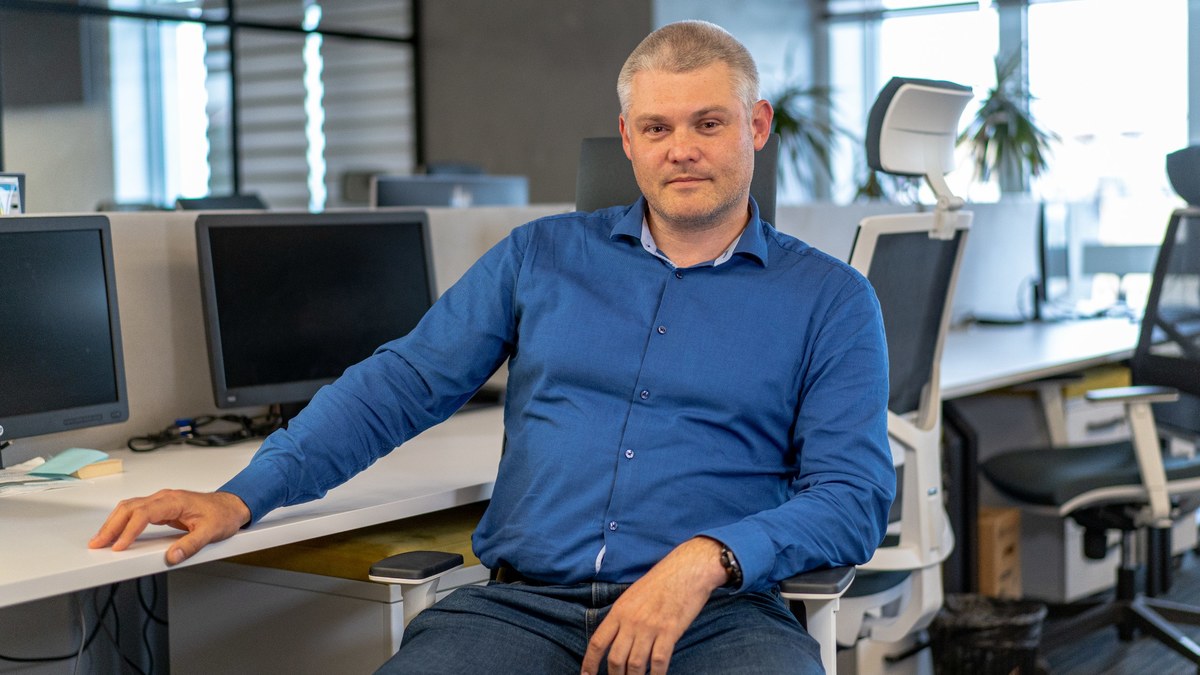
Mykhailo Ovcharenko, Director of the IT Development Department of Client Services and Account Servicing at Raiffeisen Bank, told dev.ua why the bank needs the digital document management system Your Electronic Storage system (YES Platform), what its effectiveness is, and why other banks in the group are interested in its development.
From old to modern
For a long time, Rife used an electronic document management system developed by an external vendor. However, at some point, this system could no longer fully meet the growing needs of the business. Given this, during a full-scale invasion in 2022, the financial institution decided to create its own, modern document management system. A system that would not only meet the requirements of security and flexibility, but would also create a new, positive client experience — convenient, fast, and future-oriented.
Mykhailo Ovcharenko, Director of the IT Development Department of Client Services and Account Maintenance at Raiffeisen Bank
«With the old product, we couldn’t build a full-fledged customer journey or use documents in a mobile application, because the outdated document management system didn’t support modern technologies,» explains Mykhailo.
To create the new system, the team chose AWS infrastructure services. This decision was logical, since most of the bank’s infrastructure is already in the Amazon cloud. Using a proven cloud platform made it possible to significantly save money, ensure high reliability and security, and gain flexibility: in the future, the bank will be able to seamlessly scale or optimize system resources depending on the load.
«We deployed the core of the new system and completed many necessary modules. In fact, we started as a small startup and are now moving towards an enterprise solution — fast, modern, and flexible,» says Mykhailo.
He explains that currently, a team of eight specialists is simultaneously maintaining the old document management system and developing a new one.
«Now all new documents of Rife are stored in a cloud microservice infrastructure, and not in a monolithic software complex, as it was before. In other words, this is a separate platform for storing and document lifecycle, capable of providing any tasks: from client onboarding to loan processing,» says Mykhailo. Now the creation of products and services, access to documents for auditors, operations officers and other bank specialists is possible without contacting a centralized team in accordance with agreed roles and rights.
«This is an automated platform that scales depending on business needs,» explains Ovcharenko. «We haven’t covered all processes yet — some documents still remain in the old system. But our plans include implementing full-fledged scanning and tracking of all documents. This will allow us to cover any type of documents and business processes.»
«The YES platform, developed by Raif specialists, is adapted to all Ukrainian and European requirements and fully meets them,» adds Mykhailo. Some of the processes and services have already been implemented on the basis of the new document management platform — both in the new MyRaif bank mobile application and in physical branches.»
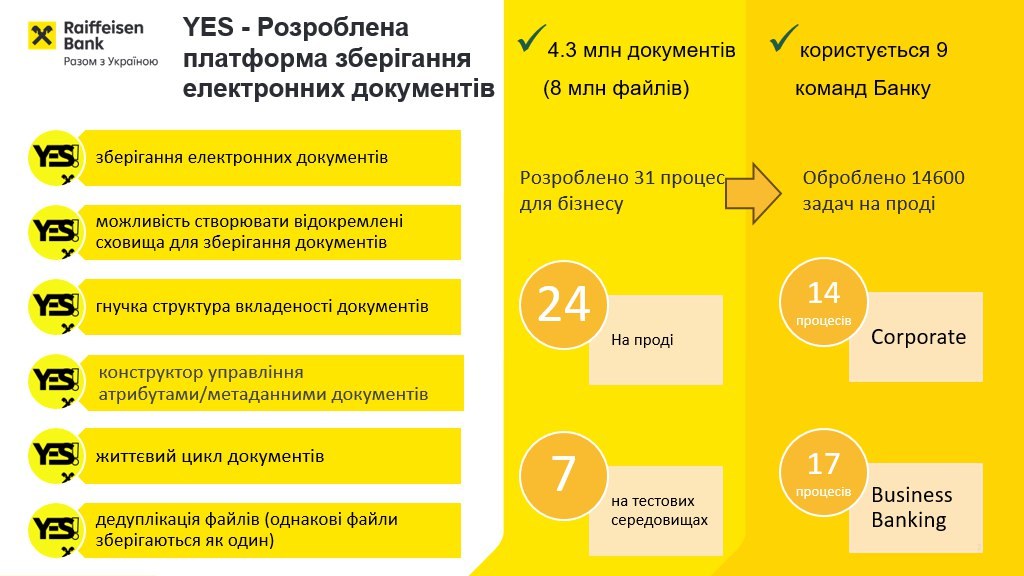
What kind of development is the YES platform and how is it already affecting Rife’s business?
YES platform is a bank-wide centralized platform for storing and accounting for client documents (metadata and attachments), which can be used by any bank division via API. The platform allows you to securely store both purely electronic and paper copies of documents created during the provision of banking services.
Thanks to this, Rife receives a convenient tool for centralized management of all documents, which positively affects internal processes and improves customer experience.
This approach allows business units to develop universal processes regardless of the document format (paper or digital), since all files will be tied to the master customer database.
YES Camunda is another key component of the new system. This platform acts as a basis for launching business processes that interact with YES, the bank’s internal ecosystem. Each business domain has its own isolated service with independent processes, which allows you to avoid inter-service dependencies and conflicts.
One of the key advantages of the approach is the isolation of processes and web forms: each element works within its own service.
This allows the team to make changes or updates on the fly without affecting other parts of the system. This significantly speeds up development, testing, and implementation of changes while maintaining the stability of the entire architecture.
Thanks to YESCamunda’s architecture, refining and cloning processes has become much easier. The new platform opens up opportunities for developing and implementing services that were previously unavailable. For example, it is now possible to integrate the functionality of signing documents using a CEP and ensure full integration with various bank systems.
Raif’s business is already reaping significant benefits from the implementation of the new system. The main benefits include the following:
System response speed. Compared to the old system, where switching between tasks could take up to 15 minutes, the YES platform allows switching between participants in just a few seconds, which significantly increases the efficiency of work.
Information centralization. All documentation, including input forms, is collected in a single repository, which reduces task processing time — users no longer need to search for documents in the old system archive (saving approximately 1.5 hours per day).
Checking the CEP immediately in the system is a very convenient feature that the bank did not have before.
Positive user feedback: The platform receives high marks for its intuitiveness, functionality, and ease of use. Users are eagerly awaiting new features from the development team, including integration with other systems.
Save signature for transition tasks: A new feature lets you save a signature for tasks that transition from the evening to the next workday, adding even more flexibility to your workflow.
NPS improvement: all implemented innovations have a positive impact on the satisfaction level of both internal and external customers.
Electronic document management is necessary for everyone
It’s no secret that in large organizations the number of documents is simply countless, and all of them usually relate to joint projects, clients, and users from different departments need access to them. Also, different documents have different requirements for retention periods — some documents must be stored for 20 years, and some data requires archiving for 70 years.
In general, specialists who provide support for more than 20 key banking processes have access to the development of Raiffeisen.
In addition, the electronic document management system created by the Ukrainian team, adapted to the bank’s needs, has already attracted the attention of Raiffeisen’s offices in Austria and the Czech Republic.
«If the new system finds a response, we will create a single code repository that will provide access to every innovation developed by our teams,» says Mykhailo. «The product has already aroused interest among colleagues among Ukrainian financial institutions, and although there are currently no plans to sell the system outside the group, scaling within Raiffeisen Bank is a real and promising direction of development.»
REFERENCE
With the development of the new system, Rife complies with a number of laws and regulations of the National Bank that regulate electronic document management and archival storage of the Bank’s electronic/paper documents:
NBU RESOLUTION No. 130 of 27.11.2018 On approval of the Rules for the application of the list of documents generated in the activities of the National Bank of Ukraine and banks of Ukraine.
ORDER 11.11.2014 No. 1886/5 On approval of the Procedure for working with electronic documents in office management and their preparation for transfer to archival storage.
NBU RESOLUTION of 20.12.2023 No. 172 On approval of the Regulations on the use of electronic signatures and electronic seals.
ORDER OF THE MOJ 30.12.2020 No. 4555/5 On approval of the Procedure for acceptance and transfer of electronic documents of the National Archival Fund for permanent storage.
Law of Ukraine «On Electronic Identification and Electronic Trust Services».
Law of Ukraine «On Electronic Documents and Electronic Document Management».
The information system «Electronic Archive of the NBU» will ensure the automation of the main functions of the archive, digitization of archival documents, ease and convenience of access to them by employees. In the future, the National Bank plans to expand this information system in banks and financial institutions to integrate and improve their interaction with the regulator and other government bodies.
The regulatory document of the National Securities and Markets Commission of Ukraine, which establishes requirements for the storage of electronic documents of a depository institution, is «On Approval of the Procedure for Circulation, Storage and Destruction of Electronic Documents Used by Professional Participants in the Depository System of Ukraine» (section 6 of this document).
The finish is not far off.
The team is currently working on creating a scanning module that will automate access to any paper documents. The next step is tracking, so that each specialist can track the movement of a particular document (paper copies).
After completing these processes, the old document management system will be completely completed, which will significantly reduce costs and allow you to switch to a modern, progressive solution.
It is obvious that the development of the system is just beginning: ahead is the integration of new processes, scaling of functionality, and adaptation to changes in legislation and regulatory requirements. In particular, the MyRaif application plans to implement the Customer-Box functionality, which will allow each client to quickly view all their bank-related documents in real time.
«We strive to create a centralized collection of client documents, where each user of our bank will be able to view their documentation — from personal files and photos to loan and deposit agreements. Thanks to modern technologies, this will be made as simple and convenient as possible,» the director of the IT development department of client services and account maintenance of Raiffeisen Bank confidently reports.
According to plans, the development of the entire RAF e-document management system is planned to be completed in the second quarter of next year.
200 IT professionals from Raif created a mobile superapp for a million users. What’s in the app, how does it make life easier, and who are they looking for in the MyRaif developer cohort?
«We don’t set any limits for IT professionals in choosing technologies.» Raif is changing the rules of the game in payments: you can now transfer funds instantly — in 10 seconds instead of 15 or more minutes
The bank moved to the cloud: what’s next? Cloud solutions architect Raif on challenges and solutions that will simplify cloud infrastructure management after migration