Хочете будувати кар’єру в Data Science та AI? Vodafone Big Data Lab відкриває новий набір —>
Ігор Вишневський Історії
26 November 2025, 09:00
2025-11-26
“I don’t want to contribute to the development of the Russian language even for money.” How Work.ua co-founder Andriy Borovyk is developing his own product — the Ratatype speed typing simulator — and why he focused on the educational domain
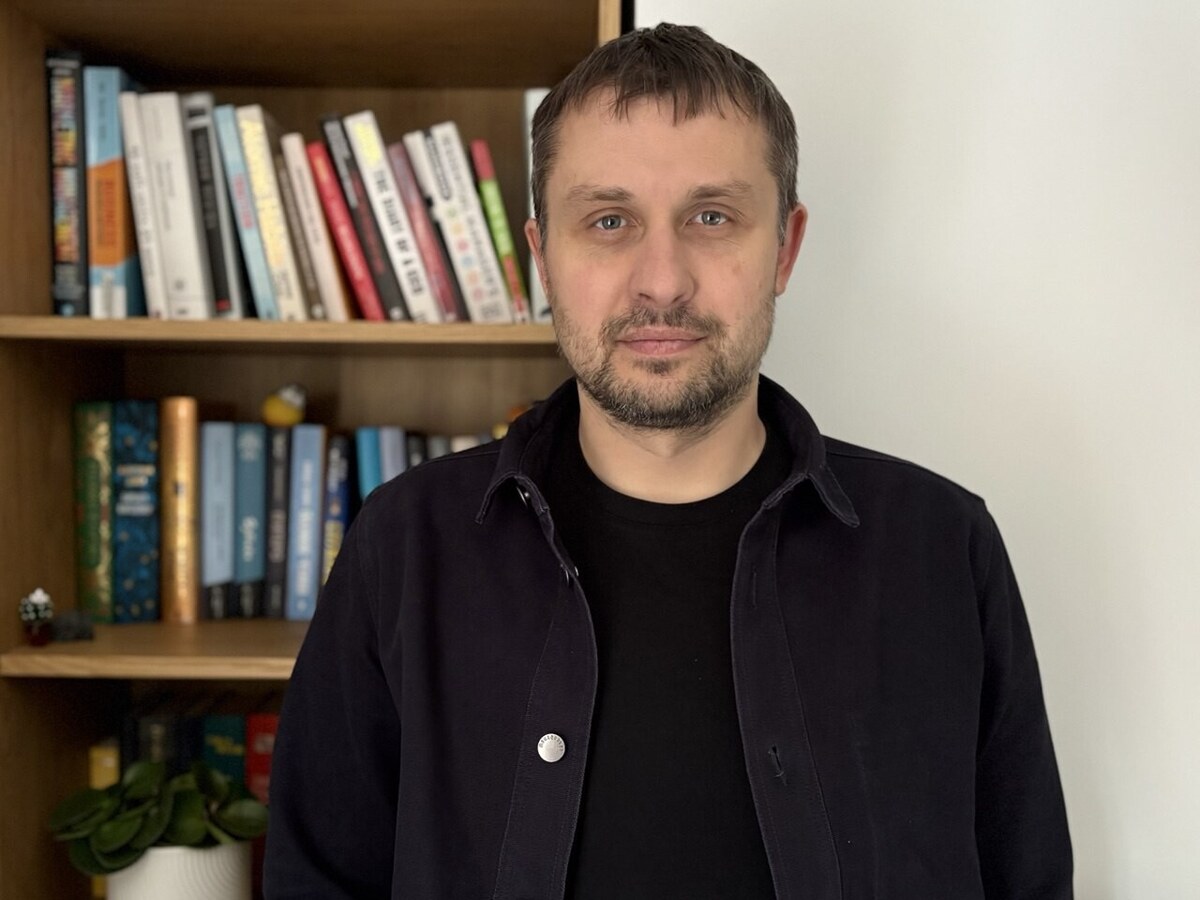
Last year, Work.ua co-founder Andriy Borovyk sold his stake to partners — another co-founder of the job search platform, Artur Mikhn, as well as Polish Grupa Pracuj and Jooble co-founder Roman Prokofiev. Since then, he has focused exclusively on the development of two of his own projects — the keyboard simulator for speed typing Ratatype and the Education.ua platform.
We talked to Andriy Borovyk about how the idea of Ratatype came about, where the touch typing simulator has already conquered the market, and where it is just getting there, and why in some countries speed typing is taught to children in schools. Andriy Borovyk also told dev.ua whether it is difficult for the project team to deal with unusual language layouts and why the task now is not only to add new layouts, but also to remove an existing one. And most importantly, why he, as a techno-businessman, believes in the educational domain despite the lack of large funds in it.
Last year, Work.ua co-founder Andriy Borovyk sold his stake to partners — another co-founder of the job search platform, Artur Mikhn, as well as Polish Grupa Pracuj and Jooble co-founder Roman Prokofiev. Since then, he has focused exclusively on the development of two of his own projects — the keyboard simulator for speed typing Ratatype and the Education.ua platform.
We talked to Andriy Borovyk about how the idea of Ratatype came about, where the touch typing simulator has already conquered the market, and where it is just getting there, and why in some countries speed typing is taught to children in schools. Andriy Borovyk also told dev.ua whether it is difficult for the project team to deal with unusual language layouts and why the task now is not only to add new layouts, but also to remove an existing one. And most importantly, why he, as a techno-businessman, believes in the educational domain despite the lack of large funds in it.
«You could draw this Cyrillic keyboard with a pencil, or you could learn touch typing.» How Ratatype came about
— How did the idea for Ratatype as a product come about? How did you discover the potential demand for this solution?
— The demand was maximum, and it was from my side. Once upon a time, about 17 years ago, I bought my first MacBook. I think I bought it in Austria, but it was definitely abroad.
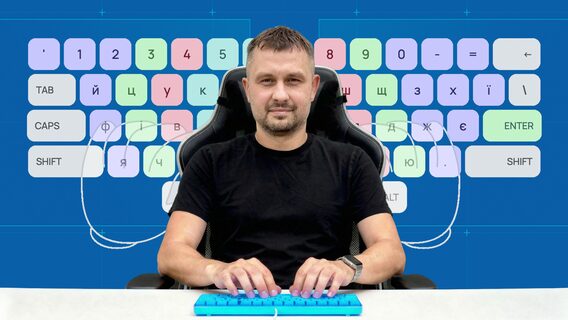
It didn’t have Ukrainian letters or a Cyrillic layout. In order to use it somehow, I had two options. You could draw this Cyrillic keyboard with a pencil, because laser engraving didn’t exist back then. That is, just draw these letters somehow. Or you could learn touch typing.
So I started thinking about how I could make an online simulator where I could learn to type text blindly in Cyrillic. Initially, this project was called «All 10» and we made it in Russian, which, of course, I’m ashamed of now.
At some point, we decided to try to make this project international, and the new name Ratatype was invented by a famous Ukrainian IT expert, Anton Borzov. He is known, among other things, for drawing the WhatsApp logo, and now actively invests in Ukrainian startups.
At Ratatype, we first made an English version, and then Ukrainian and Russian. Later, we started adding other language versions, and now we have a total of 11 languages, including Spanish, French, Italian, Polish, Portuguese, German, Dutch, and Turkish.
— Where do you have the most users right now? From which country?
— Try to guess! If we measure it by geography, the largest number of users is in Brazil. This is actually a surprise even for us, but that’s how it turned out. So, accordingly, the most popular language is Portuguese, Brazilian Portuguese.
— How do you explain to yourself that your product has done so well in this country?
— If I were to tell you one 100% certain version, I would be lying. We probably don’t know. I think there’s just no competition there, maybe that’s why.
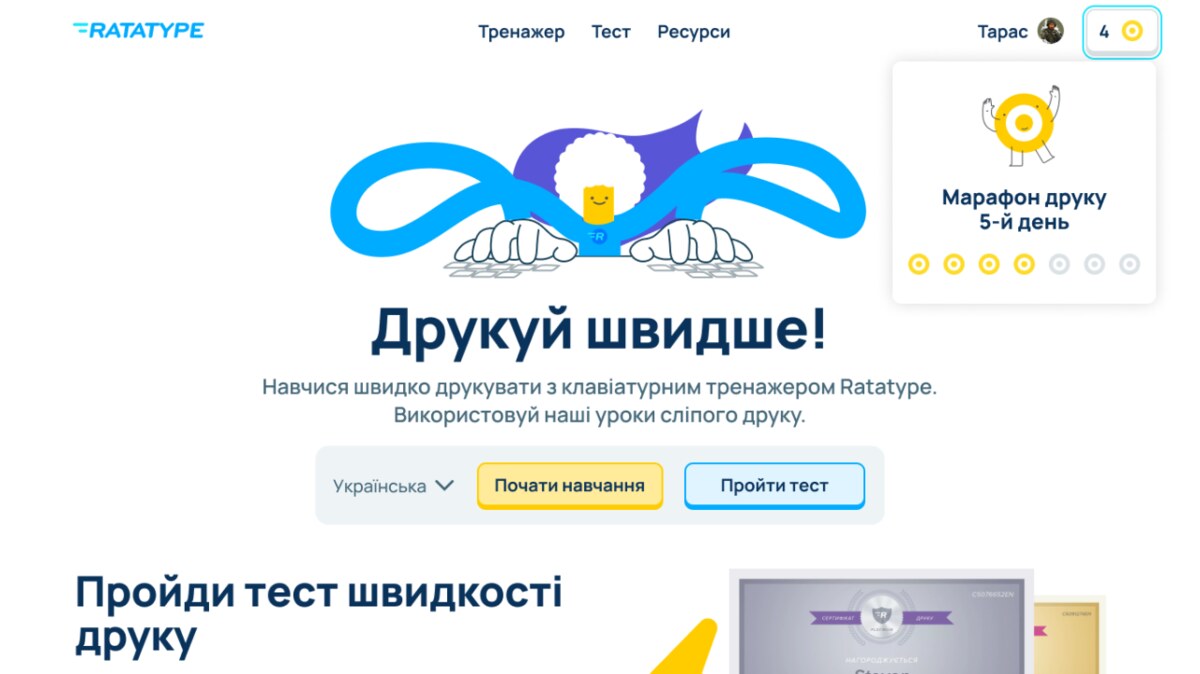
Screenshot from the website Ratatype.ua
Basically, if we talk about how we chose countries to launch in, we looked at two parameters. This is the number of people living in this country, and GDP, or gross domestic product. That is, we first analyzed how much money there is in a particular country. In this way, we derived a certain coefficient and rating, and launched there.
Yes, actually, the Turkish version has appeared. There are a lot of people there and a fairly strong economy.
— You mentioned the lack of competitors in Brazil as a factor in Ratatype’s high performance. So, actually, who are your biggest competitors? Does it depend a lot on the country or the layout?
— Of course, we have competitors, and among them there are quite large projects. There is TypingClub, which operates in the US market and positions itself more as a tool for teachers. I think they are much more popular in America than we are.
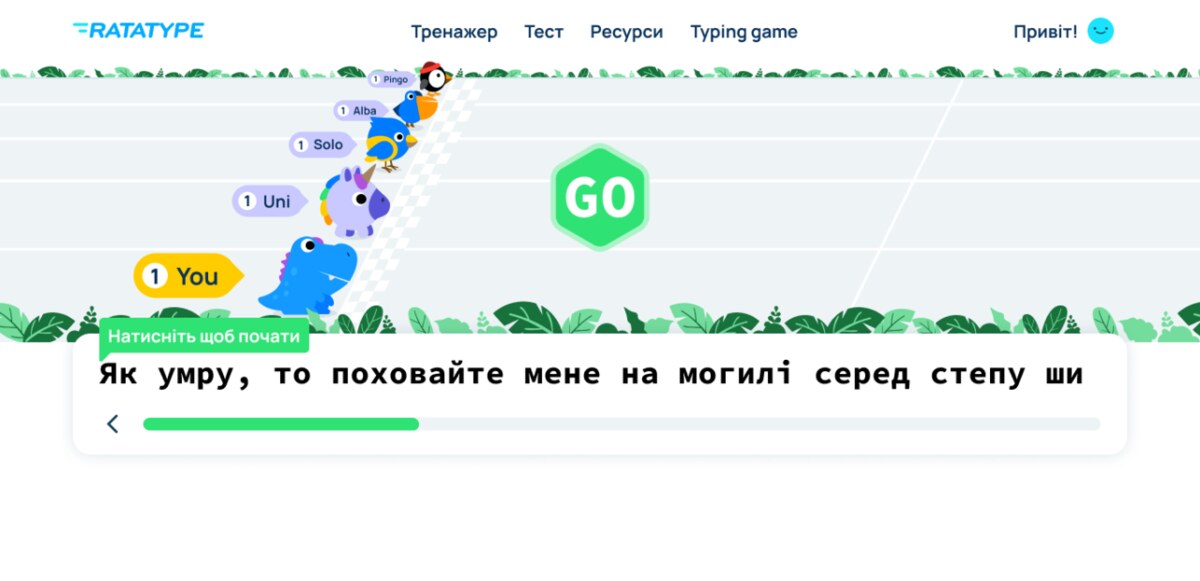
There are various projects that deal with this area in one way or another. But our product is not only a simulator. We have a test that allows you to measure how fast you type and even get a certificate. We also have a game that stimulates children to learn speed typing.
— Regarding children. Or adults. What is the basic audience of Ratatype, if we talk specifically about age?
— We found two major audiences: either children who are just learning to type on a keyboard, or students who already know how to type but want to learn to type really fast. That is, these are young people around 20 years old.
But still, there is no super clearly defined audience by age, because it is very relevant for everyone. We once believed that the ability to type quickly really saves a lot of time in your life. Many people use the keyboard every day and there is a difference whether to type the same text for an hour or 20 minutes. Then we would still have 40 minutes a day left to watch TikTok. I’m kidding, of course.
By the way, many countries realize how important this skill is in the modern world. That is why in both England and America, speed typing is part of the school curriculum.
As for age, we recently conducted a large survey of our users, and it turned out that we have a fairly large audience of older people. The oldest user in this survey was 81 years old, and he really raved about Ratatype. The skill of fast typing is kind of super underrated, because we all learn to read and write, but not to type. It should happen somehow «by itself.»
— Are you somehow working on implementing the idea that speed typing should be taught in Ukrainian schools? This could be both a social mission and a marketing campaign for Ratatype.
— We have plans to promote this idea, but we have not yet taken any concrete steps in this direction.
«Roskomnadzor has blocked Ratatype in the Russian Federation as a prohibited site»
— How serious a challenge is it for the team to launch your product on a new layout, especially if it is non-standard from the point of view of a Ukrainian. You already have a Turkish one. Perhaps you will be ready to enter the Asian market and teach speed typing with hieroglyphs?
— In fact, even if we take certain European languages, they already have some non-standard symbols. For example, such symbols are in French and Polish. So when typing, you have to hold down certain «chords» on the keyboard and additionally use the Shift, Ctrl, etc. keys.
As for launching some unusual languages in our product from the point of view of the Ukrainian user, we are thinking about Arabic. We are also thinking about Hebrew. This is in the plans.
As for languages that are even more complex in terms of characters on the keyboard, like Chinese or Japanese, they have even more complex chords. I don’t know how they can type quickly, because each character is typed in a rather complicated way.
— Do you generally set the team the task of expanding your product to the maximum number of languages?
— We have an ambitious goal to make the best typing trainer in the world. Of course, the best trainer should cover all languages. That is, there are such plans, but at the moment our team is not that big.
I like to do one task at a time, rather than layering many simultaneous tasks. Because in such circumstances, a lot of time is spent switching between tasks, and we don’t move, but simply jump from one task to another.
It’s the end of the year. We’re going to have a strategy session and decide what we’re going to do next year.
— How many people are there in your small team?
— There are five of us at Ratatype. One of our company’s values is to do more with less. We don’t have many resources, but we do a lot.
If, by the way, we talk about «language» plans, then the task is not to add a language, but to remove one. After all, we still have Russian.
There was an interesting story: when the full-scale invasion began, we immediately replaced all the texts on the test simulators with Russian. We put texts saying that Russia had attacked Ukraine and was violating all possible international norms. These texts are still there.
Ksenia Sobchak or one of their popular presenters even wrote about us then, I don’t remember.
And literally the next day Roskomnadzor blocked Ratatype on the territory of the Russian Federation as a prohibited site. But as for Russian, unfortunately, there is still a lot of audience in Kazakhstan and other former republics of the former USSR. However, we want to get rid of even this audience. Because we don’t want to make any contribution to the development of the Russian language even for money.
— Your focus on developing their national language in the imaginary Kazakhstan, just like in other post-Soviet republics that were artificially Russified, is very cool. And when you launched Ratatype, you set yourself the goal of ridding Ukrainians of Russian software, because the Russian simulator «Solo on the Keyboard» was very popular in the post-Soviet republics. Was it your competitor in the post-Soviet markets?
— I have never had, neither in my life nor within the framework of this project, a clear desire to choose an enemy and, so to speak, defeat him. This was not the case when I was involved in Work.ua, and it is not the case now.
We just want to make our cool Ukrainian product that would be popular all over the world. And if it also helps to get rid of some Soviet or Russian past, then that’s super cool! But it will be a bonus for us, not the main task.
— What is Ratatype’s business model? As far as I understand, your main version is a free version, but there is also a paid version, Ratatype+, with additional options. Does the latter generate revenue or do you make money from something else, including advertising?
— From the very beginning, we simply placed ads and earned money from them through Google AdSense. But over time, the profitability of this decreased a little. Actually, not a little, if you compare it to the time when it started. Perhaps this is due to some changes in the global advertising business, because many players and large platforms appeared in this market and began to earn money from advertising.
That’s why last year we launched these paid services that you mentioned and that we are actively promoting. Now they generate even more revenue than advertising. And we want them to generate even more revenue. However, the lion’s share of users still use the free version.
— Is Levova more than 50%, or exactly 80-90%?
— I think it’s somewhere around 90%. It’s worth noting that the price of our paid version is differentiated depending on the country. I’ll also remind you that from the very beginning we launched the project not on the .com domain, but each country has its own separate version of the site.
Screenshot from the website Ratatype.ua
We sensed a trend before it became mainstream: in my opinion, now every country wants to have something of its own, and globalization is rolling back a little.
If we take the English version, our subscription costs $7 per month. But if you pay for the whole year, then it will be $3 per month. Quite democratic. Although we are now on the way to reviewing the cost of the subscription.
«If a person is educated, it is much more difficult to manipulate them»
— In 2024, you, as a co-founder of Work.ua, sold your share. Do the products you are currently working on — Ratatype and Education.ua — belong entirely to you? Do your ex-partners from Work.ua also have a share in them?
— I am now the full owner of these products.
— In addition to the two projects I mentioned, are you developing any other digital products — is this an exhaustive list? Or, perhaps, do you have plans to launch something new?
— Two products is not so little. It’s twice as much as one! After I left Work.ua, I opened a company called Orbita-Y.
Now these two projects — Ratatype and Education.ua — are under this «flag.» But the name itself — «Orbit» — could, in principle, be the beginning for a larger number of satellites orbiting in this orbit.
That is, there are only two of these projects at the moment. In principle, that’s enough for me. What will happen in the future — we’ll see in the future.
— Both of these products are somehow invested in the educational domain. Why education? After all, this is not the area where the largest amount of money is spent, and as a technopreneur and businessman, you should think about this not least.
— Personally, I believe that the solution to many of humanity’s problems lies in the domain of education. If a person is educated, it is much more difficult to manipulate them. It is more difficult to buy their vote for buckwheat. They vaccinate their children and stop the spread of diseases. Perhaps such a person does not even take microloans because they understand how interest works. They do not buy something that they have not yet earned. That is, a lot of informed decisions are made simply on the basis of some educational level.
So I personally believe in education very much. Unfortunately, education, as you said, is not a very popular story in terms of funds. But I want to be part of this engine that advances this story both in our country and in the world.
If we take Education.ua, then, in principle, when we created Work.ua, Education.ua was a logical continuation of this story. After all, if you don’t know how to do something yet, you can learn to do it and find a job. That’s how this project came about.
And in general, as our great poet said: «Learn from others, and do not shun your own.» We work under this slogan.
— Tell us a little more about Education.ua. What challenges do you face in developing this platform?
— The main goal of Education.ua is to help a person choose where to study. For her or her child — to find the place where the study will be most suitable for her request.
If you are choosing a school for your child, you can look at the distance on the map, and also choose an educational institution based on the average exam results of its students, that is, the quality of knowledge, and many other parameters. We try to collect all the open data possible so that the choice of education is as balanced as possible.
This is a super complex project because it essentially contains seven separate projects. After all, it’s not just schools, it’s universities, kindergartens, and tutors. And these are completely different audiences.
Unfortunately, the audience that currently uses this project is constantly decreasing due to the events taking place in our country. Therefore, it is quite difficult to make this story at least somehow profitable, considering that the number of children is decreasing both due to the full-scale invasion and demographic changes. However, we do not abandon this story and continue to work.
— Are there more than five people working on this project? Are the same five people pulling two projects? Although, that’s probably impossible.
— It happens that teams help each other, but, of course, these are separate teams with separate tasks. At Education.ua, this team is also small — up to 8 people.
— I understand you’ve been living in the UK for some time now. Actually, as a tech entrepreneur currently promoting educational products, how can you assess the level of educational digital products in the UK itself?
— British education is known all over the world and, one way or another, they are very good marketers for their education. After all, everyone knows that British scientists have discovered something again and again. But if we talk about the education system in Britain as such, it is super complex and super diverse. There are a million different ways a child can learn.
I have two children, and as long as I have lived here, I have been studying the education system — just to understand where and how my sons should study. In terms of various digital applications, all educational institutions work in their own way, and each school can choose which tools it uses. There is no centralized system that would work for the state.
My son, by the way, complained that his school has a very powerful system that blocks all Internet traffic that can distract from learning. That is, all games, TikTok and Instagram at the level of his school are banned. I also want to say that many British schools have completely switched to paperless learning, that is, learning takes place on iPads or other gadgets, without paper books and notebooks.
— Didn’t you have the ambition to repeat the Education.ua experience for the British market?
— There were certain opinions on this topic, but we must take into account that the British can be super-conservative in choosing products that they are used to trusting. We looked at various of their projects, which are similar to ours, and some of them are 80 years old. They are much older than the Internet and arose on the basis of some newsletters before World War II. Then this newsletter was transformed into a magazine, and then they started working on the Internet. The same goes for educational institutions — there are schools that are 250-300 years old, 600 years old. So it is very difficult to break these ties that were built not just over decades, but over centuries.
These people in 2025 still have two faucets that don’t mix hot and cold water. This is both a conservative and a very progressive nation that somehow combines these two things at the same time.
PHP-розробник каже, що у Work.ua йому не виплатили понад $5000 зарплати, а після розголосу намагалися схилити до написання заяви на звільнення за власним бажанням
Інженер-програміст у компанії «Реактор» (Work.ua) Микола Цуркан на форумі DOU розповів історію про те, як його роботодавець не виплачує обумовлену в офері зарплату, схиляючи розробника до того, щоб той написав заяву на звільнення за власним бажанням.
За час війни на ринку стало вдвічі більше вакансій для віддаленої роботи: кому платять більше
За даними порталу Work.ua, за останні чотири роки віддалена робота стала одним із найважливіших трендів ринку праці. Цьому сприяли пандемія та війна. Ось кілька висновків аналітиків Work.ua про зміни, які переживає ринок.