Хочете будувати кар’єру в Data Science та AI? Vodafone Big Data Lab відкриває новий набір —>
Олександр КузьменкоRobots
24 July 2026, 09:00
2026-07-24
Ukrainian robot barista advises users to take shelter during an alarm and refuses to make coffee for rude people. RoboL Robotics launched the first robot cafe in a shopping mall in Dnipro
Dnipro startup RoboL Robotics has moved from laboratory prototypes to commercial operation. The company installed its first robotic kiosk under the Robi Coffee brand in the Apollo shopping center in Dnipro. The founder and CEO of the project, Anton Kotyk, told dev.ua how the robot reacts to air alarms, what operational challenges the team faced, and why the startup is preparing to expand to Finland.
Dnipro startup RoboL Robotics has moved from laboratory prototypes to commercial operation. The company installed its first robotic kiosk under the Robi Coffee brand in the Apollo shopping center in Dnipro. The founder and CEO of the project, Anton Kotyk, told dev.ua how the robot reacts to air alarms, what operational challenges the team faced, and why the startup is preparing to expand to Finland.
From laboratory testing to real sales in the shopping center
Launching a robotic kiosk in a regular shopping mall required developers to thoroughly refine the technical and operating system. While the laboratory stand worked in ideal and controlled conditions, the public space revealed dozens of unpredictable factors.
«This is a big event for us, because we understand that there is a big difference between recording a good video of work from the laboratory and making a commercial product that can work in an unpredictable environment without downtime. This launch required significant improvements to our CRM/ERP system and mobile application,» notes Anton Kotyk.
The basic architecture of the robobarista remained the same as in the first developments, but the commercial version received dozens of improvements. The team rewrote the software, communication algorithms, and equipment control. The developers also rebranded and changed the design of the robot in view of the upcoming launch of the franchise. In addition to preparing coffee drinks, the kiosk’s functionality was expanded — now the robot also serves desserts.
Empathy during anxiety and refusing to make coffee for rude people
Artificial intelligence is responsible for creating an emotional connection and adapting to the context in Robi Coffee. Algorithms analyze the surrounding environment and adjust the robot’s behavior to guests and external events.
«We taught the robot to communicate in a cool and emotional way. From interesting cases: customers said that while ordering coffee, anxiety began to set in, people began to get nervous, to which the robot confusedly began to ask what happened, and then advised to immediately run for cover. Our guests really remembered such empathy. For movie premieres, we teach the robot new phrases and new faces. People are also very surprised by this,» says the founder of the startup.
At the same time, ethical safeguards and algorithms to protect against inappropriate behavior were integrated into the system.
«There were also funny cases. When teenagers came up to order drinks and started talking obscenely to the robot, it refused to cook for them,» recalls Anton Kotyk.
Currently, the scope of tasks of the AI robot barista continues to expand. While previously it was mainly responsible for communication and entertaining guests, now algorithms are taking on operational tasks.
The system is already implementing computer vision to monitor the quality of ingredients and finished products, and is also delegating certain tasks related to managing the daily operations of the coffee kiosk to AI. In the future, the team plans to add AI control of the cleanliness of the work area, although the developers note that this is a complex process that will take time.
Operating room, first mistakes and crumpled cups
The point in the Apollo shopping center has been operating for about three weeks and serves as the only test site. The company’s main goal at this stage is to confirm the unit economics, check repeat purchases and adjust processes. The coffee business turned out to be a challenge not only in the technical plane, but also in the issue of building supply logistics, where the team still lacks experience.
The first two weeks of operation were a stage of intensive debugging. During the transition from a laboratory prototype to real sales, the developers encountered a large number of technical nuances. The dynamics grew gradually: if on the first day the robot prepared only 8 drinks, then in two weeks the figure increased to ~50 cups per day.
«Our immediate goal is to bring the system to a level where technical downtime will not exceed 4 hours per month and the robot will only require scheduled maintenance. But the main thing is a quality product and high-class service, because people come to look at the robot, and they remain regular customers only because of this. And we can already be proud of our first successes, because even in such a short period of time of work with interruptions, we have our first regular visitors,» explains the project founder.
The reaction of shopping center visitors was mostly positive — both in terms of the taste of the drinks and service, and in terms of the idea itself. However, the developers openly admit that there were some technical and culinary blunders at the start.
«Of course, there were many mistakes — both in terms of the taste of the drink, which we are constantly trying to improve (but not everything is perfect right away), and technical errors, when the robot slightly crushed the glass or slightly underfilled the drink. Usually, people are understanding about such mistakes, and we, of course, rework or refund the money. So far, I see good signals that people are getting used to the new service and the number of guests is growing,» shares Anton Kotyk.
At this stage, Robi Coffee deliberately keeps its drink prices in the lower range among coffee shops in this location. The startup’s strategic priority is to test the viability of its operating model and the percentage of repeat purchases, rather than maximizing the average check.
Loss of engineers due to mobilization and plans for Finland
The most serious test for the project recently has been personnel losses.
«We face challenges almost every day. Most of them are routine, but the one that really threw us off balance was the loss of two key engineers due to mobilization,» the founder said.
Despite this, RoboL Robotics has already begun production of the second version of the robotic kiosk. The updated model takes into account the problems of the first version, will be more stable and reliable in operation, as well as cheaper to manufacture and maintain.
The startup is currently developing with the founders' own funds, but has recently applied for several grant programs, the attraction of which should accelerate scaling.
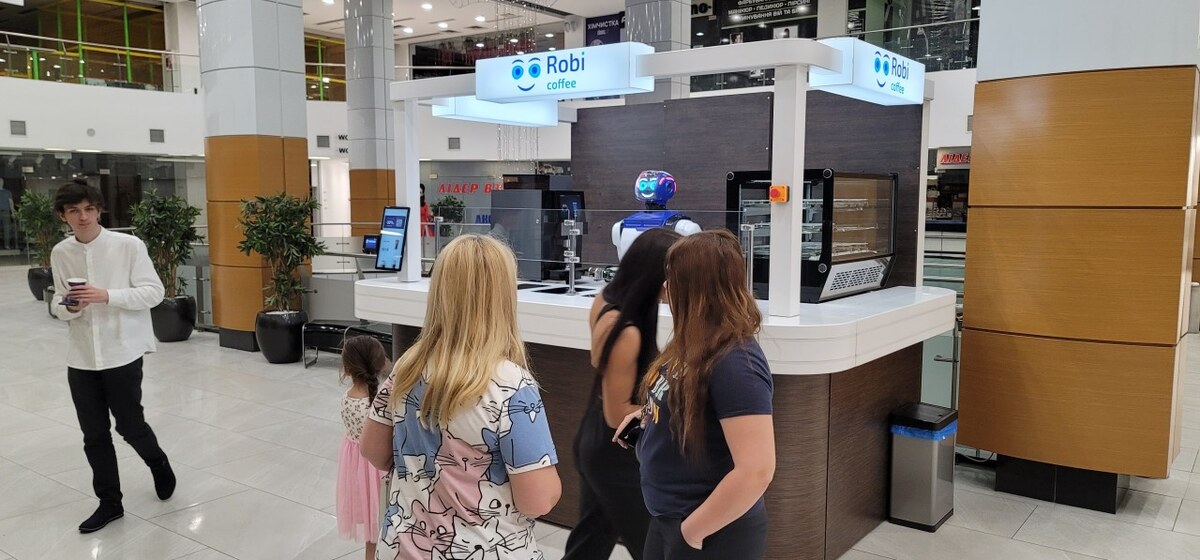
Robi Coffee robotic coffee shop in Dnipro. Photo: Anton Kotyk
The company’s large-scale plans include launching 20 of its own robotic coffee shops across Ukraine, fully deploying the Robi Coffee franchise, and obtaining international certificates to enter the European market.
«We have already started booking exclusive franchise rights in the cities of Ukraine. Also, there is an entrepreneur who is already waiting for our kiosks in Finland,» says the founder of RoboL Robotics.
The startup’s philosophy is based on the concept of human-machine symbiosis: the robot is not seen as a replacement for personnel, but as a tool to get rid of exhausting routine work. The automated system guarantees precise adherence to the recipe and cooking algorithms, while the person is responsible for hospitality and creating the atmosphere.
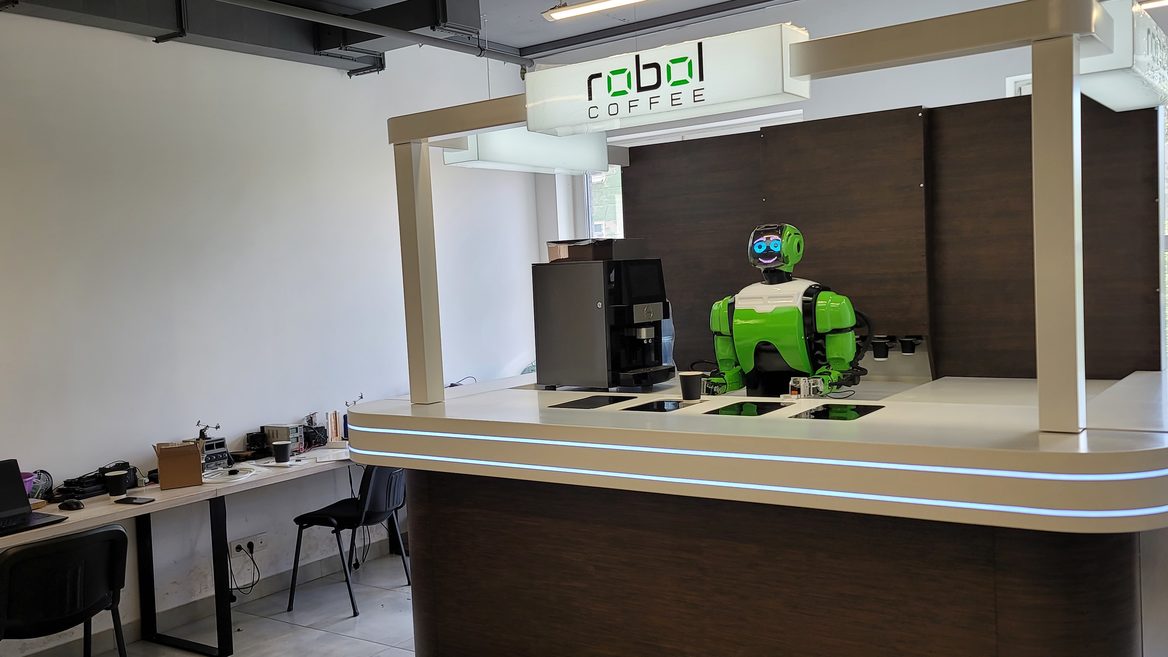
The customer places an order via a self-service terminal or mobile app. The robot prepares the drink and places it in one of four automatic dispensing zones with the customer’s name and order number, sending a notification to the phone. During breaks, the robot entertains guests by recognizing their emotions, gestures and faces. Human intervention is only required for evening service (flushing the system, refilling ingredients) or in case of force majeure, for example, if a guest has knocked over a drink.
During the MVP development phase, a team of 12 professionals invested $330,000 of their own funds in the project and attracted a pre-seed grant of $25,000 from the Ukrainian Startup Fund (USF). The initial cost of the retail robotic kiosk was estimated at $35,000 (or $2,500 to $2,900 per month for rent).
«The robot cooks, and the person receives guests.» How the Ukrainian startup Robol works, which produces humanoid robobaristas for autonomous coffee shops
«If you say „kohfe“ instead of „coffee“, the assistant will understand you.» The AI director of the Ministry of Digital Affairs told how the voice assistant on the «Diya» portal copes with surzhik