Хочете будувати кар’єру в Data Science та AI? Vodafone Big Data Lab відкриває новий набір —>
Наталя ХандусенкоAI Eng
2 September 2025, 12:07
2025-09-02
AI as a "co-pilot": Americans have developed a new technology that allows paralyzed people to control robotic arms with their thoughts
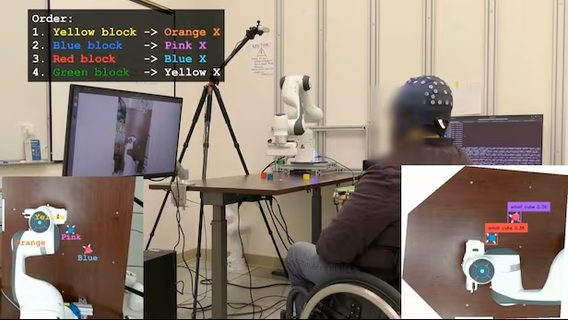
Researchers at the University of California, Los Angeles (UCLA) have developed a new, portable, noninvasive brain-computer interface (BCI) system that uses artificial intelligence to help people with physical disabilities. The system can understand users' intentions and allow them to control a robotic arm or a computer cursor.
Researchers at the University of California, Los Angeles (UCLA) have developed a new, portable, noninvasive brain-computer interface (BCI) system that uses artificial intelligence to help people with physical disabilities. The system can understand users' intentions and allow them to control a robotic arm or a computer cursor.
UCLA researchers aim to develop AI-BCI systems that offer shared autonomy, allowing people with motor impairments such as paralysis or ALS to regain some independence in daily life, Interesting Engineering writes .
"By using artificial intelligence as a complement to brain-computer systems, we are aiming for much less risky and invasive pathways," said Jonathan Kao, lead author of the study and an associate professor in the Department of Electrical and Computer Engineering at UCLA.
How the system works
Until now, state-of-the-art BCIs have required risky and expensive neurosurgery. The benefits of the technology have often been outweighed by the invasiveness of the procedure. Wearable BCIs, while safer, often lack the reliability needed for practical use.
This new system combines an electroencephalographic (EEG) cap with a camera-based AI platform that captures brain activity. The team developed special algorithms to decode the brain signals obtained using the EEG cap.
A camera-based artificial intelligence platform then takes over, interpreting the user's intent in real time to control actions such as moving a computer cursor or robotic arm.
What the test showed
The tests were conducted on a group of four participants, including three people without motor disorders and one paralyzed person.
In a two-task test—moving a cursor to eight targets and using a robotic arm to move four blocks—all participants completed the task much faster with the help of artificial intelligence.
A paralyzed participant was a key example; he was able to complete a task with a robotic arm in about six and a half minutes with the help of artificial intelligence, a task he could not have completed on his own.
"Next steps for AI-BCI systems could include developing more sophisticated 'co-pilots' that move robotic arms with greater speed and precision, and provide dexterity that adapts to the object the user wants to grasp. And adding more training data could also help AI collaborate on more complex tasks and improve its autonomous EEG decoding," said study co-author Johannes Li, a doctoral student in electrical and computer engineering at UCLA.
Як нейромережі бачать вільну та незалежну Україну? Тест dev.ua
Нейронні мережі для генерації зображень бачать світ по-своєму, їхню логіку зрозуміти часом зовсім неможливо. Але таки хочеться. На честь Дня Незалежності України редакція dev.ua вирішила провести невеликий експеримент.
Ми задали чотирьом різним нейронним мережам п’ять однакових запитів: «прапор України», «День Незалежності України», «український Крим», «перемога України» та «українці». Отриманими результатами ми ділимося з вами нижче.
У TikTok тепер можна генерувати фон за допомогою нейромережі. Ми протестували її та ділимося результатами
У TikTok з’явилася нова функція «Розумний фон». З її допомогою як фон для тіктоків можна підставляти згенеровані нейромережею зображення. Редакція dev.ua протестувала цю технологію і ділиться своїми враженнями.