Наталя ХандусенкоMoney
16 March 2026, 12:11
2026-03-16
How much do AI leaders earn: Europeans earn $100,000 less than their American colleagues
Despite the global AI boom, the role of leaders responsible for this technology is still in the formative stage: half of AI positions are expansions of existing ones. In addition, an interesting trend is observed in salaries: top managers can earn less than their deputies.
Despite the global AI boom, the role of leaders responsible for this technology is still in the formative stage: half of AI positions are expansions of existing ones. In addition, an interesting trend is observed in salaries: top managers can earn less than their deputies.
The survey surveyed 318 top managers from the US, UK and continental Europe, revealing significant differences in pay and approaches to AI leadership across regions.
Almost half of AI jobs are renamed roles
One of the key findings of the study was that almost 50% of organizations did not create new AI leadership positions, but simply expanded the powers of existing roles by adding responsibility for artificial intelligence.
“This approach creates some confusion in the market — companies are looking for AI leaders, but they are still determining what functions these leaders should perform. This has led to artificially inflated expectations regarding compensation,” the researchers noted.
AI CEO salaries: the gap between the US and Europe
The study showed significant differences in compensation between regions.
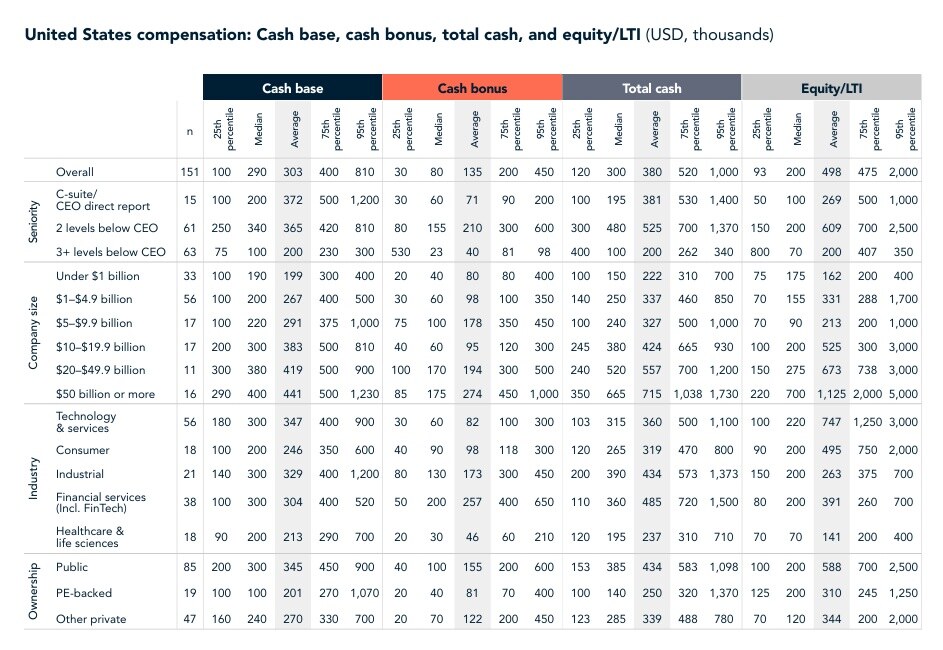
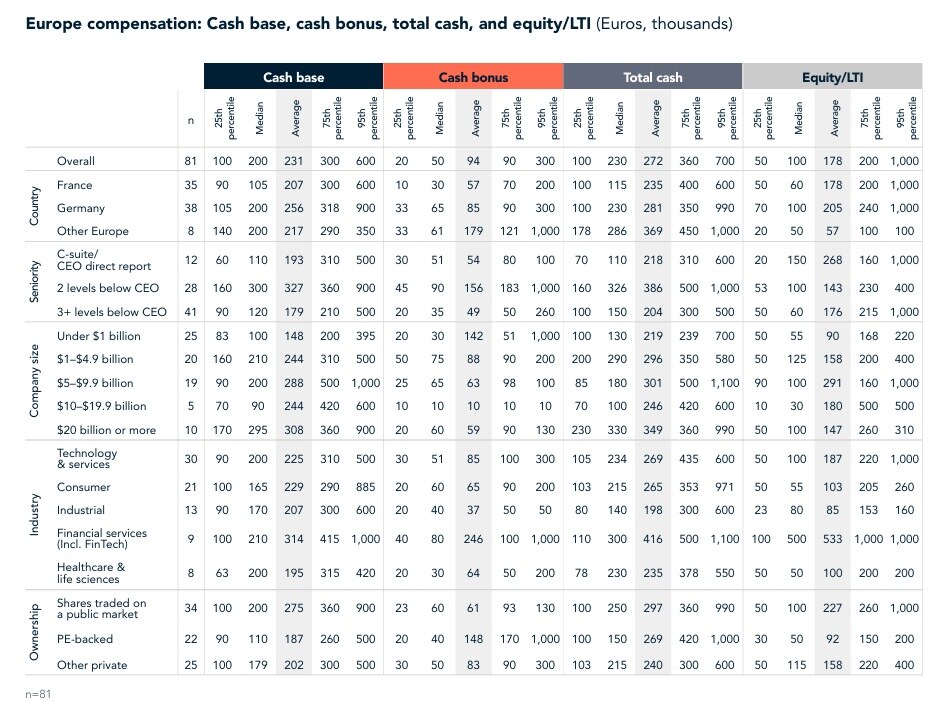
In the US, the average total compensation (base salary + bonus) is around $380,000, while in continental Europe it is an average of €272,000.
When you add in stocks and long-term investment programs (equity/LTI), the gap becomes even wider. American AI leaders receive an additional $498,000 in stock on average, while their European counterparts receive only €178,000.
The middle management paradox: when deputies earn more than top managers
Another interesting trend is the disruption of the traditional salary hierarchy.
In some cases, executives two levels below the CEO receive larger bonuses and equity stakes than top managers who report directly to the CEO.
In the US, the median total compensation for those two levels below the CEO is $525,000, while for the CEO's direct reports it is $381,000. A similar trend is observed in Europe.
This suggests that companies value practical expertise and operational management of AI projects more than strategic positioning at the C-suite level.
The financial sector pays the most
Regardless of region, financial services and FinTech offer the highest compensation for AI professionals:
USA: average total compensation $485,000.
Continental Europe: €416,000.
The tech sector, despite being the largest employer of AI talent (37% of respondents), lags behind finance in compensation levels.
European AI leaders have less social security
Another important finding: only 39% of AI executives in the UK and continental Europe have severance pay, compared to 52% in the US.
At the same time, when severance pay is available, it almost always includes base salary (92-96%), but only in half of cases does it cover bonuses (42%).
Most severance packages in Europe are designed for 4-6 months (60% of cases), while in the US the range is wider.
Hybrid work has become the norm for AI managers
Despite the rise of remote work, most AI leaders continue to work regularly in offices.
more than two-thirds of managers visit the office at least once a week;
at the same time, only 37% live within a 50-mile (≈80 km) radius of the office.
This demonstrates flexibility in location while maintaining the importance of in-person collaboration.
In the US, 41% of AI leaders work from the office every day, and 28% at least once a week. In Europe, these figures are slightly lower: 37% and 34%, respectively.
Companies are still learning how to work with AI
Despite the rapid interest in artificial intelligence, most companies are still in the early stages of its implementation. Many organizations are conducting experiments, launching pilots, and testing new tools, but full-scale AI solutions remain elusive.
The main barriers to large-scale implementation of AI remain:
data quality;
security;
regulatory requirements.
In some cases, the desire to move quickly has already led to problems, including lawsuits and compliance risks, forcing leaders to be more cautious about aggressively scaling AI.
Як нейромережі бачать вільну та незалежну Україну? Тест dev.ua
Нейронні мережі для генерації зображень бачать світ по-своєму, їхню логіку зрозуміти часом зовсім неможливо. Але таки хочеться. На честь Дня Незалежності України редакція dev.ua вирішила провести невеликий експеримент.
Ми задали чотирьом різним нейронним мережам п’ять однакових запитів: «прапор України», «День Незалежності України», «український Крим», «перемога України» та «українці». Отриманими результатами ми ділимося з вами нижче.
У TikTok тепер можна генерувати фон за допомогою нейромережі. Ми протестували її та ділимося результатами
У TikTok з’явилася нова функція «Розумний фон». З її допомогою як фон для тіктоків можна підставляти згенеровані нейромережею зображення. Редакція dev.ua протестувала цю технологію і ділиться своїми враженнями.