Хочете будувати кар’єру в Data Science та AI? Vodafone Big Data Lab відкриває новий набір —>
Ігор Вишневський Startup
9 February 2026, 09:00
2026-02-09
How to make employees' soft skills a measurable indicator on which a company can make decisions about their careers. Startup SoftTrainer offers an answer to this question
It is common to think that soft skills are something that cannot be «measured» in numerical terms, so operating with information about these skills of your employees is based on some abstract ideas or personal assessments. Meanwhile, in the modern technological world, it is soft skills, according to many experts, that will clearly come to the fore — while AI will do a significant part of the routine work. Based on the assessment of not only hard skills, but primarily soft skills, the manager offers successful employees a salary increase or new roles in the company, but it turns out that these decisions are made simply on the basis of a certain subjective vision, right?
It is common to think that soft skills are something that cannot be «measured» in numerical terms, so operating with information about these skills of your employees is based on some abstract ideas or personal assessments. Meanwhile, in the modern technological world, it is soft skills, according to many experts, that will clearly come to the fore — while AI will do a significant part of the routine work. Based on the assessment of not only hard skills, but primarily soft skills, the manager offers successful employees a salary increase or new roles in the company, but it turns out that these decisions are made simply on the basis of a certain subjective vision, right?
The Ukrainian startup SoftTrainer, with its B2B product, decided to turn everything upside down in the assessment of employees' soft skills, not only making them a «measurable» indicator, but also, most importantly, stimulating their development. This is achieved by creating simulations of work situations that the employee must solve as a kind of quest, communicating with AI in chat or by voice. For employees, this allows them to «pump» their problem-solving skills, and for company managers, to assess the leadership qualities, stress resistance or empathy of an employee based on specific data. dev.ua spoke with founder and CEO Ruslan Kovalenko about what «chips» SoftTrainer offers its users, what path the startup has taken and what stage it is at now. What follows is his direct speech.
How SoftTrainer works
We help businesses collect the necessary data about employees so that businesses can make effective decisions about their talent. The main focus is on talent within the company. What decisions does this help make? These can be decisions about promotions, training, restructuring teams within the company.
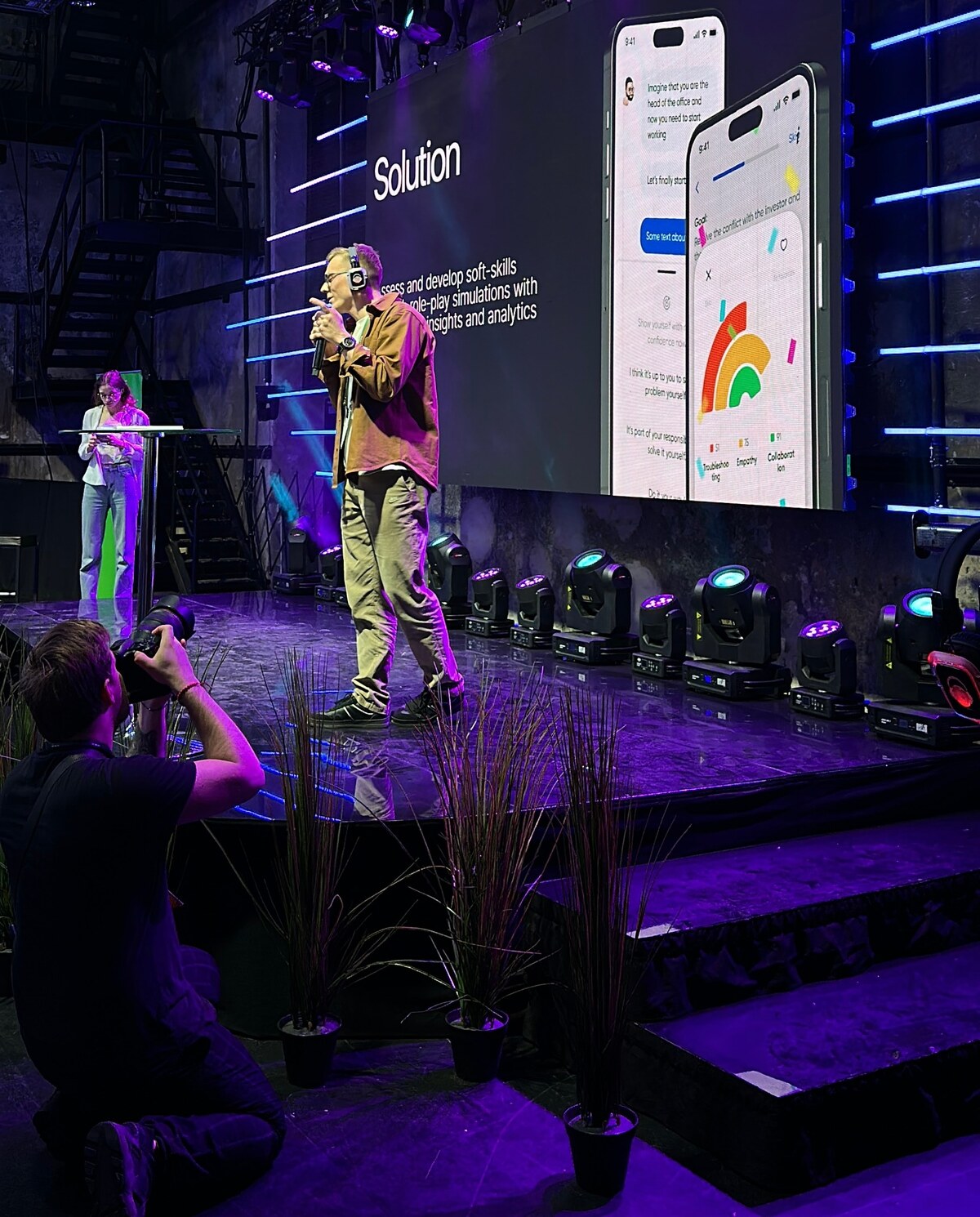
The idea is to build customized simulations of work situations. A simulation is a kind of role-playing game, the interaction of a person with an AI copilot, with artificial intelligence, which, in turn, plays different roles. For example, the role of a manager, a subordinate, or the role of a disappointed customer, or the role of the person you are trying to sell something to.
When a person interacts with these «characters», we follow the patterns, collect them, and then convert them into analytics, into completely understandable charts and dashboards, which we actually show to the people who make decisions in the company.
In addition, based on this data, we help businesses form an individual development plan for each employee, that is, we understand their strengths and weaknesses, and we give an understanding of what to do about it. In general, we focused on two main vectors of employee development — leadership and sales. Thus, a person who interacts with our simulator has the opportunity to develop their skills.
Now we have interaction via chat and voice. Why chat? Because, for example, this is a typical type of interaction for customer support, where disappointed and dissatisfied people turn. Customer support communicates via chat, so, in fact, there was such a request in the business.
But there are other cases of work situations — for example, about giving feedback, about talking about a salary increase, etc. These conversations usually take place during a call, so it was very important for us to do it in the form of a voice — a person communicates about it with an avatar using his voice.
Why only voice, no video? First, from the point of view of technical implementation it is more difficult and expensive. But there is another nuance — in fact, there is a trend indicating a decrease in employee involvement in conversations with a video avatar. That is, products that try to simulate a real conversation over video and realistically draw a person have less involvement than those products that do not do this.
When it comes to using artificial intelligence in our product, it does not evaluate answers. Our AI is involved precisely in building simulations, that is, generating these cases.
We conduct the evaluation using our own system, we have our own algorithmic approach. Artificial intelligence hallucinates, so we cannot delegate the evaluation to it yet.
Where did the idea come from?
In fact, I had these insights from different sources. At first, I was at a hackathon with enthusiasts, where we had the idea of making a tool based on ChatGPT that would help train soft skills — you communicate with some characters, and AI gives you a rating. We even made the first attempts to implement it and go sell it to companies. This was when ChatGPT first appeared. But it was very difficult to sell this tool, because we did not support this expertise with anything.
At the same time, I was working as a developer in a large company, and I began to monitor how my company actually approaches the assessment and development of its employees' competencies. I saw that in this regard, companies usually «reinvent the wheel.» They often hire some external trainer, he will come and teach some skills. But did we record this? And did we understand anything from this? And did we ourselves have some shift in competencies? In fact, the company does not know these things.
Here we can mention performance reviews. This is also one of the approaches that potentially allows you to gain insights about your employees. But such an assessment has a lot of nuances.
Therefore, we are really building an innovative product, although the simulation approach itself is not innovative.
There is a segment of assessment centers on the market, which, roughly speaking, are our competitors. But this path is expensive and is usually used only by companies that have a high risk of making a decision regarding their candidates. For example, take banks — when appointing a person to a top-level position, they pay crazy money to the assessment center to help predict how well this person will cope with their duties. To give you an idea, checks for such an assessment can range from $2,000 to $51,000.
During such a test, assessment centers also simulate imaginary work situations — a group of people sit «behind the glass» and make notes about the candidate with a pen on paper. But, we can say that our startup «automated» these people who sit on the side and monitor these patterns of the candidate.
About competitors, the market and customers
As far as I know, there are no such products on the Ukrainian market. That is, there are similar things, but they are at a very early stage and have not yet achieved significant success. In fact, we are already entering the European market, we have serious discussions there, which is very important for us.
There is an Israeli product, which also has incredible access to capital. That’s why everything is going much faster for them, but, to be honest, they started earlier. If we take sales simulators separately, then there are much more such products. I even saw a product at Y Combinator that was specifically focused on a simulator for working with sales.
Honestly, the presence of competitors is even an indicator for us that we are moving in the right direction. It would be much worse if there were no such startups — and it shows that there is demand in the market.
We are looking towards Europe, but we also want to stay in Ukraine. There is a market here, and there are companies that are able to pay money for such a product. But I want to say that a very large number of Ukrainian companies are in the survival phase — they are not looking towards development, but thinking about survival. Because development is about foresight. And it is about how to train your employee, and after two years to grow him into a manager or head of a department, or after three or four years — into a C-level specialist. That is, most companies strive to look for a ready-made person from the market, rather than grow such people. But we still try to find those who grow, because our startup is about investing in the future.
Let’s take, for example, Nova Poshta, which is doing well and is really developing. They invest money in development and training. We have tried to cooperate, and I think we will try again. Because when we first contacted them, our product looked a little different.
We currently have about eight pilots that we aim to convert into long-term collaborations.
About the team and investments
I’m a developer myself, plus I see a bunch of AI-based development tools. So I used to think I wouldn’t waste time or money on onboarding and would do everything myself. Now I understand that it doesn’t really work that way.
Currently, our team has an L&D Lead who is responsible for clients, identifies their requests, is responsible for collecting data from them and processing it, because this is a really big part of the job. There is also a person who is in charge of communication and is involved in how to convert a particular company into a client, because our sales funnel is quite long, but, I think, quite high-quality. Because we first invite our clients to a pilot to demonstrate the benefits to interested L&D or HRD.
We are also currently involving a person in the project who is an expert in various certifications such as Thomas or Hogan. We have already found her and are now working on a format for cooperation. After all, there is an expertise in how to properly assess people, and we want to combine this expertise with technology. That is, we are putting this whole story on rails.
As for funds, we are doing quite well in this direction, because we managed to attract grants. First of all, this is a grant from Seeds of Bravery. We also went through the acceleration at Mission Possible and won a grant. So for now, these funds are quite enough for us to move forward in the next six months.
We are thinking about the future and how we can be independent of grant money, so in the next six months we have plans to reach a level where clients can cover all our costs. But there is also the idea of attracting investment, and that is why we got into Challenger.
One of the areas where this accelerator helps us is finding an investor, as well as understanding our unit economics and what we can scale. In fact, within this accelerator, we are actively working to attract investment within six months.
About last year’s successes and plans for this year
I consider the success of last year to be the establishment of cooperation with clients, which was also helped by our partners from the 8reach agency — they are great at finding targeted leads! Thanks to this, we have a very good conversion, and last year we really built a strategy for this area of work. As I said, now I have started the first pilots for the foreign market.
One of the things we implemented last year is voice interaction. We heard a lot of feedback from our leads that chat is not an interactive enough story, and in order to increase the stress factor and get the end user interested in interacting with the app, you need voice. We invested time and money in that, and now we have this voice interaction. But we want to, as I said, invest our resources in professional talent assessment — so that there is an instant assessment when a person interacts with our avatar with voice.
We want to create a tool so that when communicating with this agent, a person has a kind of coach who would give instant tips.
It will look like this: «Listen, now you are giving very directive feedback. The result of this will be this and that. And if you change the approach, it will allow you to achieve this and that.» We really want, in fact, to show alternative consequences through this coach and thereby interest the interlocutor in developing his own leadership skills. This will allow him to become a better version of himself. This is our main task now.
In Ukraine, they have found a way to monitor the health and fertility of cows 24/7. The giants of the livestock industry are already interested in the solution. What the HEFT startup offers
«People don’t know anything about this material. They only have associations that it’s slippery and that it smells.» How Ukrainian startup Fiskin is conquering the fashion industry by offering luxury accessories made from fish skin
«Ми не можемо дозволити путіну захопити Україну. Це божевілля». 20 тез Ілона Маска з великого інтерв’ю Business Insider
Мільярдер Ілон Маск дав відверте інтерв’ю виданню businessinsider.com, де торкнувся теми вторгнення рф в Україну, космічних подорожей та речей, що роблять людей особливими.
Наводимо тезисно адаптований переклад тексту.
Головні soft skills для айтішників: добірка гнучких навичок від розробниць
Фахівці Google з’ясували, що більш розвинені гнучкі навички безпосередньо пов’язані з продуктивністю IT-команд. А ще кандидатів з прокачаними soft skills охочіше беруть на роботу. Але які саме скіли потрібно розвивати? Bubble поговорив про це з успішними дівчатами з ком’юніті, а заодно підібрав корисні книги, статті та відео для самоосвіти.