Марія БровінськаAI Eng
10 December 2025, 19:08
2025-12-10
From 30% to 62% AI users: how Raiffeisen Bank built an AI culture in 18 months and saved hundreds of thousands of dollars
A year ago, AI at Raiffeisen Bank was more of a topic for internal discussions than a real tool. Today, the bank’s approach to technology has changed dramatically: teams work with AI tools every day, and internal technology implementation initiatives have significantly accelerated key processes and opened up new efficiency scenarios for the financial institution’s employees.
Hryhoriy Tatsyi, CTO of Raiffeisen Bank Ukraine, told dev.ua about the transformation that changed not only the speed of development, but also the very definition of what it means to be a developer.
A year ago, AI at Raiffeisen Bank was more of a topic for internal discussions than a real tool. Today, the bank’s approach to technology has changed dramatically: teams work with AI tools every day, and internal technology implementation initiatives have significantly accelerated key processes and opened up new efficiency scenarios for the financial institution’s employees.
Hryhoriy Tatsyi, CTO of Raiffeisen Bank Ukraine, told dev.ua about the transformation that changed not only the speed of development, but also the very definition of what it means to be a developer.
Content
In short: what AI gave Raif
When a student intern came to Hryhoriy and built a full-fledged KYB service for business customer verification in a week—a task that would have taken a full-time senior developer two sprints—Raifu’s service center realized that the industry was undergoing a truly fundamental change. «He wasn’t a self-taught genius. He just worked well with Claude Code,» says Tatsyi.
In 18 months, Raif IT achieved a 50% increase in development productivity, saved $178,000 on a single project, and reduced the time to create a POC from weeks to four hours. «But the most important thing is not the tools. When I studied industry data from DX, Dora, and Antropic, which analyzed more than 135,000 developers in 435 companies, I saw an interesting pattern: traditional enterprise companies with structured implementations show higher AI implementation results than tech giants. This gave me confidence that we were moving in the right direction,» says Hryhoriy.
Artificial intelligence will change more radically each year than all of software has changed in the previous twenty years. Teams that learn to work in this environment will gain an advantage that cannot be bought. It can only be built—systematically, honestly, and together.
Speed is no longer a competitive advantage for developers, but a hygienic minimum. In this new reality, AI does not replace engineers. It makes engineers who they were meant to be from the beginning: people who build systems, make technical decisions, and are responsible for the outcome.
A developer ceases to be a person who writes code line by line.
«He becomes an operator of complex intelligent systems. An architect, a mentor for dozens of digital „junk“ working under his control. A person who forms logic, not syntax,» says Tatsyi.
The story of AI implementation at Raif, he says, is not a quick win. «It’s been 18 months of experimentation, failures, course changes, and systematic work on a culture that turned skeptics into active users,» explains Tatsyi. Below are his conclusions and insights that СTO has made and gained during the AI implementation.
Cold Start: How One Question in Paris Changed Everything
In September 2023, Hryhoriy spoke at the McKinsey conference in Paris, where he talked about Raif technology initiatives. After the presentation, one of the attendees asked a question that surprised CTO: «Are you already writing AI tests using GitHub Copilot?»
«That’s when I first heard about Copilot. Back at the bank, we launched a quick pilot project for 50 licenses. And here’s the first cold shower: Copilot was still raw at the time, generated a lot of „bad“ code, and only 30% of developers actually used it. The rest returned to their usual workflow, and I understood them — the tool was more of a hindrance than a help,» says Hryhoriy.
He admits that the bank could have stopped there, deciding that «AI wasn’t ready for the enterprise yet.» «But something told me that it wasn’t about the technology as a whole, but about the specific implementation,» СTO notes. So in early 2025, another pilot project was conducted at Raif—this time with Cursor.
20 developers participated in the pilot project, and the average rating of the tool after the developers' evaluation was 8.3 out of 10. «For routine tasks, the tool worked 10 times faster. Vitaliy, our backend developer, said: ‘The Rego policy, which my colleague worked on for two hours with ChatGPT, took me 20 minutes with Cursor.’ Mykyta, a DevOps engineer, refactored the entire project in one weekend — he admitted that he would never have rewritten it manually in that amount of time,» says Hryhoriy.
The first lesson was clear: not all AI tools are the same. You need to test, measure, compare. And only then scale.
Cases that convinced skeptics
In large organizations, for every new idea, there are a dozen reasons why it «won’t work.» Entrepreneurship loves concrete evidence. So Raif began to systematically collect it.
Case 1: Connector for days instead of months
The bank had a team that refactored an old IBM stack. It needed to switch from Oracle DB to PostgreSQL for the data bus — that’s 18,000 euros in savings per year and technology consistency instead of a zoo. But there were two pain points: the lack of an ODBC connector for the AIX platform for PostgreSQL and the lack of deep DBMS expertise in the team.
Raiffeisen Bank Service Center Hryhoriy Tatsiy
This could have been a story for months. But an engineer who had never done this before, using GitHub Copilot, had a working connector and script to migrate data from Oracle to PostgreSQL in a day. It took a few more days for comprehensive testing. Two engineers plus Copilot — and everything went into production according to our SDLC process, including security, architecture, and review.
I saw the first shocking effect: what traditionally took weeks is now done in days or even hours.
Case 2: Call Analytics and Savings of $178,000
The debt collection department turned to Raifu Service Station with a request: we need a tool for analyzing collector calls. «We care deeply about our clients and want to be sure that our specialists adhere to the standards of communication with clients,» says Hryhoriy.
The IT guys put together the first prototype in four hours. They spent three hours choosing a transcription model — starting with OpenAI Whisper (≈65% accuracy — not enough), moving to AWS Transcribe (~84% — acceptable), and later replacing it with Google Gemini 2.5, which gave a jump in accuracy to 93%. It took another hour to write the frontend and backend for our queries.
Raiffeisen Bank Service Center Hryhoriy Tatsyi
To avoid making it seem like AI can do wonders, I’ll be honest: to bring the product to production according to all the company’s development rules, we needed 2 senior managers, a product owner, an analyst, and 3 months of time. Because writing code is fast, but negotiating integrations, signing contracts, and doing it according to banking standards is another challenge.
However, the project paid off even before it went into production: the cheapest supplier that would have agreed to develop such an E2E system would have cost us $220,000. It cost us $42,000 — a savings of $178,000.
When Hryhoriy compared these numbers to industry benchmarks, he saw that this was no anomaly. According to public research, companies that use AI-powered development save an average of 3.6 hours per week per developer, while those that use it daily save 4.1 hours. The Raiffeisen team’s numbers were in the same range, but they applied these hours of savings to specific business cases with measurable ROI.
Case 3: Student and the new reality of seniority
The third turning point was when a student came to the bank for an internship — with no experience in fintech or even business development. This was someone who just had basic development knowledge.
Raiffeisen Bank Service Center Hryhoriy Tatsyi
We said: here is our pain point — we need to do KYB (Know Your Business), we need a service that analyzes the client’s website by dozens of parameters, gives an assessment, creates a report on the client. We need to do this on Java + Kafka with a bunch of NFR. The task was estimated in 2 development sprints by a senior developer, including analysis. If you want to join our team — come on.
In a few days, using Claude Code, the student put together a fully working prototype in Python: with AI models for analysis, interface, basic logic. We did a review, found that the quality and understanding of the code was at a high level, and said: great, refactor to Java with our standards and welcome to the team.
So at the bank, we realized that with new tools, the very definition of skills is changing. People who can think product-wise and work with models are becoming a new category of employees.
This is supported by data СTO has seen in public reports: Junior engineers are the most active users of AI — 41,3% of them use these tools daily, the highest rate of any seniority level. And they’re showing results. The time to achieve the 10th personal result for new RIF employees using AI has decreased from 86 days in Q1 2024 to 39 days in Q3 2025.
Case 4: Analyst turned developer
Dmytro from the analytics department was so interested in the call analysis product that he was ready to develop part of the service himself. Therefore, the bank decided to conduct an experiment: can a person without any programming knowledge develop at least part of the functionality?
Raiffeisen Bank Service Center Hryhoriy Tatsyi
We tasked Dmytro with writing a frontend for an analytics service based on our design library. The short answer is: no, he can’t right away, because AI is still a multiplier, and if you multiply 0 by any number, it will still be 0.
But Dmytro was persistent. Not understanding what AI was writing to him, he simply started learning how to write in Node.js using AI. And in 4 months we already had a working front for our call analysis service.
Previously, we would have said: well, it’s at least six months for training, given that he has a main job, another month for mentoring. And here a person is just doing it. And for me, this was a sign: AI is not about replacing developers, but about the fact that the boundaries of professions are blurring.
Hryhoriy reminds us that Anthropic’s research, based on a survey of 132 engineers, found the same trend: backend developers are building complex interfaces, and non-technical people are involved in the development. One of their engineers described his transformation as «going 70%+ to code reviewers/editors, not to new code writers.» This accurately describes what СTO is currently seeing at Raif.
Second lesson: Artificial intelligence is a multiplier, but it requires a knowledge base and critical thinking to work effectively.
At Raif, artificial intelligence has allowed us to quickly create four products that are already in use:
OCR platform — we started with models derived from Qwen2, but after the release of Gemini Nano Banano, we switched to it. It turned out that Gemini not only generates images well, but also analyzes them perfectly. This became critically important when we saw real-world conditions: a loader takes a photo of a delivery note in a dark warehouse with an old phone. Simple PDF files are processed well, but it is with such low-quality photos that Gemini copes much better than previous solutions.
Call analytics (evaluation service) — works in production, analyzes thousands of calls and provides an objective assessment of service quality.
Behind the scenes, runtime problem analysis, automatic AI documentation, and YAML configuration generation have significantly accelerated DevOps processes.
MCP servers for internal tasks — almost every department can create a microtool for itself.
Scaling: Why Buying Licenses Is Only 10% of the Work
With this concrete evidence, Hryhoriy decided to scale the bank’s AI expertise. By mid-2025, the number of GitHub Copilot licenses had grown to 300, and the developers’ total annual budget for AI development had reached €80,000. And then the team faced an unexpected problem: the licenses were there, but there was no use.
The first two months after scaling looked good on paper — 300 licenses issued, says Hryhoriy. «But when we looked at the actual usage, we saw a disturbing picture:
30% of developers actively use
40% have a license but use Copilot several times a month
30% do not receive a license at all
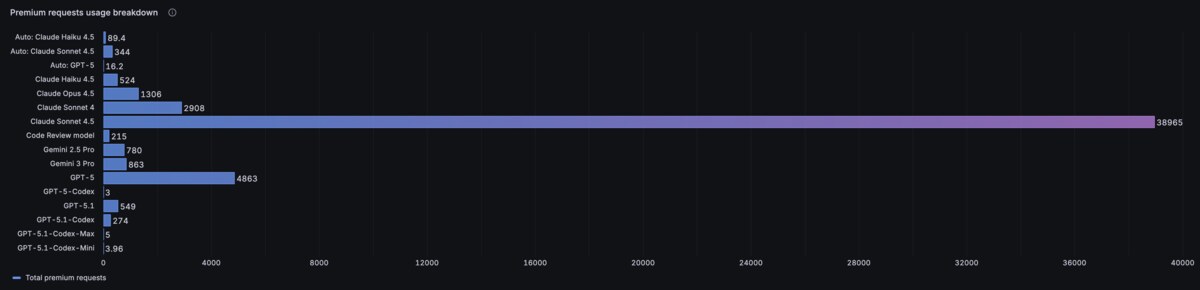
«The metrics for evaluation were premium request usage, lines accepted, network traffic to endpoints,» he explains.
The team understood why this happened.
«We handed out the tool, but didn’t explain: how to use it effectively, what tasks it solves best, how to integrate it into the workflow, why it’s even worth spending time learning it. It sounds banal, but in an enterprise environment this is a critical mistake. People are busy, they have deadlines, and if the new tool doesn’t provide quick value, they return to the usual workflow,» notes CTO Raif.
Then the experts found a temporary solution: the FinOps approach to engagement. «As a strong FinOps organization, we decided to apply the same approach to AI licenses as we do to cloud resources. The rule is simple: if Copilot has not been used even once in a month, we cancel the license. Not forever, not as a punishment, but simply counting the money. But most importantly, we changed the metric of success. It used to be ‘how many licenses were distributed’ (reach). Now it’s ‘how many people are actually using it every day’ (engagement),» explains Hryhoriy
Why is this important? According to public research, the overall adoption rate of AI in companies has reached 91% — but that’s just «access.» Real-world day-to-day usage is much lower. Raif decided to focus on quality, not pretty numbers in reports.
When considering how to move people through the sales funnel, the bank identified four groups of employees and developed a strategy for each:
Non-users (do not use at all)
Why: They don’t see the value, they’re skeptics, «It suits me»
What we do: Coffee conversations with real cases, invitations to demonstrations, showing specific time savings
License holders but inactive (have a license but barely use it)
What we do: personal adaptations, seminars for beginners, a friends system with active users
Casual users (infrequent users)
Why: used for simple tasks, not knowing about the possibilities
What we do: advanced workshops, demonstration of complex scenarios, sharing of prompt templates, context management, model knowledge management
Daily users (our goal is daily users)
Why: saw real value integrated into the workflow
What we do: we ask them to share their experiences, we make them ambassadors, we collect feedback for improvements
The data shows why this is critical: Those who use it daily save 4.1 hours per week, generate 60% more withdrawal requests, and now the goal for IT teams is to move people through this sales funnel.
Speaking about the effectiveness of this approach, it is worth noting that the bank has currently issued 220 licenses for 400 specialists who use IDE in their work.
83 people in cohort 2 (have a license, almost never use it)
137 people in cohorts 3 and 4 (those who use services for occasional and daily use)
180 in cohort 1 (not used at all)
Due to the change in workflow within IT teams, the approach to determining estimates has also changed.
«If we change the workflow, it makes sense to change the expectations from different levels of seniority,» explains Hryhoriy. Today, the requirements for junior, middle, and senior bank employees have transformed.
Rating
This was before artificial intelligence.
What happened to artificial intelligence?
Younger
writes simple code under guidance
with the help of AI, you can close real tasks within a week of adaptation. It is important not to «know the syntax by heart», but to understand what needs to be done and how to check the result.
Average
writes complex code independently
Knows how to review AI-generated code, bring it to production quality, and critically evaluate solutions. Becomes an «AI-savvy code reviewer.»
Senior
knows everything, solves the most complex problems
correctly sets the model’s tasks (question/context engineering), sees the architecture, understands the limitations of AI, and makes decisions where AI will help and where human evaluation is needed.
«Critical: all code generated by AI undergoes mandatory review by senior engineers. AI speeds up writing, but financial quality (the level at which the system behaves flawlessly in everything related to money) is provided by humans. It’s not „AI writes and goes into the product“ — it’s „AI writes, humans check logic/architecture/security/performance“. Such multi-level review allows us to get AI speed without sacrificing quality,» Tatsyi comments.
Anthropic data supports this: Senior engineers are less concerned about skill atrophy because they «know what the answer should be or what it should look like.» They use AI as a tool, not a crutch. Younger engineers are more likely to blindly trust AI’s results.
Lesson Three: Engagement is more important than reach. 60% active users is better than 100% licenses without real use. And achieving engagement requires more than just handing out tools—it requires a system of onboarding, support, and ongoing learning.
Moreover, Anthropic, in its study, describes the transformation as follows: engineers see themselves as «taking responsibility for the work of 1, 5 or 100 Claudes.»
In practice, this means the following:
less time writing code line by line;
more time for architectural decisions and code review;
focus on verifying what AI generates;
working with artificial intelligence as a junior developer — setting tasks, checking the result, training
The developer’s role, Tatsyi notes, is not disappearing — it is evolving — from detailed programming to strategic management of artificial intelligence agents that solve technical problems under your guidance.
Team Preparation: Why Training is Critical
To increase employee engagement in the use of AI, the bank launched a regular event called «Coffee Conversations with the CTO.» These are not work meetings, but evening sessions outside of working hours, where interested people gather, tools are demonstrated, and real-life cases are shared. «We invited the most active users to demonstrate how they use AI,» says Tatsyi.
The bank also launched internal training seminars:
How to choose a model
How to write tips
How to work with context
How to build pipelines
How to test models
How NOT to use MCP (this is a separate story about lessons learned)
«It works. I have researched public reports on the impact of structured training and support, and the numbers are impressive. A 25% increase in GenAI adoption yields: 16% reduction in knowledge gaps, 10,6% increase in change confidence, 7,4% improvement in engagement, 6,5% acceleration in implementation,» notes СTO Raif.
«Currently, the bank’s artificial intelligence team is developing an entire course — an internal track — that will teach any employee to work with artificial intelligence, regardless of their profession,» says Hryhoriy.
Lesson Four: Structured training and support are not just nice to have, they are critical to success. The difference between «license rollout» and «systematic implementation» is a 6–16% improvement in various metrics (from speed of service delivery to knowledge gap reduction). The biggest impact is on team confidence and closing knowledge gaps.
Technology stack: what works for AI and what doesn’t
The technical stack at Raif’s IT team was shaped through a series of experiments, says Tetsi. Eventually, the team identified a set of tools that worked, as well as those that «didn’t work.»
What works
What didn’t work
GitHub Copilot (220 licenses, 62% adoption) is a key tool for everyday development. Developers generate code for routine tasks 10x faster, especially for general-purpose code.
n8n — automation platform proved expensive due to high security requirements. Sounds good in theory, but the reality of enterprise security requirements made it unprofitable.
Claude Code is for more complex, reasoning-based tasks. It’s a tool that allowed a student intern to build the KYB service in a week. It allows developers to tackle tasks they have no experience with at all.
ElevenLabs is a good voice agent for a contact center, but it’s difficult to quickly customize it for banking tasks. Achieving true humanness in speech still takes time, and the Raiffeisen team couldn’t afford extensive customization.
Microsoft Copilo t — chatbots and RAG solutions for internal knowledge bases. It turned out to be an ideal basic solution thanks to direct integration with Teams and easy creation of RAG chats with our data sources. But there is an important caveat here: operational implementation of data is a big problem. Gaining access to «other people’s» data is easier than it seems, so testing, security and control are paramount.
Google Gemini 2.5 — call transcription with 93% accuracy. We tested different models: OpenAI Whisper showed ~65% accuracy (not enough), AWS Transcribe — ~84% (acceptable), and Gemini 2.5 gave a qualitative leap to 93%. With additional processing, experts easily reached 99% and at the same time halved the cost of the solution. Then they added batch queries — which reduced the cost even more (but with the need to make allowances for «hallucinations»).
Hryhoriy is proud that artificial intelligence has not remained a toy for just one team. Different departments have started to find their own use cases and implement solutions.
The CloudOps team created a Claude CLI agent workflow to validate Terraform modules. Instead of validating each module individually, AI aggregates issues and provides a «helicopter view» of an organization’s practices—repeated anti-patterns, missing standards, opportunities for unification. The result: high-level quality assurance of Terraform code without the expense of a senior engineer.
They also automated testing of RDS backup restoration for PostgreSQL, MySQL, Oracle, MS SQL Server. Lambda function + engine specific layers + Terraform module. This shortened development cycles.
The infrastructure team migrated the NiFi registry to infrastructure as code from Terragrunt. Using AI for pattern analysis and optimization, they changed the instance type from c6a.large to t3a.medium — saving 50% without any performance impact. Accelerated deployment by 35%.
Another work they did was a Terraform module for automating the OCI database. AI helped with code generation, IAM policies, and configuration optimization. The result: a 30% cost reduction, infrastructure deployment from weeks to days.
The ESB (Enterprise Service Bus) team used AI to migrate from Oracle to PostgreSQL (I told you about this at the beginning — €18k savings). But they went further: they optimized the ActiveMQ infrastructure using AI. Deployment time went from 1 day to 16 minutes (30x faster improvement). Terraform optimization + Ansible playbook + AWS cost optimization.
The Data Lake team has built its own MCP server with RAG to integrate with Alation, AWS Glue, and Athena. This is the middleware between the LLM agents (Claude, GitHub Copilot) and the metadata repository. The AI can now generate SQL queries for Data Lake, Apache Spark code, navigate schemas using natural language prompts, and perform SQL translation from source DWH databases (Sybase IQ, Oracle ADW) to Athena-compatible SQL.
The web development team used Claude Code for video customer identification — a complex micro-frontend in UFO (our back-office system) with no documentation, no local debugging. Claude Code helped develop mockups for the local environment and unlock the user interface for all 4 steps of the process. It also reduced the time to support unit tests.
That’s only part of the story, СTO says. Almost every team has found their own use cases and started experimenting, he says.
Open source contribution
At Raif, we not only use AI tools, but also share our experience with the developer community. «We have open-sourced our APM workflow for unit tests — a set of practices and automation that help us maintain code quality while actively using AI generation,» Tatsyi says proudly.
He explains the importance of this step: When AI generates code quickly, testing becomes a critical bottleneck. The workflow developed by the Raiffeisen team allows for automatic generation of unit tests with proper coverage and validation. «We saw the value of this approach internally and decided that other corporate teams facing the same challenges could benefit from it,» says Hryhoriy
According to him, part of the philosophy is that a bank should not be a black box.
«We can and should contribute to the ecosystem, especially when it comes to best practices for implementing artificial intelligence in a tightly regulated environment,» CTO is convinced.
Hryhoriy notes that he follows the main industry recommendations: avoid locking into a single vendor and support a multi-vendor approach. He explains: the AI market is changing too quickly to rely on a single vendor. Research data shows that AI-based tools like Cursor demonstrate higher PR throughput compared to traditional solutions, but after a few months the picture may change.
Problems that need to be discussed honestly
Not everything was perfect for the Raiffeisen team working with AI tools. The CTO describes a number of challenges the developers faced while finding the right solutions.
Code quality
According to public research, the impact of changes on the failure rate shows «mixed results» — about as many organizations improve quality as they worsen it. Most changes occur within ±1-2%. «We see the same thing: quality depends on how carefully the developer checks the results of the AI,» says Hryhoriy.
Atrophy of skills
Hryhoriy notes that using AI consciously while maintaining the ability to critically evaluate the outcome is becoming increasingly difficult, as the results often look very cool at first glance. Anthropic engineers express the same concern: «When getting a result is so easy and fast, it becomes harder and harder to actually spend time learning something.»
Shadow AI
Raif found that developers are using AI tools that they buy out of their own pocket. According to the data I’ve seen, 44% of organizations are struggling with this.
«I want to specifically mention our security team here — they have become true partners in this transformation. Instead of simply blocking Shadow AI (which would have been the easiest solution), they have invested heavily in a DLP (data loss prevention) system to protect themselves from risks, but at the same time not to stifle innovation. We have developed acceptable use policies that clearly define which types of data can be used with which AI tools, and DLP automatically monitors compliance with these rules,» says Hryhoriy.
The cultural paradox of interviews
The bank discovered an interesting problem: candidates often hide during interviews that they actively use artificial intelligence tools. They are afraid that it will look like they «don’t know how to program themselves.»
«We have the opposite approach: using artificial intelligence is an advantage, not a disadvantage. When a candidate says during an interview: „I write using GitHub Copilot and Claude Code,“ for us this is a signal: the person knows the modern workflow, is not afraid of new technologies, and understands how to be more productive,» says Tatsyi.
But the industry hasn’t had time to reorganize yet, he adds. Many companies still evaluate «can a human write an algorithm on a whiteboard without AI» instead of «can a human effectively solve a business problem with AI.» This creates a cultural gap between how Raif developers actually work and how banking IT professionals are valued in the marketplace.
«My advice to candidates: don’t hide your AI skills. Look for companies that value them. And to companies: review your interviews. Don’t ask 'do you know the syntax by heart', but 'how do you use AI to solve complex problems',» says Hryhoriy.
Immediate injection
This is a big problem, especially in MS Copilot. Gaining access to «other people’s» data is easier than it seems.
Bottlenecks beyond AI
Here’s what’s interesting: When Hryhoriy looks at developers’ time allocation, the savings from AI outweigh the time lost on days with lots of meetings and interruptions. According to the data from our systems that I analyzed, the biggest bottlenecks are:
Days full of meetings
Interruption frequency (frequent interruptions in work)
Disputes between architects
Build and test wait time
Development environment setup issues (development environment setup issues)
Incidents (incidents and firefighting)
Context consultation (the need to constantly communicate your context to colleagues)
AI, according to Tatsyi, saves developers 3-4 hours a week, but meetings and interruptions eat up much more. This means that productivity at scale requires a comprehensive approach — not just AI, but also optimizing the entire workflow.
What’s next: taking AI beyond code
The Raif family is just at the beginning of their journey, and they have many plans for the future.
In the spring of 2026, Raif will launch a full-fledged internal course on artificial intelligence, «From Zero to Hero.» According to Hryhoriy, this is not just a guide to «using GitHub Copilot,» but a comprehensive program that will allow you to learn:
How to choose between different AI models for different tasks
Rapid engineering from basic to expert level
Working with context and structured results
AI Ethics and Acceptable Use Policy
Practical seminars with real banking cases
Important: The course is not just for developers, as AI is changing work far beyond code. Hryhoriy reminds us that according to public research, 60% of designers and product managers in technology companies already use AI on a daily basis. Engineering managers who actively use AI create twice as many pull requests — they write code for prototypes and simple functions themselves.
He sees this trend in Raif too. Analysts are writing SQL and Python instead of waiting for developers. Product managers are prototyping interfaces. Designers are generating component code using Figma. DevOps is automating infrastructure tasks in hours, not days.
«Expanding the definition of a developer doesn’t mean everyone becomes a developer. It means the technical barrier is lowered and people can focus on solving problems, not on syntax,» concludes Tatsyi.
8 tips for CTOs planning to implement artificial intelligence in business
Summing up his 18-month experience working at the bank, СTO Raif advises colleagues from other companies to adhere to certain canons.
Test before you scale. Not all AI tools are created equal. Run pilots, measure results, listen to developers. We spent 6 months experimenting before we scaled, choosing the tools and vendors we would work with going forward — and it paid off.
Focus on engagement, not reach. 200 licenses with 30% adoption is worse than 100 licenses with 60% active usage. Structured training and support improve key metrics:
Reducing knowledge gaps
Growing confidence in change
Improving engagement
Delivery acceleration
Create a culture through cases. Businesses love concrete evidence. Collect it systematically, measure ROI, and share successes.
Be honest about the challenges. Skill atrophy, code quality, shadow AI are real problems. Acknowledge them and work on them.
Think holistically. AI is not a magic bullet. Non-AI bottlenecks (meetings, code reviews, continuous integration wait times) often consume more time. Productivity at scale requires optimizing the entire workflow.
Avoid locking yourself into one vendor. The market is changing too quickly. Take a multi-vendor approach and be willing to experiment.
Share your experience with the community. The Raiffeisen team made their APM workflow open to unit testing because they saw that many teams were facing the same challenges. Enterprises can and should contribute to the ecosystem, especially when it comes to AI in a highly regulated environment.
Don’t limit yourself to one team. The greatest value comes when AI is used not just by developers, but also by CloudOps, infrastructure, data, and web teams. Each team finds its own unique use cases, from Terraform code review to custom MCP servers for Data Lake.
The bank has moved to the cloud: what’s next? Cloud solutions architect Raifu on the challenges and solutions that will simplify cloud infrastructure management after migration
Artificial Intelligence against Fraudsters: Raifu cyber experts have created an AI-based tool that detects fraudulent actions with money before they are committed. How the Raifu anti-fraud system works
«Чи є у мене талант, якщо комп’ютер може імітувати мене?». Штучний інтелект пише книги авторам Amazon Kindle. The Verge поспілкувався з авторами та виявив багато цікавого
Письменники-романісти використовують штучний інтелект для створення своїх творів. Видання про технології The Verge поспілкувалося з письменницею Дженніфер Лепп, яка випускає нову книгу кожні дев’ять тижнів, й дізналося про те, як працює штучний інтелект для написання романів. Наводимо адаптований переклад статті.
Have important news to share? Message our Telegram bot
Key events and useful links in our Telegram channel