The first autonomous AI cyberattack: why it happened earlier than expected, how agents break Claude, and whether AI can be trusted with bank accounts
Google's report on the first fully autonomous cyberattack and the high-profile €100 million robbery in France, where the attackers involved an AI agent, finally turned AI threats from the horror stories of futurologists into a headache for engineers.
How autonomous agents look for holes in popular software, why they are still "burning" in logs, but will soon learn to act quietly, and whether it is safe to give personal Claude access to your own finances, Dima Ashkinazi, head of the Ukrainian darknet monitoring and threat intelligence platform Alerts Bar, told dev.ua.
"Honestly, I thought it would come a little later. Friends are already joking about when we should expect an uprising of AI agents - next year or the year after. But seriously, autonomous attacks did not appear yesterday. Over the past few months, it has been happening quite organically," Dima Ashkinazi, head of Alerts Bar, told dev.ua.
The main reason for this jump is the ability of AI agents to instantly "digest" the source code of popular open-source projects and find bugs there that the developers themselves are not yet aware of (zero-day). The last few weeks have turned into a continuous update marathon for engineers:
later, a critical hole was found in the popular Next.js framework;
and on the eve of our conversation, the Ashkinazi team was up and running until 2 a.m., patching servers due to a new vulnerability in Nginx .
Ashkinazi shared that at the recent SOC Day conference, during a panel discussion on integrating darknet monitoring into large SIEM systems, a representative of the government response team CERT-UA confirmed that the number of incidents involving AI agents is growing exponentially.
The weapon turned out to be double-edged. On the one hand, the pentesting industry is booming — now specialists can automatically check the infrastructure simultaneously for tens of thousands of known vulnerabilities (CVE). On the other — hackers are doing the same. Artificial intelligence in pipeline mode “taps” sites, reads digital fingerprints and looks for unpatched services like the old phpMyAdmin. According to Alerts Bar, the number of such automated queries in web server logs is now growing exponentially.
They "burn" at the start, but manage to steal: how AI attacks work
The paradox of the first wave of AI attacks is that they are very loud and noticeable. While a regular hacker tries to cover his tracks, today's agents often act "head-on" - simply combing through a huge list of known CVEs. But thanks to their blazing speed, they often manage to extract data before the administrator reacts.
For companies with properly configured monitoring, such straightforwardness is more like a gift.
"The web server logs show every request. If the company has normal analytical tools, then literally after the first ten "taps" you can block the IP address and prevent the agent from executing the remaining 9,990 requests," explains the head of Alerts Bar.
However, it is too early to relax. According to Ashkinazi, the next step for attackers is to move from brute force to heuristic algorithms and point-based scenarios, when agents will learn to act cautiously and not attract unnecessary attention.
On the defense side, they are not standing still either — the classic arms race in cybersecurity continues. As a successful example of counterplay, the expert cites the Ukrainian startup Labyrinth, which creates honeypot-class systems. These are decoy servers with deliberately left vulnerabilities. They simulate part of the corporate network, but do not contain real data. When the AI agent starts scanning the company, it comes across the honeypot first — and instantly “surrenders” itself and its attack vector to the security team.
Massive CVEs or compromised DevOps accounts
The head of Alerts Bar also recalls that during the panel at SOC Day, there was a revealing debate among cyber experts about where to expect the main attack. A colleague from CERT-UA called Threat Intelligence tools more like “an exotic cherry on the cake,” emphasizing that the headache today is precisely the massive attacks of AI agents through known CVEs.
Dima Ashkinazi agrees that the flow of primitive automated attacks is breaking records, but warns against underestimating classic espionage on the darknet. As an example, he cites the recent high-profile incident with the crypto exchange Binance : the attack on the giant was made possible not by a cunning algorithm, but by the compromised credentials of a DevOps specialist, thanks to which hackers entered the infrastructure. So without monitoring leaks, protection remains blind in one eye.
Credit card in Claude's hands: should agents be given access to finances?
After the story in France, where €100 million in cryptocurrency was instantly withdrawn from the accounts of a contractor and an AI agent due to a hack, some banks have started rewriting their contracts with customers. The logic is simple: if you yourself connected your AI assistant to financial services and lost money, it is solely your responsibility.
Despite such warnings, the head of Alerts Bar advises not to give up on integrating AI agents into work and life, including for financial accounting. Without these tools, he says, a person will very quickly lose out to those who have already automated routines.
"It's an eternal theme in IT - the more convenient, the more dangerous."
The main danger lies not where you usually look for it. Don't be afraid that the model developer himself will secretly steal money from your card: this industry will be under strict regulation, and such a scandal will instantly destroy the reputation of any tech giant. The problem is that your AI agent becomes the perfect "single key" to your whole life.
“Within our darknet monitoring, we already regularly find compromised accounts, including Claude, including session cookies. With their help, hackers can bypass two-factor authentication, log into the user’s account, and gain simultaneous access to everything connected to this agent,” warns Dima Ashkinazi.
These cookies are stolen in the old, proven way - through info-stealers and Trojans that people download onto their computers themselves through carelessness or social engineering.
How to avoid becoming prey in the age of AI hackers
To take advantage of AI agents and avoid losing data or money, the head of Alerts Bar advises sticking to a few pragmatic rules.
For business:
Have an experienced CISO, not a certificate collector. The company needs a CISO who is passionate about his job and really builds protection, not just a bunch of papers and ISO certificates "for the sake of it."
Train your team. Regular cyber hygiene (Security Awareness) courses remain the best vaccination against social engineering.
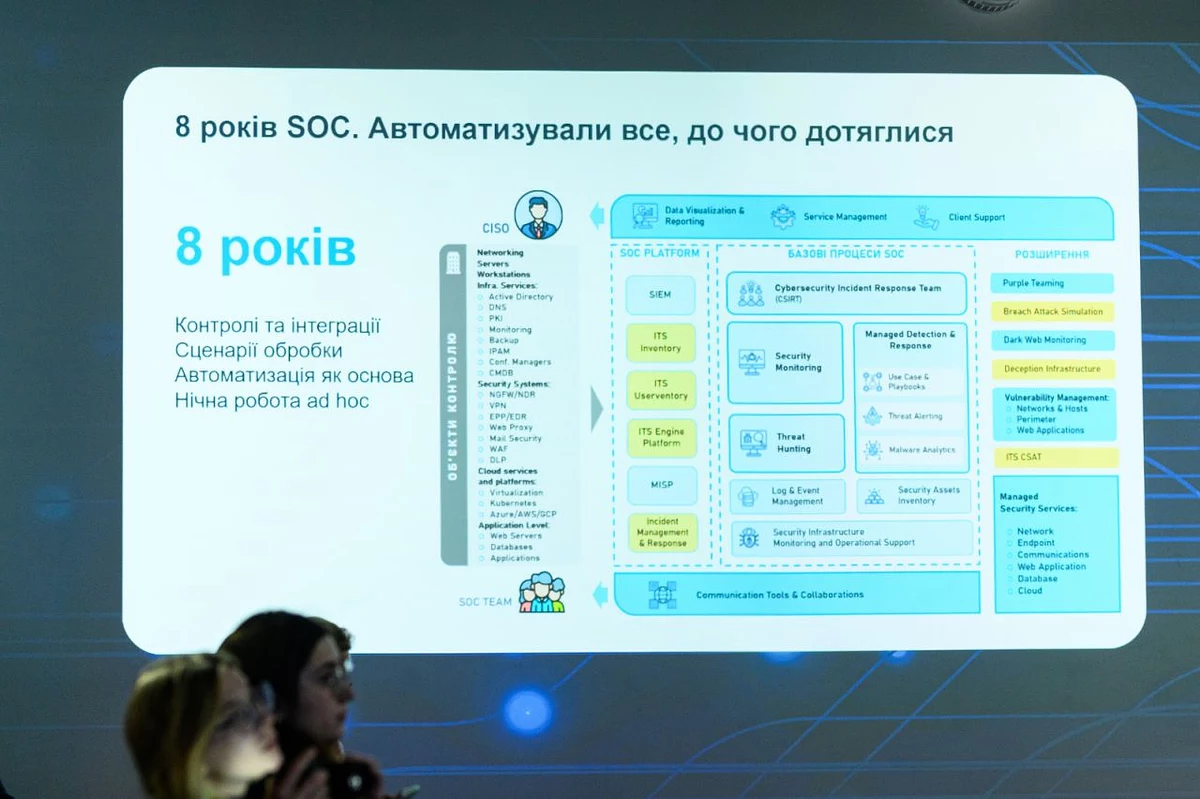
Take a closer look at Ukrainian vendors. The domestic cybersecurity market has grown to the point where it is able to cover the lion's share of the needs of large businesses. At the same SOC Day, CISO of Galnaftogaz (OKKO gas station network) Oleg Matata showed a stack of about 30 security services that the company uses — and almost half of them are provided by Ukrainian developers.
Slide from Oleg Matata's presentation
For regular users:
Don't delay updates. Even if the next iOS update has moved familiar buttons and is annoying with a changed interface, critical updates should be installed immediately — large tech companies close discovered vulnerabilities as quickly as possible.
Don’t fall for fake “I’m not a robot” verifications (ClickFix). This is one of the most insidious trends for infostyler infection: the site displays a captcha window and asks you to press Win + R, open a command prompt, and paste the supposed verification code there. In fact, it’s a PowerShell script that instantly downloads a virus and steals passwords and cookies from the browser.
“We discovered a data leak from an Oracle top manager.” CEO Alerts Bar — about how hackers bypass 2FA and antiviruses and why 80% of attacks start with info stealers