Хочете будувати кар’єру в Data Science та AI? Vodafone Big Data Lab відкриває новий набір —>
Ігор Вишневський That's Life
21 September 2026, 09:00
2026-09-21
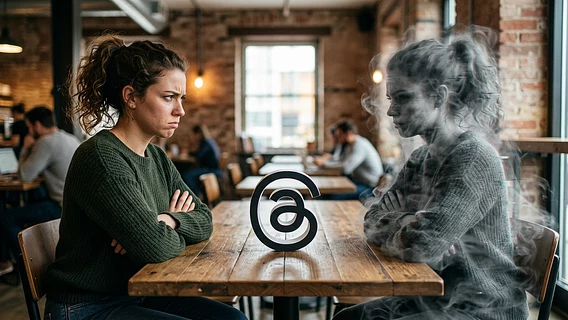
Hype and hate on Threads. Where does the influx of fake pages of Ukrainian companies come from on this social network and can evil "doppelgangers" ruin the reputation of top brands?
The social network Threads quickly acquired a special vibe and became popular, including among IT professionals, as a platform where you can relatively easily get the attention of the audience, especially if you don’t skimp on words and are able to generate bright, and sometimes provocative, content. The press services of famous Ukrainian brands have long begun to compete on Threads with their own wit, making memes and poking fun at their competitors. But over time, the social network has also become filled with their brutal and ill-mannered “doppelgangers.”
The social network Threads quickly acquired a special vibe and became popular, including among IT professionals, as a platform where you can relatively easily get the attention of the audience, especially if you don’t skimp on words and are able to generate bright, and sometimes provocative, content. The press services of famous Ukrainian brands have long begun to compete on Threads with their own wit, making memes and poking fun at their competitors. But over time, the social network has also become filled with their brutal and ill-mannered “doppelgangers.”
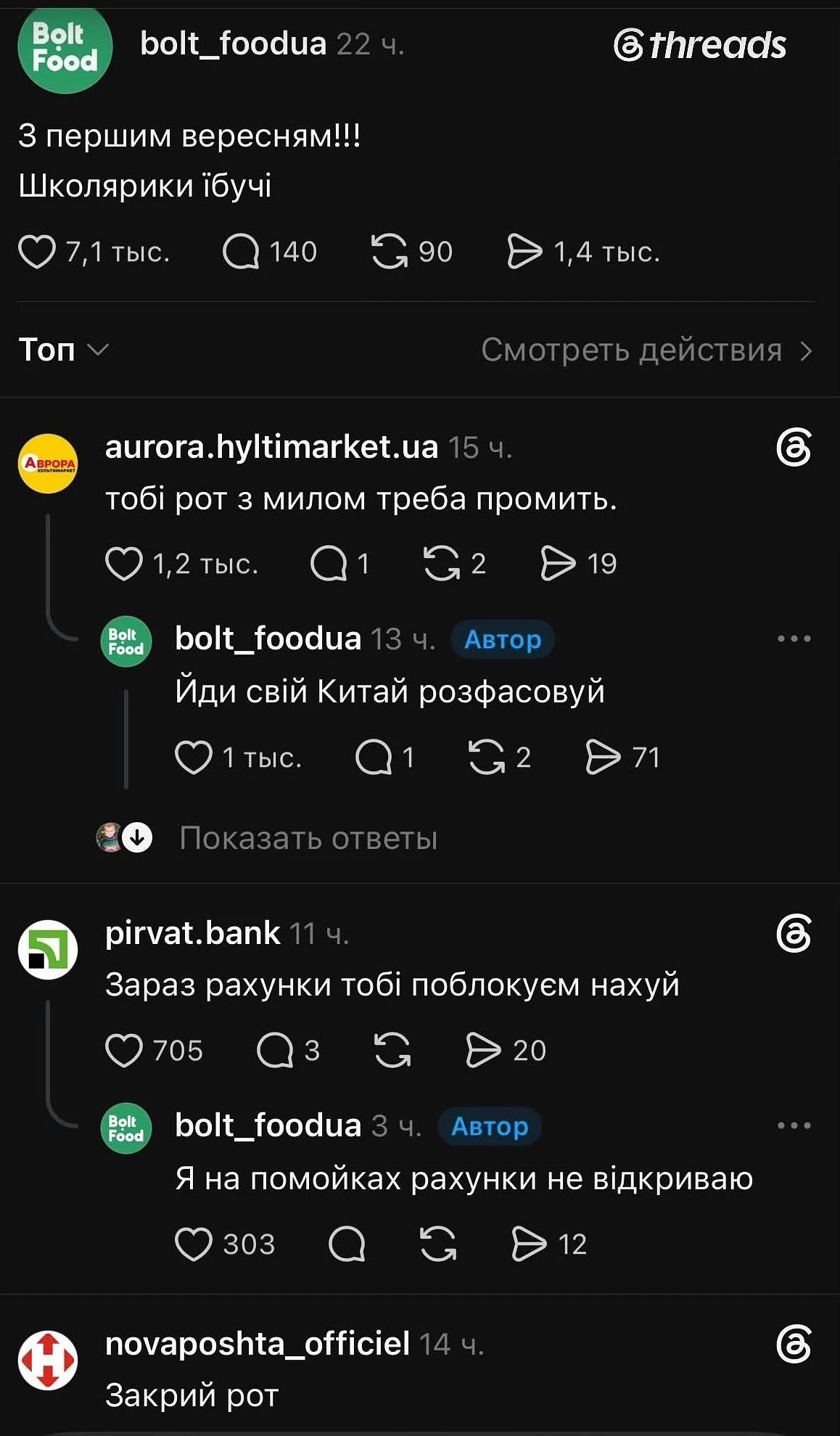
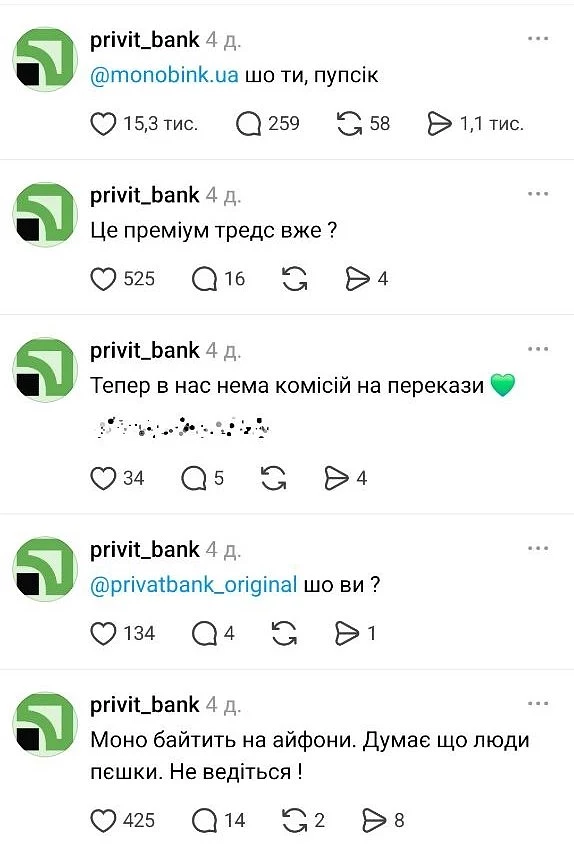
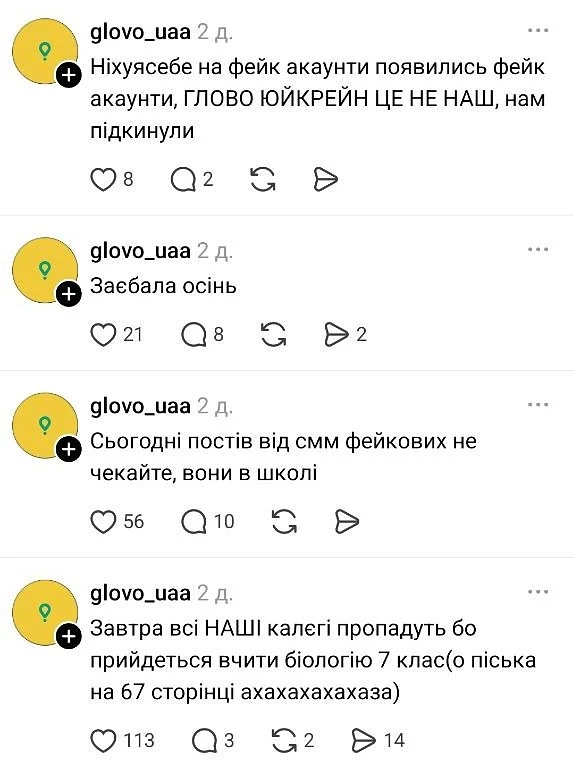
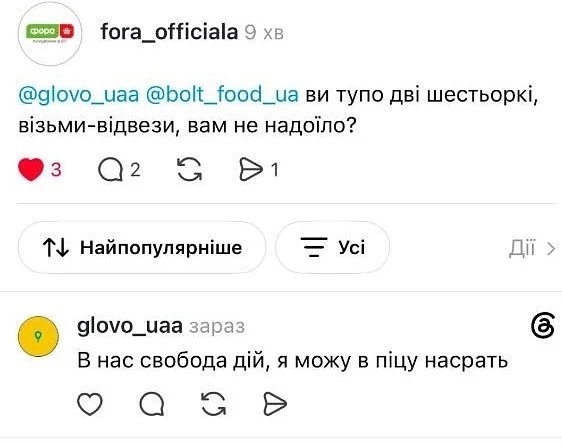
For several months now, fake accounts of Nova Poshta, Privatbank, Monobank, Kyivstar, Comfy, Rozetka, Bolt, Glovo, Aurora, Auchan, Fory, Silpo, ATB, Novus, Varus, Megamarket, DTEK, Ukrzaliznytsia, and many other large businesses and enterprises have been fighting among themselves in Threads, covering each other with obscenities and promising to “destroy the cabin.” Some of them are blocked by the Meta corporation at the request of the brands themselves and due to their complaints, some continue to live, and some others are resurrected after being blocked, changing a few letters or a single symbol in the account name.
The phenomenon of someone taking someone else’s identity is called brandjacking, and the goal of this article is to understand how much damage such a fever of fake accounts on Threads is causing to the reputations of brands themselves and who could be behind it. We received comments from the press services of Nova Poshta, Bolt, Glovo, and Varus on this issue, and also spoke with marketers, PR people, and SMM experts. Their opinions and versions are in this article.
Ragebait is doing its job — outreach in favor of “fake”
Digital entrepreneur Yaroslav Makarevich, who is, among other things, a PR consultant for one of the major retail brands, recently conducted an analysis of this phenomenon in the Ukrainian segment of Threads. Using AI to analyze the activity and statistics of fake accounts of major brands, he came to the conclusion that fakes often surpass the original in terms of reach by dozens of times.
Makarevich estimated that one of the posts by the fake ATB lookalike had 1.32 million views, over 50,000 likes, and 695 comments. At the same time, he said, ATB’s official Threads page has 41,185 followers, and none of its recent posts have come close to these figures.
“A fake account with 1,402 followers outsold the original by about thirty times. The fake’s budget was zero hryvnias,” he wrote in a column on Economic Truth.
One explanation for such figures may be that fake accounts, unlike official ones, are not limited by any rules of good manners at all. If official accounts can afford jokes on the verge of foul language, then “fake” accounts go far beyond this limit. And since Threads can be considered a very favorable environment for the spread of “ragebait” (deliberately created provocative content that is intended to cause users to be very angry, indignant or irritated — Ed.), such a result should not be surprising.
Do brands themselves consider this a reputational problem?
According to Marina Orishko, social media manager at Nova Poshta, the very existence of such accounts carries a potential reputational risk. “People don’t always look at the nickname before taking a screenshot or sharing a post. They see our avatar, novaposhta in the title, and that’s enough for them to start perceiving the phrase as the company’s official communication,” she notes in a comment to dev.ua.
Orishko adds that Nova Poshta’s SMM is more concerned not with the fact that someone is joking on behalf of the company, but with situations where this joke is perceived as their real response. “There have been such cases: other users even later explained in the comments that it was a parody account,” she says.
The Varus network’s press service does not see this trend as a significant reputational threat, considering it temporary. They suggest that such a trend will likely lose relevance as quickly as it appeared, since such communication is technically difficult to conduct in the long term.
"Similar formats have already been observed, in particular on the X network (Twitter), and faded over time. Despite the temporary nature of the trend, each case is considered individually, and pages are subject to mandatory blocking. The main risk remains the potential misleading of consumers on behalf of the company," the Varus press service said.
Glovo notes that communication from fake accounts “creates a false impression about our values and service standards.” Thus, for some users who are not yet aware of the existence of the fake, this may appear to be the company’s official position.
“Legally and factually, we, as a company, are not responsible for the actions of third parties who create third-party pages or fakes. We understand that our customers and the majority of the audience can distinguish official brand communication from provocations. However, any unauthorized actions on behalf of our brand are a potential reputational risk,” the Glovo press service stated in response to our request.
A similar position is voiced by the Bolt press service: such a style may pose a reputational risk if the audience mistakenly perceives third-party statements as the company’s position.
“A violent, provocative, or obscene tone is not consistent with Bolt’s communication and is not acceptable for the brand. However, we have not recorded any significant reputational damage in this case,” the company said.
“Society places responsibility for any scandal, even one caused by a “doppelganger,” squarely on the original”: what experts say
Roman Gerashchenko, CEO of SMM agency Sasquatch Digital, believes the "rampant" of fake brand accounts in Threads is a direct threat to brand safety.
“Tone of Voice for a recognizable brand is not a stylistic play, but part of the trust in it, accumulated over the years. The average user on Threads rarely checks the verification checkmark or the account name character by character — and when a parody page resorts to provocations, part of the audience sincerely perceives this as the official position of the company,” he claims.
The greatest danger, in his opinion, is when parody crosses the line of ethics.
“A brand has only one reputation account, and society places responsibility for any scandal, even one caused by a doppelganger, squarely on the original,” says Gerashchenko.
Marketer Dasha Andreeva states that Threads, as a relatively new social network for Ukraine, encourages a bold style, and users often try to imitate the "general tone of voice" — when everyone is bold, ironic, sharp, and humorous.
“Brands are also trying to keep up. Even large, established companies with strict communication rules allow themselves much more on Threads than on Instagram. But this is not a serious problem as long as others understand that this is NOT official brand communication. For now, it is a generally understood joke,” she claims.
When confusion occurs, the brand, according to Andreeva, has a real problem.
Dasha Andreeva, marketing specialist
“Someone might fall for a fake, then see that it’s fake, smile or argue — and move on. And someone won’t figure it out and will be left with the idea that the brand is behaving inappropriately. Somewhere in the subconscious, the label “inappropriate” appears next to this brand. And that’s it — over time, figuring out where/why/how it came from is very difficult. “For some reason” they don’t like this brand, even after years.”
According to her observation, the issue of intellectual property gets lost in the humor.
In addition, she draws attention to the issue of digital security. “If a fake bank or mobile operator account says ‘follow the link to get a bonus’, it’s already a ready-made phishing scam from a brand that people trust. I haven’t seen anything like that yet, but if the account is promoted and over time it adds such activity, the consequences could be dire,” she warns.
Yevhen Shevchenko, CEO of UAMASTER digital agency, agrees with other experts: in his opinion, the presence of fake brand accounts in Threads is definitely a reputational risk that can turn into a problem. In particular, because some users do not distinguish fake accounts from real ones. “As history shows, negative or scandalous messages often have a large reach, while apologies or the publication of the official position of the brand are an order of magnitude smaller,” states Shevchenko.
Seek and destroy
What do companies themselves do when they find such an unpleasant “doppelganger” on Threads? Do their SMM teams receive special instructions on how to behave in communication with their fake “alter ego” and how to inform the audience about it?
Glovo says that thanks to monitoring tools that track brand mentions on social media, they detect the appearance of fakes very quickly, after which they send complaints to Meta about fake accounts.
The main recommendations for the company’s SMM managers are as follows:
do not communicate publicly with the fake, do not enter into correspondence or comment on posts on the fake page, so as not to attract additional attention and increase reach;
send complaints to Meta through special forms to combat impersonation;
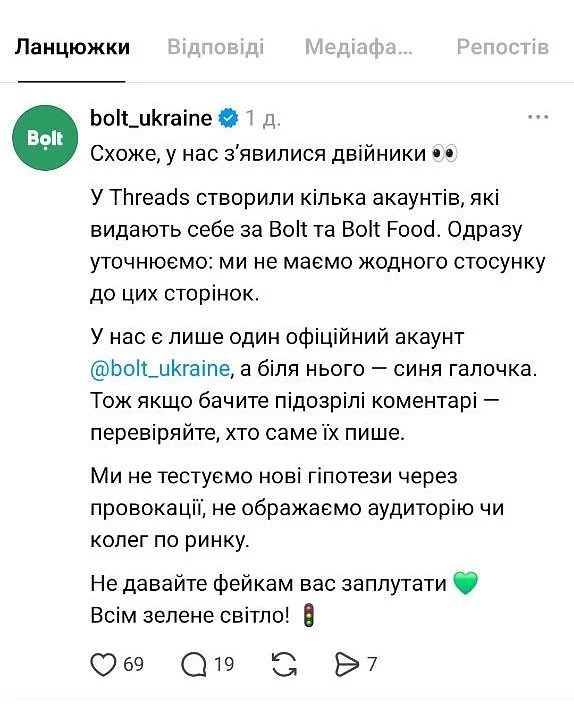
If necessary, inform the audience about the fake, urging users not to click on dubious links, check the blue profile verification checkmark, and send complaints about the fake.
Bolt also learns about accounts almost immediately after they appear. In addition to monitoring the company itself, such cases are also noticed by the support team and users who tag official pages.
When a fake account appears, the main principle of communication followed by Bolt is to clearly separate the company’s official position from third-party content and adhere to a recognizable tone of voice. "It is consistent communication that helps the audience recognize unofficial pages," they say.
SMM manager of Nova Poshta Marina Orishko recalls that the fake NP account was one of the first to appear on Threads in connection with this case. “We noticed it literally the first or second day after it appeared. Screenshots with sharp responses quickly spread across the network, in publics and chats with colleagues,” she says.
According to Orishko, no matter how "ridiculous" the "doppelganger" content may be, a situation where someone uses the name and identity of another company and misleads people is not okay.
Maryna Orishko, Social Media Manager at Nova Poshta
“We immediately started the blocking process: we filed a complaint about the account, including from the official Nova Poshta page, and contacted Meta. At the same time, it is difficult to predict how long the blocking will take, and the final decision and timing depend on the platform’s moderation.”
She added that they do not have a separate “ten-page” instruction, but the team has a clear logic of action: not to reinforce the account and to intervene when there is a risk to users or the brand’s reputation. “If we see that people are really confusing pages, we can explain directly in the comments that this is not an official account. If this is an obvious joke that does not harm anyone, then it does not always make sense to reinforce it with your own reaction,” the representative of Nova Poshta stated.
As with the other companies mentioned, Varus usually learns about the appearance of such pages in the first days of their creation, in particular thanks to customers. “Customers begin to actively tag the official account, clarify information, and warn about the appearance of clones,” the supermarket chain says.
They add that they are unable to directly block fake pages through Meta administrative support, but they use the only correct and most effective way in this situation — they file complaints against each such page as one that impersonates an official account.
“In our appeals to the platform, we emphasize that such pages potentially mislead customers, as well as create direct risks to the brand’s reputation and the security of users’ personal data,” the Varus press service explained.
First of all, the network’s SMM team promptly files complaints about detected fake pages, and to protect the audience, they publish warnings in posts or stories on all official channels. Such messages remind of a list of real brand pages so that users can easily check the source of information and avoid fraud.
"An additional protection tool is the connection of platforms: Instagram and Threads accounts are closely linked, and from the official Insta page there can be only one verified profile in Threads. Accordingly, fake pages will not have such a system link, which is an additional marker of danger for attentive users," they remind.
Is there a spoonful of honey in a barrel of tar?
We also asked business representatives and experts whether they see any positives for brands in this whole story? After all, it helps to increase the reach of official pages if you “twist” it to your advantage. Moreover, according to one conspiracy theory, the fake accounts could theoretically be the work of official press services themselves, which could supposedly attract attention to the brand in such an extraordinary and risky, but effective and hype-filled way. But business representatives deny this — if there is any positive from increasing reach, it is clearly not comparable to the possible risks to reputation, so no one would play such “games”.
Marina Orishko from Nova Poshta admits that the “doppelgangers” definitely create additional noise around the brand. “People tag the official page, come to check if we really wrote it, discuss individual posts. Recently, we have seen much more mentions of Nova Poshta precisely in the context of these fakes — in social networks, Telegram channels, and media materials,” says the SMM manager of the postal operator.
At the same time, in her opinion, it is difficult to call this a tool for increasing reach, because it is uncontrolled attention. “Today it is funny and organic, and tomorrow the post will have very real consequences for the brand. Therefore, reach here is more of a side effect, rather than a plus for which it is worth leaving these fakes,” the specialist concludes.
Glovo doesn’t see any positives for itself at all. "We don’t consider the emergence of such accounts as a source of increasing brand awareness, because they only carry reputational risks and mislead people, creating false perceptions," the Glovo press service noted. They add: one way or another, all the information noise remains inside the fake account, without bringing any benefit to the official Glovo channels.
Bolt’s press service sees this situation as additional attention and coverage for the brand, but there are nuances. "This effect does not eliminate the risks associated with possible confusion about who owns the account and whether its content reflects the company’s position," they stated.
The Varus press service also acknowledges the possible presence of a certain positive impact from this story, based on the principle of “any PR is PR.” “However, this effect is very individual and directly depends on the overall image of the company,” they added.
Varus says: if the brand’s reputation is strong and positive, then this is unlikely to hurt and may even provide additional engagement, but at the same time, if there are unresolved reputational problems, such pages can only exacerbate existing weaknesses.
“In any case, we do not recommend intentionally initiating the appearance of such accounts for the sake of a temporary information drive or “hype” and we do not use such audience engagement technologies ourselves,” they note.
“You can only parody what the audience knows well”
Digital entrepreneur and communications expert Yaroslav Makarevich believes that there can only be one positive for brands here — brands will better understand the audience’s request for relaxation and humor and will take this case into account when further planning their own campaigns.
“Companies will also pay more attention to media literacy and cyber hygiene to prevent fakes or hacks. For example, Aurora realized that they urgently needed to submit a request for a “blue check mark,” he gave an example. .
CEO of UAMASTER digital agency Yevhen Shevchenko is convinced that a small positive effect for official accounts may be observed, but it is incomparably smaller than the risks and potential problems — both in probability and impact.
“If I were the PR departments of brands, I would closely monitor the situation and consider filing complaints against fake accounts if completely inappropriate posts appear there,” he advises.
Roman Gerashchenko from Sasquatch Digital, commenting on this issue, says that at first glance, one can see some positives, because this is a kind of status indicator: only top brands are parodied, and if the official page successfully picks up the humor and "wins" in a public dialogue with the doppelganger, it receives organic viral reach.
Roman Gerashchenko, CEO of Sasquatch Digital
“Here it is worth separating the tactical gain from the strategic question: is this game necessary for business at all? Flirting with an official account with a fake is more of a signal of a weak position than of a strong SMM”
According to Roman Gerashchenko, in EU jurisdictions, the situation with unauthorized use of a brand name and visual identity would be resolved much more strictly — through a trademark infringement complaint, and profiles would be removed within a few hours upon a DMCA complaint. “This is not only a matter of law, but also of a basic culture of respect for other people’s intellectual property,” adds the CEO of Sasquatch Digital.
The comment of marketing expert Dasha Andreeva echoes Roman Gerashchenko’s position: she says that for brands, in essence, this is a visual test of how much the investment in marketing and branding has paid off. “You can only parody what the audience knows well,” she concludes.
Large “fan page” reach can have an indirect impact on the official pages of brands, but, in her opinion, the potential benefits are not worth the risks. “This can have an indirect impact, for example, users can search for the official page to check information. Successful responses from the official account of the brand can also have a positive impact: sometimes with humor, sometimes with the necessary information. There is a well-known opinion that “black PR is also PR”, but I am not a fan of this approach. Because on the one hand, yes, you can flash in front of a potential client for free, and on the other hand, you can leave a negative memory about yourself,” the marketer states.
Why this is definitely not a prank by the top companies themselves
None of the marketers and PR specialists whose comments we received admit that the companies' press services themselves could be behind this hype with fake accounts on Threads.
Digital entrepreneur Yaroslav Makarevich, who conducted analytical research on this issue, found that the main activity of fake accounts on Threads falls on weekends, so this already casts doubt on the version about the involvement of press services. But this is certainly not his only argument.
Yaroslav Makarevych, digital entrepreneur
“More importantly, no brand plans a campaign in which its own official account publicly defeats a fake, and that’s exactly what happened. Also, if this is the plan, it is necessary for more than a dozen competing teams to agree among themselves synchronously and without any leaks. In addition, the lookalikes joked about getting into the lineups in the feed, the humor was often beyond the permissible limit”
According to marketing expert Dasha Andreeva, even big brands would hardly take such a risk, because the hype is not worth the reputational crisis that could result.
“Especially within companies, there are usually quite strict rules regarding content and activity on social networks, so I don’t really believe that this is possible. And what some brands are doing now is going into the comments on these fan pages and either joking or bringing the conversation back to real facts. I think companies are now more interested in protecting themselves from possible risks than taking advantage of the benefits of this phenomenon,” she says.
CEO of UAMASTER digital agency Yevhen Shevchenko does not have a clear answer to this question, but still states at the level of guesswork — these are not representatives of companies or their contractors. “These are not affiliated people who are having fun in this way, or testing certain hypotheses, or improving their SMM skills,” he expressed his opinion.
Sasquatch Digital CEO Roman Gerashchenko is equally sure that this is not an experiment by the brands themselves. “No corporate lawyer would agree to such a reputational risk, and there were so many fake accounts that synchronizing their actions between teams would be technically difficult,” he says.
Who do the "victims" suspect and why?
The Varus press service believes that most often the creation of such pages is driven by a desire to quickly gain popularity, because by using brand recognition, an account can attract a large audience and ensure high reach in a few days.
“The audience you have gained can then be monetized through advertising. In addition, in the future, such an account can be renamed and adapted for completely different goals or projects,” they say.
Maryna Orishko, the social media manager at Nova Poshta, claims that she and her colleagues have already heard many conspiracy theories on this topic: from a group of SMM experts testing content strategies to the brands themselves creating fakes to write things that you wouldn’t allow yourself to write on their official page.
“In the case of Nova Poshta, this is definitely not the case — we have enough work without a fake account. It seems to us that everything is simpler: someone tried it, saw that the mechanics worked, and others picked it up. That’s how a parallel world of fake brands that communicate with each other appeared in Threads. Most likely, the main motivation here is hype, reach, and the format of the game with the audience itself,” says the SMM specialist.
Glovo draws the following conclusions: behind such accounts are people who are parasites, using the already established trust and recognition of a well-known brand as a "free springboard."
“They generate viral reach through provocative content, for example, to quickly gain followers for subsequent renaming or selling of the page,” the company says.
Meanwhile, Bolt’s press service is not voicing any speculation on this topic. "We do not know who exactly is behind these accounts and what their authors' motives were. We can only confirm that they are not representatives of Bolt, and the account itself is in no way connected with the company," they assured once again.
So who is behind all this?
Spoiler alert: we don’t know the definitive answer. However, we were given some well-founded guesses.
Yevhen Shevchenko admits that, most likely, different people are behind different fake accounts, and their goals may differ.
Yevhen Shevchenko, CEO UAMASTER digital agency
“We ourselves once did a similar experiment on Twitter a long time ago, in 2009: we created an unofficial account for “MTS Ukraine”. At that time, our agency did not have a contract with that brand. Only, unlike the current case, we ran the account without swearing and aggression.”
Roman Gerashchenko, in turn, believes that these are most likely SMM enthusiasts experimenting for fun, or those who "pump" accounts through ragebait mechanics.
“The Ukrainian user has repeatedly gone through similar waves: fake announcements of "entering the market" of new brands, raffles of apartments for reposts, accounts that allegedly sell promotional codes at a discount or accept transfers through a third-party payment operator — this is a recognizable evolution of the classic scam scheme,” he claims.
Gerashchenko also does not rule out the version of a “hostile attack” on Ukrainian business, although he considers it unlikely. In his opinion, Threads is a truly provocative platform, and the reason for consumer mistakes and subsequent brand apologies is the networks themselves, which at one time normalized the pan-fraternal and provocative tone of communication, creating a template that is now easy to bring to absurdity.
Dasha Andreeva points out that such accounts, promoted on certain trends, are often later sold. “Conventionally: a fake bank account, which is now joking and hyping, gains hundreds of thousands of views and thousands of subscribers, and then becomes a store page (in the best case),” she gives an example.
The expert is inclined to believe that these are ordinary people — creators who launched and continue to promote a new feature. “Threads has become an accessible tool for large outreach — this can easily be felt by any user who writes their opinion on a controversial topic. That is why a whole wave of creators has appeared who work specifically in Threads,” she concludes.
Yaroslav Makarevych, who previously discovered that the most activity of fake accounts occurs on weekends, claims that at least a group of people are behind this. It is not yet known whether they are acting together, but it is certainly not a single author.
“The weekend speaks more about free time than about the number of people. It’s definitely a network, not a single person: the accounts responded to each other, maintained a common tone, and used the same mechanics — one changed letter in the nickname. Perhaps it was a small group of people, to which other participants began to join organically as a joke. That is, the “weekend” is an argument against corporate origin, not for a single author,” he says.
The digital entrepreneur is inclined to believe that, most likely, these are anonymous authors who did it for the sake of attention and did not expect millions of views themselves. “There are also those who came to monetize ready-made coverage: funnels in Telegram, fundraising, a classic prelude to phishing with the collection of data of the “winner”. It is important that the audience realizes that brands were really not behind this, and therefore, next time do not distribute these publications and do not interact with them,” he warns.
“I didn’t know it was so much easier to get into IT before.” Junior UI/UX Designer whose viral post about a “slave-owning” job was shared on Threads — about the challenges facing juniors in 2026
"When you’re a clerk, you don’t hear explosions, groans, last words. You don’t see blood, wounded bodies without limbs and with their insides ripped out." Mobilization diary from an IT worker in Threads — about changes in the mentality of the army, front-line cities, and losses