Хочете будувати кар’єру в Data Science та AI? Vodafone Big Data Lab відкриває новий набір —>
Олег ОнопрієнкоGameDev Eng
3 July 2026, 09:00
2026-07-03
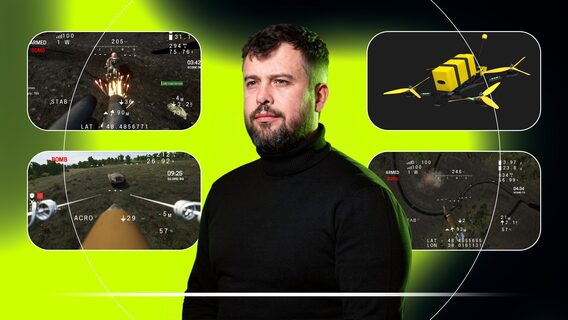
"I take a real drone and just burn it. It's things like this that form the boundary between a game and a simulation": The story of creating the most hardcore UAV simulator for the front. Interview with the co-founders of Simtech Solutions
In today’s world, the ability to control a drone is becoming no less important than shooting skills. The founders of Ukrainian Fight Drone Simulator, Vladyslav Plaksin and Yuriy, combined their experience working with technological 3D models and combat experience to create a product that has already taught more than 7,000 drone operators practical skills. In an interview with dev.ua, the developers told how the project’s ecosystem works, why the developers are not afraid of disappointing sales on Steam, and what the next steps in the evolution of the Ukrainian military simulator will be.
In today’s world, the ability to control a drone is becoming no less important than shooting skills. The founders of Ukrainian Fight Drone Simulator, Vladyslav Plaksin and Yuriy, combined their experience working with technological 3D models and combat experience to create a product that has already taught more than 7,000 drone operators practical skills. In an interview with dev.ua, the developers told how the project’s ecosystem works, why the developers are not afraid of disappointing sales on Steam, and what the next steps in the evolution of the Ukrainian military simulator will be.
About Ukrainian Fight Drone Simulator
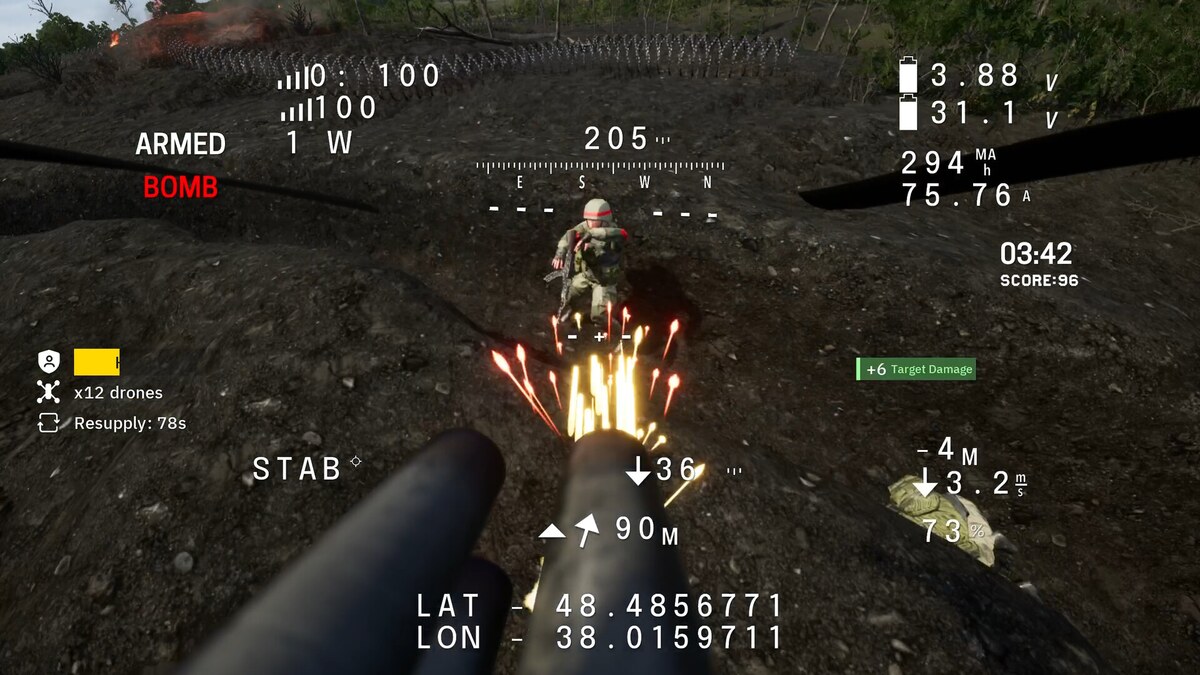
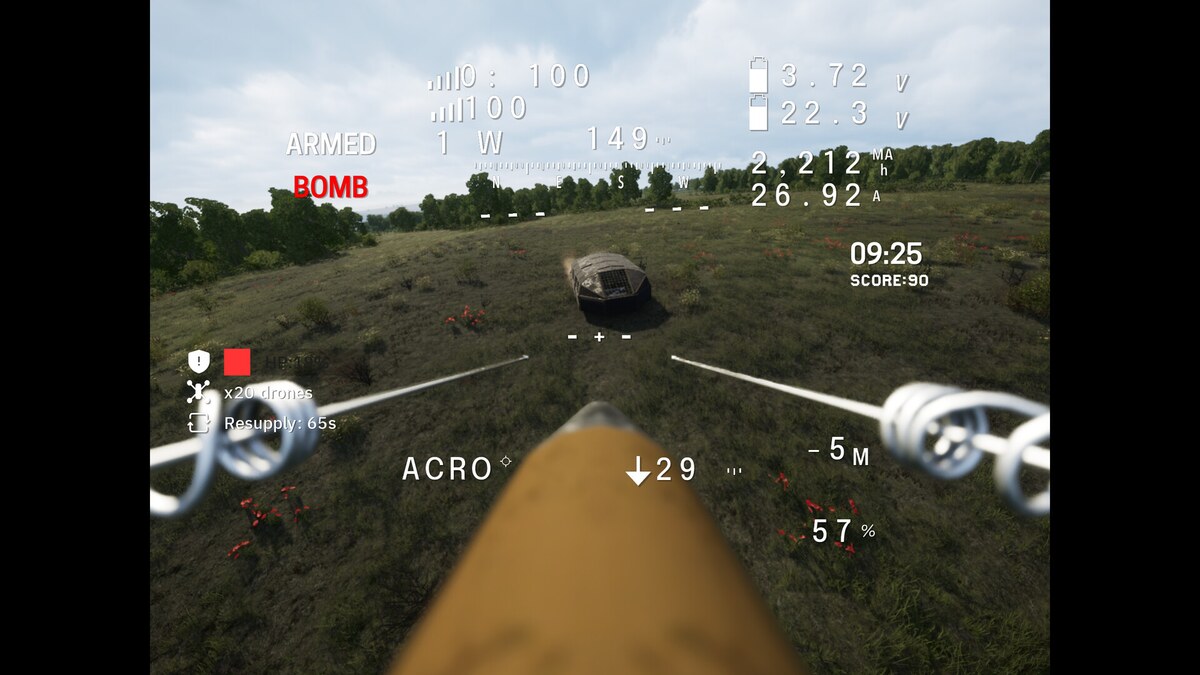
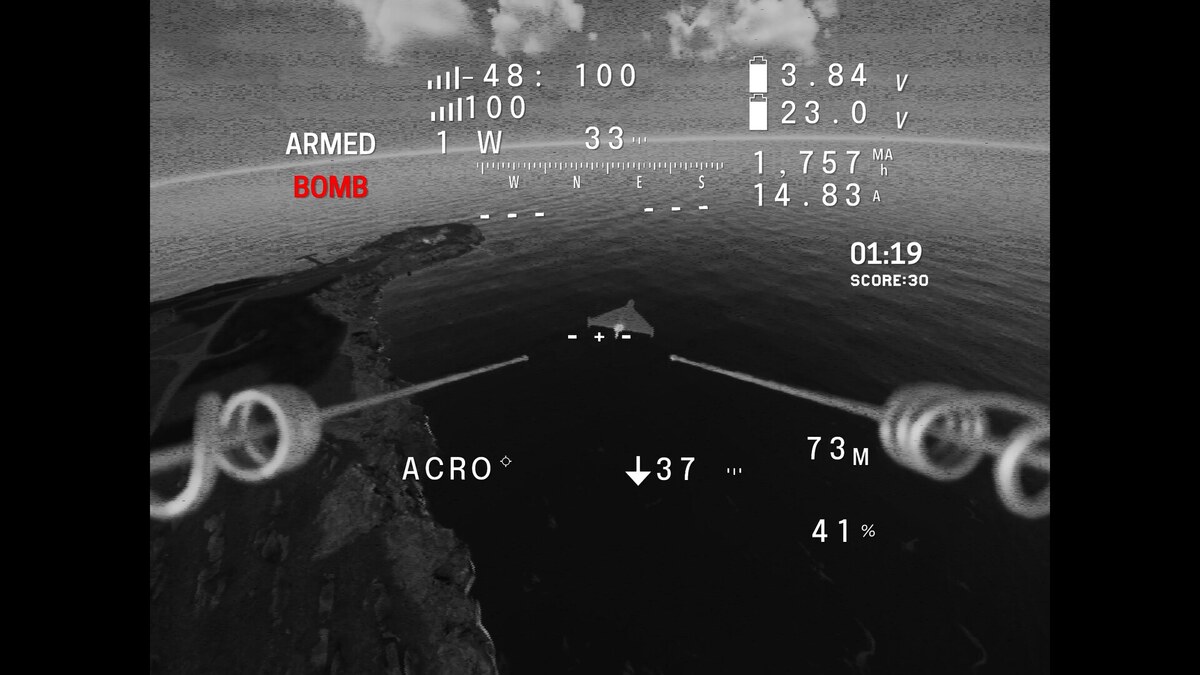
Ukrainian Fight Drone Simulator (UFDS) is an ultra-realistic FPV combat drone simulator based on proven combat operations. UFDS combines first-person immersion with tactical command, and the player, controlling the drone in FPV mode, plans the mission, monitors equipment, ammunition and evacuation — just like real-life strike drone operators do.
The project differs significantly from classic flight simulator games in that it has a deep physics engine. It reproduces in detail the behavior of a drone depending on its configuration, the influence of the weight of the ammunition, as well as environmental factors that interfere with the operator’s communication, control, and visibility.
Experience in VR, collaboration with Achilles and K-2, and connections with the creator of STALKER
— Who exactly is behind the studio’s origins? What is your and the other co-founders' professional background, and did you have any real experience in game development or creating commercial simulators before UFDS?
Vladyslav Plaksin: Back in 2022, we saw that there was no simulator on the market that would help train the military. I met with Yuriy, and we were both fascinated by this idea. However, after that there was a pause of about a year before we moved on to more substantive work.
Before that, I was a little familiar with the gaming industry thanks to Sergey Grigorovich. Even before the war, during our communication, we repeatedly agreed that the best way to learn is through games. It would be really cool to change the concept of learning in schools and all educational institutions in general: to add games so that they give people the opportunity to learn faster and in a larger volume.
There are three of us in total. The third partner is the most experienced in game development, coming from a AAA studio, so he has deep expertise in the tactical and development side. We were all united by a common idea, and I had the opportunity to finance it.
Yuriy: I worked at large technology companies with 3D models, so I have experience working with graphics and various technical and engineering tasks.
My previous experience led me to game development and game creation: around 2019, I started experimenting with game engines. All this gave me a technical understanding of what the future holds and how these technologies are extremely useful for tasks such as developing simulators and other similar solutions. In addition, I was involved in VR research and creating prototypes of simulators.
— What is the vision of Ukrainian Fight Drone Simulator?
Vladyslav Plaksin: We began developing the project, developed a roadmap, and laid down several fundamental principles.
The first principle is that we do this primarily for the military. For the Ukrainian army, this simulator is absolutely free and will remain so until the end of the war.
The second point is that we had to create not just a simulator, but a tool that provides real military knowledge. It should teach people not just how to fly, but also how to perform combat missions.
That is why we work closely with the Drone Fight Club drone pilot academy, as well as with many military units such as the Achilles Battalion, K-2, the 190th Training Center, and others. From them we receive real-life situation analysis and feedback, which we then immediately integrate into the simulator to constantly increase the educational value of our military version. This is what sets us apart from other simulators: every thing we implement in the military version, we try to make 80–90% realistic.
For the state, this means huge savings. It’s one thing when you take a real drone without proper experience and don’t understand what’s happening at speeds over 200 km/h — you’ll just crash it. And it’s quite another when you’ve worked out the procedurality and basic physics in a simulator. Then you fly in real life and feel that nothing has changed.
Banal mathematics: if without practice in the simulator every third or fifth pilot crashes a drone, then for 500 crews (and we need no less to shoot down the same «shaheeds») about 100 drones are lost. One hundred drones worth $3,000 each are $300,000 of saved funds for the state. That is, the maximum realism of physics gives a direct economic effect.
Our third goal is about the game environment. You’ve probably seen other simulators where everything looks a bit simplistic: an SAU stands in the middle of a field, an APC drives along an open road, and you just have to hit them. That’s not the case on the frontline. I’ve been on combat missions myself and I know that finding a target can be extremely difficult, even when it’s illuminated by a Mavic. The equipment is always carefully camouflaged.
That’s why we create the most realistic environment and camouflage. When students are trained in the training centers of the Armed Forces of Ukraine, they have to get used to the fact that it will not be easy. They have to be prepared: searching for a target on a Mavic for an hour or two is a completely normal front-line reality.
«Black box» for a drone: how to achieve 95% realism in flight
— How accurately do you reproduce drone models in your simulator?
Yuriy: As accurately as possible. First, we take the original 3D model from the manufacturer «one to one». All dimensions, seating positions, engine characteristics, communication and other parameters are transferred directly as they are in reality. This is the first stage, when we purely nominally integrate the drone into the system.
After that, real flights are conducted: we directly record the drone’s performance, similar to how the «black box» in airplanes works. We reproduce this information in the simulator, compare the real behavior of the drone with the virtual one and bring it to maximum similarity.
Of course, there are computational limitations. We do not calculate super-complex simulations at the micro level (for example, micro-changes in wind flow), because the drone itself is heavy, and such trifles do not significantly affect the control. The main thing we calculate is the correct aerodynamics. For example, when an anti-aircraft interceptor drone changes position and becomes «combat», acting as a wing. This is where the influence of aerodynamics on the side beams and other structural elements begins. When the drone turns, the area of these surfaces and the center of aerodynamic pressure are crucial and directly affect its behavior.
During experiments in reality and in the simulator, this behavior is critically important for instructors and pilots. They teach not to disrupt the drone in a dive and to act correctly in emergency situations. And we repeat these situations exactly. Relatively speaking, about 95% of the behavior is reproduced, because it is based on the logic of a real flight controller, which performs calculations in the same way as in a physical drone.
I haven’t seen any other simulator that calculates the thrust of each motor, power, ESC temperature, VTX temperature, speed, RPM, and battery status. We have it all working. We even have a separate person who is exclusively responsible for calculating battery performance, adjusting it to the correct energy consumption depending on the type of drone.
Therefore, our approach is more engineering than purely game development. Of course, the team has strong game development specialists whose experience is extremely useful for optimizing and ensuring the quality of graphic content. But everything else is an engineering part. We are dealing with real products, so we cannot afford game conventions. In ordinary games, the technical component can be beaten with creative mechanics or simply fantasized. We don’t have that.
We are limited only by the physical capabilities of the hardware, the requirements of manufacturers, and the technical specifications. This dictates our combined approach. We are constantly looking for a compromise between computing power, graphics, and engineering precision. It is at the intersection of these areas that our project is born.
— Considering that you work directly with the manufacturers and use non-public specifications, your drone models are extremely accurate. Isn’t there a risk that the Russians will simply download the game from Steam, «parse» its files, and gain access to classified information that they shouldn’t see?
Yuriy: We anticipated this. The Steam version does not contain sensitive content: we do not add drones from real manufacturers, including interceptors. It is no secret to us that games on Steam are hacked.
That is why the public version does not have the real large maps that are in our military collection. The protection of the military version does not work through Steam at all. We use the best cryptographic protection system that does not allow hacking or opening the simulator on the territory of Russia.
We are strictly monitoring this. So far, there has not been a single case where someone has been able to launch the military version in the Russian Federation. We clearly separate the content that is publicly available from that intended for the military.
— How many people are currently creating and supporting the simulator?
Yuriy: Currently, our technical team, which is developing the simulator, has about 30 specialists. But it wasn’t always like this. We started with a smaller team with different levels of training, but later we realized that the product needed to be developed in many directions, and therefore, we needed to involve more specialists.
With our approach to development, it is impossible to plan the creation of new content many months in advance. The situation on the front changes extremely quickly. We receive feedback on current combat missions and understand that it is simply impossible to predict the needs of the military in advance.
That is why we constantly listen to the front and instructors to quickly create relevant missions. This forces us to constantly adapt our work processes: flexibly reassign specialists to other tasks and thus comprehensively develop the entire project.
Project Mathematics: From Steam Sales to the Success of Lucky Strike FPV Drones
— Where did you get the starting budget for launching and developing the project? Were it your own savings, volunteer funds, specialized military grants, or attracted investments?
Vladyslav Plaksin: First, we cooperate with manufacturers. Their integration occurs approximately at cost — it is very difficult to calculate it exactly, but this is the first channel that allows us to receive funds.
Secondly, we cooperate with NATO and other partners of Ukraine. Unfortunately, neither NATO nor most partners have yet fully understood what drones are. But that’s another point: when small schools on their territory are ready to use our simulator, we also receive some compensation for it.
Thirdly, if you look at the statistics, we also made quite a few sales on Steam. It’s over $300,000, but the platform itself, conversion, etc. take a lot. God forbid that at least half of this revenue reaches us.
In addition, I have separate business lines that complement each other. For example, we once developed one of the first FPV drones, Lucky Strike. These drones are now extremely actively used on the front.
Sometimes you don’t even immediately see how much the tool you developed stimulates sales. Our simulator helps drones develop no less, because the guys can train and show better results on the battlefield thanks to previous practice in it.
That is, we have many monetization channels, and we mix them. We constantly analyze: is this enough for us, do we want to grow? Currently, the team says: «We want to attract more professionals, we want to scale.» But for this we have to achieve certain KPIs that I set. This is the plan we are moving according to.
— When you made the decision to make a civilian version, what were you primarily guided by — the desire to create an additional source of income for the studio or the popularization of the military movement?
Vladyslav Plaksin: The Steam version is a «showcase» and a tool for basic training for young people. We strive to create a culture of piloting in society, adapting the experience of aviation clubs of the past to the realities of modern warfare. This is not just a game, but a «social elevator» to the profession of a UAV operator.
Our goal is to convert «game time» into real skills. When a recruit joins the army with 300 hours of flight time, the state saves at least UAH 100,000 on his basic training and minimizes the loss of expensive equipment during the training process. Training 1,000 pilots per year is hundreds of millions of UAH in budget savings.
We deliberately divided the project into two levels:
Civilian version: A maximally gaming format to attract a mass audience, where the priority is interest and duration of stay in the simulator.
Military version: A professional tool that contains real frontline scenarios, cloaking and target search algorithms that the civilian user is not yet ready for.
— Did the Steam version ultimately meet your expectations in terms of downloads and sales?
Vladyslav Plaksin: As the main investor of the project, I can say that the result turned out to be twice as bad as my personal expectations. But we always set ourselves a very high bar. On the other hand, we compared the numbers and consulted with the developers of similar simulators, and they assured us that our results are actually very good.
During the recent update, we fixed a lot of things that weren’t bugs at all for the military version, but were critical for the Steam audience. For example, too long a search for a target or complicated settings. With the military it’s easier: we always have an instructor in touch. If something didn’t work in the first versions, we could just explain over the phone how to change the configuration on the console. You can’t do that with regular players on Steam.
When we released the public version, the simulator supported the 10 most popular controllers. But we didn’t even think that people would want to fly with regular gamepads, for example from PlayStation. Users brought this problem to our attention. We collected all the feedback and spent almost half a year updating the simulator to a level where the average player would be happy to use it.
If we compare the version from six months ago with the current one, the core has remained unchanged — the drone physics and realism are still high. But we have added many details that are critically important for the average user. We continue this work. For example, during the last release we updated the rating system, but players immediately pointed out another nuance: faster mission completion should be rewarded with additional bonuses. We are adapting this.
The most difficult stage of development: how to teach the team to fly for real
— From a technical point of view, what was the most difficult thing to implement in the game’s code and physics?
Vladyslav Plaksin: One of the most difficult challenges was to teach the entire team to fly drones. It was very difficult for many (even Yuri at first) to understand at a basic level how all this flying works. And when you don’t get endorphins from the process, you don’t want to do it. So we had to forcefully say: «You have to fly for two hours in the simulator,» and then send it to the instructors: «Now you go to the gym to fly with an instructor.» It was difficult, because usually I try to build my work on people’s faith in the product.
For example, if we are creating a real drone (not a simulator), I insist that everyone we train should fly the maximum distance and see for themselves that it works. Yes, it takes a lot of time. If the drone is designed for 25 kilometers, then the round trip flight is about an hour. If there are 10 people in a group, the instructor has to fly with them for 10 hours and, of course, gets terribly annoyed. But when a person makes this flight on their own, they gain faith in the product.
The second difficult point is the need to constantly question your own work, in particular the physics of the drone. Usually the developer thinks that he has done everything right. And I say: «Let’s check it with reality.» We spend a huge amount of time testing, and if something doesn’t work, we go back and redo it.
For example, we have implemented battery overheating. It is impossible to drive at 100% throttle, like in other simulators. The physics are absolutely real. Sometimes, the developer creates some mechanics, and I say: «It won’t work like that in real life.» He asks to prove it.
I take a real drone, show it and… burn it. It’s a waste of $50 on a motor or $100 on an ESC. But it’s things like that that form the boundary between a game and a simulation: you have to test everything you create with reality.
Yuriy: Technically, we are constantly looking for a compromise between hardware performance and the amount of calculations we want to implement. This is one of our main challenges. There are also technical requirements from drone manufacturers, which set us tasks in the must-have format (mandatory functions).
We are constantly searching for a balance: on the one hand, we want to use proven and understandable production pipelines from game dev, and on the other hand, we are constantly experimenting. We are looking for new solutions, consulting with engineers, and creating a combination of a systems approach with non-standard compromise solutions that the specifics of combat drones require of us.
Future plans
— Where will UFDS go after the June multiplayer update? Do you plan to go beyond just being a drone simulator?
Yuriy: We plan to expand the content and add new types of drones, including ground robotic complexes (GRCs) and water drones. These are not just plans — they are a matter of time. Previously, the use of GRCs was something exclusive, but today it is commonplace, a normal logistics practice. We understand that without the integration of such systems, the product will be incomplete, so we are trying to implement these types of platforms into our simulator as soon as possible.
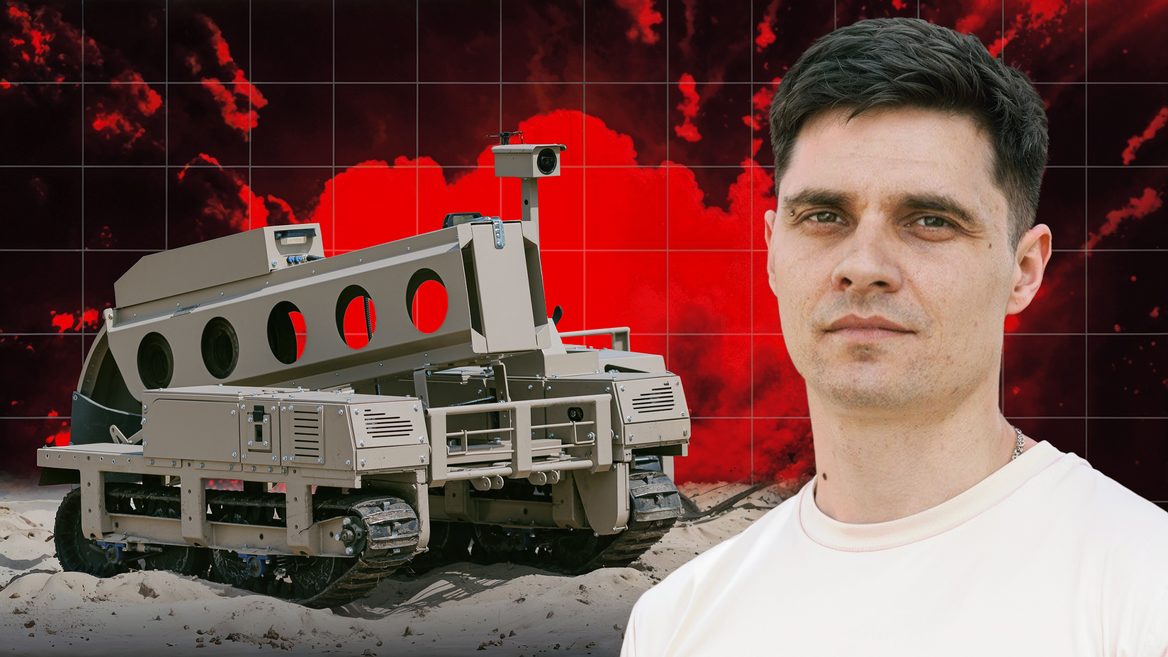
«2025 has become the year of the NRC, but to meet the need on the front line, 40,000 robots are needed.» Interview with the co-founder of Tencore, the largest manufacturer of ground robotic systems in Ukraine
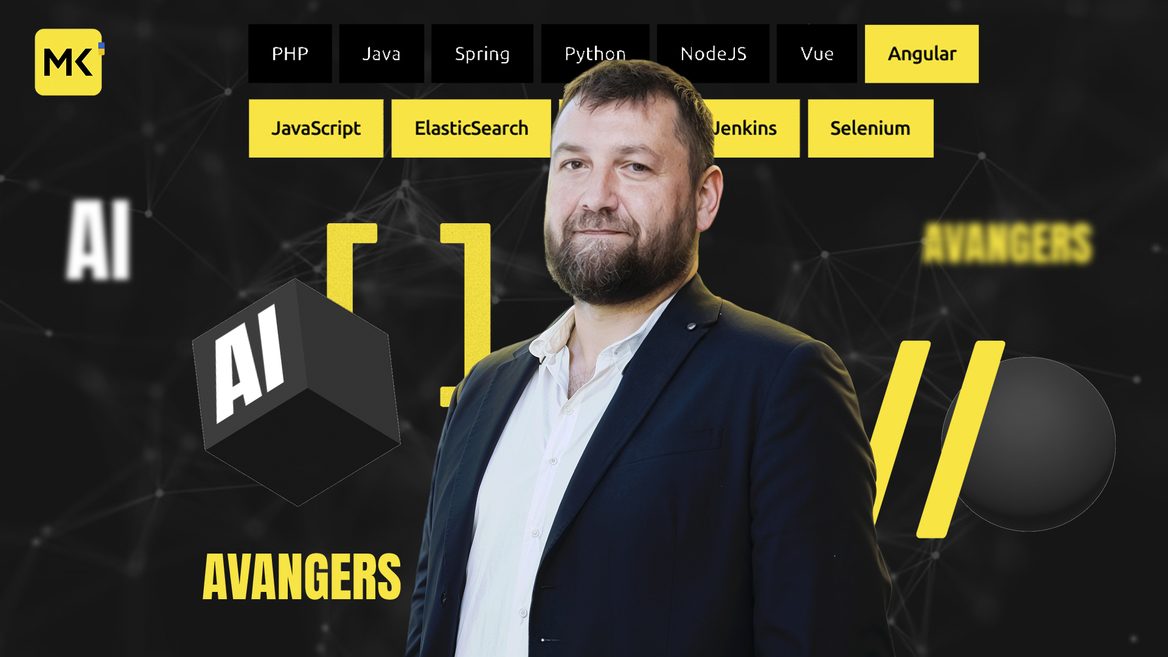
«We did something we never dreamed of in 2022.» How artificial intelligence is changing the state and the army from within — an interview with the creator of the Avengers AI solution that automatically identifies military equipment
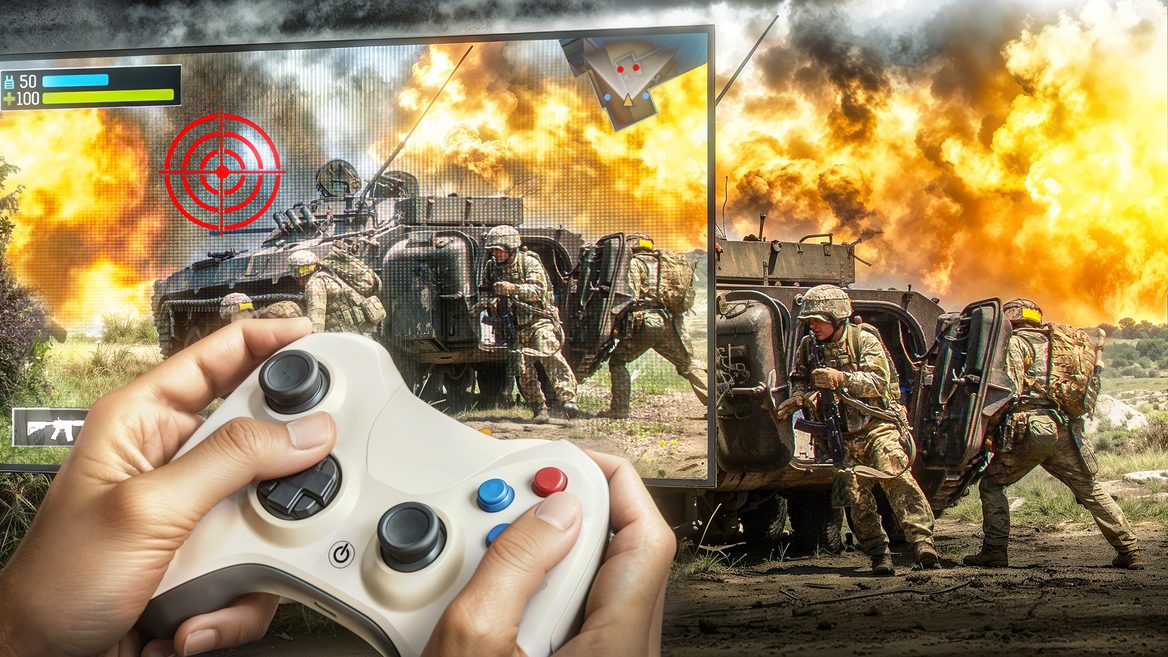
«The game gave an understanding of what you will have to work with in reality.» Interview with an artilleryman of the Armed Forces of Ukraine about gamification in the Defense Forces
Понад половина геймерів страждають на напади неконтрольованого гніву. Які причини агресії та яка консоль дратує найсильніше
Реалістичні та захопливі ефекти у відеоіграх стають причиною глибокого розчарування, коли гравці не можуть пройти боса або побити свій рекорд, ідеться у статті Daily Mail.
Hollow Knight — інді-пригода про жуків, яка за якістю перевершує майже всі ААА-ігри
Hollow Knight Silksong — це одна з найочікуваніших інді-ігор на поточний момент. Її розробкою займається студія Team Cherry, яка раніше випустила лише одну гру — Hollow Knight. Але й цього виявилося достатньо, щоб розробники назавжди увійшли в історію ігрової індустрії. Адже Hollow Knight за якістю не поступається дорогим ААА-іграм, а місцями навіть перевершує їх.
Розповідаємо про цю незвичайну пригоду з жуками в головних ролях, яка обов’язково має залишитися у ваших серцях.
Celeste – чарівна історія про прийняття себе і водночас нереально складна гра
На перший погляд Celeste може здатися стандартним ретро-платформером, мода на які не вщухає із середини «нульових». Певною мірою так і є, чого приховувати. Але насправді ця відеогра дарує набагато більше, ніж може здатися, якщо судити про неї поверхнево.
Адже Celeste чудово працює і як метафорична історія про прийняття себе, і як надмірно хардкорний спосіб випробувати свої нерви та ігрові вміння на міцність. Розповідаємо про цю чарівну пригоду, яка зовсім недарма отримала нагороду за найкращу інді-гру 2018 року (і яка допомогла головному розробнику прийняти себе як трансжінку).
Have important news to share? Message our Telegram bot
Key events and useful links in our Telegram channel