Хочете будувати кар’єру в Data Science та AI? Vodafone Big Data Lab відкриває новий набір —>
Наталя ХандусенкоAI Eng
21 October 2026, 13:26
2026-10-21
Ukrainian company Zibra AI launches ZibraXYZ: technology for Physics AI that compresses data by 30 times without the need for decompression
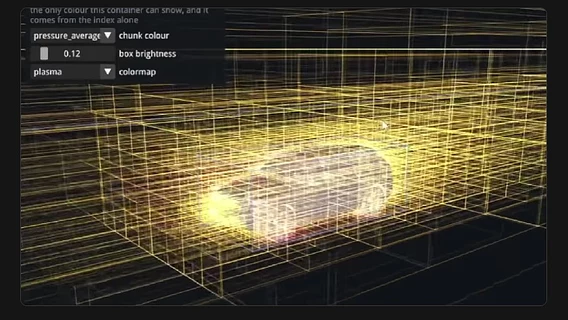
Ukrainian technology startup Zibra AI has announced ZibraXYZ, a high-performance data layer for large engineering datasets. The new technology allows you to compress engineering 3D and 4D data up to 30 times and work with it directly, even if its volume exceeds the memory of the workstation or graphics card.
Ukrainian technology startup Zibra AI has announced ZibraXYZ, a high-performance data layer for large engineering datasets. The new technology allows you to compress engineering 3D and 4D data up to 30 times and work with it directly, even if its volume exceeds the memory of the workstation or graphics card.
What is the industry's problem?
The field of Physics AI (artificial intelligence in physical systems, where models are trained to describe real-world behavior) requires massive amounts of simulation and sensor data. Such data sets can be 1,000 to 10,000 times larger than traditional media files.
Traditional workflows force companies to store petabytes of uncompressed data, transfer it for hours over slow networks, and create numerous duplicates before analyzing or training AI. This makes data storage and transfer prohibitively expensive, and preparation and visualization slow.
How does the ZibraXYZ solution work?
ZibraXYZ offers a fundamentally different approach. Data is organized into self-contained compressed blocks (pages) with random access.
The program loads from the repository only those fields, regions, time steps, or resolutions that are needed for a specific task.
GPU decompression at speeds up to 500 GB/s: Decompression occurs directly in the graphics card (GPU) memory, bypassing the processor (CPU) and intermediate storage buffers.
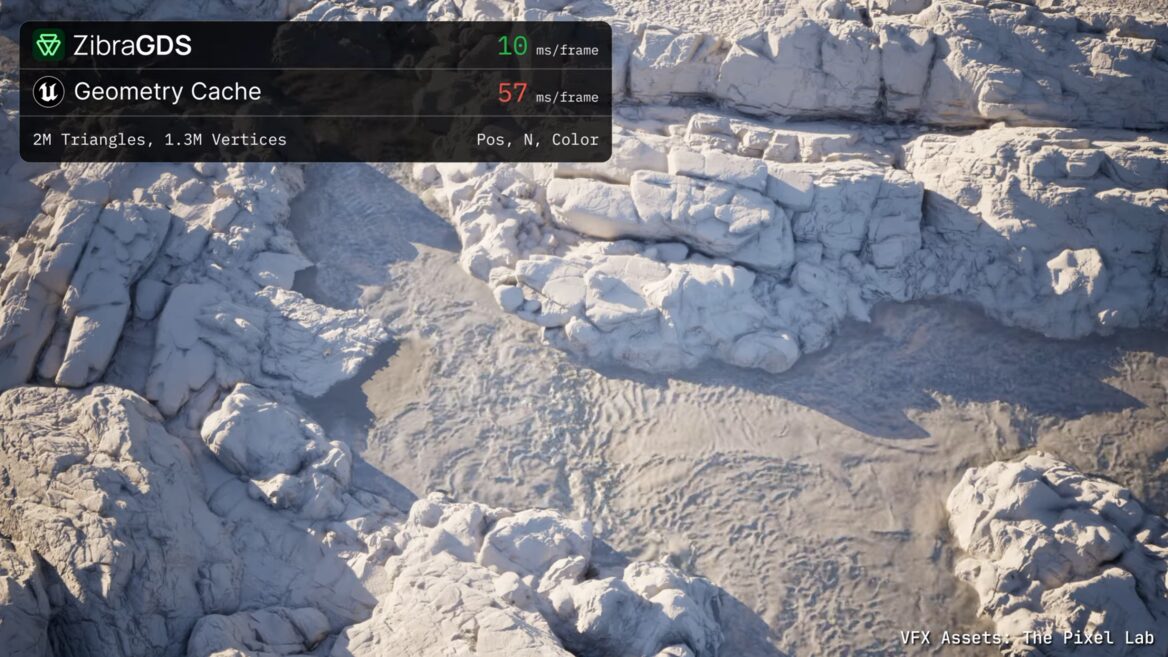
High compression: up to 30x for structured meshes and up to 15x for unstructured meshes. Data can be stored both losslessly and with a controlled margin of error.
Versatility of supported formats: volume meshes, surface meshes, point clouds, and splines in 3D and 4D are supported.
Thanks to this, visualization begins immediately after the first required data arrives, and the load on the network and memory is significantly reduced.
Areas of application and integration
Compressed data remains fully functional in three key areas: Interactive exploration of time steps, slices, and grids with progressive loading and direct support for ParaView according to the VTK standard for visualization.
In the context of AI training, selective reading, buffering, integration with PyTorch, and ready-made scripts for reproducible selection of datasets are available.
In addition, a C++/Python SDK is provided for engineering analysis, allowing you to create your own applications and pipelines.
Those who wish to try ZibraXYZ on their own datasets can order a technical demo on the official website zibra.ai/zibraxyz.
Як нейромережі бачать вільну та незалежну Україну? Тест dev.ua
Нейронні мережі для генерації зображень бачать світ по-своєму, їхню логіку зрозуміти часом зовсім неможливо. Але таки хочеться. На честь Дня Незалежності України редакція dev.ua вирішила провести невеликий експеримент.
Ми задали чотирьом різним нейронним мережам п’ять однакових запитів: «прапор України», «День Незалежності України», «український Крим», «перемога України» та «українці». Отриманими результатами ми ділимося з вами нижче.
У TikTok тепер можна генерувати фон за допомогою нейромережі. Ми протестували її та ділимося результатами
У TikTok з’явилася нова функція «Розумний фон». З її допомогою як фон для тіктоків можна підставляти згенеровані нейромережею зображення. Редакція dev.ua протестувала цю технологію і ділиться своїми враженнями.