Ukrainian Codebridge launched Shvydko: an API that selects an option based on text, gives an estimate, and names the probability
The Ukrainian Codebridge team has opened the public API Shvydko: a model that does not generate text, but makes decisions. It selects an option from a list, gives a rating on your scale, or tells how likely it is that a statement is true. The response is returned as JSON. The product works in free preview mode, there is a Playground for your own examples.
About the team
Codebridge has been developing software and AI systems for clients since 2021. The founders met at KPMG: Konstantin Karpushin (CEO) worked there for over ten years and rose to partner, heading the innovation and technology department. Myroslav Budzanivskyi (CTO) has been working as a software architect for over 12 years, previously working at GlobalLogic, KPMG, and Cybercube. In addition to Shvydko, the company also makes voice input Lispr.
Idea: Jev, but for Ukrainian text
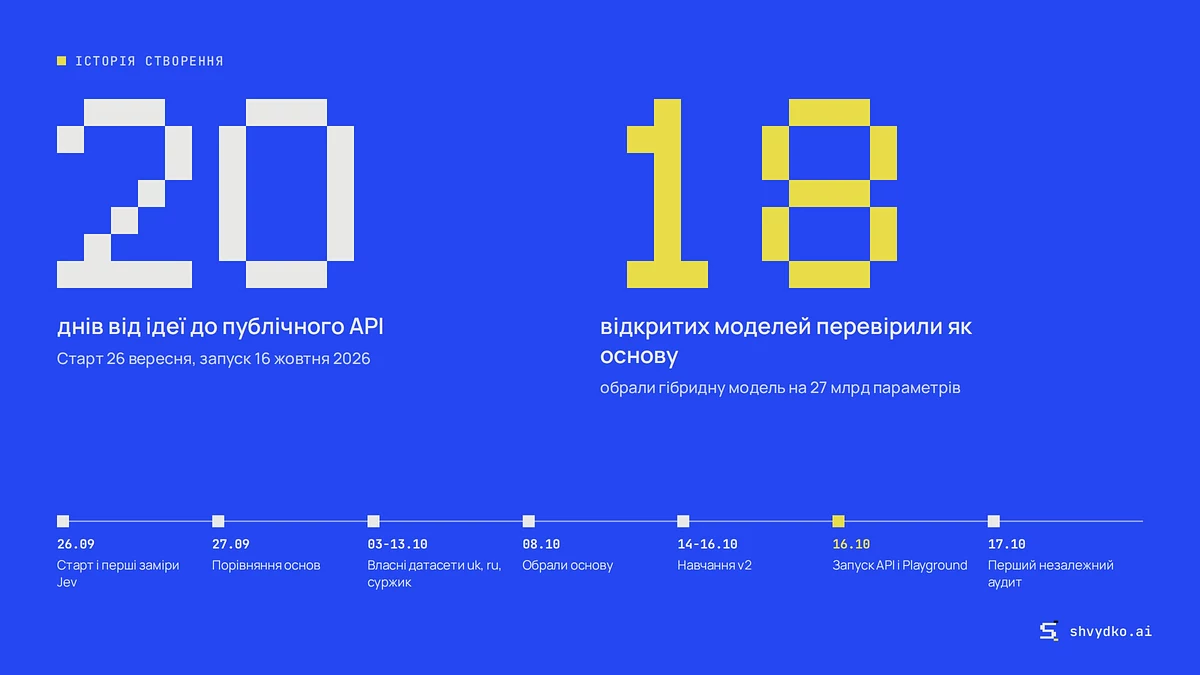
On September 15, the American TypeSafe opened access to Jev, a model that does not write text, but issues a “calibrated solution”. In 24 days, the company raised about $870 million at a valuation of $7.5 billion, Bloomberg reported. Codebridge says that they ran Jev on their own first tests and saw a gap: in English, it answered correctly 91% of the time, in Ukrainian and Russian 81%. Clients write in Ukrainian, Russian and Surzhyk, often in the same message. On September 26, the team began to create its own model, and on October 16, it opened a public API.
How it works
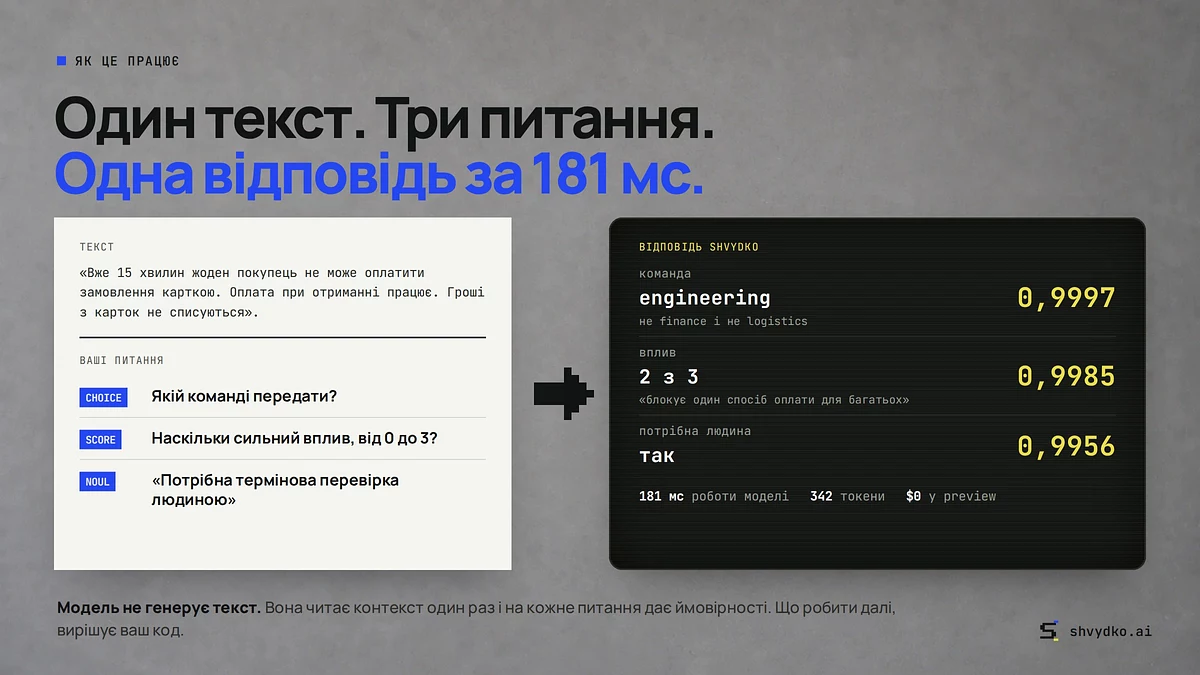
The developer sends a text (an appeal, letter, or document worth up to 32,000 tokens) and several questions of three types:
Choice selects one option from a list;
Score puts a rating on your scale;
Noul estimates the probability of a statement.
The model reads the text once and answers all questions in parallel, each question is blind to the others. In the example on the website, a query with three questions about a payment failure took 181 ms for the model to run. This is one synthetic scenario, not a quality test.
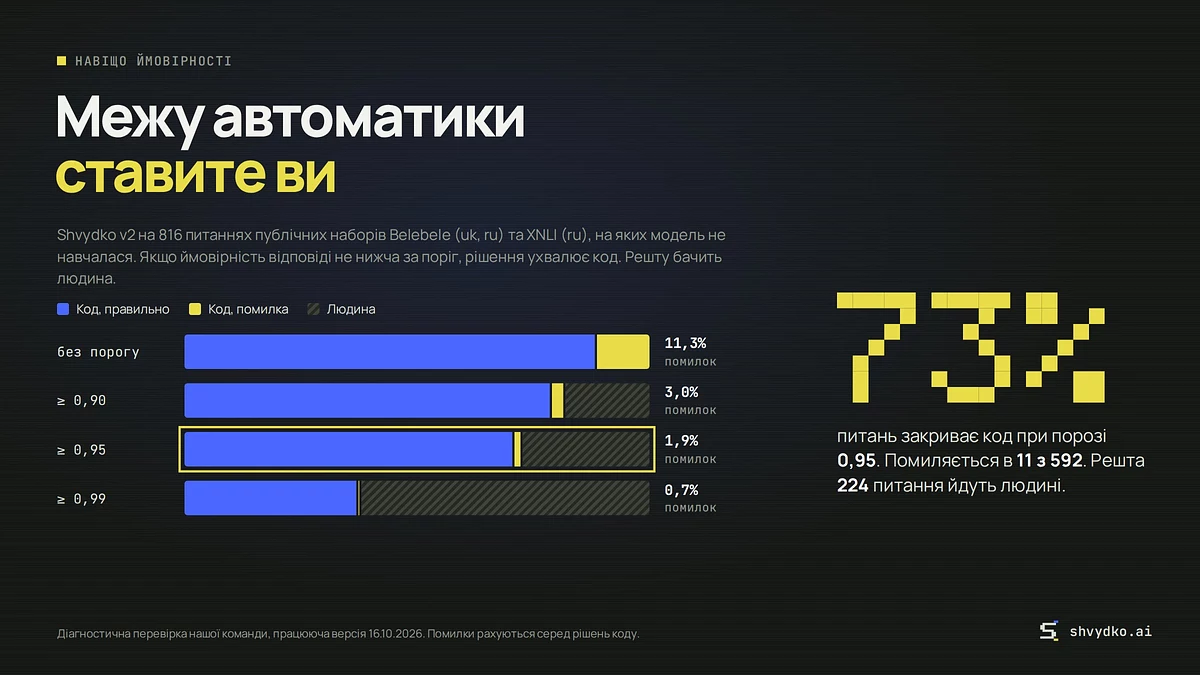
The main thing in the answer, according to the team, is probability. The developer himself sets the threshold: if the model’s confidence is 95% or higher, the code acts automatically, if not, the solution is reviewed by a person. On 816 questions from public sets that the model did not see during training, such a threshold, according to Codebridge, gave 73% of automatic solutions and 1,9% of errors among them. The query format coincides with Jev, so the code for it, according to the team, is transferred to Shvydko by replacing the address and key.
What’s under the hood?
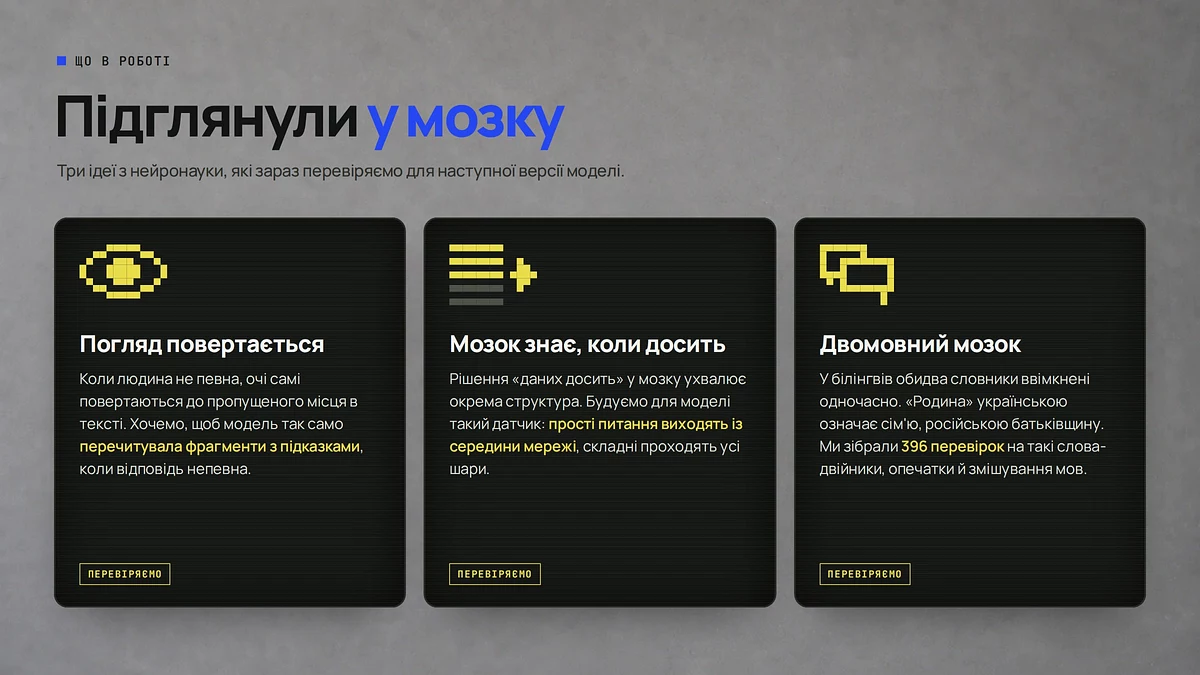
According to CTO Myroslav Budzanivsky, the basis is the open Qwen model with 27 billion parameters, trained using LoRA adapters. Instead of generating text, the model has a “decision head” that immediately outputs the probabilities of options. The team also calibrates them on deferred data so that they can be used to set a threshold. The datasets are collected in Ukrainian, Russian, and Surzhyk: real texts, synthetics from teacher models, and markup by several independent judge models. Trained on GPU H200, serviced on GPUs in the EU. Several people are working on the product, and equipment rental costs about $800 per month.
Price
Tariff: $0.042 per million incoming tokens, weekends are not paid. According to publications, Jev costs about the same. For 100 thousand requests per month for ~800 tokens, this is about $3.40. The team plans to earn money not on tokens, but on separate deployments in the EU or on the client’s server, pre-training on company data and integrations.
And if you compare it to Jev
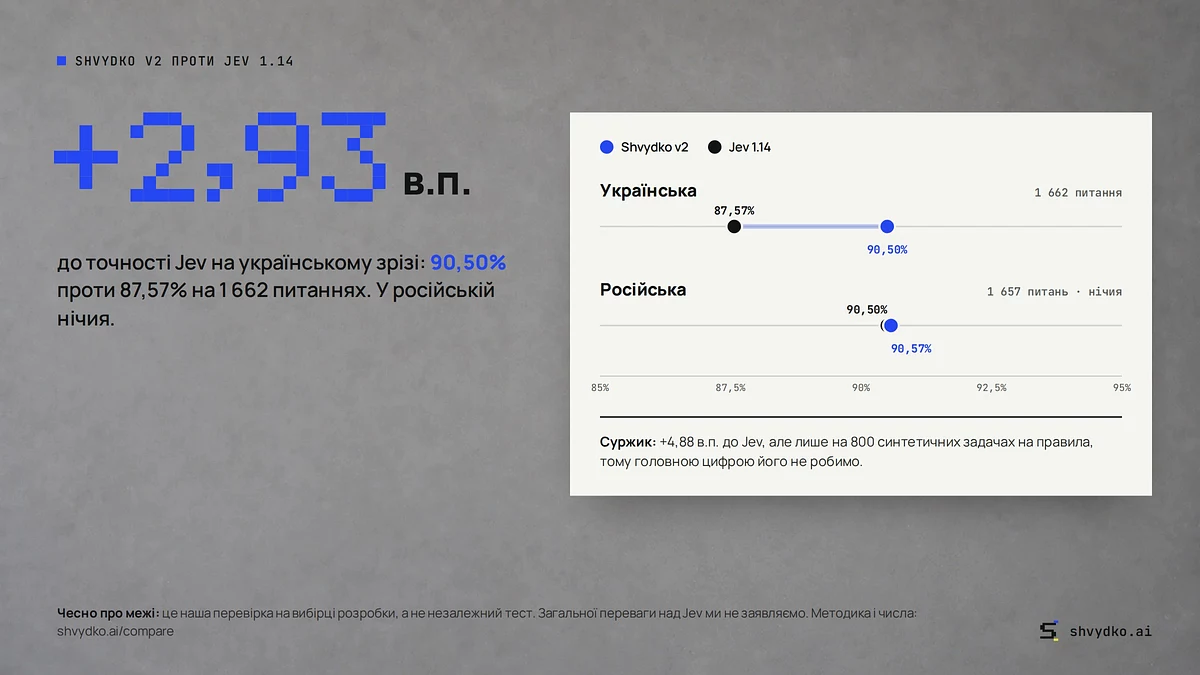
Codebridge independently compared Shvydko v2 with Jev 1.14 on its diagnostic sample. In Ukrainian it is 90,50% versus 87,57% (+2.93 p.p., interval +0.77…+5.10), in Russian it is almost equal (90.57% versus 90,50%, interval crosses zero). In Surzhik it is 100% versus 95,13%, but there are only synthetic problems on the rules, so this is not an assessment of language knowledge. In Ukrainian problems on inference from a passage, Jev is even ahead: 94,66% versus 93,89%.
The company itself emphasizes that the result does not prove an overall advantage: it is part of a dev panel, not an independent final test. The scenario types and the rule task generator match the training data, and speed, economy, and English-language quality were not evaluated.
Users and plans
The product has just been launched: so far, these are the first two dozen registrations and several teams already working with the API. One of the first users sent two detailed reports with his own comparison with Jev, his findings will be included in the next version. Version 3 is promised approximately at the end of November: more accurate verification of assertions, long documents up to 32 thousand tokens and a faster model. The team is also preparing its own LIVE-UK test on texts from seven Ukrainian sources published after June 1, 2026, and a paid mode with the first teams on separate deployments.
“A useful classifier does not mean a revolution in AI yet.” How Ukrainian IT professionals evaluate the sensational Jev model — use cases in real products
Цей короткий термін на слуху у всіх, хто стикався з розробкою. Але далеко не всі розуміють, що саме він означає та навіщо потрібний. Розробник Петро Газаров розповів про API простими словами у своєму блозі.