Хочете будувати кар’єру в Data Science та AI? Vodafone Big Data Lab відкриває новий набір —>
Олександр КузьменкоSpaceTech
4 July 2025, 08:15
2025-07-04
A new interstellar object has entered the Solar System at high speed. It is the third such object in history to be spotted by scientists.
A large object from other parts of the galaxy has entered our solar system on an unusual trajectory. It is the third such object to be detected, following the cigar-shaped asteroid Oumuamua in 2017 and comet 2I/Borisov in 2019.
A large object from other parts of the galaxy has entered our solar system on an unusual trajectory. It is the third such object to be detected, following the cigar-shaped asteroid Oumuamua in 2017 and comet 2I/Borisov in 2019.
The new cosmic body has been given the temporary name A11pl3Z, and its unusual trajectory is leading astronomers to speculate on its extra-solar origin, Futurism reports.
On July 1, the object was added to the International Astronomical Union’s list of confirmed near-Earth objects. NASA and the Jet Propulsion Laboratory also added it to their list of near-Earth objects.
Scientists estimate that its diameter could be about 20 km. It could also set a new speed record, flying past Earth at a relative speed of about 90 km per second.
It is currently unknown what type of cosmic body A11pl3Z belongs to. But this is a rare opportunity for scientists to study an object from another star system.
«After several more preliminary observations and further studies, it became clear that this object is moving on a hyperbolic trajectory through the Solar System,» wrote astronomer David Rankin.
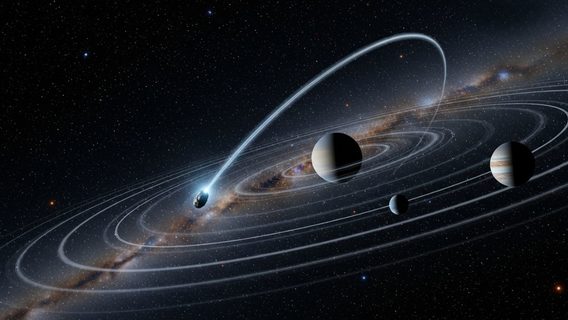
The new object has the highest eccentricity ever detected, at 6.05, he said. In other words, it is moving on a «straighter» trajectory through the solar system than any other object documented by scientists. Rankin added that Oumuamua had an eccentricity of ~1.02, and Comet 2I/Borisov had an eccentricity of ~3.35.
A11pl3Z will make a «semi-close» approach to Mars in October and Jupiter in March of next year. Neither of these approaches «will have a significant effect on its orbit.» The object also will not pose a threat to Earth, as the planet will be on the other side of the Sun during the next approach.
Scientists still can’t agree on the exact origin of 'Oumuamua, nearly eight years after it was spotted by astronomers using a telescope in Hawaii. Some claim it’s an asteroid, others say it’s a comet, and some people still believe it was a spaceship.
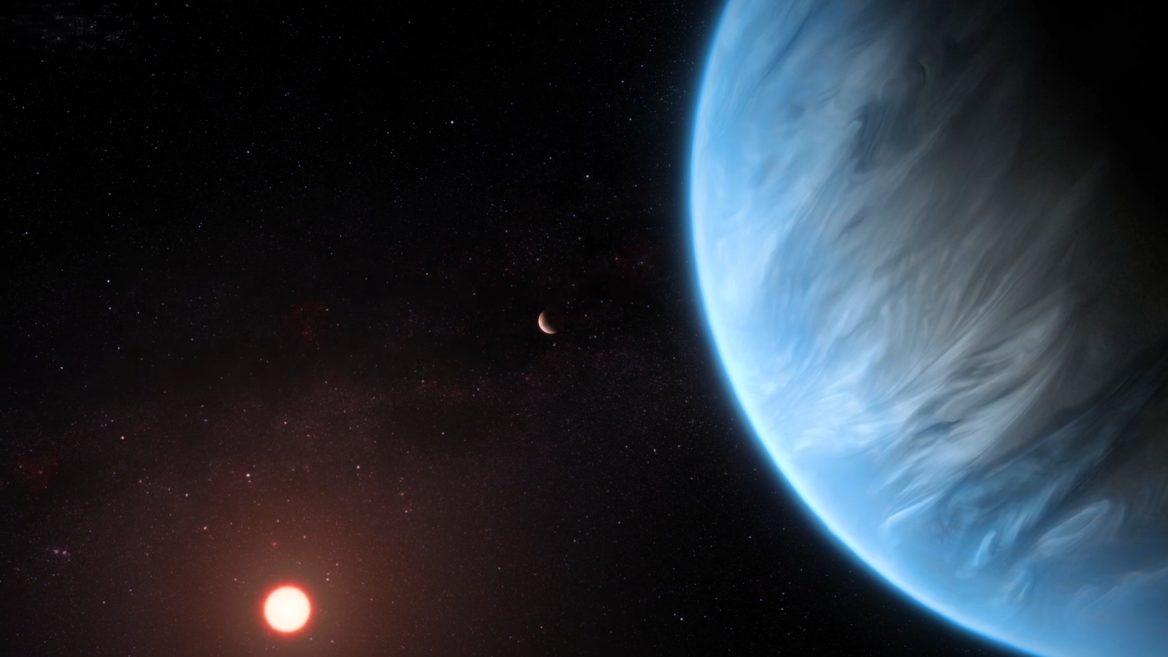
«This is the strongest evidence that there may be life there.» Scientists have found molecules in the atmosphere of planet K2-18b that are produced only by living organisms on Earth