Марія БровінськаScience Pop
12 October 2025, 12:07
2025-10-12
Cancer vaccine shows 88% efficacy in mice. Startup NanoVax Therapeutics begins active human trials
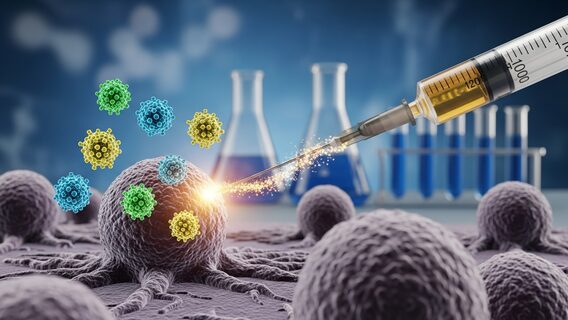
A study by researchers at the University of Massachusetts Amherst found that their nanoparticle vaccine effectively prevented the development of melanoma, pancreatic cancer, and triple-negative breast cancer in mice. Depending on the type of cancer, up to 88% of vaccinated animals were tumor-free, and the vaccine reduced or even completely stopped metastasis.
A study by researchers at the University of Massachusetts Amherst found that their nanoparticle vaccine effectively prevented the development of melanoma, pancreatic cancer, and triple-negative breast cancer in mice. Depending on the type of cancer, up to 88% of vaccinated animals were tumor-free, and the vaccine reduced or even completely stopped metastasis.
«We designed the nanoparticles to activate the immune system through multiple pathways simultaneously and interact with cancer-specific antigens. This allows them to prevent tumor growth with impressive survival rates,» says Prabhani Atukorale, an assistant professor of biomedical engineering in the Riccio College of Engineering at UMass Amherst and lead author of the study, published October 9, 2025, in the journal Cell Reports Medicine.
Atukorale previously demonstrated that her nanoparticle therapy could shrink and completely clear tumors in mice. Now she has shown that the technology works and howpreventive vaccine.
To bring this idea closer to real-world application, Prabhani Atukorale and Griffin Kane founded NanoVax Therapeutics, a startup that develops and commercializes this nanoparticle technology. Now they will test the vaccine in humans.
How it works
In the first test, the nanoparticle system was combined with well-studied melanoma peptides—antigens that «teach» the immune system to recognize cancer cells. Three weeks after vaccination, the mice were injected with melanoma cells.
The result was striking: 80% of the mice vaccinated with the vaccine remained tumor-free and lived until the end of the experiment (250 days). All other mice vaccinated with traditional vaccines or unvaccinated developed tumors and died in less than 35 days.
The vaccine also completely prevented lung metastasis: none of the vaccinated mice developed secondary tumors, while the others did. «Metastasis is the biggest challenge in cancer treatment. It is the cause of most cancer deaths,» explains Atukorale. She calls this phenomenon «immune memory»: the immune system doesn’t just respond to a specific event, but remembers the threat and is ready to fight it in the future.
Second phase of the study
To test the versatility of the approach, the team usedkilled tumor cells (the so-called lysate) — that is, material directly from the tumor mass. After vaccination, the mice were injected with melanoma, pancreatic cancer, or triple-negative breast cancer cells.
The level of protection was extraordinary:
88% of mice with pancreatic cancer did not get sick,
75% with breast cancer,
69% with melanoma.
None of these animals had metastases after reinfection.
«The secret is that we force the body to produce a very strong T-cell response — that’s the basis for the high survival,» says Griffin Kane, a research scientist at UMass Amherst and first author of the paper.
How the «superadjuvant» was created
Any vaccine has two key elements: an antigen and an adjuvant. The antigen «teaches» the immune system to recognize the enemy, and the adjuvant «turns on» its response. The problem is that the most effective adjuvants often don’t work together at the molecular level.
Atukorale’s team solved this problem by creating a lipid nanoparticle that stably holds two different adjuvants and delivers them to cells simultaneously. This causes synergistic immune activation.
Scientists believe that this approach can be applied to many types of cancer — both in preventive and therapeutic programs. Atukorale and Kane have already created a startup, NanoVax Therapeutics, which is commercializing the technology.
«Our company’s core technology is these nanoparticles and this treatment. We want to move the development from the lab to the clinic to really improve patients’ lives,» says Kane.
Вас також кусають комарі? Розповідаємо про пристрій від українських стартаперів, який може цьому зарадити
Як зауважив нещодавно один військовий, якой побажав залишитись невідомим, орки, може, й не поцілять, а комарі точно зʼїдять. І від них потерпають зараз багато українців.
Позбавитись від комарів назавжди ефективно й екологічно допоможе гаджет Mosqitter. Цей стартап заснували дві українки — Анастасія Романова та Ольга Дьячук.
Ми вирішили нагадати, що може Mosqitter, про принципи його роботи та особливості, на злобу дня.
(текст від 21 жовтня 2021 року)
Кнопка здоров'я. Українці розробили систему, яка рятує пацієнтів стаціонару від смерті. Вони - переможці IT Arena Lviv 2022
Медичний психолог, який переїхав в Україну з Москви в 2014 році, Іван Осадчий, придумав систему, яка допомагає медсестрі і пацієнтові не втратити один одного в стаціонарі. Його стартап knopka вже працює в декількох лікарнях понад три роки не лише в Україні, а й у Польщі.
Повторюємо історію стартапу-переможця IT Arena Lviv 2022. Текст від 28 вересня 2022 року.