Хочете будувати кар’єру в Data Science та AI? Vodafone Big Data Lab відкриває новий набір —>
Валентин ШнайдерRobots
7 July 2025, 15:10
2025-07-07
Scientists have turned living beetles into controlled cyborgs to search for people under rubble
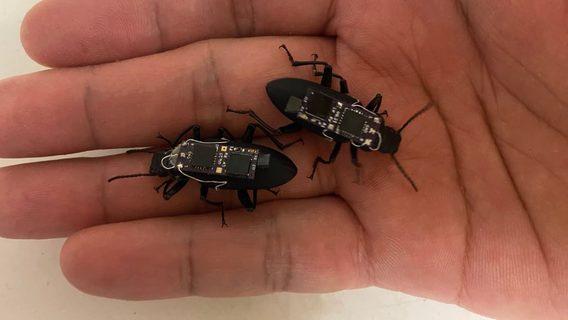
Australian researchers have trained real beetles to carry out rescue missions. Thanks to a microchip on their backs, the insects can be controlled remotely, even making them climb walls in disaster zones.
Australian researchers have trained real beetles to carry out rescue missions. Thanks to a microchip on their backs, the insects can be controlled remotely, even making them climb walls in disaster zones.
Scientists from the University of Queensland have created living cyborgs: real Zophobas morio beetles, which were equipped with microchips, electrodes and batteries. As Interesting Engineering writes, the insects remain alive, but are able to move in the desired direction under the influence of signals from a joystick.
«We haven’t genetically modified them or replaced any organs. The beetles are completely real, we just control their reflexes through electrical stimulation of the antennae and elytra,» explained project leader Dr. Tan Wo-Doan. In this way, the insect can be directed left, right, forward or stopped.
A key advantage is the beetle’s ability to squeeze through the narrowest openings, crawl across chaotic terrain, and even climb vertical surfaces. The insect can withstand the weight of a backpack with a chip and battery equal to its own.
The first experiments used external power, but researchers are now introducing compact batteries and mini-cameras. Such «six-legged scouts» will be able to transmit video from under the rubble in real time, for example, after a mine collapse, earthquake or air strike.
The cyborg beetles were tested on natural terrain, including surfaces of varying complexity. Unlike microrobots, which have problems with vertical movement, the beetles showed a stable result even on walls. «In nature, they have soft pads on their feet that work like natural suction cups and no drone can repeat this,» added research assistant Lachlan Fitzgerald.
The idea of creating cyborgs based on living organisms arose in the early 2000s. However, the Queensland study is one of the first to show stable control of insects in a real environment. The team plans to test the cyborg beetles in a real rescue operation within five years. If the technology is brought to full autonomy, it could replace microrobots in the most difficult disaster zones.
Recall that we also published a story about how Swiss scientists developed tiny water robots that look like motorboats that monitor water quality and are safe for fish.