Хочете будувати кар’єру в Data Science та AI? Vodafone Big Data Lab відкриває новий набір —>
Марія БровінськаІсторії
7 August 2025, 08:43
2025-08-07
"I have a deferment thanks to school." A candid conversation with an IT professional from Pingle Studio, who teaches computer science at a Kharkiv school, about mathematics, the pains of Ukrainian education, AI in teaching, and the combination of pedagogy and work in IT
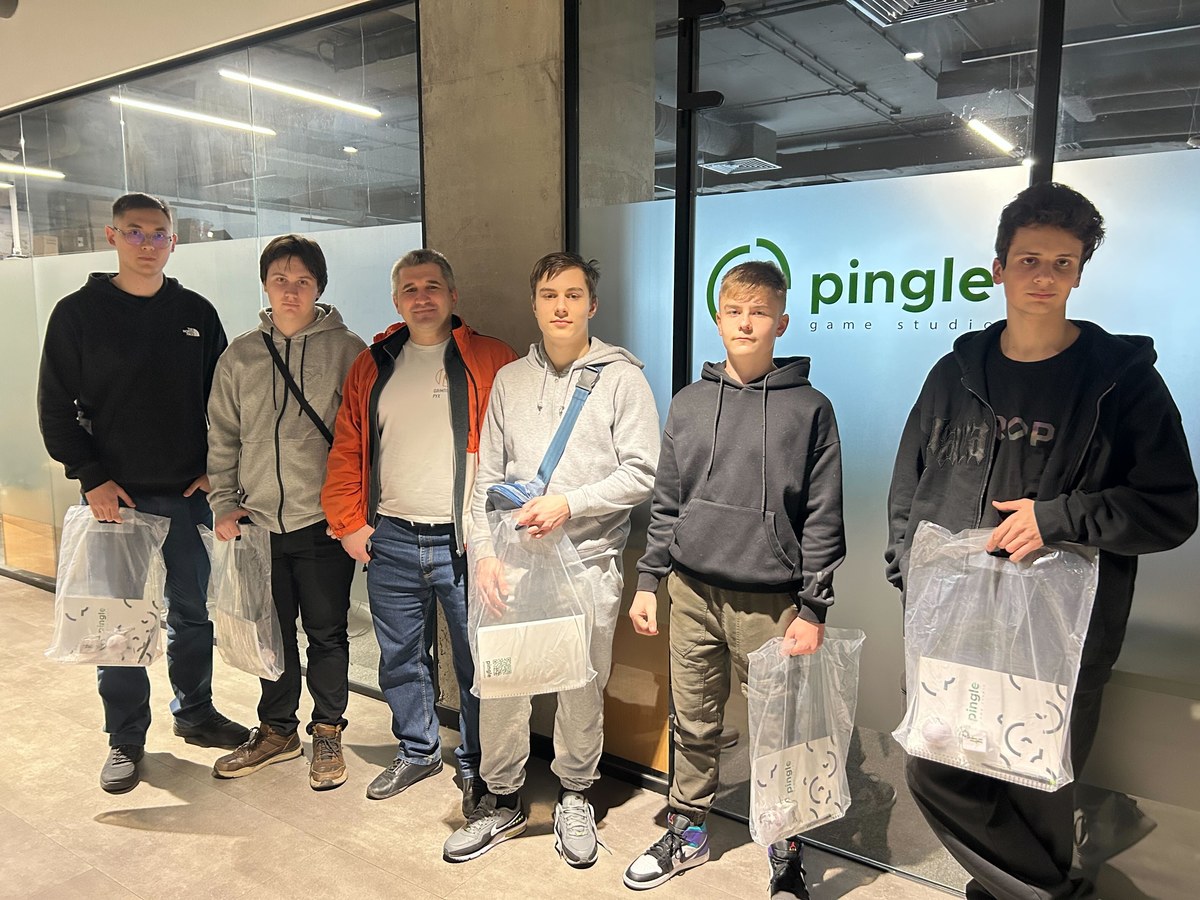
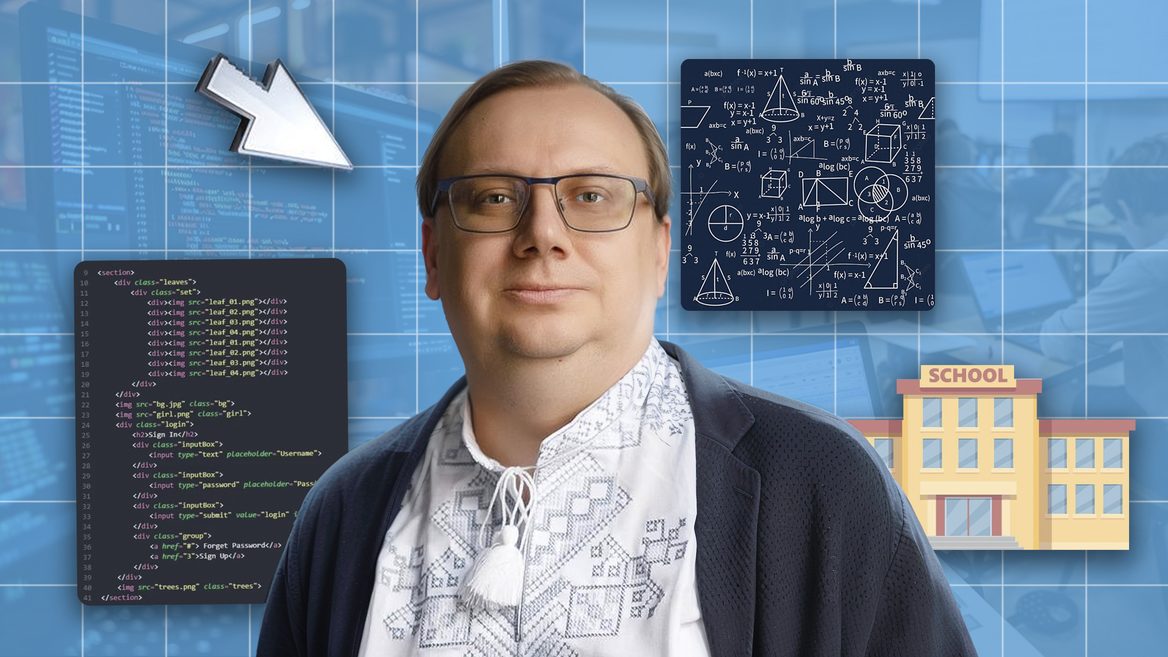
43-year-old Oleksandr Omelayenko from Kharkiv successfully combines work in IT and teaching at school. In parallel with his work in a game development company, he works as a computer science teacher in grades 5-11. And this, the IT specialist admits, gives him important preferences. In particular, thanks to the school, the specialist has a deferment from mobilization.
dev.ua continues the series of articles about IT specialists who combine work in business and teaching. Below is a frank conversation with Project Lead of Unreal Department at Pingle Studio Oleksandr Omelayenko about Ukrainian education, NMT, bureaucracy, and the difference between working in IT and at school. Next is the direct speech of the specialist.
43-year-old Oleksandr Omelayenko from Kharkiv successfully combines work in IT and teaching at school. In parallel with his work in a game development company, he works as a computer science teacher in grades 5-11. And this, the IT specialist admits, gives him important preferences. In particular, thanks to the school, the specialist has a deferment from mobilization.
dev.ua continues the series of articles about IT specialists who combine work in business and teaching. Below is a frank conversation with Project Lead of Unreal Department at Pingle Studio Oleksandr Omelayenko about Ukrainian education, NMT, bureaucracy, and the difference between working in IT and at school. Next is the direct speech of the specialist.
Dreamed of becoming a soldier or an astronaut
By education, I have a master’s degree in physics (specialization — low-temperature physics), I also have the qualification of a teacher of physics and mathematics. Like almost every Soviet child, I dreamed of becoming a soldier or an astronaut. But even in childhood I got acquainted with the world of science — and decided to become a scientist. This goal was achieved, but in the early 2000s, science became «very hungry», so I had to look for other ways.
Until 2011, I was engaged in various things. In 2002–2003, I had a private business — a gaming club (it was very popular in the 2000s), later I worked in trade: I started as a sales consultant in the computer department of the ISS company, later became its head, and later — a manager for work with small and medium-sized businesses.
Crisis of meaning
Oleksandr Omelayenko
Interesting fact: in any job I have, sooner or later I have started teaching others.
Perhaps this was the key to the next stage of my life. In 2010, after experiencing a crisis of meaning, I realized that I was doing something that, in a global sense, did not change anything. Then I decided to change my profession.
Returning to science was not attractive — I was already there. I considered two options: medicine and pedagogy. Pedagogy won out for practical reasons: it could be mastered in a year, while studying to be a doctor would take much longer.
In a financial sense, pedagogy also had prospects: in addition to the school salary, there were clubs and private lessons.
Before the pandemic, income was quite competitive — the transition to IT at that time even looked like a financial downgrade.
Coming to gamedev
I got into game development by accident. At that time, I was already working in an IT company, but the tasks became too similar — a feeling of stagnation appeared. In 2022, feeling the need for new challenges, I opened a profile on Djinni — and almost immediately received many offers. There was no particular difference in what to work on, so I chose Pingle — because of interesting conditions. In addition, I didn’t know Unreal Engine at all then, and this became another argument: I wanted to try something new and unfamiliar.
Combining teaching and working in IT is quite possible, although difficult. A full-time school job is only 18 hours of teaching per week, but there is also lesson preparation, classroom management, etc. I gave up the latter, and optimized my training thanks to experience.
There are no problems on the IT side.
In normal companies, the schedule is flexible — no one cares when you work, the main thing is that the tasks are completed on time.
Before the full-scale war, I was conducting live lessons in parallel with working in an IT company — and this did not create any difficulties. Now Kharkiv schools operate remotely, which, on the one hand, simplifies the combination of two classes, but on the other — makes education less effective and less interesting for the teacher himself.
What did coming to IT give? Definitely — development. But as for ambitions — I’m not sure. It seems to me that they can be realized in any field. Covid significantly hit the earning opportunities in education, and the full-scale war only deepened these problems. Therefore, financial stability is undoubtedly one of the main advantages of the transition to IT.
Teachers' pain points and combining IT work with teaching
The main problem of teachers is their dependence, which makes them almost without rights. Those who have additional sources of income (clubs, part-time jobs, other work) may feel more confident at school — to have their own position and not be afraid to express it. But the biggest difference is in the attitude towards the teacher as a person. At school there may be a formal «respectful» address, but behind it there is often no real respect — for opinion, for time, for human dignity.
I try to make complex things simpler. One of the main problems with the school curriculum is the emphasis on facts: «here’s the formula, remember it» — without explaining its meaning and practical application.
In my work, I focus more on understanding: I shuffle topics so that they logically intertwine, show where and how different methods are used. It also helps that I teach computer science — we significantly change the program, and students gain real knowledge of programming («Algorithms and Data Structures»), which, in turn, strengthens mathematical understanding.
As for the curricula, pedagogies, journals, and all the accompanying paperwork, this is, without exaggeration, the worst part of the school system. All this paperwork is exhausting and has nothing to do with teaching. I try to minimize its impact and automate everything I can. Thanks to this, «paperwork» now takes only 2–3 weekends per semester — and that is still tolerable.
Is it possible to build a high-quality system in public schools similar to the one that works in IT? Yes, absolutely. For example, paper journals have already been abandoned — now everything is kept electronically, with a final printout at the end of the year. Personally, I have always kept my documentation electronically, automating all possible processes as much as possible.
But the problem is not bureaucracy as such — it is only a consequence. The main problem is in the attitude towards people and the remuneration system. When a teacher’s work is undervalued and he is treated as an executor of instructions, no amount of automation will solve the essence of the problem.
The level of knowledge in mathematics is really low
Ukrainian education is currently facing serious problems. First, Covid, then a full-scale war: children, especially in the east of the country, have not had a full-fledged education for 5–6 years. This has a strong impact on the level of knowledge — and not only in mathematics. But there were problems before: outdated programs, lack of an individual approach, overcrowded classes, low teacher motivation.
So yes, the level of knowledge in mathematics is indeed low, but this is far from the worst thing in modern Ukrainian education.
When the lessons were offline, I used many methods to engage the children, and it really worked: they were genuinely interested in math and programming. But in the online format, the situation is completely different — the responsibility largely falls on the parents, and the student can easily just «switch off» and ignore the teacher. To get the child interested, he or she has to at least notice me — and without the participation of the parents, this is often impossible.
What do I think about the NMT in mathematics? The greatest difficulty lies not so much in the tasks themselves, but in the format: tests in all subjects take place simultaneously, and it is difficult for students to correctly distribute their time. In such conditions, control over the process becomes even more difficult. The math tasks themselves, in my opinion, are even simpler than they were in the ZNO — which, by the way, should not be considered too difficult either. There will always be complaints about the difficulty of exams — that’s just how human nature works.
The students really developed many interesting projects — often within the framework of the MAI or TUI. However, my contribution to these projects was mainly advisory: I helped with ideas, directions, and testing solutions. Therefore, I do not consider it correct to attribute these results to myself — these are primarily the achievements of the students themselves.
Bonus from school
They say that there are queues of young male teachers in schools these days, because educators can get a deferral from mobilization. In fact, educators constantly complain about the shortage of personnel, especially in technical disciplines. So it is hard to believe in such «queues.»
I have a deferment thanks to school.
AI in education
Do schoolchildren use GPT chat to do homework and tests? Of course. We have discussed this a lot with colleagues, and I usually take the position of «defending GPT». My main point is this: studying any subject in itself does not make a person smart. Playing chess simply makes you better at chess — that’s all.
Neural networks are the same old copying, just from a new source. But unlike classical copying, they can actually help with retrieving and structuring information.
If you look at it more broadly — not in the context of grades, but in the context of a person’s future effectiveness — everything is much more interesting. The task of school is not to give a ready-made profession, but to teach how to acquire knowledge and be able to apply it. Therefore, instead of fighting neural networks, it is worth teaching children how to use them correctly.
Is it worth teaching math to excel?
By studying a subject «excellently,» a person doesn’t necessarily actually master the subject itself—they simply learn how to achieve a high grade. Is this a useful skill? More likely than not. But does it indicate a deep understanding of the discipline? Very indirectly.
Mathematics and programming are tools that open up many possibilities. They are universal and applicable not only in IT, but also in such fields as literature, music, management, etc.
Mathematics is not a set of formulas and integrals, but a way of thinking and solving practical problems. And programming is, in essence, polished mathematics in a controlled environment.
Should schoolchildren plan a career in IT? During school years, it is important to familiarize yourself with different areas and choose the one that really interests you. And you should not perceive this as a final decision — you can change your professional trajectory at any age. And mathematics and programming in this context are a win-win investment: they will definitely help, regardless of the chosen field.
I have graduates who went into engineering or IT thanks to me. There are dozens, maybe hundreds of them.
Life hacks for studying mathematics and computer science
In math, always ask yourself the question: «Why?» — this helps you really understand the material, not just memorize it. In programming, the main thing is practice. You can’t learn to ride a bike just by reading books. The same goes for code — you need to write, try, make mistakes, and fix it.
Mathematics and programming are universal tools that increase human efficiency in almost any field of activity. They teach you to think structured, analyze, and find optimal solutions — and this is useful far beyond IT.
«Many students think they already know everything, quickly forgetting what they learned before.» A computer science teacher who also works at SoftServe, about students' short-term memory, AI and digitalization at school, and life hacks for studying exact sciences
«I could give up all technologies and methods if I had to choose.» A computer science teacher works in the Kyiv region, teaching students how to use AI and neural networks, create apps, and read Forbes. Here’s her story
Мануал для джуна. Що треба знати початківцю у Project Management в GameDev: 30 питань та приклади тестових завдань
Джунів, які шукають роботу, проходять купу співбесід та отримують відмови замість оферів, під час війни побільшало. А все тому, що до співбесід необхідно ретельно готуватися. dev.ua розпочинає серію матеріалів про те, що треба знати джунам для проходження співбесіди та отримання омріяного оферу від першого роботодавця.
Оксана Хачко, Team Lead PM в Pingle Game Studio, створила список питань, на які треба орієнтуватися проджекту-початківцю, йдучи на співбесіду. Нижче — кілька тестових для такої позиції.
«Україна навіть пахне інакше!». Історія співробітниці Pingle Game Studio з Харкова, яка повернулася до України з Європи
dev.ua вже розповідав історію Дарії Чучмай, People Partner у Pingle Game Studio, яка евакуювалася до Польщі з рідного Харкова з однією лише пляшкою води та величезним бажанням повернутися до України. Свою мрію вона здійснила: перетнула український кордон і тепер знову живе в Україні. В рамках циклу історій про те, як айтішники повертаються додому, розповідаємо її історію.
«Головне — не здаватись та не опускати руки». 4 історії джунів, що отримали роботу в реальних проєктах з нульовим досвідом
«Досвід роботи в комерційних проєктах за фахом — від 1 року» — найдратівливіша фраза в описах вакансій для всіх, хто хоче увійти в айті. Часто навіть якщо людина працювала в цій сфері, але з іншим стеком, отримати омріяне робоче місце в компанії їй надскладно. Щоправда, є безкоштовна можливість долучитися до IT через інтернатуру.
Сьогодні розповідаємо чотири історії співробітників IT-індустрії, які потрапили на роботу без потрібного досвіду. Так, це радше виключення, аніж правило, але це цілком можливо.
Have important news to share? Message our Telegram bot
Key events and useful links in our Telegram channel