How fast human thought moves — a new discovery by American scientists
Scientists have discovered that our brain processes thoughts much more slowly than previously thought.


Scientists have discovered that our brain processes thoughts much more slowly than previously thought.

Scientists have discovered that our brain processes thoughts much more slowly than previously thought.
Researchers at the California Institute of Technology have made a stunning discovery about the human mind: our thoughts move at a speed of just 10 bits per second , which pales in comparison to the staggering billion bits per second at which our sensory systems gather data about the environment, writes TechSpot.
By analyzing human behavior such as reading, writing, playing video games, and solving a Rubik's Cube, the team calculated a rate of 10 bits per second—a rate that scientists describe as "extremely slow."
By comparison, a standard Wi-Fi connection processes about 50 million bits per second, making our mental processes glacial by comparison. This stark contrast raises a paradox that the team of scientists aims to explore further: How does the brain filter all this information?
The human brain contains over 85 billion neurons, a third of which are responsible for higher-level thinking in the cerebral cortex. Individual neurons can transmit more than 10 bits per second, but our overall thought process works much slower. This discrepancy is another mystery neuroscientists are trying to solve.
Furthermore, the study highlights a particular limitation of human cognition : our ability to process only one thought at a time, rather than multiple thoughts in parallel, as our sensory systems do. The sequential nature of thinking is evident in activities such as chess, where players can only imagine one possible sequence of moves at a time.
Scientists suggest that this limitation may be rooted in our evolutionary history. They suggest that the earliest creatures with nervous systems used their brains primarily for navigation—moving toward food and away from predators. If our complex brains evolved from these simple systems, it explains our tendency to follow only one “path” of thought at a time.
“Human thinking can be viewed as a form of navigation in the space of abstract concepts,” the researchers write.
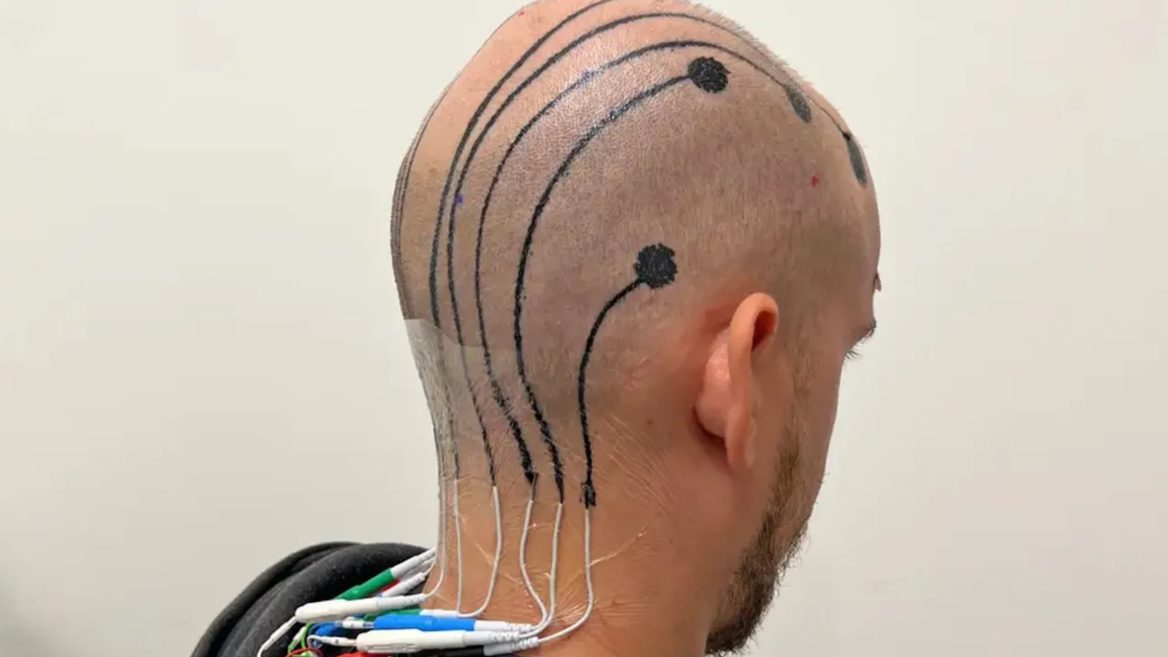
This new quantification of the speed of human thought has far-reaching implications, potentially debunking some of the futuristic scenarios proposed by tech visionaries . For example, the idea of creating direct interfaces between the human brain and a computer to speed up communication may prove less promising than previously thought, as our brains will likely communicate at 10 bits per second anyway.
The study also suggests that our cognitive speed is well-adapted to our environment. “Our ancestors chose an ecological niche where the world was slow enough to make survival possible,” the researchers note. “In fact, 10 bits per second is only needed in the worst-case scenarios, and most of the time our environment changes much more slowly.”