Олександр КузьменкоScience Pop
20 March 2025, 15:00
2025-03-20
Scientists have found that microlightning in water droplets could have led to the emergence of life on Earth
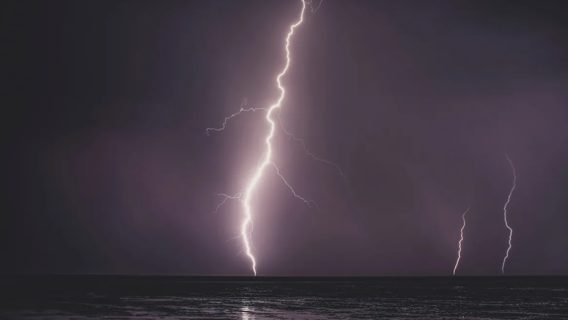
A new study from Stanford University suggests that life on Earth may not have begun with a single powerful lightning strike in the ocean, but rather with many smaller microlightning flashes that appeared in water droplets from waterfalls or waves crashing against the shore.
A new study from Stanford University suggests that life on Earth may not have begun with a single powerful lightning strike in the ocean, but rather with many smaller microlightning flashes that appeared in water droplets from waterfalls or waves crashing against the shore.
Scientists have found that water sprayed into a mixture of gases thought to have been present in Earth’s early atmosphere can lead to the formation of organic molecules with carbon-nitrogen bonds, including uracil, a component of DNA and RNA, the Stanford Report reports.
A study of the weight and a new perspective on the controversial Miller-Ury hypothesis, which claims that life on Earth began with a lightning strike. This theory is based on a 1952 experiment that showed that organic compounds can be formed by applying electricity to a mixture of water and inorganic gases.
In the current study, scientists found that water sprays, which create small electrical charges, can do the job on their own, without additional electricity.
«Microelectric discharges between oppositely charged microdroplets of water create all the organic molecules previously observed in the Miller-Urey experiment, and we propose that this is a novel mechanism for the prebiotic synthesis of molecules that make up the building blocks of life,» said senior author Richard Zare, a professor of chemistry at Stanford’s School of Humanities and Sciences.
It is believed that for several billion years after its formation, the Earth had a whirlwind of chemicals, but almost no organic molecules with carbon-nitrogen bonds, which are necessary for proteins, enzymes, nucleic acids, chlorophyll and other compounds that make up modern living things.
How these biological components came about has long puzzled scientists, and the Miller-Urey experiment offered one possible explanation: lightning striking the ocean and interacting with gases from the early planet, such as methane, ammonia, and hydrogen, could have created these organic molecules. Critics of this theory point out that lightning strikes are too rare and the ocean is too large and diffuse for this to be a realistic cause.
Zare, along with doctoral students Yifan Meng and Yu Xia, and graduate student Jinheng Xu, offer another possibility in their study. The team first investigated how water droplets develop different charges when they break up during a spray or splash. They found that larger droplets often carry a positive charge, while smaller ones carry a negative charge. When the oppositely charged droplets approached each other, sparks flew between them.
Zare calls this «microlightning» because it involves the way energy is stored and discharged as lightning in clouds. The researchers used high-speed cameras to document the flashes of light that are difficult to detect with the human eye.
Although tiny flashes of microlightning are difficult to see, they still pack a relatively large amount of energy. The researchers demonstrated this energy by directing a spray of room-temperature water into a gas mixture containing nitrogen, methane, carbon dioxide, and ammonia, which is thought to have been present on the early Earth. This led to the formation of organic molecules with carbon-nitrogen bonds, including hydrogen cyanide, the amino acids glycine, and uracil.
Researchers say these findings indicate that it wasn’t necessarily lightning strikes, but tiny sparks from crashing waves or waterfalls that gave life on our planet its start.
«On the early Earth, there were water sprays everywhere—in cracks or on rocks, they could accumulate and create this chemical reaction. I think that solves a lot of the problems people have with the Miller-Ury hypothesis,» Zare says.
As nauka.ua notes, no experiment can provide 100% certainty about what happened on the early Earth. But this work by scientists confirmed the existence of a mechanism that could ensure the stable synthesis of organic molecules on the early Earth.
In addition, the experiment strengthens the hypothesis that similar processes are possible on other planets. If microlightning is a universal mechanism for the formation of organic molecules, then the emergence of life in the Universe may be a much more common phenomenon than scientists previously assumed.
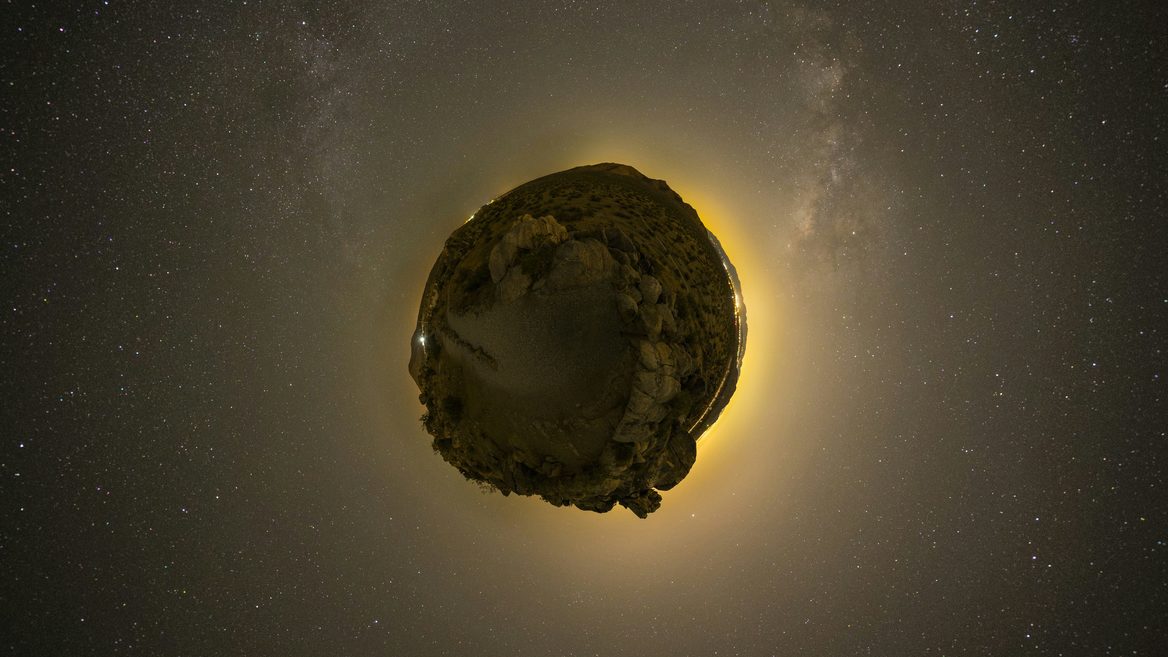
Scientists previously reported that samples of dust and pebbles from the near-Earth asteroid Bennu, which were delivered to Earth by NASA’s Osiris-Rex spacecraft, contain the ingredients necessary for life, as well as remnants of an ancient world.
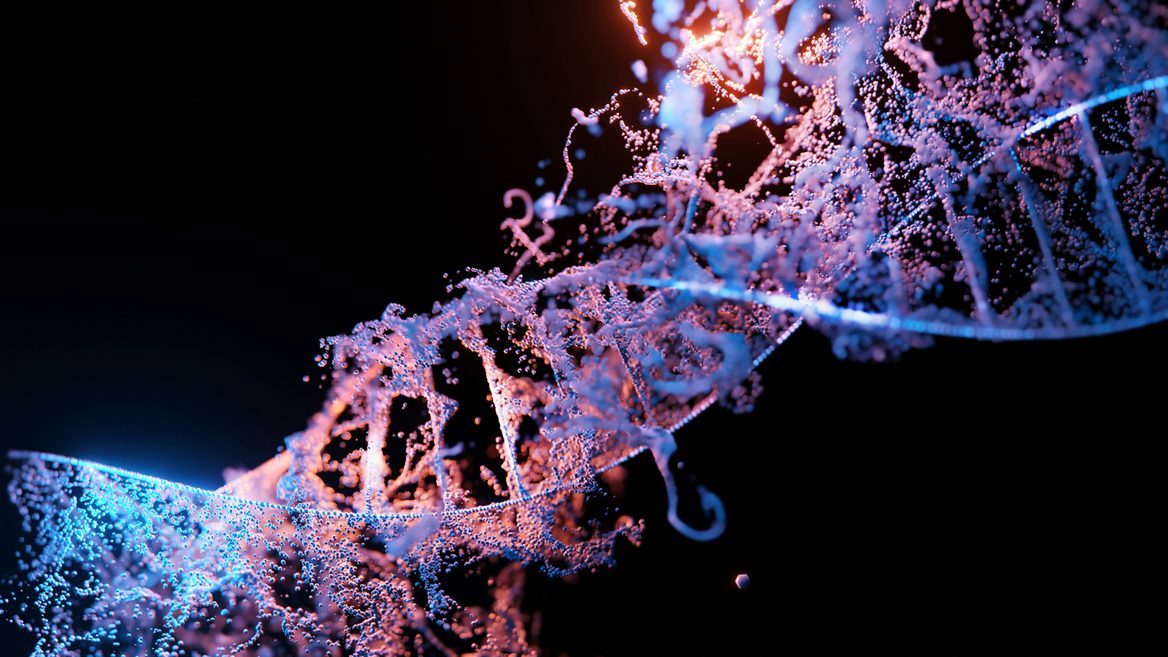
American scientists, together with Nvidia, have developed an AI model, Evo 2, trained on over 100,000 types of DNA, which will be able to code biology and pave the way for the creation of artificial life.