Марія БровінськаWork
2 June 2025, 14:45
2025-06-02
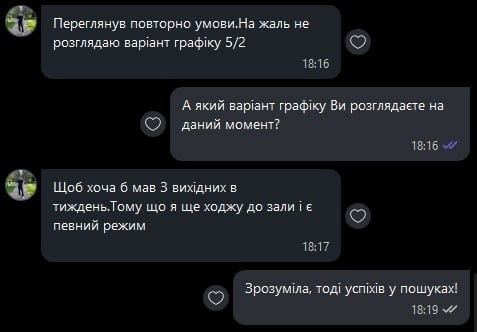
"Unfortunately, I don't share the 5/2 schedule." The candidate offered the recruiter his working conditions - to have three days off per week instead of two. What did this turn out to be and what does the community think about the requirement?
CEO of HR agency HR-Lab Yulia Pashchenko shared the story of hiring a specialist who refused to work on a schedule with two days off, demanding a third.
CEO of HR agency HR-Lab Yulia Pashchenko shared the story of hiring a specialist who refused to work on a schedule with two days off, demanding a third.
«What, was that possible? The situation that arose just a few days ago in a conversation between our recruiter and a candidate,» she wrote and posted a screenshot.
«Once 5/2 was the standard. Today it’s 'no, thank you'.» The labor market is changing. And its buzzers are changing. Their request is simple and loud: more days off, flexibility, a regime that doesn’t ruin life. This is no longer a story about 'lazy candidates'. This is a new coordinate system. And we, HRs, recruiters, and business owners, need to either adapt or lose touch with the future. The trend is obvious: Work-life balance is not a bonus, but a requirement, morality and personal rhythm are a priority, flexibility is the new currency in hiring,» she wrote.
According to the expert, employers need to review schedules, especially at junior and middle levels; form EVPs not only around money, but also around conditions; give more autonomy in work — control the result, not the process; learn to honestly talk to candidates about flexibility, and not promise something that is not there. «And the most important thing is to study your audience. Because the new generation will not play by the old rules. We are not obliged to change everything immediately. But we are obliged to listen,» she noted.
There are over 170 comments under Yulia’s post. Aitov residents are lively commenting on the issue of work schedules.
Founder of the recruiting service Matchsy Alex Burlachenko notes: «5/2 is still about something alive?! A formula in which a person works 5 days in order to get away from himself for 2 days. Maybe it’s enough to play the „norm“ that appeared along with the factory horns? We’re not screwing around. Live people — live pace. Not a casting to survive until Friday night.»
«For many years, I have been working exclusively on a flexible schedule, with a partial workload of 10, 15, 20 or 30 hours a week. This allows me to legally and honestly take on 2-3 projects. But not as a contractor. Namely, as a project-involved full-time employee. This allows me to deeply immerse myself in the specifics of the employer’s business, to interact directly with employees and managers. And it’s great!», — shares his experience business analyst Volodymyr Pereverzev .
According to Product Owner Andriy Smetana, the above dialogue is a bad conversation with a candidate who knows what he wants and is into sports. «He sees that four days can be effective for the company. You can lower the salary and get a super efficient employee for a penny. After a year of working for me, I gave people a half-day schedule. And they did twice as much by choosing this schedule than by working all day so as not to lose it.»
HR Iryna Sylvester said: «It’s interesting, especially when I have experience implementing a 4-day work week in the American IT industry and the results of work and motivation of employees were very high. They worked and did everything they had from 5 days to 4 and had Saturday-Monday off. It’s very convenient, especially to solve some everyday issues in institutions where they also work only on weekdays. If you look at the statistics of people’s working hours and discard some smoke breaks or coffee breaks that stretch the completion of tasks, then you can really work productively for 4 days and rest for 3. Therefore, I am not surprised that the candidate is interested in such a schedule, many companies are already switching to such a regime and have excellent results.»
The founder of an IT recruitment agency, Anastasia Voitenko, states that now the candidate market is increasingly starting to take life into account and try to somehow manage to live it outside of work tasks and everyday life. «With the war, this began to manifest itself more clearly. Some people have this desire for a remote work format (during those hours in traffic jams, you can save time for yourself), for example, someone simply realized that when they manage to multitask during the day and manage to solve both work and personal matters, they are looking for a more flexible approach not based on working „served“ hours, but on the final result of the work. Therefore, as a person, I understand such messages, as a business — I will resist such candidates. Therefore, it is so important now to form a healthy idea in both parties about responsibility for work and responsibility for the mental/physical health of subordinates,» she explains.
«We don’t ‘make dumplings’ — our work doesn’t require physical presence or micromanagement.» Do Ukrainian IT employers require IT professionals to return to the office?
«A company cannot 'buy a pig in a poke'». Why do Ukrainian IT employers give candidates test tasks, how long do they take, and are they willing to pay for the tasks at EPAM, Ciklum, SoftServe, Sigma Software and other companies
#Всратівакансії. ТОП-5 пропозицій про роботу, над якими глузують айтішники
Кількість вакансій в IT з початком війни скоротилася, та шедеврів серед них не поменшало. dev.ua зазвичай попросить дизайнерку Анну Лазурко, яка регулярно публікує у своєму LinkedIn вакансії з дивними та кострубатими описами та вимогами, робити добірку з таких «шедеврів». Ось тут можна почитати першу, другу та третю таку добірку.
Цьоготижнева добірка створена dev.ua за допомогою добре відомого у LinkedIn хештегу #всратівакансії. Насолоджуйтеся!
Мануал для джуна. Що треба знати початківцю, аби влаштуватися маркетологом в IT-компанію: 30 запитань і поради від досвідченого фахівця
Джунів, які шукають роботу, проходять купу співбесід та отримують відмови замість оферів, під час війни побільшало. А все тому, що до співбесід необхідно ретельно готуватися. dev.ua розпочинає серію матеріалів про те, що треба знати джунам для проходження співбесіди та отримання омріяного оферу від першого роботодавця. Маркетинг спеціаліст IT-компанії Universe Катерина Скрипка розповіла, що треба знати та як вдало пройти співбесіду в IT-компанію маркетологам-початківцям.
«Я вигоріла настільки, що вже не могла дивитися на комп'ютер». Історія QA-інженерки про великі гроші, безглузді купівлі, вигорання та дауншифтинг
Хмельничанка Олена Шеліна ― айтішниця, яка настільки вигоріла на роботі, що вирішила покинути IT-сферу та докорінно змінити своє життя. За 9 років роботи в IT дівчина пройшла всі ступені кар’єрного зростання, змінила кілька компаній і навіть напрямів. Та прокинувшись одного ранку, вирішила, що більше не зможе виконувати свою роботу якісно. Дівчина переїхала в село, завела господарство та повністю змінила професію. Розповідаємо її історію.
«Навряд чи можна вірити фідбекам компаній». Тестове в IT: робити чи не робити? Відповідають айтішники
Дизайнерка Анна Лазурко поскаржилася в LinkedIn, що жодна компанія, у яку вона робила тестове, не надала фідбек за її проханням чи без нього. «Отримали, ігнорили на тиждень-два, а потім „рухаємося з іншим кандидатом“. Це взагалі єдина фраза, якою мені відмовляють. Як зрозуміти, що ти робиш щось не так і не те, коли нема жодного фідбеку?», — запитала розчарована спеціалістка.