Реклама партнера — Название партнёра
UNIT.City — місце, де люди працюють... КРАЩЕ! Обирай свій простір просто зараз 👉

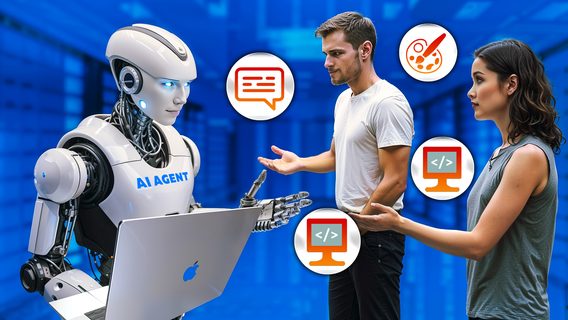
2025 is called the year of AI agents. Are AI agents really a must-have for everyone, and what AI assistants are the Ukrainian divisions of EPAM, Intetics, Levi9, P2H and Railsware working on?

Artificial intelligence is already taking the work out of the hands of millions of tech company employees and beyond. Many tasks are already being outsourced to so-called AI agents, which are performed more accurately, faster, and at lower cost than when they were handled by humans.

dev.ua asked representatives of Ukrainian IT companies what prospects they see for AI assistants this year.

Leave a comment
2025 is called the year of AI agents. Are AI agents really a must-have for everyone, and what AI assistants are the Ukrainian divisions of EPAM, Intetics, Levi9, P2H and Railsware working on?

Artificial intelligence is already taking the work out of the hands of millions of tech company employees and beyond. Many tasks are already being outsourced to so-called AI agents, which are performed more accurately, faster, and at lower cost than when they were handled by humans.

dev.ua asked representatives of Ukrainian IT companies what prospects they see for AI assistants this year.

The boom of AI agents in the world

Companies are actively developing AI assistants that have proven their effectiveness time and time again. In particular, LinkedIn launched the first AI agent that will take on the role of recruiters. Microsoft introduced 10 AI agents for various business processes in Dynamics 365. Back in March, American startup Cognition introduced the AI-based tool Devin, which the developers call «the world’s first fully autonomous AI software developer.» And Slack is being transformed into a platform where AI agents will work alongside humans as digital colleagues.

Meanwhile, Nvidia CEO Jensen Huang dreams of his company employing 50,000 people and 100 million AI assistants. And Pascal Brier, innovation director at consulting firm Capgemini, believes that autonomous AI assistants will start communicating with each other in 2025.

Ukrainian IT companies are not lagging behind the tech giants. In particular, Sigma Software has created an AI agent called Sima, which saves the team thousands of hours of time. And SoftServe uses AI tools of both its own production and well-known solutions on the market to increase the efficiency of IT project teams. MacPaw plans to release its own AI assistant , Eney, by the end of 2025.

What are AI agents?

AI agents are autonomous programs that use artificial intelligence algorithms to work and can often operate without human intervention, having certain given parameters for operation.

These are artificial intelligence models and algorithms that can make decisions on their own in a dynamic world. These are systems that can perform a wide range of tasks, similar to a human assistant. In the workplace, an AI agent can analyze a to-do list and perform tasks from it, such as sending calendar invitations, reminders, or emails. Agents can also process speech, audio, and video.

«In 2025, the popularity of agents will decrease significantly as we move closer to AGI»

Pavlo Yalovol, VP of Innovation at Intetics

Progress in the field of generative AI is so rapid that it makes sense to focus not on years, but on quarters, and sometimes even months.

Yes, the topic of Agentic AI gained popularity back in 2024, and already in January 2025 OpenAI makes it possible to create agents without leaving ChatGPT. At Intetics, we started creating AI agents for our clients back in the summer of 2024 and are currently continuing to work on new agents that:

  • measure the dimensions of car windows;
  • create autotests based on a text description;
  • search for POIs (Points of Interest) in a given region and periodically update data on those that are outdated,
  • create proposals for our clients and automate the execution of internal operational tasks.

We believe that by 2025, the popularity of agents will significantly decrease as we move closer to AGI (Artificial General Intelligence), and people will no longer need dozens of agents created to perform a single task tied to a specific industry. Rather, each user (or organization) will have their own AI assistant that can help with any task, taking into account the context of a specific person or organization.

«2025 promises to be a pivotal year for AI agents»

Vadym Vlasenko, Solutions Architect at EPAM

2025 promises to be a pivotal year for AI agents, which are rapidly gaining popularity due to their ability to automate a variety of tasks.

Over the past year, we at EPAM have been actively developing AI agents for areas such as e-commerce, software development, contact centers, marketing, insurance, the tourism industry, etc.

I work with my own AI agents every day to help with research and documentation. For example, they can independently collect data from the internet and integrate the results into systems like Confluence, which saves a lot of time.

Additionally, our team has created a proprietary no-code platform for building AI agents that allows for easy integration with various integrations, such as databases and project documentation. This platform opens up automation to a wide range of users, allowing them to quickly adapt agents for business tasks without deep technical knowledge.

This confirms the growing trend of integrating AI into business processes, driving increased efficiency and the ability to focus on strategically important tasks.

«Now AI agents can not only help write code, but also do code reviews, optimizations, and even build applications from scratch»

Igor Kozlov, Data & ML Engineer at Levi9

Undoubtedly, the last year can be considered a breakthrough year in the field of Generative AI. The speed and scale of development of both models and architectures of AI agents are impressive. One of the main areas of application of agents is customer support. Most requests can be processed by agents with a knowledge base, which significantly reduces the need for human intervention and optimizes the cost of maintaining customer support.

Last year, we implemented such a system as a POC for one of our clients. And this year, we are working on creating AI Buddy for internal use. This tool will help our employees in self-development and answer frequently asked questions about the company’s internal processes. Buddy is also implemented using agentic architecture, which allows us to improve the quality of answers, because each data source is responsible for its own agent and they can work in parallel.

In addition to customer support and self-development, it is also important to understand the impact of agents directly on the software development process. They can now not only help write code, but also do code reviews, optimizations, and even build applications from scratch (a good example of this is v0 by Vercel, https://v0.dev/).

However, it is important to consider security risks: how safe is it to transfer code and data to third-party models? For some customers, the optimal solution is to use open-source models deployed locally or in the company’s cloud.

At Levi9, we already use agent coding on certain client projects. This is governed by additional agreements that take into account all necessary security aspects.

«AI agents are not a panacea and definitely not a must-have for all products»

Nika Tamayo Flores, Product Lead, Railsware

It may sound a bit provocative, but AI agents are not a panacea and certainly not a must-have for all products. Yes, their popularity is growing rapidly, and we also plan to work with them in the future. However, they are definitely not a primary need for some complex products, such as Coupler.io, which helps collect data and create dashboards.

Why? The main «trick» of AI agents is interaction through queries. But do many users really want to understand how everything works «behind the scenes»? Most likely, they are more interested in three things: query speed, price and quality of the result. And whether it works thanks to AI or other technologies is not a fundamental question, while AI is more of a nice bonus.

Classic machine learning is often enough to cover most of the needs of product users. It is cheaper, easier to implement, and, moreover, more environmentally friendly. If you haven’t thought about how much water and electricity is needed to execute a single query in an AI model, you can read here .

However, the impact of AI on human activities is already tangible and continues to grow. Artificial intelligence becomes especially effective in cooperation with humans and their intelligence. It can quickly analyze large volumes of data, while humans can make strategic decisions, taking into account the broader context. Such cooperation helps to solve tasks more effectively: employees are freed from routine, and the company receives a significant increase in productivity.

«We see how automation of routine processes and implementation of AI become an integral part of business»

Dmytro Mashchenko, Chief Operating Officer, P2H

The demand for AI agents is growing in areas that require automation of complex but repetitive processes, such as web development, e-commerce, marketing, and customer support. In web development, AI enables the creation of more intuitive and interesting web products. It allows you to create content, analyze data from different angles, and make decisions based on it. But most importantly, AI optimizes the operational work of the team, speeding up the development cycle. For example, AI automates repetitive tasks such as code generation, testing, prototyping, and debugging. Thanks to this, developers can focus on more complex and creative aspects of web development. In addition to automating processes, AI can help improve the results of the work performed or suggest improvements based on the data it processes. AI can effectively automate aspects such as code quality, User Experience, and SEO.

More than a decade ago, we at P2N developed a method that allowed us to quickly calculate clear volumes and deadlines. For example, the team identified a set of standard elements for cutting, styling, and aligning according to the design in 12-15 minutes. At the height of the AI ​​era, we came to the conclusion that this method could also be taught to a machine. Thus, the AI ​​Tool was born, which simplifies the assessment of the complexity and cost of website development — of course, with developer moderation and result adjustments as needed. This tool combines our experience in creating websites with modern artificial intelligence (AI), allowing clients to quickly receive understandable results and plan projects more effectively. The tool analyzes the design or structure of the site and offers three assessment options: Classic front-end development (HTML, CSS, JS). Site creation with Elementor (WordPress plugin).

Website design on WordPress. The user uploads a design to Figma, screenshots of the site, or provides a link that is scanned by AI. The model counts unique elements, determines the complexity of the implementation, and provides three options with a budget and timeline calculation. We used the Supervised Learning method to train the model. It is trained to recognize design elements based on labeled examples. The model was improved until it began to produce results with 85% accuracy in just 2 minutes. The optimized architecture allows you to work quickly even with large requests. 2025 can be safely called the era of AI agents.

We see how automation of routine processes and implementation of AI become an integral part of business. Our tool confirms this trend: it actually performs the role of an «AI agent for evaluating web projects», automating a complex process and freeing up time for more important tasks. We do not stop there and strive to further increase the accuracy of the model, as well as expand its functionality and make it available for analyzing new design formats. At the same time, we are actively exploring the capabilities of AI agents for development in order to offer customers even more solutions that automate their business.

Slack is being transformed into a platform where AI agents will work alongside humans as digital colleagues
Slack is being transformed into a platform where AI agents will work alongside humans as digital colleagues
On the topic
Slack is being transformed into a platform where AI agents will work alongside humans as digital colleagues
Swedish-Ukrainian IT company Sigma Software invested about $400,000 in the AI ​​chatbot Sima. It saved it thousands of hours of work
Swedish-Ukrainian IT company Sigma Software invested about $400,000 in the AI ​​chatbot Sima. It saved it thousands of hours of work
On the topic
Swedish-Ukrainian IT company Sigma Software invested about $400,000 in the AI ​​chatbot Sima. It saved it thousands of hours of work
Read the country's main IT news in our Telegram
Read the country’s main IT news in our Telegram
On the topic
Read the country’s main IT news in our Telegram
Also Read
Roosh запускає нову освітню платформу AI HOUSE CLUB для ML/AI-спеціалістів та дата сайнтистів. Розповідаємо, як подати заявку та чому навчатимуть
«Моя фінансова мета — накопичити $1 000 000, щоб мати пасивний дохід і жити на нього». Як айтішники витрачають гроші та в що інвестують
Зарплата айтішників в Україні — одна з найвищих. І ІТ-галузь під час війни — єдина галузь, яка зростає, попри війну. А айтішники — серед тих, хто найактивніше підтримують армію. Середній місячний донат айтішника становить 10% від зарплати, або $270. dev.ua вирішив розпитати айтішників, куди вони витрачають гроші й у що інвестують під час війни. 
1 comment
Як нейромережі бачать вільну та незалежну Україну? Тест dev.ua
Нейронні мережі для генерації зображень бачать світ по-своєму, їхню логіку зрозуміти часом зовсім неможливо. Але таки хочеться. На честь Дня Незалежності України редакція dev.ua вирішила провести невеликий експеримент. Ми задали чотирьом різним нейронним мережам п’ять однакових запитів: «прапор України», «День Незалежності України», «український Крим», «перемога України» та «українці». Отриманими результатами ми ділимося з вами нижче.
«Гори вчать тягнутися до результату і гамувати амбіції». Java Software Architect з Levi9 — про підкорення вершин та гірські походи, що заряджають
«Навколо IT» — нова рубрика, в якій ми збиратимемо все корисне для життя айтішника, яке не стосується його роботи. Виявляється, у айтішників найрізноманітніші хобі. Ми вже писали про айтішників-бігунів, плавців, художників, музикантів, танцівників, і навіть заводчика собак.  Герой сьогоднішнього матеріалу — айтішник-підкорювач гір Дмитро Ковальчук, що працює Java Software Architect в компанії Levi9.
1 comment

Have important news to share? Message our Telegram bot

Key events and useful links in our Telegram channel

Discussion
No comments yet.