Хочете будувати кар’єру в Data Science та AI? Vodafone Big Data Lab відкриває новий набір —>
Олег ОнопрієнкоAI Eng
10 December 2025, 09:00
2025-12-10
Gigawatts are more important than algorithms. Why the future of AI will be decided by energy professionals, not programmers
The rapid development of artificial intelligence has changed the world not only in the field of technology, but also in global energy. In a matter of years, the AI industry has transformed from a modest consumer to that neighbor who constantly runs three air conditioners during blackouts. We figured out how the world is heading towards blackout schedules thanks to the generation of two brothers who no one congratulated on their birthday.
The rapid development of artificial intelligence has changed the world not only in the field of technology, but also in global energy. In a matter of years, the AI industry has transformed from a modest consumer to that neighbor who constantly runs three air conditioners during blackouts. We figured out how the world is heading towards blackout schedules thanks to the generation of two brothers who no one congratulated on their birthday.
From controlled load to critical deficit
Until recently, data centers created a significant but manageable load on the power grid. Web hosting, streaming, and traditional cloud computing were distributed relatively evenly.
This has changed dramatically with the advent of large language models (LLMs) and generative AI, which require enormous computational resources. Now, data center electricity demand is growing at about four times the rate of overall global electricity demand.
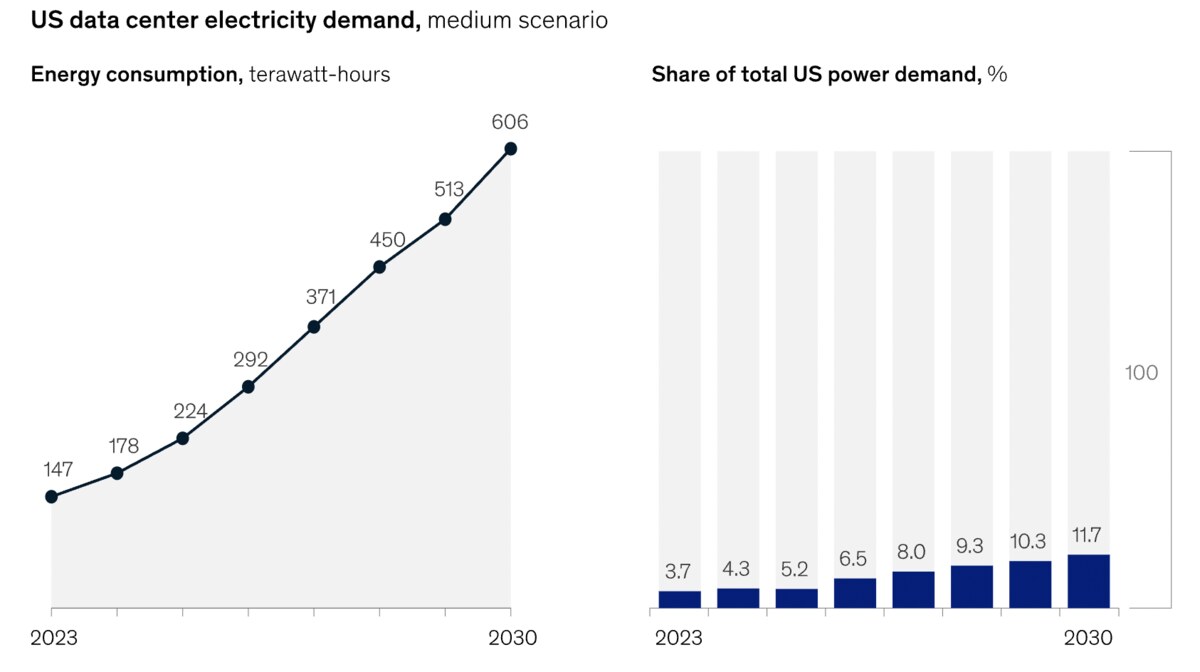
McKinsey analysis shows that global demand for data center capacity could more than triple by 2030. In the United States alone, additional electricity demand for data centers is expected to be about 460 TWh by 2030, three times the current level of consumption.
It is estimated that the US will need more than $2 trillion to upgrade its energy infrastructure to cope with this load. The problem is that building large power lines takes 3-7 times longer than laying internet lines, and planning and obtaining permits can take up to 10 years.
The consequences of this growth are dramatic. On July 10, 2024, a small fault on a high-voltage line in the US “Data Center Alley” forced more than 60 data centers with a total capacity of 1.5 GW to immediately switch to autonomous power from diesel generators. This caused such a sharp reduction in the load on the network that it almost led to an imbalance and lockdown over a large area.
A prime example of a critical load was Elon Musk’s xAI company, which announced plans to expand its Colossus supercomputer in Memphis to accommodate up to 1 million graphics processing units (GPUs). However, the local utility, MLGW, publicly warned that Memphis’ infrastructure may not have the capacity to support such ambitious plans.
MLGW CEO Doug McGowan called it “a physics problem, not a political problem.” xAI was forced to self-finance the construction of a new substation just to meet its initial request for 150 MW. Musk also found himself at the center of a scandal over the installation of illegal and unauthorized gas turbines for his Colossus data center, which had a total capacity of almost half a gigawatt.
Country-sized consumption
According to Goldman Sachs, energy consumption in data centers dedicated to AI/ML tasks will increase from 7.7 GW to 22.7 GW by 2027, which is three times the current figure.
In 2022, global consumption already exceeded the combined consumption of France and the United Kingdom. By 2027, the energy required to operate AI could be equal to the consumption of entire countries , such as Sweden or Argentina.
Open AI is planning to build a next-generation Stargate data center with a potential consumption of 7–10 GW, which is equivalent to the power of 7–10 nuclear reactors. Sam Altman sometimes gives figures up to 50 GW. For comparison, this is practically equal to the entire pre-war generating capacity of Ukraine (50–55 GW).
By 2035, energy will be a critical factor in the development of artificial intelligence. Computing capabilities will no longer be limited by hardware performance, but by available megawatts of power and cooling resources.
Price per request
In general, the energy consumption of AI is divided between two main processes: training (building bigger and smarter models) and inference (processing billions of daily user queries). While training consumes huge amounts of electricity, daily inference (providing answers) is an endless marathon of consumption. Let's take two of the most popular AI models as an example.
Google Gemini: One average query to the Gemini model consumes 0.24 watt-hours of electricity. This is equivalent to the consumption of a 100-watt TV for 9 seconds.
ChatGPT: The average GPT-5 response (per 1000 tokens) can be around 18 Wh, and in peak cases up to 40 Wh. If we take the 2.5 billion requests per day that ChatGPT serves, this corresponds to the daily energy consumption of 1.5 million average US households.
Agree, it was not a small price to ask an LLM to write a birthday greeting and generate a video of a cat rushing to work in the guise of a superhero.
How the biggest "gluttons" satisfy their appetite
Hyperscale providers: AWS, Microsoft, Google, Meta and others account for at least three-quarters of the industry’s total energy consumption. The high demand for generation has led to an unprecedented boom in the segment of manufacturers of critical energy equipment. Shares of companies such as Caterpillar, Cummins and Rolls-Royce have grown even faster than shares of technology giants such as Amazon and Meta.
Due to unprecedented demand, FAANGs are being forced to become not only technology giants, but also energy companies, investing in generation.
Satya Nadella, CEO of Microsoft
The biggest problem we face right now is not a surplus of computing power, it's electricity. It's the ability to build data centers fast enough and close to power sources. If you can't do that, you could end up with a bunch of chips sitting in a warehouse that I can't get to power. That's actually my problem today.
Google is preparing to switch some of its data centers in Tennessee and Alabama to a new generation of small modular reactors (SMRs). The project, which is scheduled to start in 2030, involves using plants from startup Kairos Power, which operate on molten salt technology, which is considered safer.
In the coming years, the main limitation for AI will be not just GPU power and memory shortages , but the capabilities of power systems. For the first time, the industry is resting not on algorithms or chips, but on megawatts and the infrastructure that can deliver them.
The future of AI now depends not only on software engineers, but also on those who build reactors, substations, and power lines.
RAM prices are rising faster than gold and have already caught up with PlayStation 5. This is just the beginning: we talk about the new chip crisis and who it will affect
One and a half times faster than Gemma 3. Interview with the leader of the Lapa LLM project — the most efficient large language model for the Ukrainian language
Ukrainian answer ChatGPT. How Kyivstar and the Ministry of Digital Economy will build a national LLM for Ukraine: insights and international AI experience VEON