Ігор Вишневський That's Life
16 December 2025, 09:33
2025-12-16
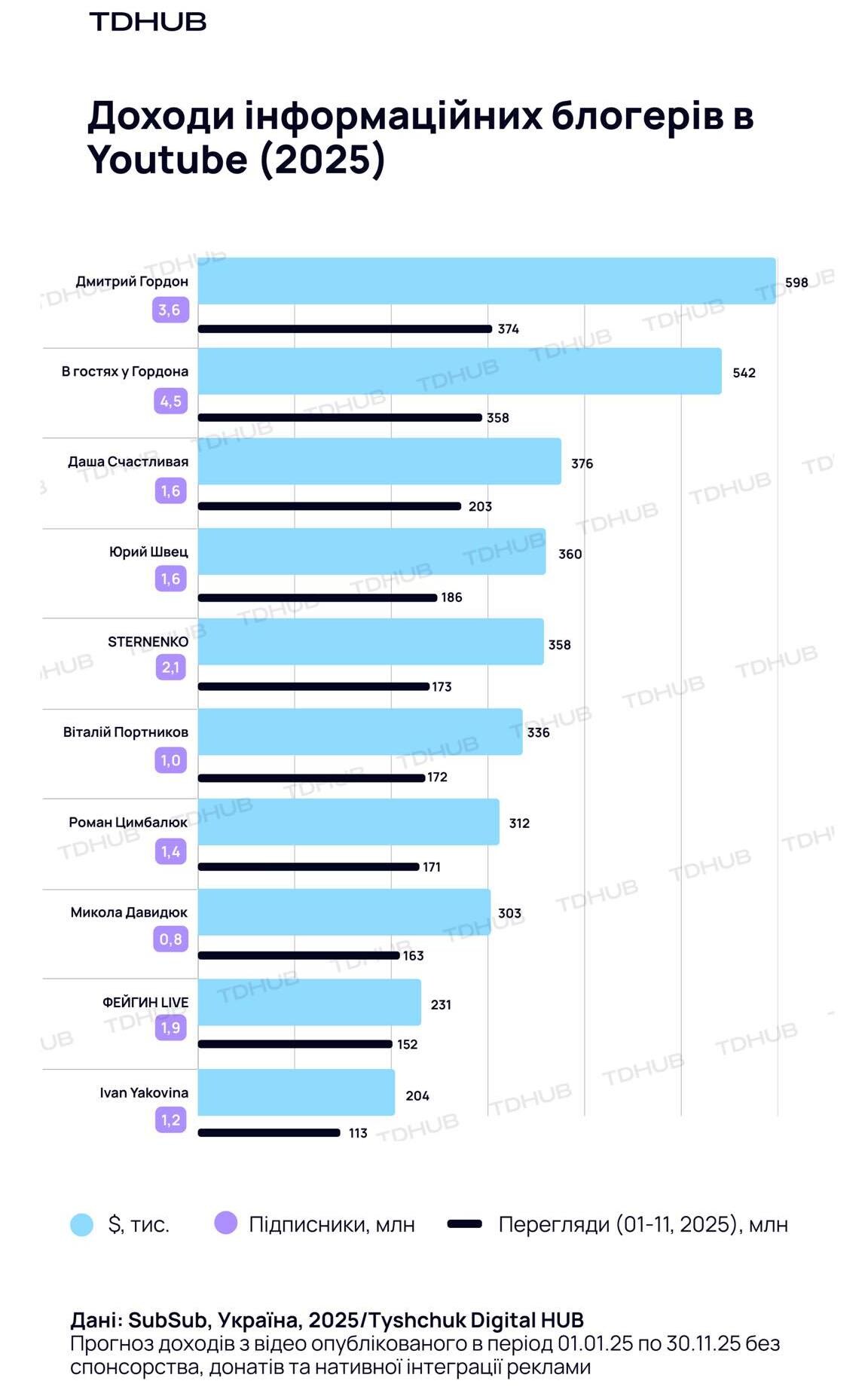
Gordon's two YouTube channels earned him at least $1 million this year. Sternenko and Portnikov earned three times less. Who else is in the top of Ukrainian YouTube
Dmitry Gordon’s two YouTube channels — «Dmitry Gordon» and «Visiting Gordon» — brought their owner at least $1 million in content views.
Dmitry Gordon’s two YouTube channels — «Dmitry Gordon» and «Visiting Gordon» — brought their owner at least $1 million in content views.
This was reported on Facebook by the head of Tyshchuk Digital HUB, Olga Tyshchuk-Volska, who published a rating of Ukrainian YouTube channels and the amount of money they generate.
«A considerable amount, eh? So many Ukrainians have seen enough of clickbait, where Putin dies every month, and Moscow burns every week. I am sure that the top five infobloggers earn at least $30K per month on average,» she commented on Dmitry Gordon’s financial results.
Tyshchuk-Wolska added that the ranking takes into account the number of views, not the number of subscribers.
«I note that this does not include views from archived videos, so the amount could be even higher. Interestingly, only Gordon’s team posts 16 videos per day, while the rest of the dozen upload an average of 2 videos,» the expert analyzed.
According to the rating she provided, the top channels in terms of views, and, accordingly, monetization, are Dasha Schastlyvaya, Yuriy Shvets, STERNENKO, Vitaly Portnikov, Roman Tsymbalyuk, Mykola Davydyuk, FEIGIN Live, and Ivan Yakovina.
Tyshchuk-Wolska also points out that the study does not take into account revenues from sponsorships, donations, and native integrations, and the data is based on SubSub analytics.
Соціальні мережі та штучний інтелект формують глобальні наративи про війну в Україні. Як їх використовують українці та росіяни — аналітика від Foreign Policy
Напередодні вторгнення росії в Україну соціальні медіа слугували полем битви для держав і недержавних діячів, щоби поширювати конкуруючі наративи про війну та зображати поточний конфлікт у своїх власних інтересах. Видання Foreign Policy опублікувало великий аналітичний матеріал, як українці та росіяни використовують соціальні мережі, щоб давати інформацію про війну. Наводимо його адаптований переклад.