Хочете будувати кар’єру в Data Science та AI? Vodafone Big Data Lab відкриває новий набір —>
Олег ОнопрієнкоGameDev Eng
30 December 2025, 09:00
2025-12-30
From raw release to live Zone: S.T.A.L.K.E.R. 2 year in review
The first anniversary of the release of STALKER 2 is not just a calendar date, but the culmination of an unprecedented path of "fixing bugs." For many players, this year has become a long paid beta test, where they watched with their own eyes how the raw product gradually turns into the very game that was promised in the trailers. We tell you how GSC Game World fought technical disasters, returned cut features, and what came of it.
The first anniversary of the release of STALKER 2 is not just a calendar date, but the culmination of an unprecedented path of "fixing bugs." For many players, this year has become a long paid beta test, where they watched with their own eyes how the raw product gradually turns into the very game that was promised in the trailers. We tell you how GSC Game World fought technical disasters, returned cut features, and what came of it.
Release status: unstable Zone
The launch of the game on November 20 last year can be described as a small disaster. Players were faced with extremely polar opinions: from the wild joy of veterans to the disappointment of fans of mods like Anomaly , who expected a completely different gaming experience. Despite the coolly conveyed atmosphere, most of the discussions revolved around the technical state of the game. Fans of the series, who had been waiting for a sequel for 18 years, joked that it could not be otherwise: “this is a tribute to the tradition of the first “Stalker”, which was also criticized for poor optimization at the release”. However, for new players, on whom the developers themselves were betting , such arguments turned out to be unconvincing, so many gamers simply issued refunds or postponed the game until better times.
Main technical and gameplay claims at the start:
The game was incredibly CPU-intensive, especially on stalker bases. Owners of 8GB graphics cards suffered from constant lag, while endless shader caching and RAM leaks could lead to a complete system freeze.
The hacked A-Life 2.0 can rightly be considered the biggest disappointment of the stalker community. The life simulation system, which GSC actively promoted as revolutionary, was virtually absent at release and did not even come close to the level of previous parts. The zone felt empty, and the NPCs behaved extremely illogically. After the release, the mention of A-Life 2.0 as a revolutionary system was “surreptitiously” removed from the game’s description on Steam.
Mutants were real "bullet sponges", withstanding an incredible number of hits even on low difficulty. NPCs had "sniper" accuracy with shotguns at crazy distances. Repairing equipment cost more than new weapons, and the weight of some items in the inventory was illogical.
The guards' "bald heads" could hang in the air, trees appeared right in front of the player's nose, and the geometry in Pripyat was broken.
The fundamental reason for the technical condition, experts say, was the premature transition to the Unreal Engine 5 engine, which was too raw at the time, and with which the studio had not worked before. The development of STALKER 2 initially began on the previous version of Unreal, while the original trilogy was developed on GSC's own X-Ray Engine. It is worth noting that most modern games that use Unreal Engine 5 are released poorly optimized due to the specifics of the engine.
In general, the current GSC team is a team created almost from scratch and by and large STALKER 2 is their first project with such a composition. Yes, the team includes veterans of the studio, but the challenges caused by the war and the relocation of the studio from Kyiv to Prague greatly influenced the development process and the concept of the game. Even the complaints about A-Life 2.0 could have been less if the key programmer of this system , Dmytro Yasenev, had not had to take up arms to defend Ukraine from the occupier.
Despite its poor condition and the game's availability on Xbox Game Pass, where the game was available by subscription for only the first week, Heart of Chernobyl sold 1 million copies in the first two days.
The first phase of rescue
GSC Game World responded to the criticism instantly. A week later, patch 1.01 was released, containing over 650 fixes. This was just the beginning of the “patching marathon.” In less than a month, the number of reported bugs exceeded 2,500. In the future, major updates were released almost every month.
Patches 1.1 and 1.2 focused on stabilizing the game: they fixed quests that did not start and soft lock missions, when during the passage some bugs stopped the progression of the plot. One of the funny but revealing changes was the fix for the ability to use a loaf as armor. Patch 1.2 also introduced weapon status indicators in the inventory and the first attempts to implement contact shadows from a flashlight.
As of March this year, the game has been played by 6 million gamers . This is a good result considering the game was not released on PlayStation 5 for a whole year due to a temporary exclusivity with Microsoft.
However, at this point the game was still far from perfect - progress was visible on paper, but fundamental issues like performance and A-Life still needed a deep overhaul. Each new patch contained a wall of text about a number of fixes and improvements, but overall it wasn't enough for players, who began demanding that GSC share concrete plans for the game's development.
Tipping Point and Roadmap
The real shift in the perception of the game occurred in the spring and summer of 2025. When GSC presented a roadmap that promised the return of classic features, as well as a Mod Kit for modifying the game. From this moment on, not just a "fix" of the game begins, but its direct improvement through the addition of new mechanics.
The real breakthrough was patch 1.5, released in June, which revived the A-Life system. For the first time, the life simulation system worked as the developers intended, although far from ideal. NPCs received their own goals, began to travel the Zone independently of the player, engage in battles and interact with the world, but the "bubble" that spawned the NPC remained within a radius of 50 meters from the player.
The long-awaited mutant looting was also implemented, which added motivation to the hunt and strengthened the role of scientists as trophy buyers.
Lip syncing for the Ukrainian voice acting has finally been added, as it previously only worked for the English version.
It was after 1.5 that the game began to gradually bring players back to it.
The second roadmap promised even more : night vision devices, binoculars, and an update to the Unreal Engine 5.
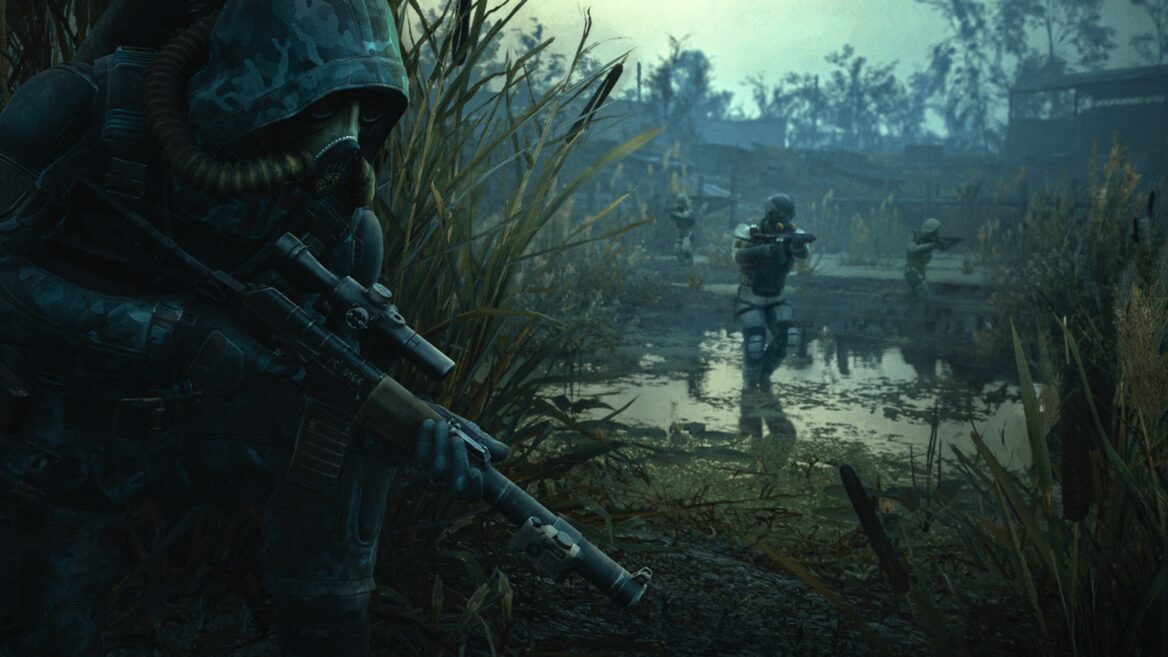
In patch 1.6 "Night of the Hunter", three models of PNB appeared - from simple monocles to advanced devices. This radically changed the night gameplay. At the same time, stealth was adjusted: it became more difficult for NPCs to notice the Scythian in bushes or reeds.
The new quest line featuring Gonta (a character from "The Call of Pripyat") not only entertained veterans, but also introduced newcomers to the mechanics of monster hunting.
For the game's anniversary, patch 1.7 added the highest difficulty level, which, combined with the "Expedition" mode, which allowed saving only in large hubs or during key moments, turned the game into a true hardcore experience.
A-Life was pumped even more, the spawning "bubble" was doubled and now the player rarely encounters a sudden appearance of enemies, and the non-game characters themselves received more goals in the Zone. So one of the tasks for the NPCs became the struggle for control over territories and now every mutant or stalker often clashes with each other. Such activity of artificial intelligence often generates cool situations that do not require direct player involvement, and some conflicts can be learned about after the fact, as indicated by the many corpses. Finally, the A-Life system began to resemble itself from the times of the original trilogy.
For the first time since its release, STALKER 2 has received a significant optimization boost. According to tech experts at Digital Foundry, the average frame rate per second has increased by 20%. This is no longer a "lagerker", but a well-optimized game.
The inventory was also completely redesigned, making it stylistically close to "Call of Pripyat", which significantly simplified resource management and added clarity to the impact of artifacts on the player's condition.
Since the technical state of STALKER 2 has been fixed, patch 1.8 is completely focused on new content. If the quest line of Gonta is a small adventure, which is more focused on explaining new mechanics, then “Untold Stories” is a whole chain of new quests from five to eight hours long. Some locations have been reworked and supplemented with new levels and interactions. Two new weapons and two modifications of old ones have appeared in the Scythian arsenal. The story itself of “Untold Stories” completes the cycle of ARG quests from the developers, and gradually leads to the events of future DLCs .
The zone doesn't let anyone go.
Over the course of a year, STALKER 2 has gone from a raw release to a solid finished project. The main result is that the game has finally become stable with new features and content. There are many times fewer bugs, optimization allows you to play even on average systems (although for perfect smoothness you still need powerful hardware), and the content content (PNB, new anomalies, quests) fills the Zone with life.
Despite the fact that not all of the promised functionality from the roadmaps has been implemented, for example, binoculars have not yet been added (their implementation is expected next year), the potential for the game's development is great.
An update to Unreal Engine 5 to a more stable version should finally solve the game's lighting and performance issues. Work on add-ons is already underway. Rumors and code finds point to a return to Limansk and a new story around a character named Nord.
The game's recent release on PlayStation 5 was met with much greater enthusiasm by gamers, with Ukrainians pushing it to the top of the local PlayStation Store. The number of concurrent online players on Steam indicates a return to focus since patch 1.5, and by the time version 1.8 was released, it had reached nearly 14,000 players, its highest level since February.
If you've been waiting for the Zone to become more stable or have been held back by technical anomalies, now is the best time to dive into the Stalker movement and explore its secrets.
"Aggressive Russophobic Content." The Prosecutor General's Office of the Russian Federation declared the studio that developed STALKER 2 an "undesirable organization"
"The Zone, like real life, does not forgive mistakes." STALKER 2 developers together with the State Emergency Service released a video about the dangers of suspicious objects