Хочете будувати кар’єру в Data Science та AI? Vodafone Big Data Lab відкриває новий набір —>
Марія БровінськаІсторії
16 September 2025, 09:00
2025-09-16
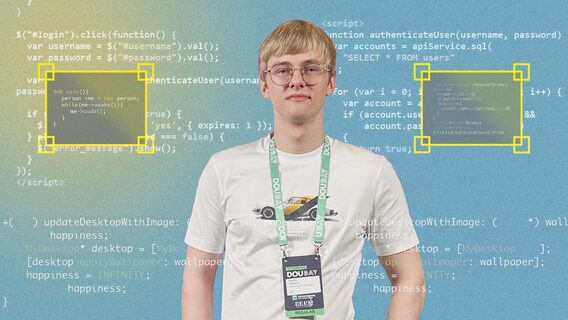
“I hated programming and never thought IT would be my life.” The story of a developer whose career was forced to start at 16. Now 19, he is already a middle manager at his dream company and plans to found his own startup in the U.S.
The story of 19-year-old Maksym Tyulyukov from Mykolaiv is about a thirst for knowledge, uninvited cardinal changes in life due to the war, and a successful attempt to build an IT career while still in school. He is perhaps the youngest middleware developer that the dev.ua editorial team has ever heard of. His career in IT began at the age of 16.
The fact is that Maksym is from Mykolaiv. And in the first 10 days of a full-scale war, he saw a column of tanks with Z-tanks in person, and realized that he had to leave. For the next six months, the guy and his family lived in Bulgaria, but due to hardship and moral exhaustion in a foreign country, they returned to Ukraine and settled in Odessa. Currently, Maksym is a student at the Odessa State University of Intellectual Technologies and Communications. He works at his dream company and ambitiously plans to move to San Francisco, found his own startup, and, of course, work for global tech giants.
Today’s story is about the difficult but inspiring path of a young man who confidently steps towards his dream despite the war, forced relocations, and circumstances that arise unexpectedly. Next is a direct speech by Maksym, who at 19 is already a Middle Back-End Engineer at OBRIO.
The story of 19-year-old Maksym Tyulyukov from Mykolaiv is about a thirst for knowledge, uninvited cardinal changes in life due to the war, and a successful attempt to build an IT career while still in school. He is perhaps the youngest middleware developer that the dev.ua editorial team has ever heard of. His career in IT began at the age of 16.
The fact is that Maksym is from Mykolaiv. And in the first 10 days of a full-scale war, he saw a column of tanks with Z-tanks in person, and realized that he had to leave. For the next six months, the guy and his family lived in Bulgaria, but due to hardship and moral exhaustion in a foreign country, they returned to Ukraine and settled in Odessa. Currently, Maksym is a student at the Odessa State University of Intellectual Technologies and Communications. He works at his dream company and ambitiously plans to move to San Francisco, found his own startup, and, of course, work for global tech giants.
Today’s story is about the difficult but inspiring path of a young man who confidently steps towards his dream despite the war, forced relocations, and circumstances that arise unexpectedly. Next is a direct speech by Maksym, who at 19 is already a Middle Back-End Engineer at OBRIO.
«I hated programming»
To begin with, I’ll say that I used to hate programming and never thought that IT would become my life. But let’s start in order. I was fascinated by computers since I was a child. My parents, noticing this, decided that I needed to improve in this direction. And they enrolled me in a small academy «STEP» when I was 9. There we tried ourselves in different areas, such as design, 3D modeling, video editing, creating websites and games, and eventually programming in different languages, etc. Programming was difficult for me, so it was my least favorite activity.
Time passed, and after graduating from the junior academy, I was offered to continue my studies at the senior academy, where I could choose from three areas: development, design, or system administration.
My parents said I had to go, and I had no choice. So I chose development because I was a so-so designer and system administration scared me.
How I still remember the summer of 2020: I was 14, and we were taking C++. It was so hard for me, I just hated it. I wanted to go out and run around in a football game with my friends, but no, my parents paid for it — so sit and study. I was very behind the group, because I was often on my phone, and it was just Covid times and online learning.
Once I came across a video on Youtube about design gates, and for some reason it interested me so much that I decided to dig further. At that very moment, a thought flashed through my mind: «All this time I have had a tool in front of me to do whatever I want, and I’m deliberately ignoring it?» And I started to catch up with the group, while simultaneously studying something else on my own, and that’s when I realized that I wanted to connect my life with IT.
The first adult decision
In the courses, I loved C#/.NET, I wrote a lot of pet projects on it, watched technical content only on it. And I remember someone telling me «your first job will never be with the stack you love,» so I understood that the stack would choose me. And I was ready for that, because I had the mindset «a programming language or any framework is just a tool.»
By the way, my first job found me, but not because of my beautiful eyes, but because of the proactivity and enthusiasm I showed during the courses, and for my powerful diploma project.
In «STEP» at the end of the course there is a thesis, at the defense of which my future tech lead was present together with a teacher who also worked at that company. The project that we presented was initially my pet project, and then grew into a full-fledged non-commercial project that we wrote as a team of students, where I acted as a team lead.
So, everyone liked our project, we defended it fantastically. And after successfully completing the course, I was offered a part-time job at LAB325 (at the beginning).
For me, it was a very difficult decision. After all, on the one hand, my mother and I were forcibly relocated from Mykolaiv, while my father remained there because of work, and he worked very hard to provide for us. I understood how difficult it was for him. On the other hand, I am still a young man and I have everything ahead of me, I need to concentrate on studying and preparing for the NMT.
Then I made my first adult decision: I confidently accepted the offer to work to relieve my dad and not be a burden on him. I promised my parents that I wouldn’t fail the NMT.
Many «firsts»
My first job was Node.js, JavaScript, GraphQL. I developed in this direction, then I taught myself Nest.js and TypeScript, I saw that it was in demand in the market.
I was very nervous before my first day at work, but it was also a very interesting experience: for the first time in my life I had to sign something, provide some copies of my documents, and understand all these abbreviations, which my still childish mind was not used to.
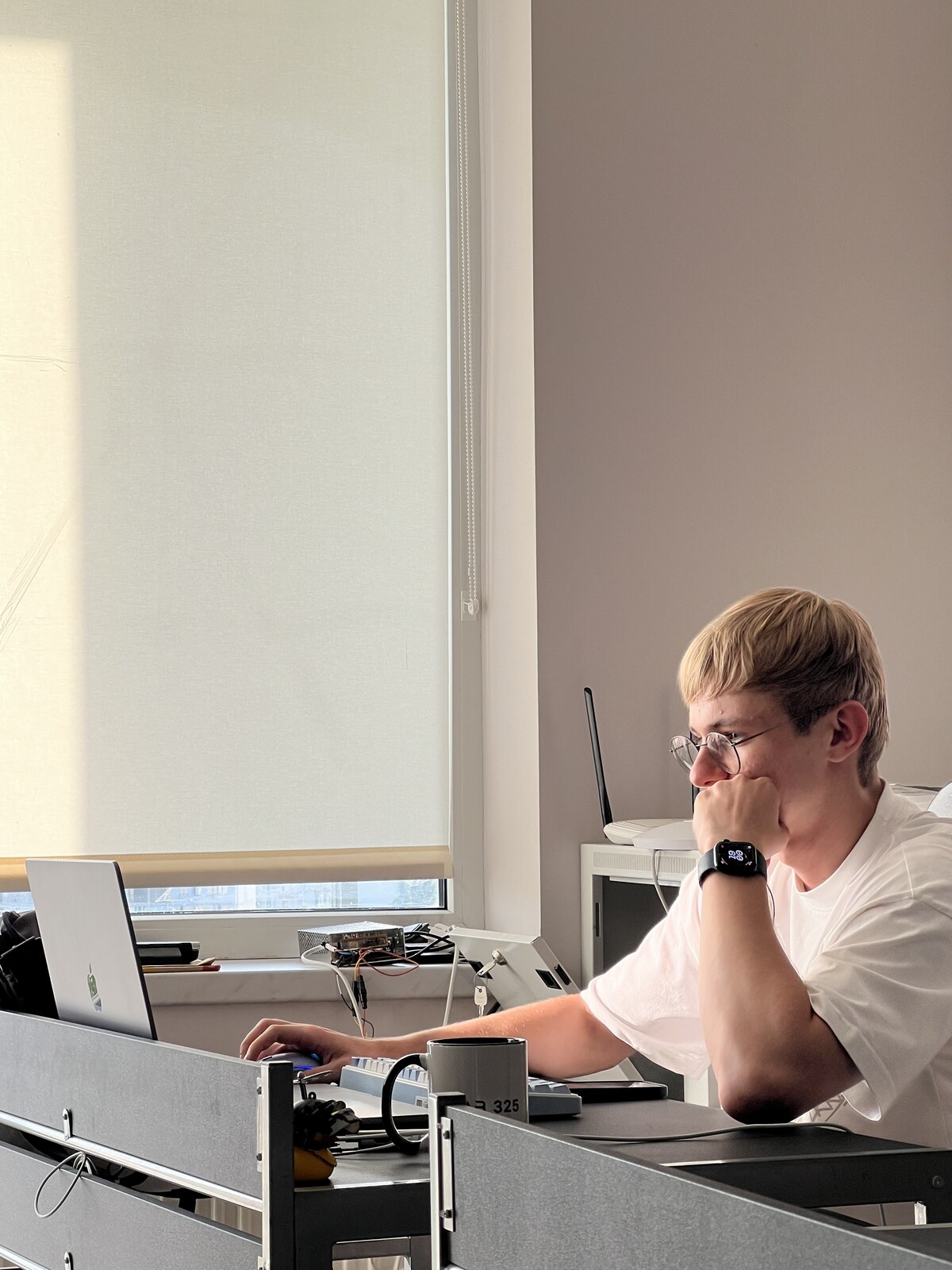
I couldn’t have imagined a better place for my first job. Firstly, it was an office, which means you see people in person, and if you need something, you can call someone. Secondly, I was very warmly welcomed into the team, they helped me with everything, were understanding, and shared their knowledge with me.
I stopped feeling lonely. I had it because I was in a new city, all my friends had left, and I had no friends in Odessa. And here they appeared, and I could finally talk to them about IT! My school class teacher was very happy for me. My friends also praised me. I became an example for them, which motivated them to work too.
I liked everything, everything was cool, everything was going well for me at work. I passed the NMT so well that I even got into university on a budget, although I had previously told my parents that only contract studies would work for me.
The most difficult thing was next…
On two chairs
Combining work and university was difficult. My schedule looked like this: wake up at 6:00, go to the gym, sit on the treadmill, go to the office, work, walk home for half an hour, do homework until night, repeat. To say that it was exhausting is an understatement. Then came the gym, blackouts, and shelling.
The university and the teachers themselves didn’t even think that students could work in their first year. But I broke stereotypes.
I never gave up, I just kept going. I had discipline. My inner voice told me to quit many times. I didn’t listen to it, because those who give up never change the world.
By the way, a funny fact: in my first year, I prayed that I wouldn’t be expelled, but in the end I got a scholarship.
Career ladder
My career was developing rapidly. In the first company I was gaining experience, but I had almost no growth in grade and salary, and after a year and a half of work I realized that I was stuck in a rut, doing the same job over and over again. I felt that I could do more, I wanted new career challenges, I wanted to have more responsibility, so I decided to monitor the market and look for a new job.
At that very moment I became a midget. Fake it till you make it. Subconsciously I knew that this was the level I would reach. So the transition from a jun to a midget took 1.5 years.
My success driver is the ability to learn and adapt quickly. Every company is different, every project is different, and I have worked in a variety of industries throughout my career, from Healthcare to Web3. I simply wouldn’t be able to keep so much information in my head without this skill.
Of course, I’m gradually gaining experience and knowledge, I’m sure that if I move along this trajectory, I’ll become a senior. But if I were to set a deadline for myself, I would take the next two years, during which I would like to grow to this grade. I think it’s quite possible.
Age as a feature
Being the youngest in the team is my specialty. In fact, I don’t remember any particularly funny incidents, but new people always reacted to my age with admiration, and always showed respect. There was never a time when someone «looked down on me.»
However, at business meetings and professional forums, entrepreneurs often didn’t take me seriously because of my age. They looked at me as if asking, «Boy, who are you?»
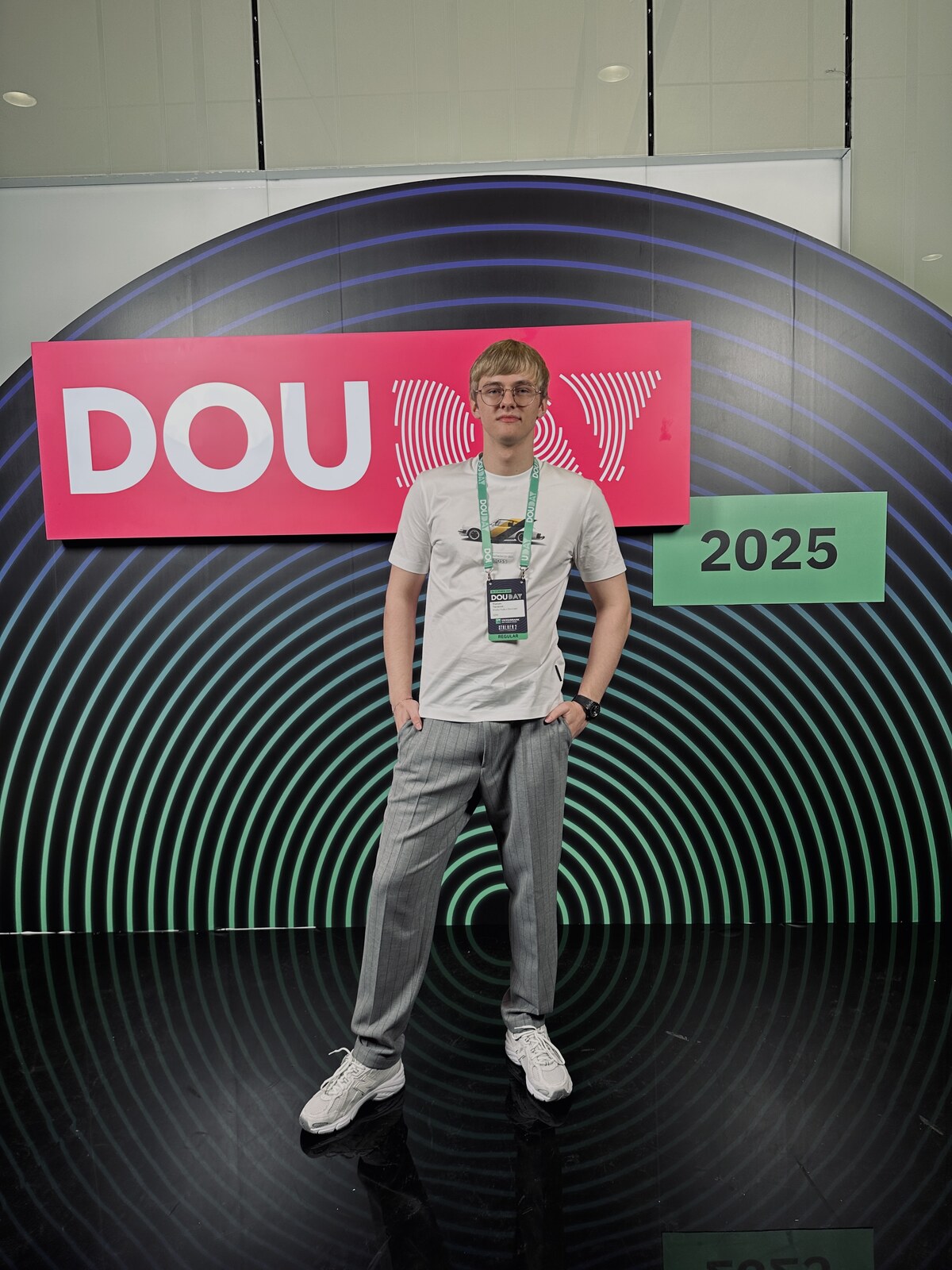
Usually, a conversation with them looked like an interview. This makes me think that in this regard, IT and other businesses are very different. I was at two DOU events — both brought cool acquaintances. With IT people, despite the age difference, it is very interesting to discuss something. People were interested in a normal dialogue with you.
From work to work
During these three years in IT I changed jobs quite often, but not because of the good life. My hardest and longest job search lasted several months. It was a very valuable experience after the first job. I received many rejections even when I thought that a 100% match would happen.
Then I changed my tactics, I decided not to chase butterflies, but to build a beautiful garden so that butterflies would fly to me. Yes, yes, I started seriously working on LinkedIn packaging.
A week later, I was offered a job as a middleman at a company that deals with Web3, I passed the screening and technical interview — and lo and behold, an offer. Officially — middleman at 18! The offer was 1.5 times what I had at my previous company.
And another fun fact: my very first company laid off most of its employees exactly two weeks after I left the company. I learned a very useful lesson for myself — anything can happen, which is why you need to constantly be on the market, monitor it, not lose your interview skills, and have an up-to-date CV.
During the three months that I worked at a new company, I received a lot of offers on LinkedIn, which I refused. Until I analyzed the market and realized that I could earn more with the opportunities I had. In addition, the Web3 sphere did not impress me at all, although I understood this niche quite well thanks to my skills to learn and adapt quickly.
The skill of «selling yourself» and a dream job through a chance meeting
I responded to the first offer on LinkedIn, then I asked for x2 of my current salary, thinking that if I had to go, then for a reasonable amount of money. I liked the company, during the interview I discovered some red flags in the current company. I sold myself very well, asked the right questions, shared relevant experience for the vacancy, taking into account all the mistakes of previous interviews.
I almost didn’t expect anything, they said, well, it will happen, it won’t happen — it won’t happen, because I’ll still have a job. At the time, I was very surprised that I got an offer, but now I understand that I’ve pretty much improved the skill of «selling yourself.» And it’s very important when looking for a job. Some people consider it more important than hard skills. After all, you can be an outstanding engineer, but if you can’t show it at an interview, if you can’t pack it well in your resume and LinkedIn, then no one will know how cool you are, and you’ll complain that the market is bad.
Time flew by, I went to my first IT event — DOU Day 2025. I was blown away there. In the literal sense of the word.
I met the lead from OBRIO who recommended me for the job. Knowing a lot about the company and remembering a YouTube video from a backend developer from OBRIO, I started a conversation about it. I was very interested in how she talked about the company. She dispelled my stereotype that in large companies there is usually a lot of bureaucracy and a minimum of freedom for an engineer. We also had a great time exchanging experiences with highload and microservices, and I immediately became interested in the idea of getting there.
My motivation is to make an impact in the world, to benefit millions. OBRIO is what I was looking for all this time, it is a product for millions of users, and what’s more, it is a cool environment for an engineer. Unfortunately, the outsourcing companies I was in covered one of two things, but not both at the same time. Therefore, it was an incredibly interesting opportunity for me to try myself in a product company.
This time I prepared as seriously as possible with fire in my eyes. Despite the high competition, and the high bar for talents in the company itself, I showed myself (I will be immodest) phenomenally. Here, as expected, I received an offer, which, to be honest, differed very little in terms of money from what I received in the current company, but I took the risk to grow as a specialist. And it was my best decision.
To sum up, I received up to 15 rejections in total during my first job search, but this statistic was improved by the fact that I successfully passed the last three interviews and received offers.
What’s next?
In the near future, I plan to develop hard skills to be a cool senior tomato. And also develop managerial and leadership qualities to be even more useful for business in the future. I dream of trying myself as a team leader.
My distant dream is to move to San Francisco, get into Y Combinator, and start my own startup. I will definitely hire the Junes so they can grow, just like I did.
The ability to «sell yourself» definitely helps with finding a job. The ability to learn quickly helps you stay afloat in such a dynamic industry as IT.
I’m also looking towards FAANG (or as they’re now called, MANGO), I see it as a logical next step in my career, but probably not in the near future.
Some advice for young IT professionals
Every young IT professional should remember this phrase: «Outstanding people will always stand out.» Don’t be afraid that the market is overheated, that it’s not doing well, and that now «it’s not like before.» If you’re cool, you won’t have any problems. There are a lot of candidates on the market, competition is high, and you have to stand out from the crowd!
Maximize all possible skills — both hard and soft. Learn to sell yourself, package your experience, and be sure to create your LinkedIn and be active there. If you have something to say/show the world — don’t be afraid to do it — it will only be a plus for you. Attend all kinds of IT events — don’t be creative. It helped me find my dream job, and it will help you!
And be sure to brush up on your English, it’s in demand everywhere.
Iterate. Learn from your mistakes. And never stop! You got this!
«Climbing the peak felt like moving to a new level in the game.» The story of a manager from ERAM who became the first Kharkiv resident to summit Everest
«You need to have one job that brings in enough money.» Ukrainian fencer who represented Ukraine at the Olympics and built a sports career is now a Lead Software Testing Engineer. How it happened: here’s her story
Професії у геймдеві. Хто такий левел-дизайнер і як ним стати?
Ми продовжуємо нашу рубрику, присвячену професіям у геймдеві. Тема нового матеріалу в ній — левел-дизайн. Його вважають підвидом геймдизайну, але все-таки практично кожна студія хоче окрему людину на позицію левел-дизайнера. Адже у цій спеціальності вистачає своїх нюансів та особливостей.
Розібратися з ними всіма нам допоміг досвідчений левел-дизайнер зі студії Fractured Byte Дмитро Нестеренко. Також він веде свій блог Game Designer Notes про геймдизайн в цілому, в якому розбирає багато цікавих нюансів розробки ігор.