Хочете будувати кар’єру в Data Science та AI? Vodafone Big Data Lab відкриває новий набір —>
Марія БровінськаWork
16 April 2026, 09:00
2026-04-16
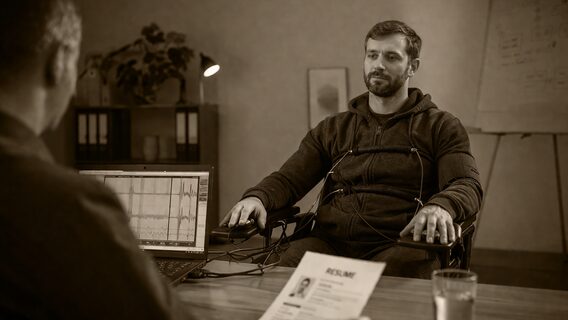
Polygraph, office, OSINT check and up to 5 stages of interviews. How IT specialists are hired at BlueBird, General Chereshnya, Himera, Frontline Robotics and other defense companies: a mini-guide for those who want to work in DefenceTech
Ukrainian defense-tech has long ceased to be a narrow niche for military engineers. Today, software developers, embedded specialists, data engineers, QA, product managers, R&D teams, designers, and operations specialists are moving here. The reason is obvious: complex tasks, a fast development cycle, and the feeling that your work affects more than just business metrics.
However, with this comes specific hiring. The sector may conduct background checks, require an offline format, give applied tasks, and in some cases, conduct a polygraph test.
dev.ua spoke with recruitment specialists from Ukrainian defensetech companies — General Chereshnya, HIMERA, BlueBird Tech, WIY Advanced Aerial Systems, The Fourth Law, Odd Systems, and Frontline Robotics — and explains what to expect from an IT professional who wants to move into the most promising industry today.
Ukrainian defense-tech has long ceased to be a narrow niche for military engineers. Today, software developers, embedded specialists, data engineers, QA, product managers, R&D teams, designers, and operations specialists are moving here. The reason is obvious: complex tasks, a fast development cycle, and the feeling that your work affects more than just business metrics.
However, with this comes specific hiring. The sector may conduct background checks, require an offline format, give applied tasks, and in some cases, conduct a polygraph test.
dev.ua spoke with recruitment specialists from Ukrainian defensetech companies — General Chereshnya, HIMERA, BlueBird Tech, WIY Advanced Aerial Systems, The Fourth Law, Odd Systems, and Frontline Robotics — and explains what to expect from an IT professional who wants to move into the most promising industry today.
Hiring here is rarely limited to two calls
If in classic IT, a candidate is used to HR screening, a technical interview, and an offer, then in the defense sector the process is usually longer and deeper.
Most often, it is from two to five stages, depending on the role and level of access to internal processes.
In HIMERA, in particular, they talk about 2–4 stages depending on the position.
At Frontline Robotics, a typical scenario consists of two or three steps: first, a competency-based interview with a recruiter, then a technical conversation with the participation of specialized specialists and managers. For some roles, a test task is added. If the candidate is strong and the company does not want to waste time, the hiring manager can join in at the first stage — to get to know each other faster and explain what the team is working on.
The Fourth Law and Odd Systems describe the process as three key stages: getting to know the recruiter, a deep technical check with prospective colleagues, and a final conversation with the team lead. For individual vacancies, they may add a small test task to see the person in a real case.
One of the most detailed processes is at General Chereshnya. There are five consecutive stages: CV check, screening with a recruiter, technical interview, further verification by the security service, and the final step — an offline meeting, a test task, or an immediate offer.
Security checks can start before the first call
Another of the main differences between the defense sector and classic IT is the candidates' compliance with the company’s security standards.
At General Chereshnya, the security service and OSINT agency are involved in the process at the resume analysis stage to verify the candidate. This may be followed by a separate security interview and a polygraph. The company explains: the key issue is not household items, but possible connections with an aggressor country, contacts with enemy special services, and other risks that are critical for the defense sector.
At Frontline Robotics, all candidates without exception undergo a polygraph. This is called standard practice regardless of role, which is intended to minimize risks to the team. TFL/Odd also uses a polygraph as a mandatory stage and explicitly calls it a security standard for deftech.
BlueBird Tech is no exception — the company includes a polygraph in its three-step hiring process. They emphasize that it is about protecting internal processes, production, and business secrets.
At the same time, there are companies with a different approach. HIMERA, for example, does not use a polygraph and says that it makes decisions based on verifiable facts, relevant experience, and expert judgment.
And WIY Advanced Aerial Systems uses spot checks only for roles with access to confidential information, expensive equipment, or critical technologies. The candidate is warned in advance, and passing is voluntary.
The biggest dropout occurs before the technical interview
Despite the shortage of personnel, defense companies filter candidates quite strictly at the start.
General Chereshnya says that about 80% of candidates are eliminated at the resume stage. The most common reasons are irrelevant experience, a poorly prepared profile, or potential security risks. Of those who pass, some refuse on their own. About 20% are not ready to work in an office format, another 20% do not have the internal motivation to go to defense or do not match the company’s values. Another 10% do not pass security checks or a polygraph.
At WIY Advanced Aerial Systems, approximately 30–40% of candidates reach the offer. Most often, the process stops due to insufficient practical skills, lack of systematicity, weak independence in decision-making, low adaptability to rapid change, or unrealistic expectations regarding compensation, role, or work format.
Some candidates exit the process on their own — after completing a test task, getting to know real working conditions, or understanding the pace of the workload.
Technical interview — not theory, but real tasks
Another notable difference from classic IT is the focus on applicability.
WIY Advanced Aerial Systems can provide engineers and R&D specialists with real-world case studies, 3D specialists with test tasks that are as close as possible to future work, and UAV pilots with simulators or practical tests. The company explains that it is important to assess not only knowledge, but also the approach to the task, the ability to work without a ready-made template and act in a limited time.
Frontline Robotics also looks primarily at whether a person is capable of solving the problems they will encounter every day, not just knowing the theory.
A strong CV alone is no longer enough
Almost all companies surveyed say that today they are hiring not only based on the technology stack.
HIMERA lists motivation and soft skills among the key criteria. For Frontline Robotics, it is important how the candidate analyzes the problem, makes decisions, takes responsibility for the result, and whether he is compatible with the team.
WIY Advanced Aerial Systems looks much wider than a resume: type of thinking, logic, structure, speed of learning, discipline, tolerance for uncertainty and interest in the field. The company’s recruiters directly distinguish between two types of candidates: those who are «looking for any job» and those who «want to work in this particular field.» The latter are considered the most effective in the long run.
The Fourth Law and Odd Systems formulate it even more harshly: the company is looking for «ideological pros.» They believe that it is difficult to be effective in deftech if a person came only for the salary.
Companies are paying particular attention to management roles.
BlueBird Tech explains: while adequacy, motivation, relevant skills, and practical experience are important for line positions, for management roles the ability to work with a team, make decisions, take responsibility, and demonstrate leadership becomes critical.
For IT professionals with management experience, this is an important signal: they are looking for not just a team lead in the title, but a person who is able to maintain results in a complex environment.
Why offline is still important and what IT professionals should prepare for before submitting their resume
For some candidates, the biggest surprise is not the polygraph, but the format of the work. In defense companies, remote work is often less common than in classic IT. The reasons are obvious: working with equipment, test areas, closed circuits, prototypes and sensitive information. That is why some candidates leave the distance after the first conversation, when they learn about the office or mixed format.
If we summarize the companies' responses, a candidate will usually be evaluated in several areas:
technical base and practical skills;
ability to solve non-standard problems;
independence and speed of learning;
motivation to work specifically in defense;
values and team compatibility;
security background and level of trust.
So before submitting your resume, you should not only update your LinkedIn and GitHub, but also honestly answer yourself the question: are you suited to a fast pace, offline format, high level of responsibility, and stricter checks?
In general, it is worth understanding that Defense-tech in Ukraine is actively looking for people, but hires much more selectively than regular IT. Here you can get more complex tasks, more influence and a sense of meaning in your work. But in return, maturity, discipline, flexibility and high trust are expected from the candidate. Therefore, the main question for an IT worker is not «will they take me», but «am I ready to work according to the rules of this industry».
1000 or more vacancies in the defense industry. What specialists are being sought in Ukrainian miltech — we talked to recruiters at the «Arsenal of Talents»