Марія БровінськаRobots
8 October 2026, 10:00
2026-10-08
“The hardest thing is to find an engineer who understands the battlefield.” CEO of ARX Robotics Ukraine on personnel for defense tech, AI in defense and the prospects of robots in war
Ukrainian defense tech is developing rapidly, but companies are faced with an increasingly difficult task: not just to create a technological product, but to bring it to mass production, train the military to use it, provide service, and constantly improve the system based on the results of combat use.
CEO of ARX Robotics Ukraine Igor Kornilov believes that scaling remains one of the biggest problems of Ukrainian softtech today. At the same time, he warns against excessive expectations from AI: in his opinion, the technology does not yet mean full autonomy, and human control remains critically important.
Ukrainian defense tech is developing rapidly, but companies are faced with an increasingly difficult task: not just to create a technological product, but to bring it to mass production, train the military to use it, provide service, and constantly improve the system based on the results of combat use.
CEO of ARX Robotics Ukraine Igor Kornilov believes that scaling remains one of the biggest problems of Ukrainian softtech today. At the same time, he warns against excessive expectations from AI: in his opinion, the technology does not yet mean full autonomy, and human control remains critically important.
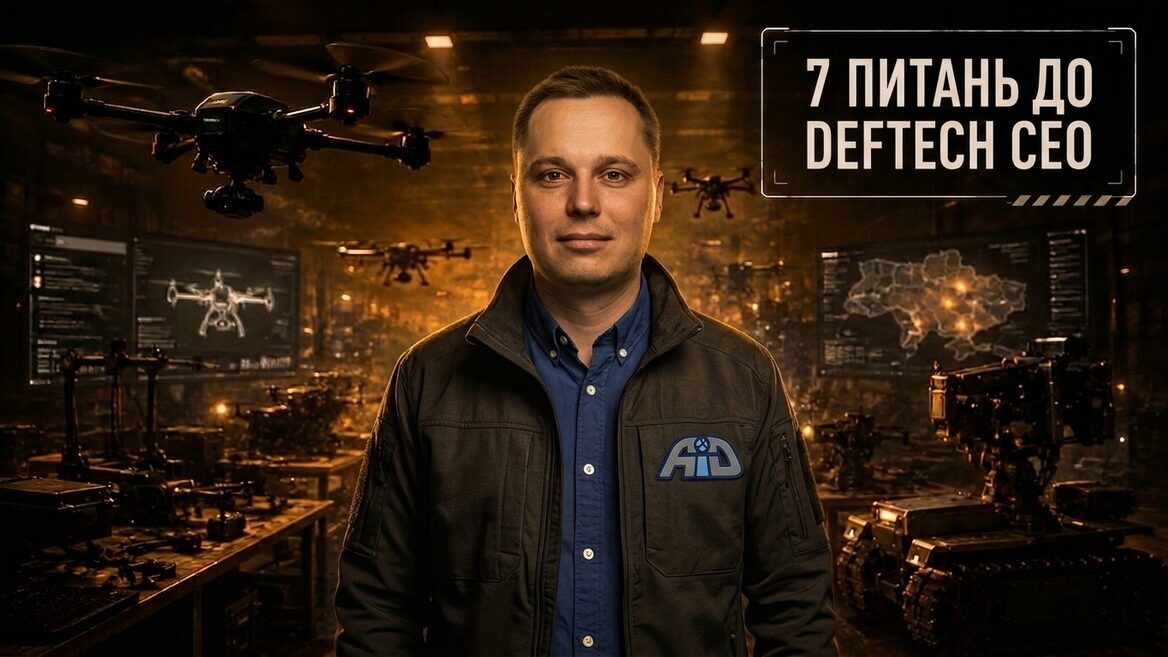
In the new edition of "7 Questions for a DefTech CEO," we talk about why reliability may be more important than a new technology feature, which engineers are the hardest to find, what civilian IT misunderstands about defense tech, and what war could become in a few years.
— What is the biggest problem facing Ukrainian softtech right now? What pain is bothering your company the most right now?
One of the main problems of Ukrainian military technology is the gap between the emergence of a promising prototype and its scaling to mass production. Since it is not enough to develop a good product — it must be tested, adapted to the basic requirements of the military, and be ready to produce at the speed and volumes necessary for the military. In addition, it is necessary to provide training for new users to work with the product, timely delivery of systems to units and return for maintenance, as well as operational repairs and constant modernization based on combat use. Despite significant progress in the development of the ecosystem, this cycle still often takes more time than the situation on the front requires.
Our current main challenge is to ensure the dynamics of scaling the company without losing the quality of the product and service. Reliability and the ability of systems to work effectively in real conditions remain key for us. Therefore, we are consistently developing production, engineering team and partnerships in Ukraine and Europe .
— What technology is most overrated today? And what, on the contrary, is underrated?
In my opinion, basic engineering reliability is underestimated: maintainability, component unification, and ease of operation. The main value of a system is determined by how consistently it performs its tasks in combat conditions.
In addition, current AI capabilities are being reevaluated, expecting that its integration will lead to the creation of fully autonomous systems. The main challenge is not to teach a product to perform a single action on its own, but to ensure that it reliably goes through the entire task cycle — from situation assessment to decision execution. Therefore, in conditions of active combat operations, human control remains critically important.
At the same time, this is not an argument against the use or development of AI. On the contrary, artificial intelligence technologies have significant potential, but it is important to understand how to implement them responsibly and effectively now.
— Who is the most difficult person for you to hire and why? How do you solve this issue?
I think it’s no news to anyone that it’s hard to find strong engineers these days. But it’s even harder to find people who combine technical competence with an understanding of how the solution they create will work in real combat conditions.
A separate challenge is finding strong leaders with relevant practical experience. In a period of rapid scaling, it is extremely important that the leader not only stays on top of the process, but can simultaneously build the system, manage it, and, importantly, personally immerse himself in the work when needed.
Ukrainian defense tech as a mature industry is just being formed, so there is not a sufficient number of such specialists. We attract people from various technological and industrial sectors and help them adapt their expertise to the specifics of the industry. During interviews, we pay attention primarily to the way of thinking, the ability to work in dynamic conditions and bring the matter to a result. Specific industry expertise can be acquired, but it is much more difficult to form responsibility and internal readiness to act.
— What skill or skills are currently the most valuable for an engineer in defense tech? Why?
One of the most valuable skills for an engineer in defense tech is the ability to translate a military request into a ready-made engineering solution. The military does not always have the opportunity to formulate a technical task, often they describe a situation, a problem, or a result that needs to be achieved.
At the same time, engineering judgment is extremely important — the ability to distinguish between a technologically interesting solution and one that is truly necessary for reliable operation in combat conditions. Time for developing solutions in defense tech is usually limited, so the ability to correctly determine priorities is sometimes more important than mastering a particular technology.
Equally important are the ability to learn quickly, the willingness to take responsibility for the result, and the ability to work in a cross-functional team. Technologies and requirements change very quickly, so not only the existing experience is valuable, but also the ability to adapt, test solutions, and improve them based on feedback.
What does civilian IT misunderstand about military technology?
In my opinion, a civilian in the IT field expects clear boundaries of responsibility and established processes. In defense tech, you need to be ready to go beyond the boundaries of your function: tasks often cover several areas of responsibility at the same time, and the industry itself is much younger — many processes are still being formed and adapted in rapidly changing conditions. At the same time, this creates room for development, initiative, real influence on how internal processes are built and the industry as a whole develops, and also allows the specialist to directly see the practical value of their work.
Defense tech relies heavily on competencies developed in civilian IT, but often has a different level of responsibility and different performance criteria. Here, the technology must not only be innovative, but also reliable and suitable for use in difficult conditions.
— What will war be like in 2–3 years from a technological point of view?
I am confident that warfare will become increasingly interconnected with robotic and unmanned systems. Therefore, their number on land, in the air, and on the water will grow, as will the proportion of tasks they will perform.
According to the Ministry of Defense, since the beginning of 2026 alone, ground robotic complexes have completed more than 100,000 missions. The military is increasingly integrating unmanned ground systems into combat missions, as they play a key role in performing tasks in conditions of high risk to people. Today, unmanned vehicles mainly operate as separate platforms. However, it is not only the number of separate platforms that will matter, but also their reliability, adaptability and ability to work as part of a holistic system.
I see a clear trend towards creating unified control systems that will provide data collection, processing, and exchange between various unmanned vehicles. This will allow for the formation of an integrated system for using vehicles on the battlefield, determining and distributing the necessary tasks, and coordinating their work to increase the effectiveness of tasks on the battlefield.
— What would you like to say to IT professionals who are hesitating whether or not to go to deftech?
Defense tech is a field for people who want their expertise to have a direct practical impact. It’s also a complex industry where conditions and priorities can change quickly, and the responsibility is extremely high, as there is a direct connection between the quality of your work and what happens on the battlefield. But if it’s important to you to see meaning in your work, there’s definitely plenty of it here.
To IT professionals, I want to say it bluntly: your experience is extremely important for this industry. The ability to create complex software products, work with data, automate processes, build architecture, and scale technological systems is extremely important for a data tech today. Without these competencies, it is much more difficult to turn individual developments into full-fledged system solutions and create a technological advantage over the enemy.
It is not necessary to have experience in the defense industry to make the transition. Much more important is a strong professional base, responsibility, willingness to learn and work in a team. It is no less important that each person in the team understands the purpose for which they came to this field. The combination of common goals with the ability to work as a team, in my opinion, creates its real competitive advantage.
“We love the word AI very much. Sometimes so much that it seems that if you add AI to a product, it automatically becomes effective.” 7 questions for the CEO of Aidrones — about NRCs, engineers and overvalued technologies in Defense Tech
“I would advise those IT professionals who are hesitant to move into Defense Tech to change their mindset.” 7 questions for DefTech CEO: owner of SKIF NVK about industry problems, personnel, and product evolution