Хочете будувати кар’єру в Data Science та AI? Vodafone Big Data Lab відкриває новий набір —>
Олександр КузьменкоGameDev Eng
2 September 2025, 10:30
2025-09-02
“It’s like a professional editor with a lot of experience monitoring your development.” Interview with the co-founder of Maval, a startup developing a no-code AI platform for creating games and media content
Ukrainian developers from the Maval studio are working on a designer that will help create visual novels, educational simulators, interactive tests, and will also be able to «animate» comics and books.
dev.ua spoke with Maval co-founder Georgy Yablochkin and learned more about the product that emerged from the game’s development and is being worked on by an American producer and former developer from Ubisoft.
Ukrainian developers from the Maval studio are working on a designer that will help create visual novels, educational simulators, interactive tests, and will also be able to «animate» comics and books.
dev.ua spoke with Maval co-founder Georgy Yablochkin and learned more about the product that emerged from the game’s development and is being worked on by an American producer and former developer from Ubisoft.
— Tell us what the Maval team is currently working on. What kind of product is it?
Maval is a no-code solution for creating interactive educational and entertainment content that works in a drag-and-drop format. The user adds scenes, characters, lines, effects in the constructor, and receives a finished product in a few hours. Maval is suitable for creating indie games, educational simulators, marketing or media content.
Our team is currently focused on the technical development of the prototype, which we presented at The Next Web 2025 conference in Amsterdam.
— How did the idea of creating such a product come about? What are its main advantages compared to existing solutions?
Two years ago, we were working on a visual novel, and we encountered the fact that the development required a large number of workspaces in different programs, which caused us constant synchronization problems. At the same time, the stories that the development teams were developing had a large number of plot holes and were uninteresting for the user.
We hypothesized that there was a need in the indie developer market for an intuitive no-code constructor for developing stories, animated comics, and visual novels that would help create interesting and logical products.
After analyzing several dozen solutions on the market in this area, we came to the conclusion that they are technically outdated, the interface is not clear, and they do not have enough tools to allow the user to complete the full development cycle in one workspace and get a high-quality final product.
With a certain idea in mind, we joined the YEP accelerator in late 2024, where our startup attracted the interest of many investors and mentors. The acceleration helped us develop a vision for our own product and finally turn the hypothesis into an idea.
After the acceleration, we held dozens of meetings with startups in the fields of education, gamedev, screenwriters, and producers from Hollywood, where we confirmed the need and necessary functionality in Maval.
Advantages of Maval:
Simplicity and clarity in terms of user interface.
A scientific approach to writing stories.
AI assistants help with dialogue, visuals, and voice acting.
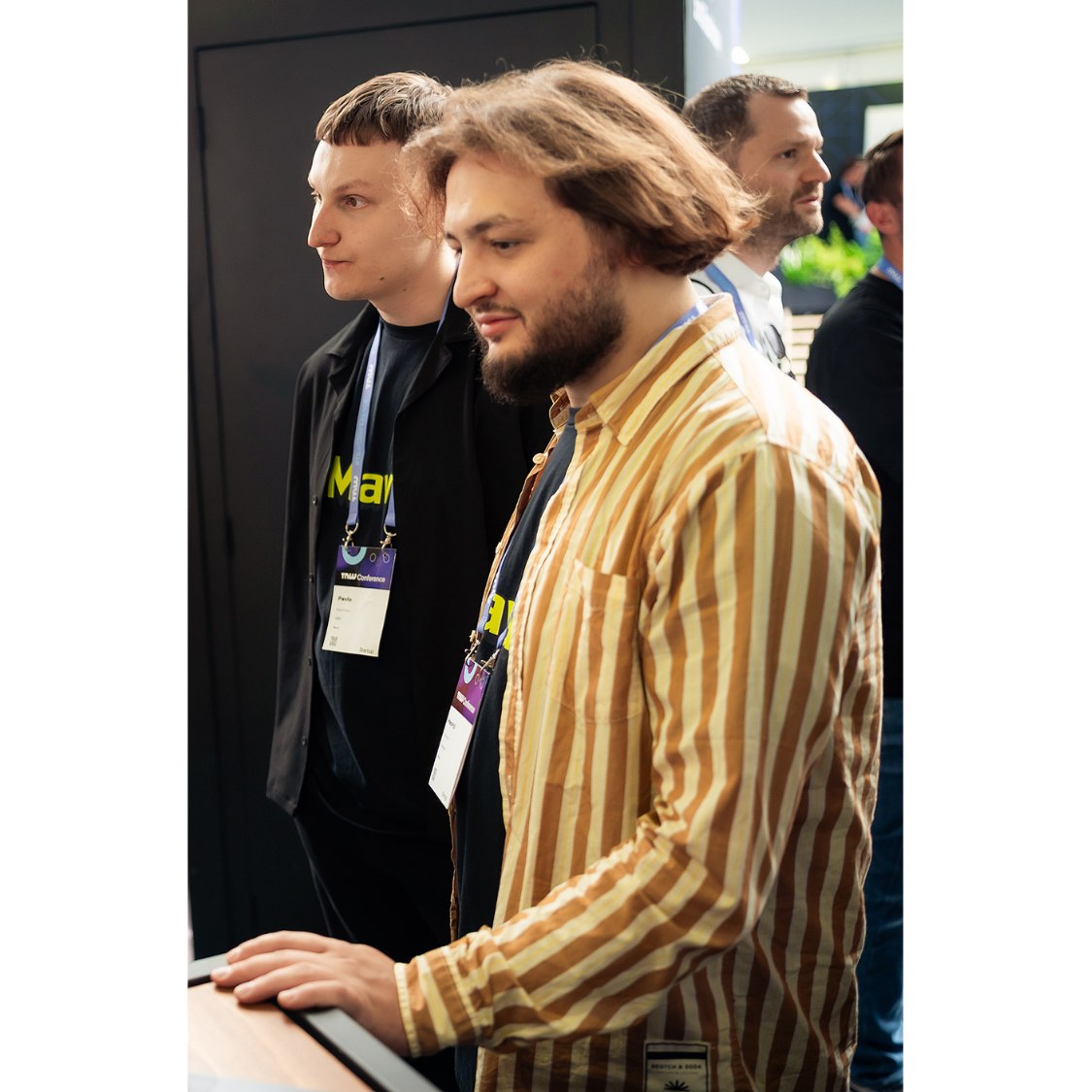
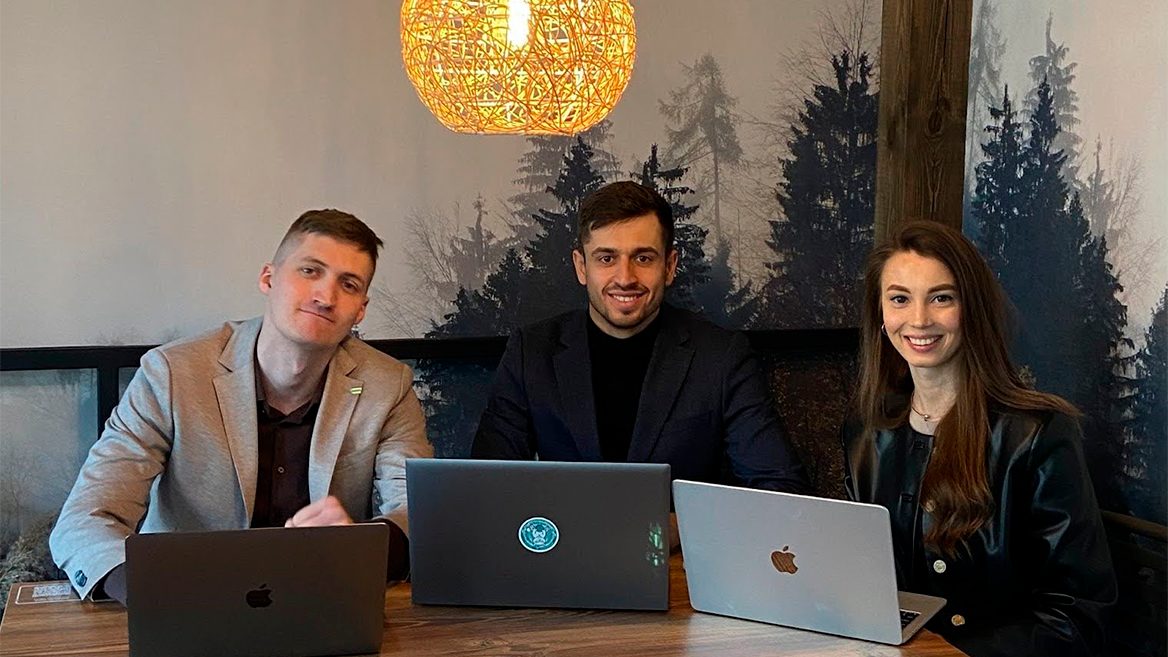
Trade Development Advisor Pavel Kalashnikov and Maval co-founder Georgy Yablochkin. Photo: Georgy Yablochkin
Could you clarify what you mean by «scientific approach»? How does the service’s artificial intelligence help in game development?
Modern AI assistants create uninteresting stories and do not maintain the sequence and logic of the story. Maval has studied narrative structures that consist of the motivations of the plot’s actors and created his own scientific method for writing stories.
It works as a story framework in the form of a conditional status quo for the world, which the player changes during the passage, forming his own unique gaming experience. All actions of the characters are based on their desires and the vector of development of their story arc. The system will tell the creator where there is a plot gap and which moments are better to work on to get an interesting product.
Maval does not compete with AI assistants, but acts as an integrator and provides them with a higher-quality prompt if it is still necessary to use generative content. For commercial products, the story core of the project can be used to add custom visuals, text, and audio tracks, while still assisting the developer in creating a holistic product.
It’s like a professional editor with vast experience who monitors your development and gives advice in real time.
— How exactly do you use artificial intelligence technologies in Maval? Will it help with dialogue generation or voice acting?
Our team is developing an AI assistant that, in combination with a story core, will help the user analyze and create a story, as well as assist in combining all the components of the finished product.
In the next steps, we will gradually deepen the use of artificial intelligence in Maval, and the use of partner AIs will help with voice acting, animations, and visuals.
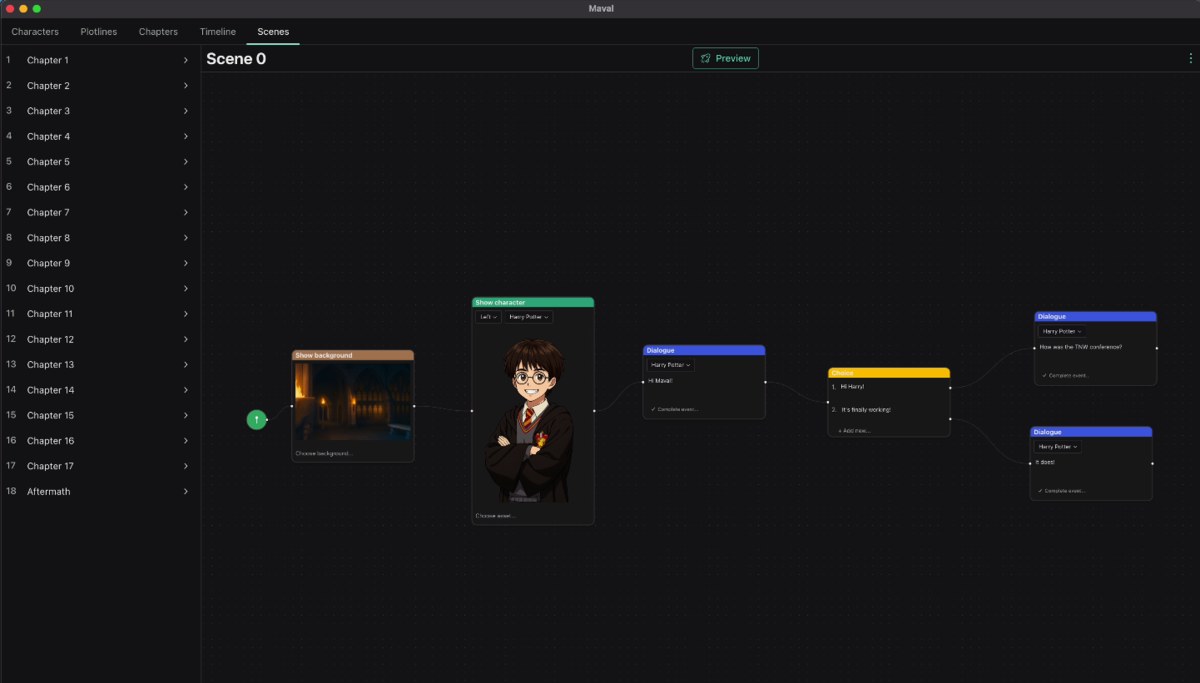
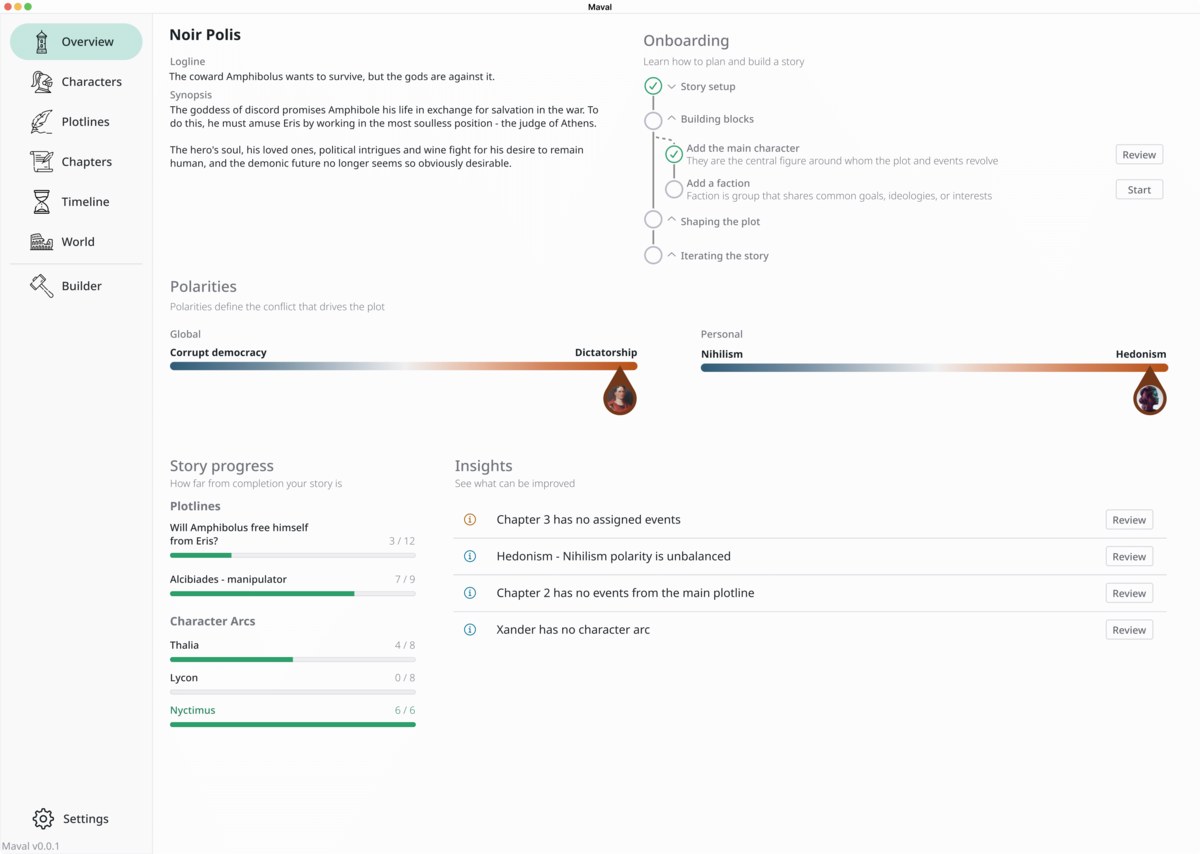
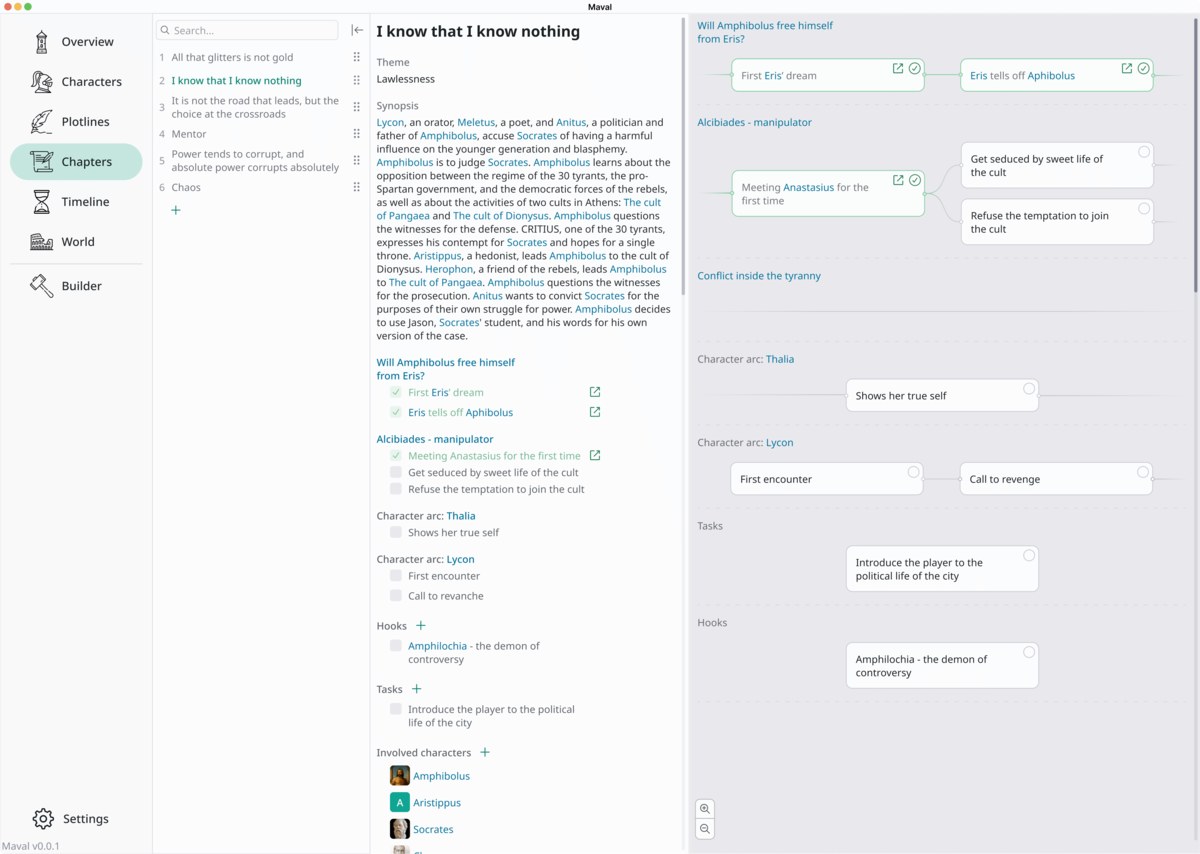
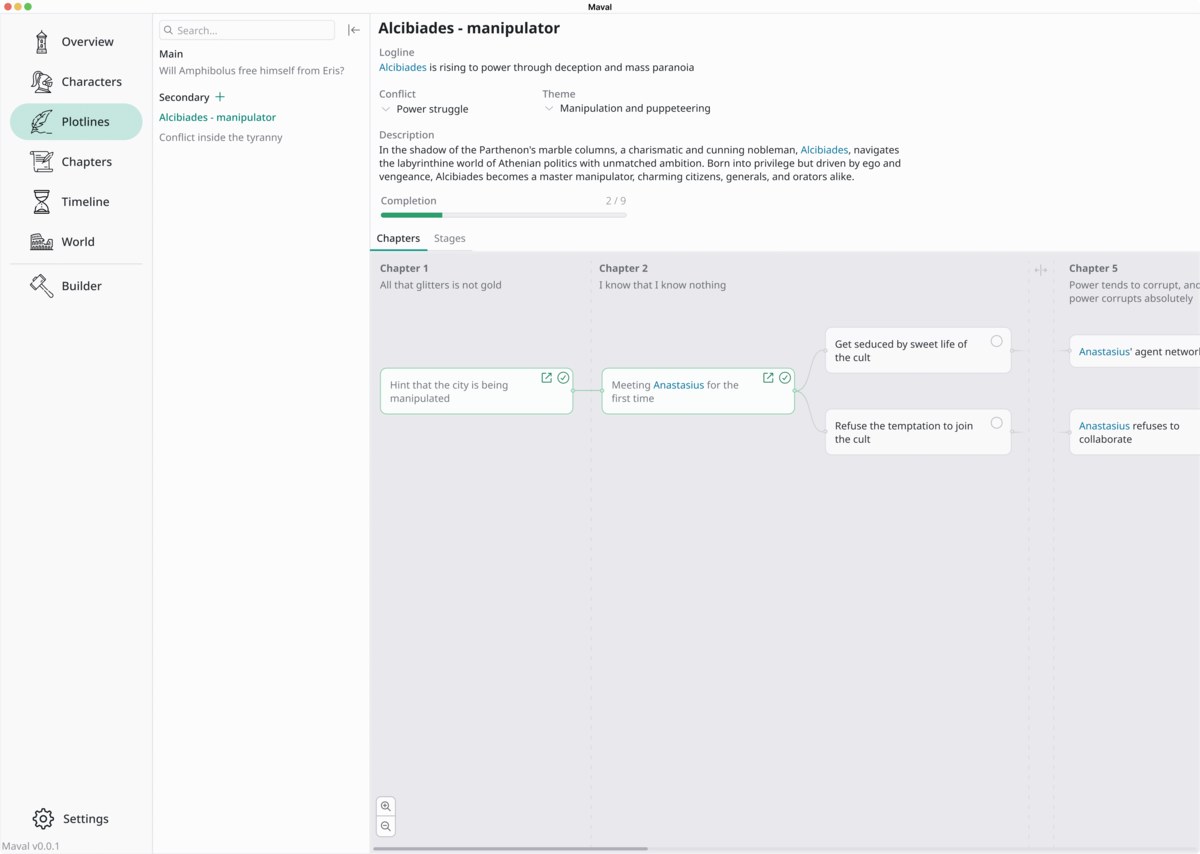
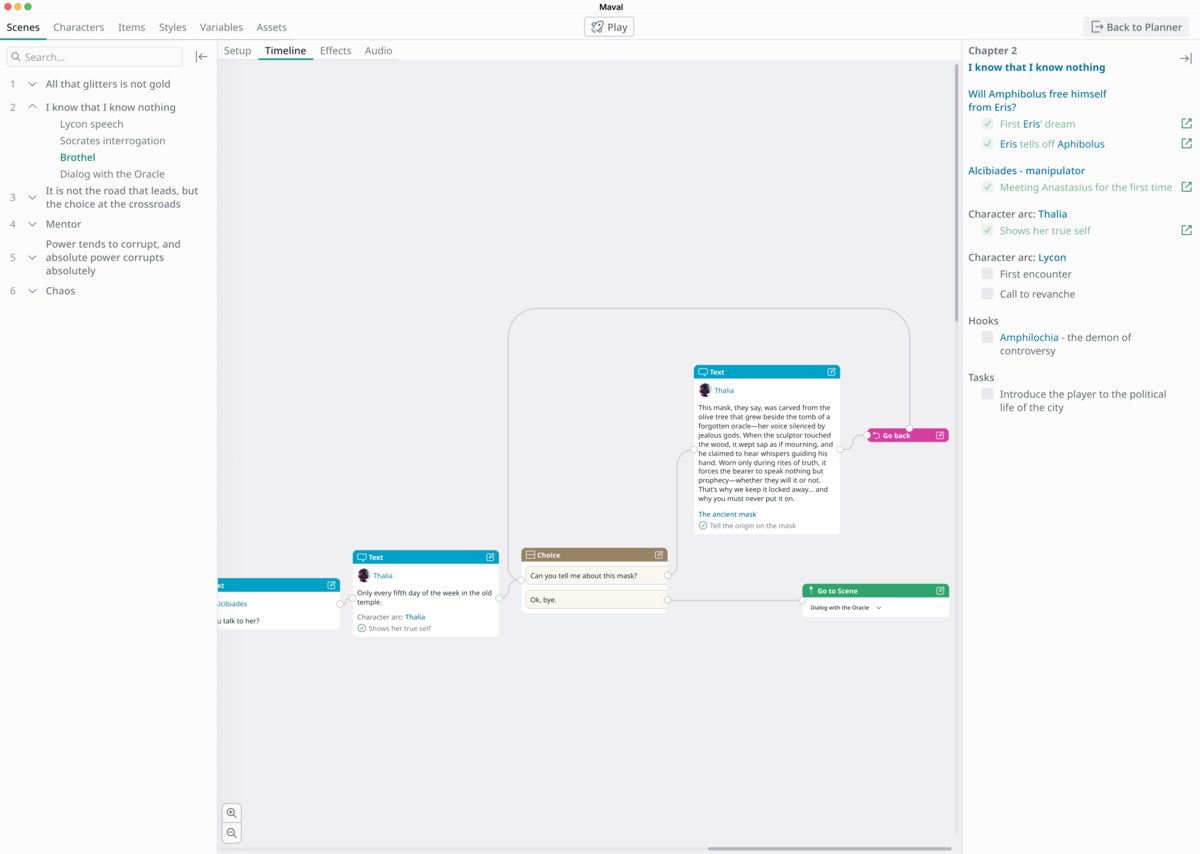
Screenshots of the Maval interface:
— AI tools to assist with programming are currently popular in the IT industry, and Maval’s solution will not require users to have such skills. Can we say that you are creating a vibecoding platform for game developers?
Our platform is like Lego. We don’t need code, we don’t do anything technically complex. Our mission is to empower everyone to create what they want.
For example, bring your favorite book to life in an interactive digital format, or make a visualization of your favorite comic. For a history teacher of Ukraine, create an animated test with graphics for 9th graders that they will really find interesting, or make a lesson in a presentation format. This makes interactive storytelling accessible to everyone.
— What team is behind the development of the Maval engine? Who are the founders, how many employees?
Georgy Yablochkin. Over 7 years of experience in business development, product management and team building. Over 10 implemented B2B and B2C projects in creative industries, EdTech, outsourcing and hardware design.
Roman Vorobey. Over 7 years of experience in product management, IT projects and analytics. Worked as a product manager at EOS Data Analytics, as well as at Defence Builder, served in the State Border Guard Service of Ukraine. At Maval, he is responsible for the creative structure of the engine, product vision and development synchronization.
Pavlo Kalashnikov. Over 7 years of experience in international trade. Advisor at the Department for Business and Trade at the British Embassy in Ukraine. At Maval, he is responsible for strategic partnerships and access to global markets.
Sean DeLoach is an American producer, screenwriter, and creative director with over 20 years of experience working in comics, film, and television.
Sasha Kotov is a technical architect of the engine, former senior developer at Ubisoft and Grafana.
Sean DeLoach and American comic book writer Stan Lee. Photo: Georgy Yablochkin
— How much did the product development cost? Were there grants or investments involved?
Over the year, we invested more than 1.2 million hryvnias of our own funds in Maval. With this budget, we went from an idea to a working prototype, and presented it in Amsterdam at The Next Web 2025 conference. We also started implementing the first B2B projects.
We haven’t attracted any external investments yet: we had to bring the idea to PoC on our own. We are currently preparing to launch our product on the market, and are planning a pre-seed round to scale the development, add AI features, and open the platform to a wider audience.
— How much will the product itself cost? How will it be monetized?
Maval has three main areas of monetization:
SaaS is a subscription-based product for creators, authors, studios, and screenwriters.
EdTech — special conditions for educational institutions: we plan free access for teachers and students, or a paid license for educational institutions with an individual plan.
B2B — turnkey development for corporate clients. In this case, the Maval team takes on the full production cycle of the required product.
Who is your product aimed at — independent developers, studios, or the widest possible audience?
We are creating Maval as a universal tool that opens up interactive storytelling to different audiences.
Indie developers are quickly making commercial games without large teams and budgets.
Studios and publishers use the platform to expand their franchises and create content based on well-known IP.-
Educational teams and EdTech platforms are creating educational simulations, interactive courses, and training tools that significantly increase student engagement.
Media and brands are getting a new format for interacting with their audience through interactive campaigns.
— What is the role of the community in the development of the platform? Is there a possibility of working together on a project at Maval?
For us, the promising transition to a SaaS model opens up a whole world of community interaction. This adds the possibility of User Generated Content in the list of templates, animations, visuals, and audio content, so that, for example, two fan groups of users united in thematic communities can freely exchange their experiences and create content.
There is a plan to implement corporate or group subscriptions, which will allow users to create joint projects with their favorite franchises with their involvement and mentorship.
— Do you plan to support the Ukrainian language on the platform — both in the UI and for text/voiceover projects?
Of course, Maval as a SaaS platform will be tested in the domestic market, so the Ukrainian language is a priority for us.
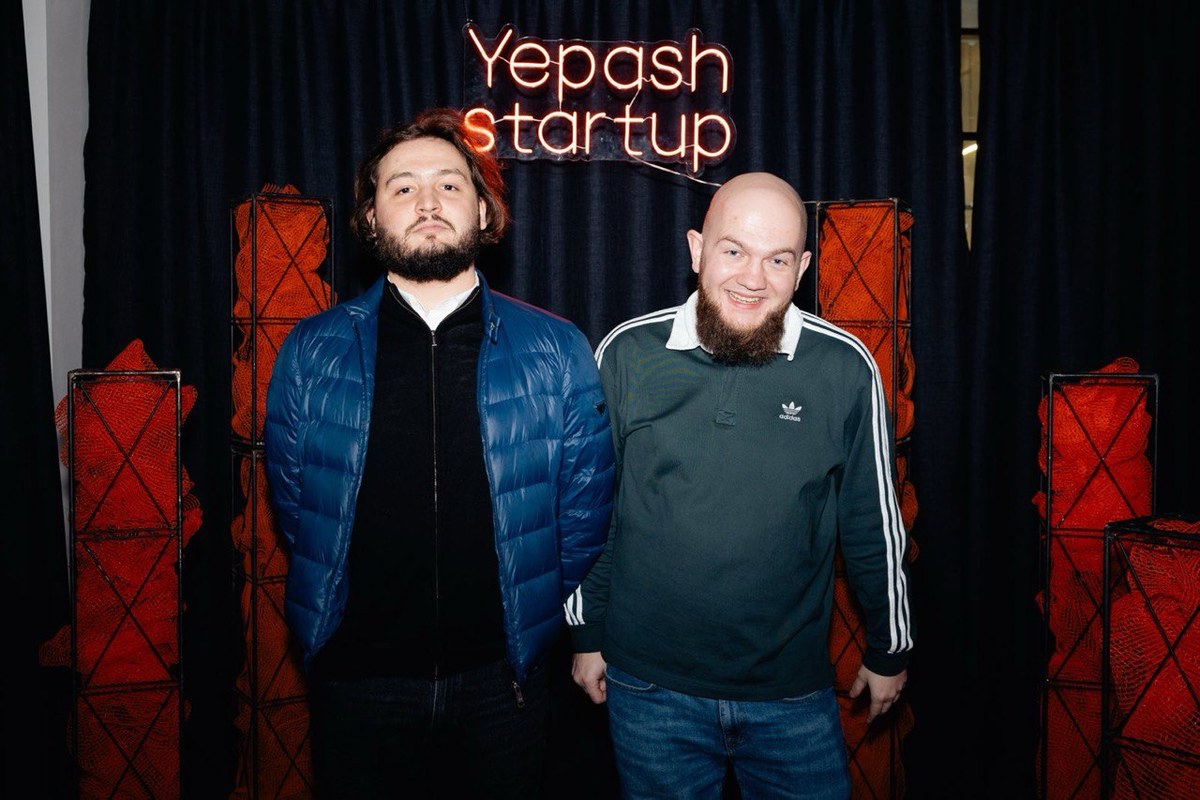
Roman Vorobey at YEP Accelerator. Photo: Maval
— Do you plan to create a marketplace of templates or scripts for Maval users?
As for templates, we don’t plan any at this stage. The plot core is the key mechanic of Maval, we take its implementation very seriously. Our product is tied to it, so the framework of arcs and plot branches is very important.
We will deepen the variability on our own. And in the future, we will develop User Generated Content. For example, in the future, users will be able to create their own scripts and offer them to studios.
— When will users be able to try out the Maval product? How will the launch take place?
We will choose the right moment so that our platform is launched at the right time and with the necessary functionality.
Maval is currently in closed alpha testing for a very limited audience. We plan to launch a public SaaS test in 2026 .
— How adaptable will the engine be to different platforms (PC, mobile devices, Web)? Is multiplatform support provided?
We will launch the project as a Web platform. If the user needs, they can upload the project and run it on the desired game engine to adapt it to the desired platform. In the first stages, import into Unity and Godot is available.
Do you plan to use the Maval engine in your own game projects, or will you focus on the B2B direction?
We plan to use Maval in gaming projects, but within the framework of partnerships. Our main focus is on B2B, product and implementation of educational projects.
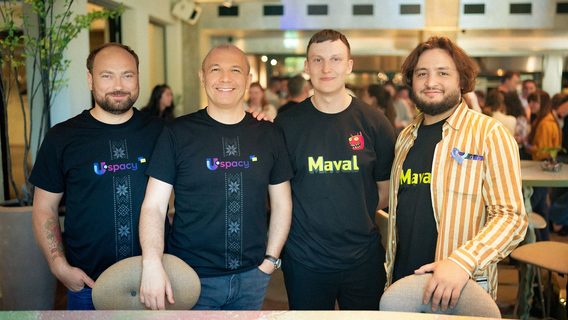
Maval co-founders Georgy Yablochkin and Roman Vorobey. Photo: Georgy Yablochkin
— How do you plan to develop the engine in the next 2–3 years?
In 2025-2026, we are working on educational projects and B2B partnerships. We are currently focusing on these areas. In addition, we are developing Maval’s public image.
In 2026, we will launch a SaaS platform and test it in the home market. Then, we will expand to priority markets.
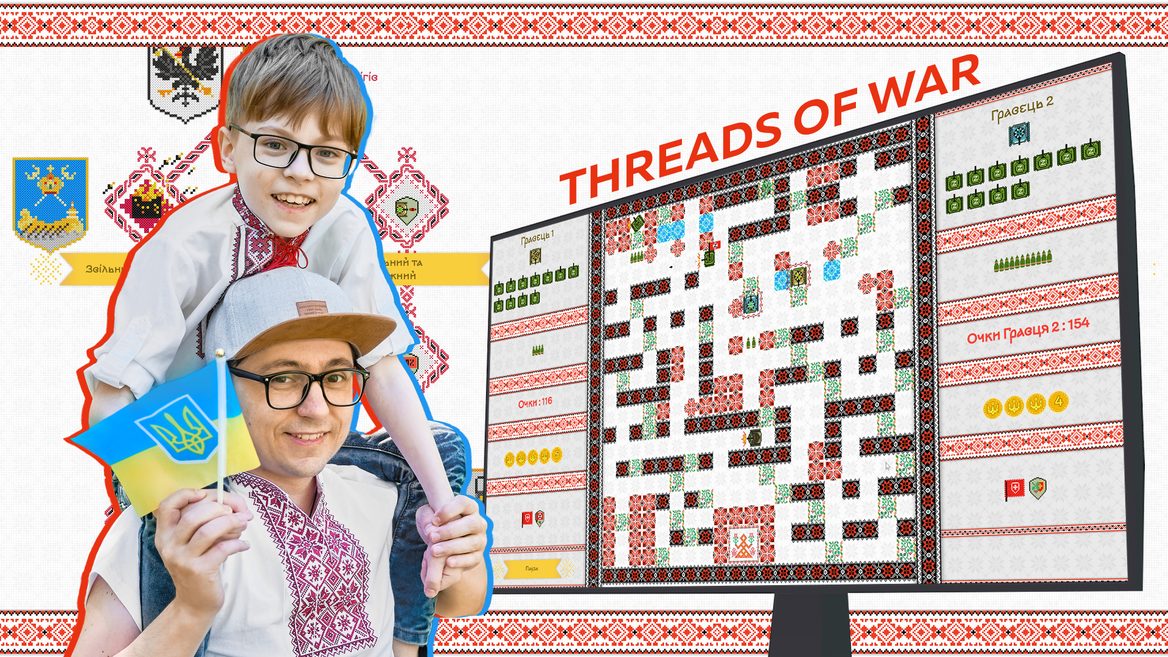
«We agreed with my dad that I would program the next game, and he would do everything else.» How 13-year-old Askold Kosciuszko created «embroidered tanks» with his father — Threads of War
«We especially focus on motivating users who are prone to procrastination.» How Ukrainian educational startup Pravozno works, helping to prepare for state exams
UPD. В Україні зареєстрували законопроєкт про декриміналізацію порнографії. Розповідаємо, як з'явилася українська еротика і чому потрібно легалізувати українську порноіндустрію
11 листопада 2024 року, у Раді зареєстрували законопроєкт про декриміналізацію порно після понад року роботи правоохоронного Комітету та робочої групи. Для початку змін передувала петиція про легалізацію еротики та порно в Україні у липні 2022 року. Вона швидко зібрала необхідні 25 000 підписів.
Тоді ж редакція dev.ua вирішила підготувати коротку історію порно в Україні. А також дізнатися, чи можна на порно збудувати багатомільярдну індустрію, якщо його легалізувати.
(текст від 8 липня 2022 року).
«Навіть для виробників трун і пам’ятників я писав тексти». Як стати game-тестувальником під час війни: історія колишнього металурга, страховика, копірайтера
34-річний Андрій Зубков під час війни увійшов в IT, докорінно змінивши свою кар'єру і буденне життя. Тепер він QA Engineer у компанії Pingle Game Studio — тестує ігри. А до цього працював на металургійному комбінаті, в страхуванні та навіть копірайтером. Свою історію про вхід в нове життя Андрій розповів dev.ua.
Have important news to share? Message our Telegram bot
Key events and useful links in our Telegram channel