Хочете будувати кар’єру в Data Science та AI? Vodafone Big Data Lab відкриває новий набір —>
Олег ОнопрієнкоWeapon
4 August 2025, 09:00
2025-08-04
"2025 is the year of the NRC, but to meet the need on the front line, 40,000 robots are needed." Interview with the co-founder of Tencore, the largest manufacturer of ground robotic systems in Ukraine
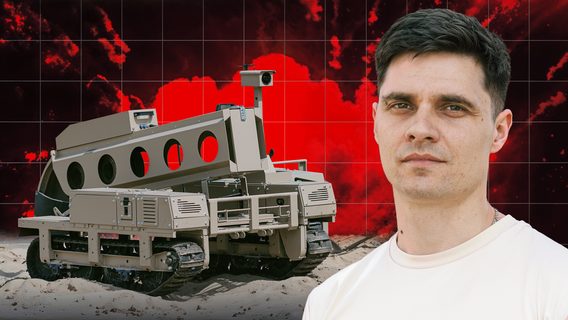
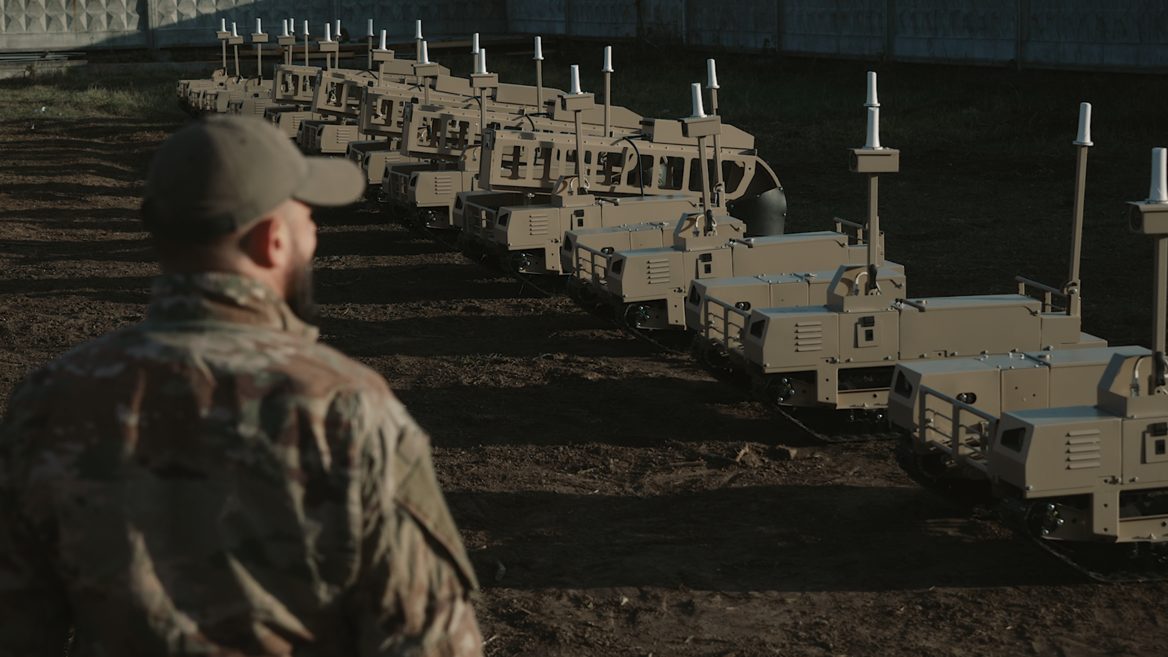
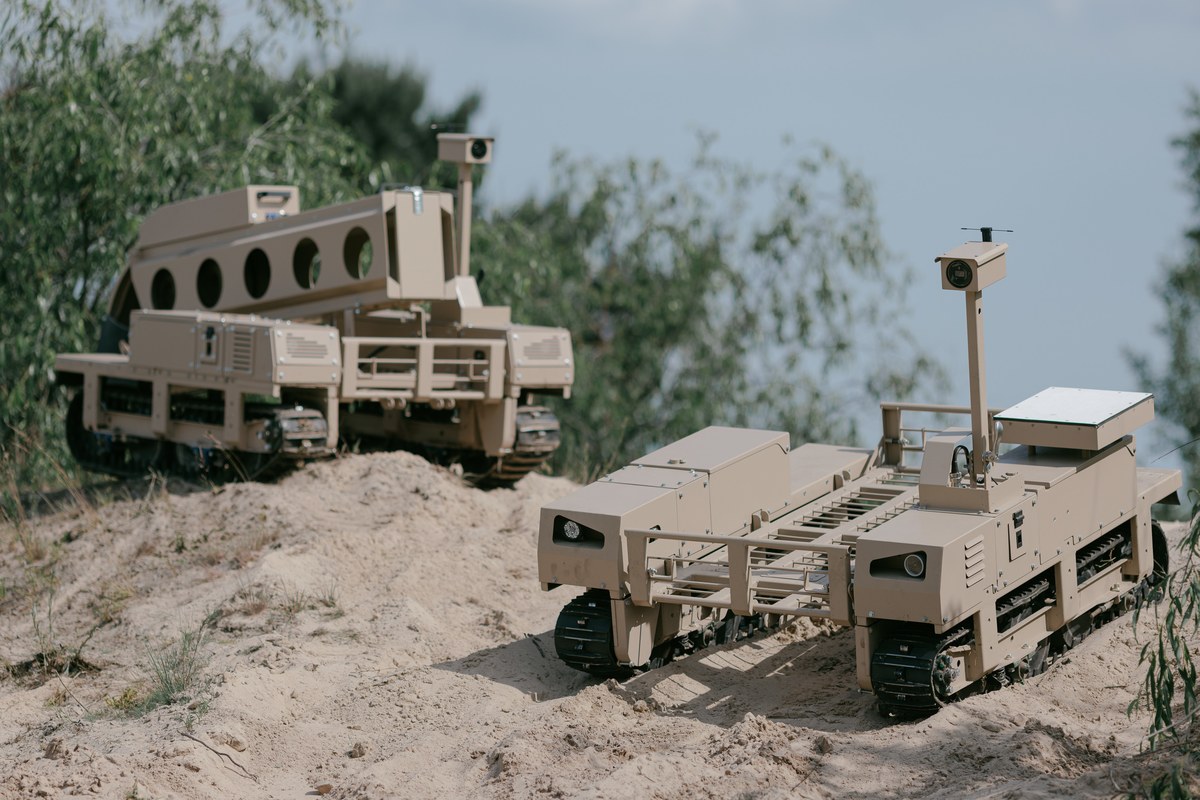
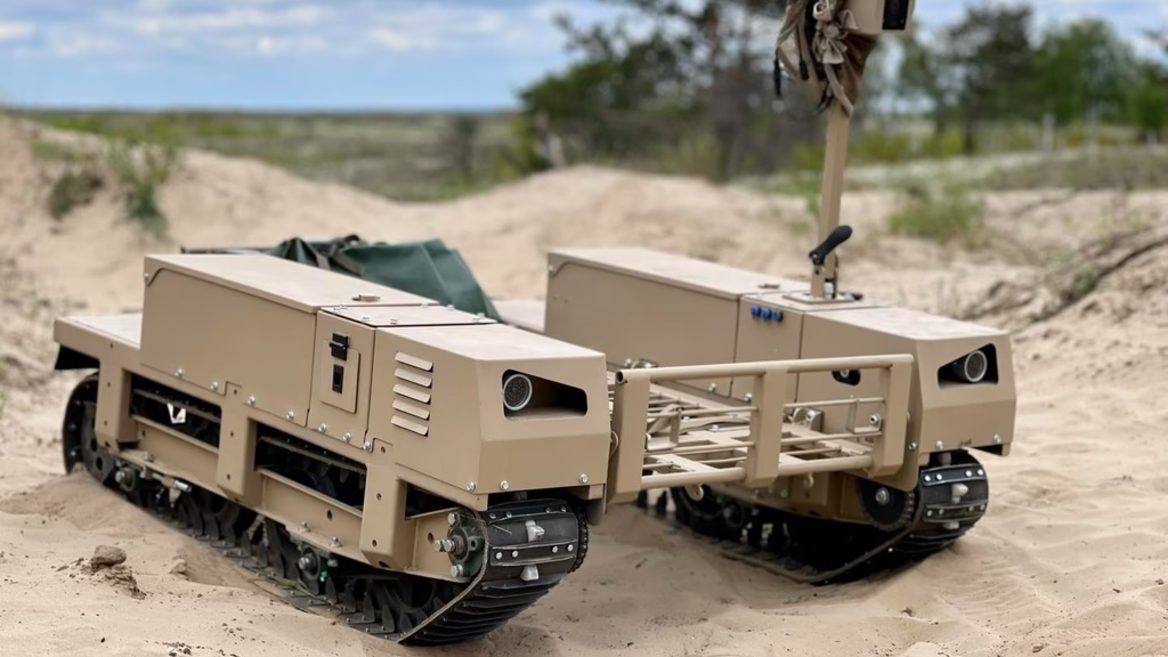
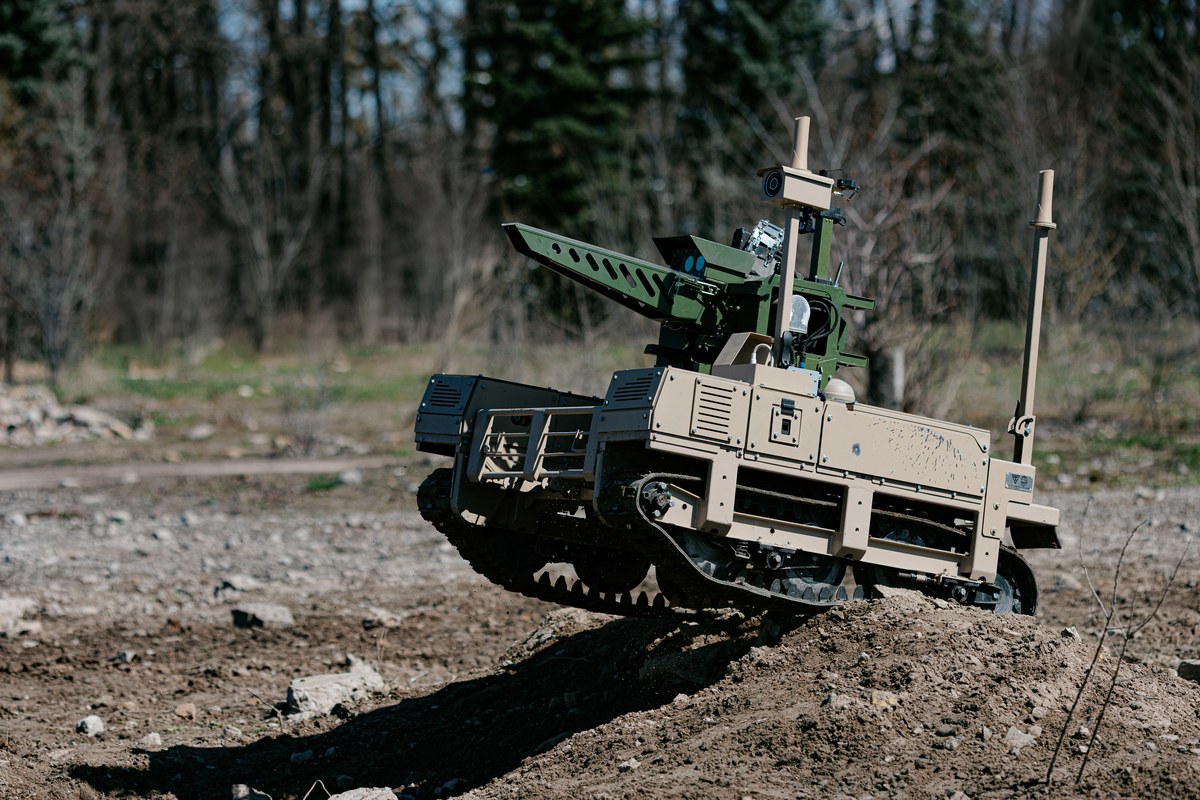
In February 2024, Tencore started as a team of mechanical engineers with the aim of helping the Armed Forces of Ukraine. Within a month, they had assembled the first 10 TerMIT combat robots, which now help evacuate the wounded, conduct reconnaissance, destroy the enemy, and deliver cargo for more than 20 brigades of the Defense Forces. Today, Tencore is one of the flagships of the market for ground robotic complexes, which consists of 95% Ukrainian components and has attracted a record public investment round in the NRC sector. dev.ua spoke with Tencore co-founder and director Maksym Vasylchenko about the role of NRC on the front, how the company managed to achieve rapid progress, and about interaction with the state.
In February 2024, Tencore started as a team of mechanical engineers with the aim of helping the Armed Forces of Ukraine. Within a month, they had assembled the first 10 TerMIT combat robots, which now help evacuate the wounded, conduct reconnaissance, destroy the enemy, and deliver cargo for more than 20 brigades of the Defense Forces. Today, Tencore is one of the flagships of the market for ground robotic complexes, which consists of 95% Ukrainian components and has attracted a record public investment round in the NRC sector. dev.ua spoke with Tencore co-founder and director Maksym Vasylchenko about the role of NRC on the front, how the company managed to achieve rapid progress, and about interaction with the state.
— How did the Tencore story begin? What was your initial idea in February 2024?
When we started the project with the understanding that it would be the creation of robots, we put 10 cores in the name of the company Tencor ( Ten core literally translates from English as “10 cores” ed .). We decided that the main goal of the company would be to create 10 key products. At the beginning, there was no understanding of what these products could eventually turn into, so we simply decided that the time would come when we needed to make the next product, we knew how many more there were to be made.
We currently have one flagship product, the TerMIT robotic ground complex. There is a lot of work going on that no one sees, because we already understand how painful it is when you do something wrong, or how mistakes by our suppliers can affect quality. We are now spending more resources, both human and financial, on building a quality and testing department.
— What is the ratio of developers to testers?
Developers — 65-70% and testers — 30-35%. Every day we test from morning to evening, both in the field and on stands. We load, overload, put into extreme conditions in a circle and after the tests are completed, we go to combat units to get feedback.
— What has Tencore already done?
In addition to the TerMIT NRC, we have developed our own control boards, on-board computers, similar to those used in automotive. We have replaced all export electronic components with our domestic ones. Our software is fully used. We have developed Ukrainian relays, which were previously Chinese. We fully produce the batteries that we use in NRC.
We are currently working on the complete mechanical part, so that it is also as Ukrainian as possible. There is a very powerful manufacturer in Ukraine who has developed a caterpillar for us that meets European quality criteria. We currently have three products, two of which we do not advertise, but we can talk about them. And the electronic component of our NRCs is already completely domestic.
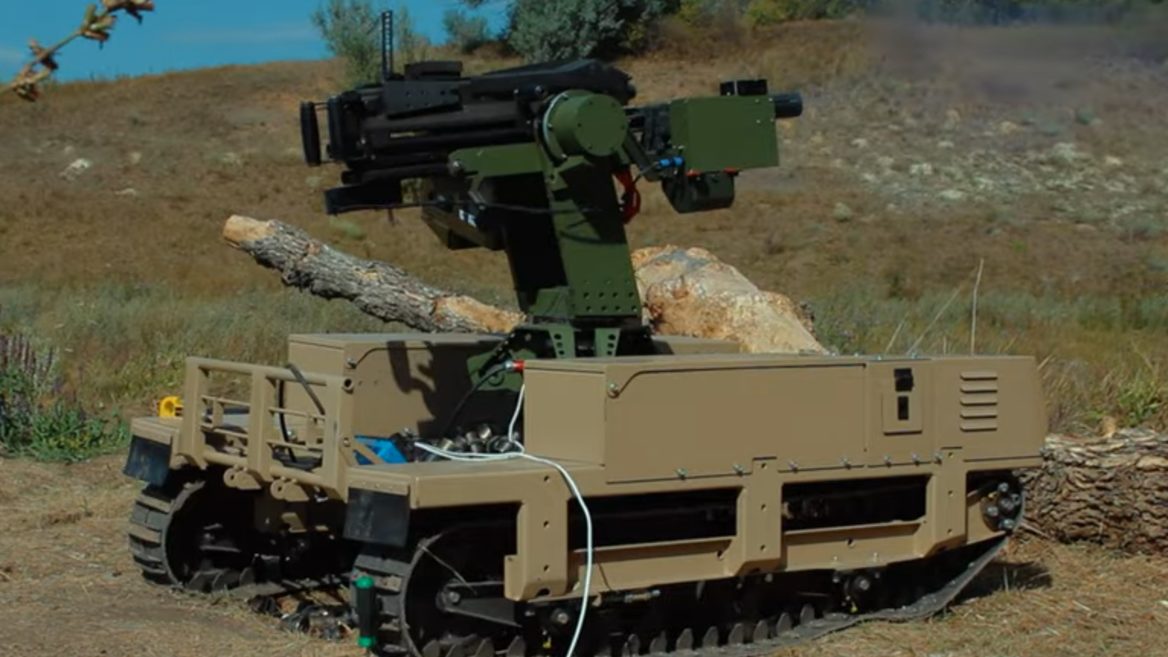
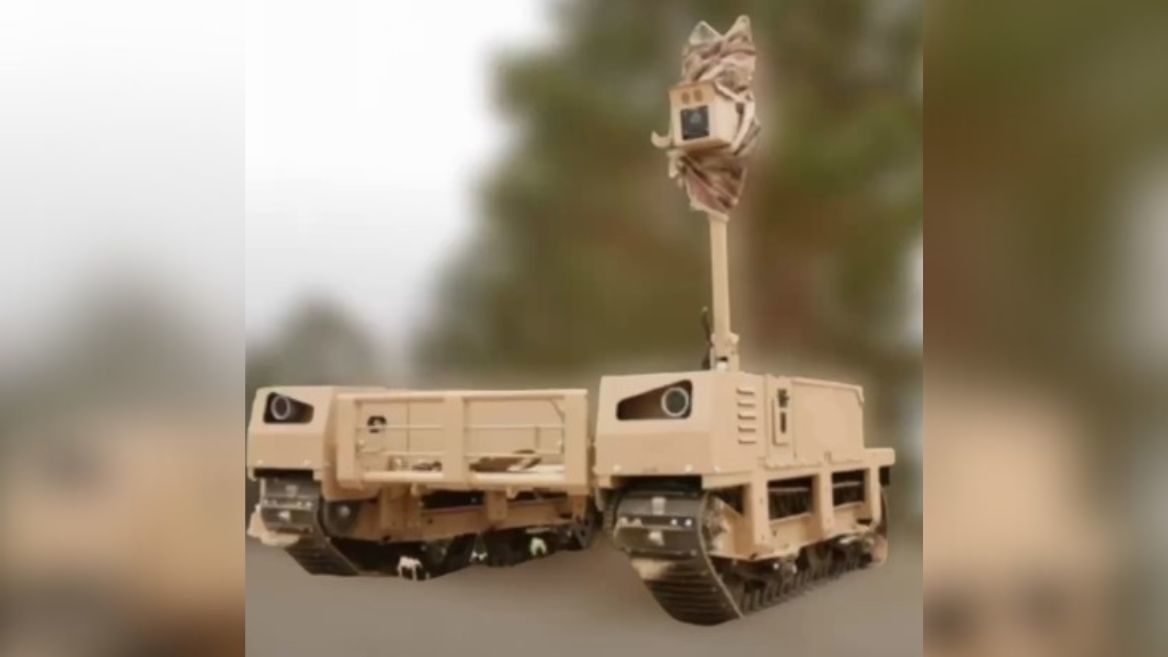
The Armed Forces of Ukraine have received Ukrainian TERMIT unmanned ground systems, which can be equipped with Browning machine guns or Starlink terminals
— The first 10 cars were delivered in March 2024, within a month. How did you manage to do that?
I have been involved in mechanical engineering all my life, so for me, making something new is a clear task with clear deadlines. At that time, we simply did everything correctly, starting with ordering the first components and parts. The team received all the blanks and materials on time and started working. While the order for cutting, painting, and delivery was being fulfilled, we finalized the assembly drawings and electrical diagrams, and as soon as all the materials arrived for production, all we had to do was assemble them and that was it.
Some colleagues in the market came from different fields. These are people who previously worked in completely different industries not related to iron, programming or electricity, so it was difficult for them. There was a lack of knowledge about how to cook materials, what additives or wires to take, how to program and solder, in general, they did not understand the very concept of production.
My partners and I have correctly used the experience we have gained throughout our lives. When you do something for the first time, it is very interesting, you lose track of time. You start to put something together, you look, and it is already night: “What time is it? Oh, 1:00 in the morning.” Therefore, there is nothing cosmic here, we just took it and put it together.
— Can those first 10 products be considered TerMITs or were they still prototypes?
These were already full-fledged TerMITs. Back then, not everyone had an understanding of what to do with it and how to use it. Someone immediately understood why, how it works, the tactics of use and showed great results. Someone did not understand and very quickly lost the car. At first, NRCs consisted of the same components that FPVs were made of and this did not have a very good effect on all the products that were on the market at that time.
— TerMIT can be remotely controlled, conditionally, from Kyiv. How did you manage to establish constant, high-quality communication between the pilot and the machine, and is there no "delay" during control?
You can control a robot from anywhere in the world. At one of the defense exhibitions in Germany, people controlled a robot that was in the Kyiv region. There is a delay, but it is minimal and does not affect the quality of work. It is difficult and this is work that few people see, we do not advertise it. Together with the Armed Forces of Ukraine, we are currently making a lot of tools that will allow control from more remote areas. Perhaps the effect will not be immediately noticeable, but we want a person to feel safe while performing the tasks set.
Our goal is to save human life. Losing a robot is not a problem, the main thing is that the person is whole, and we will make a new robot, only an improved one.
— Tell us how you agreed with many third-party product companies to integrate their solutions into your platform?
We immediately chose a strategy for ourselves not to do everything, but to do one thing first, but as efficiently as possible. And so we talked to our colleagues in the market and said: “Let's integrate with each other so that we can be as efficient as possible.” When the divisions receive any of our products, they could know what they needed to apply them together.
We try to cooperate with everyone, so our goal is to make Ukrainian consolidation as large as possible so that we can all be as efficient as possible again. This is an integral part of any mechanical engineering - combining technologies to improve the final result.
Tracked grenade launcher: the "Storm" turret and the "Termit" robot combined into a single combat system
— Were there any companies that refused to cooperate with you?
Little attention has been paid to NRC because the effect of using FPV is easier to see.
There were, however, refusals related to the lack of production capacity or due to the unpopularity of the direction. At the beginning, one company told me: “Sorry, we cannot help you, because we are currently focused on FPV and we do not have enough time and resources to develop the NRC direction right now.” To be honest, few people paid attention to NRC at all, because the effect of using FPV is easier to see. Any fund that conditionally collects for 170 FPV drones will potentially show 170 “good Russian” faces.
It is very difficult to "sell" a NRC, because it is still a car and such a product costs much more than an FPV drone. And if they collect three NRCs, then for this money you can buy 150 FPV drones. Therefore, it is very difficult to promote this story in the media, but we are trying.
— Has the number of companies wanting to integrate their solutions into your platform increased?
In addition to our Ukrainian companies, which also have a development strategy, European companies are showing interest, but it is very difficult to communicate with them on this topic, because they are very convinced that their solutions are definitely cool, high-tech, and work.
Half of these solutions are really technological, but they are very, very expensive. And if you use them, the cost of the robot can double, or even triple. And the other half, although more or less normal in price, simply does not work, does not correspond to the realities of war, although everything is made according to European standards and requirements. These solutions will not stand the test of war.
Foreigners are convinced that in their rosy world, a soldier walks calmly while a robot in front clears the way, everything is fine, no one is shooting, the trees are green. In our country, there is nothing like what they show in any area where fighting is taking place. And when you tell them about it, they are convinced that you simply do not want to understand their vision.
— Your equipment is used by the State Defense Forces, large volunteer foundations, and over 20 combat brigades of the Defense Forces. Who was your first customer?
The first was the Kolo Foundation. In general, we survived all last year thanks to funds, divisions, and ordinary people who looked like robots. If it weren't for this, we would have closed down, like several companies in our market. It was very difficult, there was not enough budgeting, contracts, just words. This year there is an opportunity to fix everything, to improve it, again thanks to the work of the Ministry of Strategic Industry ( the interview was recorded before it became known about the liquidation of the Ministry of Strategic Industry, ed. ).
We, as developers, receive a lot of feedback, we have to react to it, do something that will improve our technological advantage on the front next year. Because the units are now learning, applying new technology, gaining experience and will know exactly what they need.
All the first products were born as we thought necessary, there was no specific technical task, and now people know what they want, because they already have certain numbers, results. And when they tell me: "Here is a report of what we did in a week, how many tons of products we transported, how many wounded and dead we transported, how many territories we mined," I look at these numbers and they are impressive.
On average, a brigade can lose two to three average NRCs per day, which is the equivalent of at least 16 lives saved.
— You raised $3.74 million from MITS Capital — a record public round in the NRC sector. How did you manage to do that?
When we became open to investment, we were not looking for money. We were looking for a partner who would help us grow professionally, as a leader in our niche and globally. So that the partner would have a vision similar to ours, who wants the product to remain Ukrainian and the money to go to Ukraine. We do not need a partner who would say open a company abroad and transfer our Ukrainian IP there. We fully support Ukraine's policy that all money that may come from European investors in Ukrainian military technologies or dual-use should come to Ukraine and be spent in Ukraine for the benefit of Ukraine.
MITS is exactly the kind of partner that fully supports this aspiration, and they are very similar in spirit and interest to us. Their co-founders are Ukrainians, we got along great even when we were studying there, and this is a logical continuation of our cooperation.
$3.74 million for Ukrainian robots: Tencore receives record investment in the NRC sector
— You stated that you will direct the raised funds into R&D and hiring new engineers to develop new robotic solutions. At what stage is the R&D center now, and can you tell us a little about what developments it will be engaged in?
R&D is very expensive. We already have this direction and now we will expand it. It requires very qualified specialists, although we have great cases of cooperation with students who now work for us, but we need to do more.
We need specific equipment to manufacture some components, so we need to build muscle thanks to a team that has specific tasks. Now the whole focus is on this. We need to increase the pace, because we are losing time if we compare ourselves with our enemy. The Russians have endless resources and they have been investing them in these developments for a long time, and since we do not have such an opportunity, we are trying to get investments and use this money to pump up R&D centers.
— Do you observe a shortage of specialists?
The shortage of specialists has been observed for about half a year, this is a fact, because great specialists are already in the Armed Forces of Ukraine. Some of the specialists have moved to Europe, but we also need them, so we are waiting for the bill that we submitted together with the Council of Arms Manufacturers on the possibility of booking people for a period of 45 days in order to update their data and book them normally, and we will gradually bring these specialists from Europe to Ukraine. We have agreements with some specialists from abroad who want to join us.
— Do you plan to create a joint venture with a foreign partner? What profile of companies are you looking for?
We want to do it correctly with the maximum benefit for our country. We are currently waiting for clarifications there on how to use such tools to create the opportunity to create joint venture companies, both in Ukraine and in other countries. I do not have specific answers, but negotiations are ongoing.
— Do you plan to open enterprises abroad, as some other Ukrainian private defense companies have begun to do, and what is your general attitude towards opening up arms exports?
The opening of arms exports will be a cold shower for many.
I divide this issue into two points. The first is the notorious blockbuster of arms exports. In my opinion, the opening of exports will be a cold shower for many. Not everyone needs our products, because any country will be motivated to invest money in its development, for its defense, in its people. Therefore, I am sure that after they allow exports, people will see that no one wants to buy their products and will again look for the guilty in the Rada, the president, or someone else, they are not buying us because someone did not do something.
The second point is precisely the opening of joint venture companies, when there is a Ukrainian share of the company and a European share of the company. And therefore, the money from this company should flow back to the parent company, which is in Ukraine. The money should return to Ukraine, from any sales. Currently, this procedure is being worked out by the president's office, how this should happen, at what prices, what is the order of shipment to whom.
I am sure that if these are purely military technologies, these should be G2G (government to government) sales. The rules should be international, the same for all countries, so that there are no double standards.
"In conditions of war, direct exports are unimaginable." Denys Shmyhal spoke about opening the export of Ukrainian weapons abroad
— You claim 95% localization of components. Where is the greatest dependence on imports now and what is the company focusing on to overcome it?
Currently, the biggest dependence is on electric motors, and of course we can’t get away from microelectronics. There are manufacturers in Ukraine who are now helping us localize the production of electric motors. Perhaps, starting next year, we will be able to use domestic motors. Regarding microelectronics, this is a very difficult issue all over the world. Even China has not overcome this dependence.
— What is your assessment of cooperation with the state?
To put it mildly, the past year was not very productive in cooperation with the state. At all the meetings where it was possible to have a direct dialogue with state representatives in various spheres, everything came down to the fact that everyone understands everything, but cannot do anything. In this regard, it is not easy, so I always ask: "Can it be done as a business? There is one person as the project manager. In the Armed Forces of Ukraine, Andriy Lebedenko is responsible for innovations, so let's have him have all the rights, resources and powers." To which I am told that it is all very difficult.
At the end of 2024, the entire NRC industry received very strong support from the Ministry of Strategic Industry and things began to gradually improve. Then the Breave 1 cluster helped a lot, when the NRC direction was headed by Vladyslav Kosyanchuk, who started the NRC machine in general, he strongly supported this direction and I am very grateful to him for that. Ms. Natalia Kushnerska, who was the director there, I could always call her and tell her what was hurting and where I needed help and she found contacts. Thanks to this motivated coalition of people who understood that it might not be possible to create something the first time, but believed and moved in this direction, we received a budget and contracts for the next year.
Former Brave1 CEO Natalia Kushnerska joins Roboneers, a company that produces NRCs
2025 became the year of the NRK. During the year, we intensively cooperated with state representatives twice a week, and all this was organized thanks to the Ministry of Strategic Industry. Through them, we communicated with anyone in the states and immediately received feedback, after which we could offer solutions that, in our opinion, could improve the state of affairs, it was supported and we tried to implement this solution. I changed my attitude towards working with the state, precisely thanks to the initiative of the Ministry of Strategic Industry. Therefore, the attitude in general this year is very, very positive.
Now we have created an association of NRK manufacturers, and joined the Ukrainian Council of Gunsmiths. I would like the URZ to become a civilian ministry of gunsmiths, we have a lot of friends there, the support of specialists who understand the laws, the economy, people who are aimed at pumping up our state.
— If you saw interaction with the state in the future, what should you pay attention to now?
I would really like our country to have a development plan for 50 years. For the state to reach a new level and cooperate with companies like Tencore for the development of Ukraine as a whole, so that the knowledge of engineers can be used for faster reconstruction of the country and high-tech factories can be built. Our automotive industry has been completely destroyed, despite the fact that the country has all the necessary resources for this. We need a real transparent person or group of people who will be responsible for the development and reconstruction of Ukraine in all sectors: economy, mechanical engineering, energy, and so on.
I am wary of the level of knowledge that is currently being given to students and what percentage of this knowledge can actually be applied in life. I would review everything, contact the best universities in the world right now so that they can simply help create a program. You can gamify any lectures, you can come to the laboratory, as I did in my time, and do any exams with your own hands and create any automated products there. I would be very pleased if this became a reality.
"The game gave an understanding of what you will have to work with in reality." Interview with an artilleryman of the Armed Forces of Ukraine about gamification in the Defense Forces
— In the first quarter of 2025, the state contracted more than 9,000 NRCs. You assure that you will produce 2,000 products this year. How do you assess the demand in the market — is it already formed or is it just being created?
Once we brainstormed with one military unit and calculated how many NRCs are needed per year to provide all units of Ukraine with them. This is 40,000 robots. And to achieve this figure, we need to additionally train people, provide them with all the necessary materials and components, transport, workshops, mechanics, and so on. This is a new industry that will only grow.
People who recently visited us said that there are five powerful manufacturers of NRC in Ukraine. All companies that work for the defense of the country are currently 40% loaded. That is, we still have 60% of production capacity for the production of other weapons. Therefore, we need to work on finances, attracting money from partners, and various other tools so that we can reload the production capacity that we still have.
— What are the company's plans for the future?
The main goal of all Tencore NRCs is to save the lives of our people. Therefore, we continue to move in this direction. A robot is currently being tested, which is specially made only for the evacuation of the wounded and the dead. Its testing in combat units will begin soon. We are still working on a purely combat platform to replace people in combat positions. I can’t say yet what kind of weapons will be used.
We also plan to enter the dual-use niche ( dual-purpose ed .). I am worried that sooner or later we will have to reorient ourselves and the key factor is our people, our specialists. Their knowledge is so valuable that European companies will want to “poach” them, especially if there is no work here after the war. All military technologies sooner or later become dual-use technologies, for example, a microwave oven. For us, the urgent issue of dual-use is the use of our technologies in any segment of the automotive and agricultural sectors.
That is, we will definitely move in these directions. We are currently preparing a number of proposals, primarily with Ukrainian companies, so that they can then become better and more competitive in European markets thanks to our Ukrainian technologies.
"Now our equipment does not harvest crops, but saves lives in minefields." Interview with the leaders of XTI Engineering, which has transformed from an agricultural player into a developer of machines for humanitarian demining