A Ukrainian iOS developer independently created a conversation card app called Togethis. It has already collected about 250 downloads.
Ukrainian iOS developer Dmytro Lyshtva independently created and released the Togethis application on the App Store — a game with questions for conversations between two people, in a family circle or with a group of friends. The idea arose during a New Year’s meeting, when the company wanted to discuss interesting topics, but could not find a convenient way to quickly select questions. The development of the product took several attempts and about nine months of work from the moment the author began to regularly allocate time to it. Currently, the application has about 250 downloads.
Ukrainian iOS developer Dmytro Lyshtva independently created and released the Togethis application on the App Store — a game with questions for conversations between two people, in a family circle or with a group of friends. The idea arose during a New Year’s meeting, when the company wanted to discuss interesting topics, but could not find a convenient way to quickly select questions. The development of the product took several attempts and about nine months of work from the moment the author began to regularly allocate time to it. Currently, the application has about 250 downloads.
From a New Year’s conversation to your own application
The idea for Togethis came about at the end of 2023. Lisztva was celebrating New Year’s Eve with friends, and the company was looking for interesting questions that could spark conversation. For example, about moral dilemmas like the trolley problem or personal views on various life situations.
The developer did not find a convenient tool for this at the time. Later, in August 2024, his wife found a designer through Instagram who prepared the design of the future application. The name Togethis was also invented by his wife, and Dmytro implemented the software part himself.
He returned to full development several times, but each time he postponed it. He only started working on the product regularly in December 2025, dedicating a few hours a week to it. As a result, Togethis appeared on the App Store on September 10, 2026.
How Togethis works and how much do the cards cost?
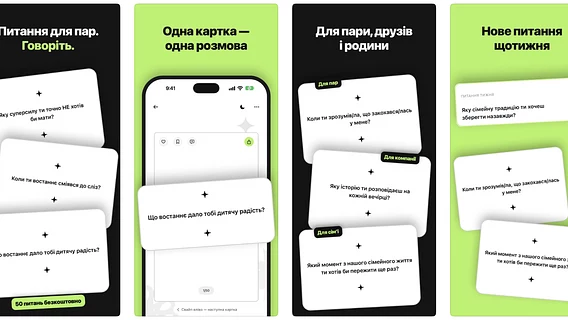
The mechanics of the app are simple: a card with a question appears on the screen, participants read it aloud and answer, then swipe to the next one. You can play from one phone — alone, with family or friends.
Togethis now has a free starter deck called "For Friends" with 50 questions. Among them are "If you won a million, what would you spend your first money on?" and "What makes you truly happy?".
There are also four paid decks available: "For Couples," "36 Questions to Fall in Love," "For Families," and "For Companies." Each costs $3 and is a one-time purchase—there is no subscription. Each paid deck has six questions available for free, so users can try out the format first.
A separate deck, “36 Questions to Fall in Love,” is inspired by a famous study by psychologist Arthur Aron. The questions are divided into three rounds and gradually move from less personal to deeper topics. According to the study, such a conversation can help build emotional intimacy between two people.
The app also features a "Guess Your Partner" mode, a question of the day, and a shared question of the week. Lyshtva notes that new questions are added to the decks every week. Togethis is available in Ukrainian and English. It has no advertising, required registration, or user tracking.
How much did the development cost and what didn’t work with the advertising?
Togethis is an indie project that Lyshtva is developing independently. At the beginning, he paid for the designer’s work, but he no longer remembers the exact amount. Among other expenses is a ChatGPT subscription for $20 per month. He used it to find technical implementation options, proofread texts, prepare marketing materials, and design screenshots for the App Store.
The developer spent $100 of the credit available in Apple Ads on advertising. He directed approximately half of the budget to Ukraine, the rest to the US. The average cost of installation in Ukraine was about $0.75, and in the US, according to his estimate, it could reach $5.
This traffic did not cover the costs, so Lyshtva refused paid promotion. Now he does not have a separate budget for marketing: the developer was laid off, so there are no additional resources for advertising.
He tried promoting Togethis on TikTok, but the videos only got about 900–1,000 views and it was time-consuming to create content. So he put that channel on pause for now.
About 250 downloads and first deck data
According to the developer, Togethis currently has about 250 downloads. The main audience is Ukrainians, but the application is also used in Poland, the USA, Hungary, and the UK.
There are no complete statistics on user returns yet. At the same time, Lyshtva tracks which decks players choose. The most popular is the free "For Friends": 50% of users tried it. "For Couples" is in second place with a rate of 34%. The remaining decks together scored 16%.
In future updates, the developer wants to add more analytics, including to better understand whether people return to the app after their first playthrough.
Why Apple rejected the app twice
Togethis’s launch on the App Store wasn’t without its challenges. Apple rejected the first version four hours after submission, citing "suspicious behavior consistent with fraud."
The reason, the developer found out, was a test shopping file that Xcode automatically added to the release build. After another rejected submission and about a month of correspondence with Apple, the app finally passed review and made it to the store.
What’s next?
Currently, Lisztva spends about 5–10 hours a week on Togethis, working on new ideas for themed decks and looking for ways to increase organic installs.
He doesn’t plan to turn the project into a large company or urgently assemble a team. For him, it’s an indie app that should fill a specific need — helping people find topics to talk about and spend time together.
“I want people to use the app and enjoy spending time together,” the developer explains.
Google has launched a free game about AI in Ukrainian for children aged 11-14. Schoolchildren will be able to try themselves as AI developers and better understand how it works
A Ukrainian developer created the social network VATRA. It is not a competitor to Facebook, Instagram or TikTok, but a Ukrainian digital ecosystem for communication and business development
Вас також кусають комарі? Розповідаємо про пристрій від українських стартаперів, який може цьому зарадити
Як зауважив нещодавно один військовий, якой побажав залишитись невідомим, орки, може, й не поцілять, а комарі точно зʼїдять. І від них потерпають зараз багато українців.
Позбавитись від комарів назавжди ефективно й екологічно допоможе гаджет Mosqitter. Цей стартап заснували дві українки — Анастасія Романова та Ольга Дьячук.
Ми вирішили нагадати, що може Mosqitter, про принципи його роботи та особливості, на злобу дня.
(текст від 21 жовтня 2021 року)
Кнопка здоров'я. Українці розробили систему, яка рятує пацієнтів стаціонару від смерті. Вони - переможці IT Arena Lviv 2022
Медичний психолог, який переїхав в Україну з Москви в 2014 році, Іван Осадчий, придумав систему, яка допомагає медсестрі і пацієнтові не втратити один одного в стаціонарі. Його стартап knopka вже працює в декількох лікарнях понад три роки не лише в Україні, а й у Польщі.
Повторюємо історію стартапу-переможця IT Arena Lviv 2022. Текст від 28 вересня 2022 року.
A Ukrainian developer created the social network VATRA. It is not a competitor to Facebook, Instagram or TikTok, but a Ukrainian digital ecosystem for communication and business development
Ukrainian developer Mykola Kolisnyk is independently creating the VATRA social network. The project has already entered initial beta testing: now the one-person team wants to attract the first users and check whether Ukrainians have a demand for their own social platform.
"A girl burned her sofa with an iron." An 18-year-old developer created the Handy marketplace to find repairmen
The idea for his own product came to 18-year-old Dmytro Grebenyuk after a completely everyday situation: his girlfriend accidentally burned the sofa in the apartment they rented with an iron. They needed to find a craftsman who could repair the damaged area, but the search turned out to be more difficult than expected. Instead of a local repair, they were offered to completely re-sew the sofa.