Хочете будувати кар’єру в Data Science та AI? Vodafone Big Data Lab відкриває новий набір —>
Марія БровінськаWork
11 September 2025, 13:12
2025-09-11
"These specialists are like superhero janitors in the programming world." A new profession is emerging in IT - vibe code cleaner: who is it and how many of them are there?
Artificial intelligence has contributed to the emergence of a new profession in IT. Experienced developers are retraining as vibe code cleanup specialists. The phenomenon is widespread. What will this lead to?
Artificial intelligence has contributed to the emergence of a new profession in IT. Experienced developers are retraining as vibe code cleanup specialists. The phenomenon is widespread. What will this lead to?
«I recently gave an interview about vibe coding, its current state and its future. One thing I could not have predicted as a consequence of the misuse of artificial intelligence tools is that a new role/position called „vibe code cleaning specialist“ would appear. And yes, now it has become a reality. Everyone who does vibe coding must master reverse engineering, testing and verification of results. Otherwise, companies would have to spend money on such additional specialists. So, the whole story of „inexperienced vibe programmer + subscription to artificial intelligence tools + vibe code cleaning specialist“ has a good chance of becoming economically inefficient compared to expectations…», notes Oleg Boguslavsky, Senior Director of Technology at SQUAD.
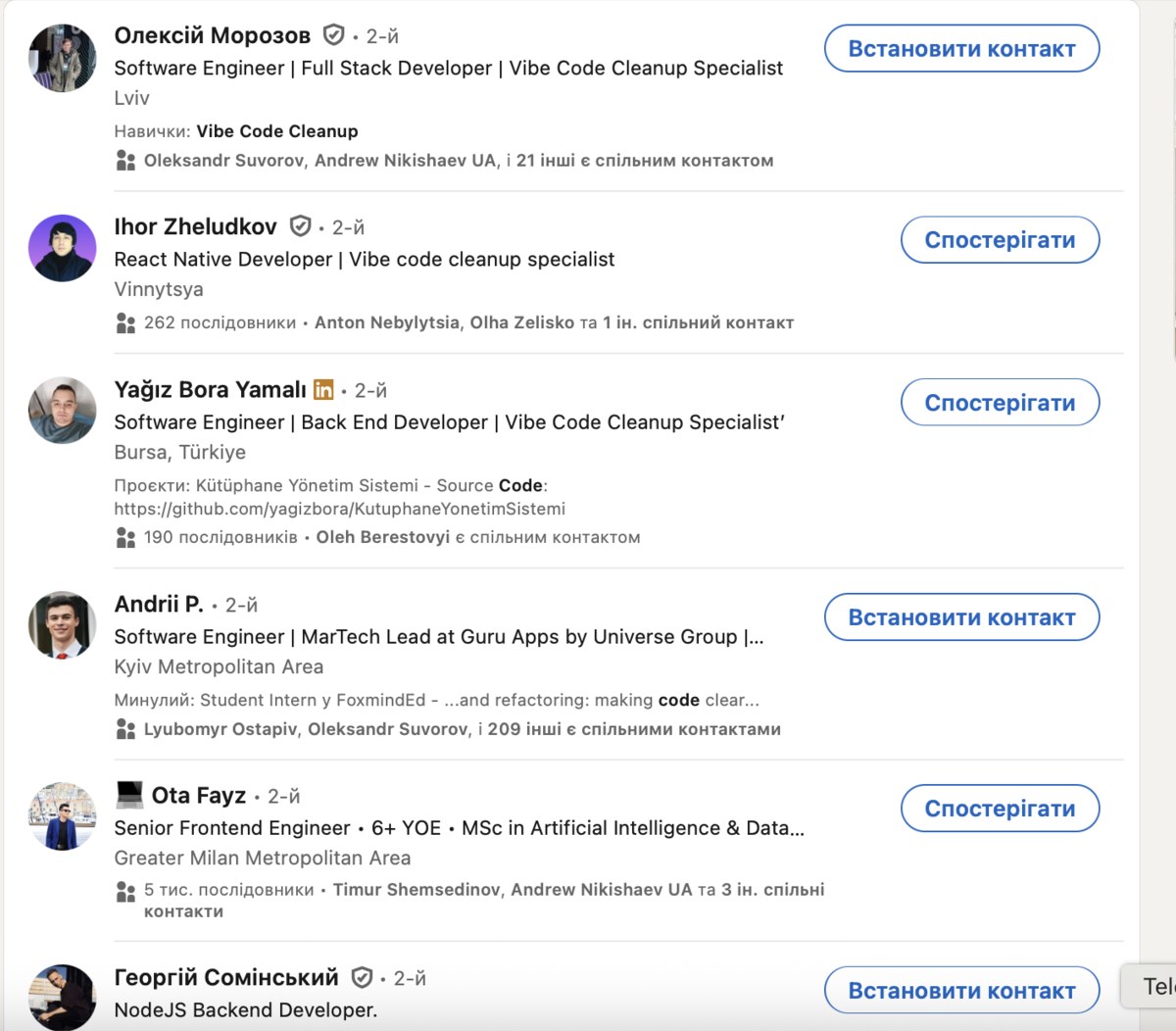
On LinkedIn, you can already find many people who indicate the role of «Vibe Code Cleanup Specialist.» This means that AI is changing the way IT people write code, and code cleaning is becoming a separate job. By the way, there are many Ukrainians among the cleaners.
Meanwhile, experts from other countries are vigorously discussing this trend.
AS Md. Ferdousul Haque, Senior Solution Architect, notes that the key point here is that there is no checklist or to-do list that guides the development step by step. He gives an example: «I requested to improve my GitHub profile via gemini-cli. The tool generated a good result, but made a mistake: it put a period in the URL after https. Because of this, the image was not displayed, and I had to fix it manually.»
Hack described the most common errors that vibe coding can generate.
In his experience, vibe coding is able to create code that has:
Syntax errors are incorrect code structure that does not compile or run.
Logical errors — the code runs, but produces an incorrect result or ignores important cases.
«Hallucinated» libraries or APIs — references to non-existent packages, methods, or parameters.
Nonsense or garbage values are random constants, dummy data, or made-up values.
«AI can generate code quickly, but it’s not always clean, scalable, or secure. This is where the „vibe cleanup“ comes in—the task of turning a raw, chaotic AI skeleton into a production-ready product,» writes Solution Architecture’s Viored Mirea. In his opinion, blind trust in AI code leads to several problems. Among them: brittle code (quick hacks without structure), security risks (hard-coded secrets or incorrect processing of personal data), unreliable tests (made-up steps or faulty logic), and lack of accountability (developers copying code that they themselves don’t fully understand).
Mirea believes that to avoid these risks, it is necessary to create safeguards. «Add tests and validation to detect faulty logic, do security checks at early stages (authentication, secrets, PII processing), provide auditing and rollback, perceive AI prompts and contexts as versioned artifacts, clearly define responsibility: there should always be someone who is responsible for the result,» he specifies.
The expert advises against using AI to give it work that you should do yourself. Instead, see it as a collaborator — a partner who helps you write faster and better. But remember: you own the final result. Cleanup, validation, and responsibility cannot be outsourced,» says Mirea.
Cloud & Gen AI Enterprise Architect Abhinav A. notes that AI and vibecoders have essentially created «a whole job market for people who clean up the aftermath of people asking ChatGPT to ‘make me an e-commerce site’ and then wondering why the payment system thinks it’s a toaster.» «These cleanup specialists are like the superhero janitors of the programming world. While everyone is having fun with their AI assistant, someone has to explain why the contact form sends emails to Mars,» he notes.
The economics of this process, in his opinion, are simply ridiculous. Companies try to save money by letting everyone «code like a vibe» on projects, and then have to pay twice as much for someone who is even capable of sorting out this chaos. «It’s like hiring the cheapest mechanic to fix a car and then wondering why the steering wheel ended up in the trunk. But at least the first guy was very enthusiastic!», the specialist explains.
How vibecoding gives IT professionals the feeling that they can do more and think bigger. Insights from developers, a designer, a System Support Engineer, a PM, and a marketer