Хочете будувати кар’єру в Data Science та AI? Vodafone Big Data Lab відкриває новий набір —>
Ігор Вишневський Around IT
8 December 2025, 09:00
2025-12-08
Chip production in Ukraine — has the government forgotten about its ambitious goal and at what stage is its implementation? Answers from Mykhailo Fedorov, Ministry of Digital Affairs, and a representative of the working group
At the beginning of the year, all Ukrainian media outlets, even those for which technology is far from the main topic, were bombarded with news about the government’s plans to establish domestic microchip production. This goal was identified as one of the strategic goals in the Strategy for Digital Innovation Development of Ukraine until 2030 (WINWIN), approved by the government in January. At the end of May, the Ministry of Digital Affairs also signed a memorandum of cooperation with the National Semiconductor Association, which stipulates that the state will support scientific developments in this area and create training programs for relevant specialists.
At the beginning of the year, all Ukrainian media outlets, even those for which technology is far from the main topic, were bombarded with news about the government’s plans to establish domestic microchip production. This goal was identified as one of the strategic goals in the Strategy for Digital Innovation Development of Ukraine until 2030 (WINWIN), approved by the government in January. At the end of May, the Ministry of Digital Affairs also signed a memorandum of cooperation with the National Semiconductor Association, which stipulates that the state will support scientific developments in this area and create training programs for relevant specialists.
However, by the end of 2025, the turbulent news background around these Napoleonic plans had calmed down to the point where it was more like calm. This does not mean that nothing was happening, but there were no loud statements from the Ministry of Digital Affairs, and the issue moved from the media sphere to the cabinet sphere. Therefore, we decided to ask the First Deputy Prime Minister — Minister of Digital Transformation Mykhailo Fedorov about the progress of this track, and also sent a request on this issue to the press service of the Ministry of Digital Affairs. In addition, a member of the working group at the Ministry of Digital Affairs, Senior Director of Advanced R&D at Silvaco, Oleksandr Grudanov, also provided us with his answers. Here is what we learned from them.
A few important points from the prehistory
We will not retell everything written earlier in detail, because dev.ua has dedicated a separate article to this. It contains not only all the plans for Ukrainian chip production, but also quite diverse and heterogeneous opinions of representatives of the technology industry about the realism and relevance of this task.
«Usually, states subsidize such projects by about 30%.» dev.ua received more information about domestic chip production, and also learned the opinion of the tech business about this initiative
But it is worth remembering that even if we take a purely bureaucratic timeline on this issue, it already shows a lag behind the schedule on some of the points. For example, the Ministry of Digital Affairs previously announced that:
The publication of a sectoral strategy for the development of the semiconductor industry was planned for the first quarter of 2025;
during 2025–2026 — submission to the Verkhovna Rada and consideration of the relevant draft law;
It was also planned to create the WINWIN Center of Excellence and WINWIN Semiconductors Lab 2025 in the educational sector by 2025;
2025–2026 — relaunch of educational programs for the specified purpose;
By the end of 2025, it was planned to start negotiations with a shortlist of potential partners and choose one of two options for implementing the idea.
Some of these items have been completed, some are in the process of being completed, and some have fallen off the timeline, but one way or another, work on them continues.
What exactly are the options in the last paragraph? Recall that earlier two potential ways were voiced by which Ukraine could reach its bright technological goal — either licensing the ready-made technology «on a turnkey basis» or attracting a strategic partner. At the same time, in response to a previous request from dev.ua, a member of the working group at the Ministry of Digital Affairs, Yevgeny Astakhov, noted that the second option is potentially more realistic for Ukraine, because it would supposedly allow for faster launch of production. Which of these ways the Ukrainian semiconductor industry will ultimately end up on, if it is lucky enough to rise from the ashes like a Phoenix, is currently unknown. But does the Ministry of Digital Affairs itself have this answer?
The draft law is ready to be submitted to the Rada
The ministry’s press service informed us that as of today, a working draft of a law on this issue has been developed within the framework of the activities of the interdepartmental working group under the Ministry of Digital Affairs.
«At the same time, an active discussion of the document with people’s deputies, relevant stakeholders, and public representatives is beginning — the draft needs to be finalized, taking into account the positions of all key parties,» the ministry stated.
The Ministry of Digital Affairs added that after approval by the Cabinet of Ministers, the document will be ready for submission to the Verkhovna Rada for consideration, and the draft law itself «lays the necessary legal and institutional foundation for the launch and development of the industry.»
«Its adoption will become the basis for the transition from concept to implementation — launching educational programs, creating research centers, and formalizing partnerships,» the Ministry of Digital Affairs emphasized.
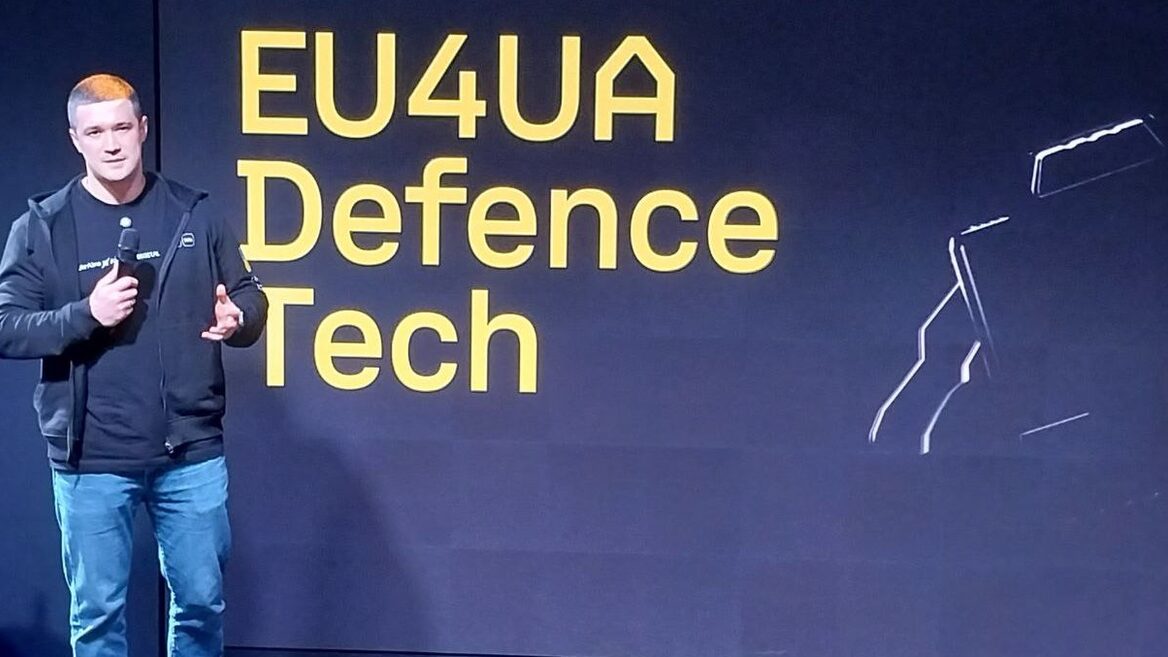
Mikhail Fedorov recently announced the readiness of such a bill. During one of the events, answering a question from a dev.ua journalist, he noted that the document will soon be submitted to the Verkhovna Rada. Fedorov also clarified that the norms of this act correspond to European ones and are synchronized with EU legislation.
«We need to do our homework.» Fedorov told how the track of domestic chip production is progressing
«Next is the adoption of the chip act — it has already been developed. This is a law whose norms will be integrated with the European Union as part of the European integration process. This law has already been developed, we will register and adopt it in the near future,» said Mikhail Fedorov.
Oleksandr Grudanov, a member of the working group at the Ministry of Digital Affairs, also focused on the issue of synchronization with European standards. «There is progress, and it is noticeable in several dimensions. During 2025, we completed the stage of analytical and regulatory preparation. Ukraine developed a national Strategy for the semiconductor industry and a Roadmap for what we call „semiconductor European integration,“ and successfully passed the framework stage of consultations with the EU on the Semiconductors track and the implementation of the Chips Act EU in Ukraine,» he assured.
Clean room
As Oleksandr Grudanov says, work is currently being actively carried out in two main areas:
a project to create pilot laboratories «Small Clean Room» — taking into account the experience of our European partners — for training, prototyping and small-scale production of specialized chips;
preparing conditions for attracting a technological partner — a factory (pure-play foundry) and forming a negotiation track.
However, according to him, not everything can be described in detail at this stage.
«To sum up, we have moved from declarations of intent to the implementation of specific projects and the preparation of technical solutions,» notes Oleksandr Grudanov.
In turn, as Mykhailo Fedorov commented, they have a corresponding project regarding the R&D process. «We have a ‘clean room’ project that we want to launch next year,» the government official noted.
What is a «clean room» for those who are far from this issue?
A clean room is a specially designed and controlled manufacturing environment with very low levels of contamination. Since modern semiconductor devices can be nanometers in size, even the smallest particle of dust can cause a defect, rendering the chip unusable. Clean rooms are therefore used both to minimize contamination and to maintain stable and tightly controlled conditions in the R&D environment, such as temperature, humidity, air pressure and airflow.
«Clean rooms» are also regulated by international standards, in particular ISO 14644-1, where there are different cleanliness classes, which are determined by the maximum allowable number of particles of a certain size per cubic meter of air.
High-efficiency HEPA and ULPA filters are used to filter the air, which are capable of removing 99,999% of excess particles. Of course, workers in «clean rooms» wear special protective suits that minimize contact with their skin, hair and clothing, and all walls, floors and equipment are made of materials that do not emit particles and are easy to clean.
In addition to the issue of the «clean room», the press service of the Ministry of Digital Affairs noted that, as previously announced, the WINWIN Semiconductors Center of Excellence is to be launched, although the timing of such a launch has not yet been announced.
«WINWIN Semiconductors Center of Excellence is planned to be launched as part of the semiconductor industry development strategy, which is currently being finalized. The issue of financing the Center is being worked out — after it is resolved, the launch dates will be determined. The Center of Excellence will become an entry point for educational, R&D and partnership initiatives in this technological field,» the ministry’s press service commented.
Training of specialists
From the responses of the Ministry of Digital Economy and Mykhailo Fedorov, it is also clear that a special emphasis in the revival of the Ukrainian semiconductor industry should be placed on training specialists from the student stage, and some steps in this direction have already been taken, but most steps are still ahead.
As the press service of the Ministry of Digital Affairs notes, the development strategy for the semiconductor industry provides for the updating of educational programs with a focus on engineering specialties that are key to the industry.
«Currently, we are preparing changes to the content of curricula in cooperation with specialized educational institutions and stakeholders. The demand for specialists in the semiconductor sector is growing rapidly, and without modern engineering education, launching the industry will be impossible. That is why education reform is one of the basic directions. Specific steps for implementation will begin immediately after the approval of the semiconductor strategy,» the ministry explained.
Mikhail Fedorov also reported on the achievement of the first agreements with educational institutions. «We have already launched educational programs with KSE. We also have a joint educational program with the Swiss University of Technology,» the government official explained.
How does the working group work and are negotiations with partners ongoing?
According to the information provided by the Ministry of Digital Affairs, negotiations with potential partners are ongoing: these include preliminary discussions with technological, educational, and industrial players — both in Ukraine and abroad.
«This is a necessary step to form a realistic model for launching the industry — with access to technology, expertise and investment. The next stage — formalizing the agreements reached — will become possible after the strategy is adopted. This will transform the initiative from a concept into a state program with clear obligations and a roadmap. It is only after this that it will be possible to decide on one of two implementation scenarios — to choose the optimal model for launching chip production,» the ministry noted.
As for the activities of the working group under the Ministry of Digital Affairs, it was they who developed the draft strategy for the development of the semiconductor industry and the working version of the relevant draft law.
«The group includes representatives of state bodies, leading industry experts, universities and business — this makes it possible to take into account the interests and visions of all key parties. Its activities provide analytical support, coordination, involvement of partners and form the basis for the practical implementation of initiatives in the field of semiconductors. In fact, the working group has created the fundamental prerequisites for the formation of a new industry in Ukraine,» the Ministry of Digital Affairs paid tribute to the efforts of experts.
According to working group member Oleksandr Grudanov, who justifies the need to implement these ambitious plans, there are at least strategic reasons for establishing domestic chip production, because it is a matter of technological sovereignty, increasing Ukraine’s defense capabilities, and the country’s place in global supply chains and the new European security architecture.
In addition, he does not see such big obstacles to this, given that chip factories are being successfully built in EU countries that have no experience in this.
«The EU is actively developing the Chips Act and building (albeit slowly) new factories. There are 27 countries in the EU, and if we look back, less than ten of them have historically made a significant contribution to the development of science and microelectronics, unlike Ukraine. Ukraine once had one of the largest industries in Europe, powerful scientific schools, its own developments and inventions. Yes, we have lost a lot, but the fact remains: most of the current EU members have never had such a level of competence, and now they are the ones attracting investments for the construction of factories and competence centers,» Oleksandr Grudanov is convinced.
According to him, despite all the difficulties, Ukraine still has something to offer, namely: a strong engineering and scientific school; progressive DefenceTech companies and startups, rare earths and the production of high-purity gases for EUV lithography.
Is Silvaco’s role in the project defined?
Since Oleksandr Grudanov is not just a representative of the working group at the Ministry of Digital Affairs, but also works directly in the industry, being the Senior Director of Advanced R&D at Silvaco, we asked whether the role of this company in the project has already been determined. Recall that Silvaco Group is one of the leading software suppliers for the semiconductor industry, among other things, engaged in TCAD (Technology Computer-Aided Design) — computer-aided design of semiconductor production technologies.
«At this stage, there are no agreements, and it is too early to talk about it. First, we need to build production, laboratories, and technological routes. Silvaco is a global player specializing in: EDA solutions for the full design cycle and physical verification of microchips, technological modeling (TCAD), AI products for automating the design of technological routes (FTDO — Fast Technology Development Optimization),» he explained.
According to Grudanov, there is currently no customer market for Silvaco products in Ukraine, so their main contribution now is scientific and technical.
«When at least pilot production starts, Silvaco can be useful in creating design enablement, that is: forming a „developer’s toolkit“ — process design kit (PDK) and supporting Ukrainian chip developers in accessing full-cycle design and physical verification products,» added Grudanov.
According to him, the company is currently actively working in the field of developing young talents. «This year, we launched internship programs: the first small group of interns successfully completed training in 2025, and we are planning a 2026 recruitment. We are also developing a course of unique lectures and practical classes on chip design automation,» shared Oleksandr Grudanov, emphasizing that the company also plans to provide free academic licenses to Ukrainian technical universities.
Open question
The purpose of this material was mainly to «wait» for the implementation of the ambitious promise. It is clear that the authorities are moving towards this step by step, without abandoning their plans. But, of course, there are also doubts about the prospects for implementing the plan, because this is a work that will take years.
At the current pace, even the bureaucratic and organizational part of the plan’s implementation will stretch over a significant period (one year has actually already passed). So what can we say about the transition to action and the arrival of the day when the first microchips will begin to be manufactured in Ukraine? Given that the role and initiative of the state in this project is primary, and the commercial interest of potential partners is secondary, if not dubious, this raises the question of whether this work will continue with a change of faces in the state leadership? Especially considering the lack of institutional continuity and the habit of political elites to cross out everything that the «paper workers» have done. However, the issue of ending the war and holding elections still remains elusive.
Member of the expert team at the Ministry of Digital Affairs: «Why not offer the US the construction of microchip factories in Ukraine as part of the agreement on raw materials? Trump loves such ideas»
Абсолютно некомпетентне зелене створіння що не може дати ради навіть з говнодією, її ламають з регулярністю потягів метро. які чіпи??? поржав. Міндіч вже відновив енергетику, тепер чекаємо коли Федоров налагодить виробництво чіпів)))









Абсолютно некомпетентне зелене створіння що не може дати ради навіть з говнодією, її ламають з регулярністю потягів метро. які чіпи??? поржав. Міндіч вже відновив енергетику, тепер чекаємо коли Федоров налагодить виробництво чіпів)))