Хочете будувати кар’єру в Data Science та AI? Vodafone Big Data Lab відкриває новий набір —>
Ігор Вишневський That's Life
26 October 2026, 09:00
2026-10-26
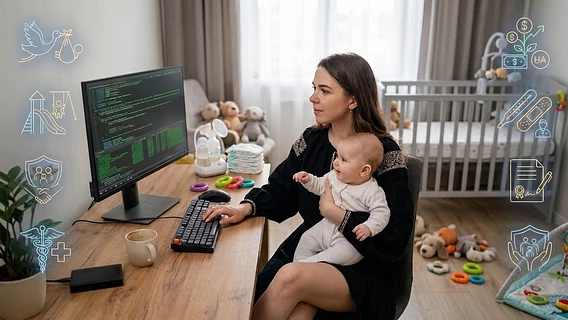
Agile Motherhood. Is the IT industry able to provide employees with flexible maternity leave options? IT companies shared their policies on this topic
We recently told the stories of three IT industry representatives who came back from maternity leave with different moods — some were awaited by their employer, offering a flexible return to work schedule, while others had to look for a new job after giving birth to a child. Unfortunately, project closures and a tough market are a more important priority for many companies than social guarantees.
So we decided to investigate the internal policies of Ukrainian IT companies regarding maternity leave and support for young mothers.
In particular, dev.ua asked what social guarantees apply to IT specialists who cooperate with companies as sole proprietors or under a gig contract; whether IT employers pay additional material assistance upon the birth of a child and for how long do they retain compensation for their employees during maternity leave; what happens to specialists who decide to take a long maternity leave and how the situation is resolved if the project is closed or the team has changed during this time.
We also learned from large IT employers what safeguards companies have in place against discrimination against pregnant women or young mothers as "risky" candidates in the employment process; whether they offer soft adaptation programs after returning from maternity leave; whether it is realistic to take urgent sick leave due to a child’s illness, and whether there are opportunities to take maternity leave not only for women, but also for men.
We were told about this and more by Sigma Software, Avenga, Ciklum, EPAM, ZONE 3000, Railsware, Svitla Systems, and Mate Academy.
Content
Employment contract, sole proprietorship or gig contract: what awaits IT workers on maternity leave
People & Culture Business Partnering Manager at Avenga, Natalia Marchvitska, explained to dev.ua whether social guarantees for young mothers differ depending on how the employee is registered — under an employment contract, as an individual entrepreneur, or through a gig contact.
According to her, the Labor Code applies to employees under an employment contract. “For them, we fully comply with the legislation on leave in connection with pregnancy, childbirth and childcare,” Marchvitska stated.
If a specialist cooperates with a company as an individual entrepreneur, this cooperation is regulated by a civil contract. Accordingly, specialists who pay the Social Security Contribution are entitled to state assistance in connection with pregnancy and childbirth from the Pension Fund.
People & Culture Business Partnering Manager at Avenga Natalia Marchvitska, photo from her LinkedIn
As for gig workers, according to the People & Culture Business Partnering Manager, they have the same rights to maternity leave as employees under an employment contract.
At the same time, the legislation does not provide for parental leave for gig workers up to three years of age, as in the Labor Code.
In response to a request from dev.ua, EPAM laconically noted that the company "cooperation is formalized in accordance with the law," and "employees receive official maternity leave with retention of position, payments in connection with pregnancy and childbirth, benefits upon the birth of a child, and fully paid sick leave for their own recovery and child care."
Daryna Kuzmyk, Talent & Culture Lead at Railsware, explained that since their team works from several dozen countries around the world, the company strives to create equal and comfortable conditions for colleagues, regardless of the country they are in. “To do this, we have internal policies and individual agreements in place in the event of the birth of a child. We fix financial support (compensation payments before the temporary suspension of cooperation), and also guarantee a return to cooperation,” she assured.
In turn, Head of HR Department at Sigma Software Yulia Ostroukh also emphasizes that all conditions stipulated by law are maintained for employees.
“At the same time, we understand that this is not enough for the peace of mind of a future mother. It is important for her to have a flexible schedule, the ability to work remotely, and to know that after maternity leave, the team will be waiting for her. And these are the conditions we create for our colleagues,” says a representative of Sigma Software.
ZONE 3000 shared that they have a Maternity leave program, so specialists who go on maternity leave receive financial support for a certain period, and they also keep their job.
They reminded us that they adhere to an individual approach in each situation and try to be flexible. “So if something doesn’t go according to plan or the specialist has certain circumstances, you can discuss with the manager when and how the mother can return to work, under what conditions, etc.,” ZONE 3000 assured.
Svitla Systems is convinced that the birth of a child is an important event, so they try to support the specialist in every way at this time. The company provides financial assistance at the birth of a child, and its amount depends on how long the cooperation with the specialist lasts. “The specialist can also take a break from work, keeping her position and contract with the company,” they assure there.
Ciklum says they support professionals during maternity and strive to help them feel confident, “without worrying about finances and access to medical services.” “Preserving well-being and taking care of the team is a corporate norm at Ciklum, so the basic maternity support package in Ukraine extends to all of the company’s professionals,” they outlined their approach there.
What payments and bonuses do IT companies offer when a child is born?
Mate Academy said that they have a Parental Leave Policy, according to which the mother receives 4 months of paid maternity leave. There is also a soft return to work with a part-time load but with full pay, as well as a structured re-onboarding plan. Separately, leave is provided in case of adoption.
“Payments are made as usual, at the end of each month. Vacation can begin as soon as the doctor issues a medical certificate… In the case of adoption, either parent receives 1 month of fully paid vacation,” they say.
At Ciklum, specialists are provided with four months of support after the birth of a child, regardless of their length of service in the company. The specialist also retains health insurance for one year from the start of maternity leave.
Yulia Ostroukh from Sigma Software adds that employees receive social assistance as provided by law, but the company welcomes the colleague’s family with a gift box with souvenirs and useful things for the baby and parents. “The birth of a child is, first of all, a great joy, and we want to share it,” she says.
Gift box for the baby’s mother from Sigma Software
According to Daryna Kuzmik, Talent & Culture Lead at Railsware, before parental leave, a colleague receives a lump sum payment, the amount of which depends on how long she has worked with Railsware, and starts at one month’s remuneration. “In addition, before that, we also pay out the entire unused balance of paid vacation days,” Kuzmik added.
For all specialists, regardless of the format of cooperation, Avenga has an internal Parental Leave Policy. It provides for: a one-time payment upon the birth of a child (Life-event Bonus); 2 additional paid days of vacation; preservation of health insurance during vacation and support from People & Culture at all stages — from vacation planning to return.
According to Natalia Marchvitska, People & Culture Business Partnering Manager at Avenga, the company has been paying a Life-event Bonus since July 2022. When a child is born, it amounts to three monthly compensations, and when a child is adopted or guardianship is granted, it amounts to one monthly compensation (to both the mother and the father).
“The bonus is available after three months of cooperation. In addition, both parents receive 2 paid days off, even if they work in the company together. The longest parental leave in the company is unpaid,” stated Marchvitska.
As the Avenga representative assured, health insurance is maintained for 6 months from the start of the maternity leave, and for individual entrepreneurs, the company can continue to administer documentation and taxes.
“A specialist can continue working during maternity leave if she wishes, with the consent of her manager. If a sick leave certificate is issued, we will agree with her on a convenient way to pay compensation,” explained Natalia Marchvitska.
ZONE 3000 assures that mothers receive financial support in a certain amount and for a certain period, but they do not provide exact figures, as they may vary depending on the department, personal and work circumstances.
“In addition, the company’s accountant helps to arrange financial assistance from the state, and also supports the activities of the individual entrepreneur throughout the entire maternity leave (if the specialist does not plan to close it),” they say there.
ZONE 3000 specialists also have the opportunity to continue attending free English classes (lectures, speaking clubs, reading club, etc.) throughout the maternity leave.
Svitla Systems pays a one-time financial assistance upon the birth of a child, the amount of which depends on the duration of cooperation, and the specialist can take up to three months of break to spend time with the baby. “If more time is needed, we look for solutions: for example, for administrative roles or when we can agree with the client, the break can be longer,” the company explained.
If maternity leave is delayed and the project is closed, what then?
Yulia Ostroukh, Head of HR Department at Sigma Software, assures that the company keeps the job for employees who go on maternity leave. “When a specialist is ready to return, we offer her positions on projects where there are vacancies, taking into account her experience and wishes,” she says.
If the project is closed, Sigma Software looks for vacant positions for the specialist on other available projects. Moreover, if technologies or market requirements have changed during this time, the company offers training and retraining so that the specialist can confidently return to work.
Ciklum explained that after the first four months of maternity leave, a specialist may, at her own request, take an additional break in cooperation for a total duration of up to one year. In this case, the terms of continuing cooperation and maintaining the position are agreed individually in advance.
“If during the specialist’s absence the project is completed or the team changes, further cooperation depends on the available projects. In such cases, the company uses internal transition opportunities, taking into account the specialist’s experience and the current needs of the company. The relevant company specialists conduct a thorough analysis of open positions and help with a comfortable adaptation,” Ciklum commented.
Avenga also assures that cooperation does not stop during the vacation, and the specialist receives Parental leave status. “The company does not limit the duration of the vacation. It is enough to notify the employee of the return or extension of the vacation a month in advance,” explained People & Culture Business Partnering Manager Natalia Marchvitska.
At the same time, there is no formal guarantee of retaining a specific position — however, the manager and the Resource department, as Natalia Marchvitska says, are making every effort to find a relevant role and project for the specialist before her return.
In particular, a month before the return of People & Culture, the manager and the Resource department discuss options for involvement in current and new projects, and after the exit, a reboarding process takes place — updating information about the company, integration into the team, and agreement on expectations from the role.
“If there is no suitable engagement yet, the specialist may remain on leave longer while we look for options for her. If the opportunity to engage her does not arise, the cooperation is terminated with a 30-day notice period, which the company pays for,” the Avenga representative explained.
Svitla Systems assures that they keep both the contract and the position, and the specialist returns to where they are waiting for her. “It happens that during this time the project is completed or the team changes. Then we together look for another opportunity that suits the specialist. People who already work with Svitla always have priority when we select teams for new projects,” they say.
ZONE 3000 told us that the specialist’s job is kept for “a certain period,” but did not specify what period. “If the mother cannot or is not ready to return to work after this period, the situation is discussed with the manager to find the best and most comfortable option for both parties,” the company says.
Railsware emphasizes that they do not break off cooperation during parental leave, but suspend it, and there is no maximum duration for such a “vacation”.
“That is, a person can have a break for as long as they need. We only ask that they let us know once every four months whether they plan to resume the partnership. In our practice, everyone returns within a year,” said dev.ua Talent&Culture Lead Daryna Kuzmyk.
According to her, the company, in turn, ensures a return to cooperation, reserving the right to offer a related or new project according to the specialist’s profile. "It is clear that business cannot stand still for years, so we redistribute functions or hire someone to fill them. We do not have a "bench" — instead, if necessary, we determine the updated scope and role together with the person when they return," says Daryna Kuzmyk.
Mate Academy, in turn, shared that after 4 paid months of maternity leave, you can take up to 2 months of unpaid leave. After that, the specialist returns to work through a phased transition.
“The employee returns either to the role she held before maternity leave, or to an identical role within the same team. We also often have open vacancies in adjacent teams, and if the employee is interested in a new role, this path is also open to her,” they explained.
A smooth transition in a tough market
For a specialist’s gradual adaptation to the work environment after maternity leave, many companies have a certain period where she has more freedom and fewer obligations, but each employer defines these conditions differently.
“We understand that returning to the full rhythm of work immediately after maternity leave is not easy. Therefore, the company allows you to choose a flexible schedule and leave gradually, increasing the workload at a comfortable pace. This allows you to adapt to both work and the new family regime,” explains Yulia Ostroukh, Head of HR Department at Sigma Software.
EPAM, in turn, claims that for a smooth return to work projects, they offer flexible schedules, part-time or remote formats.
Ciklum also has a flexible approach to organizing the work process. “The format of returning to work, including the ability to work part-time or on a flexible schedule, depends on agreements with the manager and the capabilities of a specific project,” the company explained.
ZONE 3000 makes it clear that before returning from maternity leave, a specialist can discuss with the manager under what conditions she is ready to return — full-time or for a few hours a day. The scope of tasks that a young mother can take on is also discussed.
“In addition, the HR department supports through adaptation meetings. At them, you can discuss professional, spatial, and social adaptation. This contributes to faster and easier readjustment of mothers,” they assured in response to our request.
Daryna Kuzmyk from Railsware assures our publication in a comment that the specialist has the opportunity to return to tasks in stages, on the condition of partial involvement, until the end of the parental leave period, and the transition to full-time work is carried out on her initiative and according to an agreed schedule.
“Moreover, a separate “reonboarding” plan is created for everyone who returns to cooperation. This includes updating knowledge about the product or project, updating skills, and returning to our usual track with an individual development plan,” says the Talent&Culture Lead.
Avenga also provides for a smooth adaptation after maternity leave. “Upon returning, a specialist can choose an employment format: full or part-time (100/50/25% FTE). The format is agreed with the manager. In addition, there is a reboarding process: meetings with P&C and the manager, updating information about the company, and gradual integration into the team,” commented People & Culture Business Partnering Manager Natalia Marchvitska.
The opportunity to return to work part-time after maternity leave is also provided at Svitla Systems. “We understand that it is important to find your rhythm after maternity leave. The format and scope of work are agreed individually with the manager, and if it is a client project, with the project team,” the IT company explained.
At Mate Academy, there are two options for a gradual return to full-time work: exit immediately after 4 months: 1 month with a workload of ~70% and 100% of salary, then a regular schedule, or up to 2 additional months of unpaid leave, then also 1 month with a workload of ~70% and 100% of salary, then a full schedule.
Discrimination — no!
IT companies also explained why pregnant women and mothers with young children are not "risky candidates" for them and how they combat discrimination.
According to Natalia Marchvitska, Avenga has an Anti-Harassment and Anti-Discrimination Procedure and a Diversity, Equity and Inclusion Policy.
“They prohibit any unfair or unequal treatment of a person based on gender, age, or any other characteristic protected by law,” says People & Culture Business Partnering Manager.
Various protection mechanisms are provided for this, including management responsibility. “Managers are directly responsible for impartial decisions in hiring, evaluating, and developing professionals, as well as for removing barriers that limit equal treatment and career growth,” states Marchwicka.
She added that violations can be reported through whistleblower channels, including anonymously, or directly to the People & Culture team, and the company guarantees protection from any retaliation to those who report such information in good faith or participate in the investigation.
“Each report is investigated confidentially and impartially, no later than 90 days. Violations may result in termination of cooperation,” explained an Avenga representative.
Among other things, all specialists at Avenga undergo mandatory training on the Code of Conduct, which covers the prevention of discrimination, harassment, and bullying. “When hiring, decisions are made based on professional criteria, questions about marital status and plans for children are prohibited during interviews, and recruiters are trained,” Nataliya Marchvitska assured.
EPAM declares a similar approach. “We are for equal opportunities. When hiring, we are only interested in professional skills, not personal plans of candidates, so any discrimination is excluded,” they noted.
As Daryna Kuzmyk, Talent & Culture Lead at Railsware, emphasizes, their process of attracting new specialists is completely focused on their expertise, and the selection process is based on equal opportunities, therefore it is built around technical interviews and portfolio assessment.
Talent&Culture Lead at Railsware Daryna Kuzmik, photo from her LinkedIn
“Questions about marital status or plans for parenthood are fundamentally absent from our interviewer guide. We offer various engagement formats, thanks to which our specialists comfortably combine parenthood and employment on projects,” she says.
According to Daryna Kuzmyk, their experience shows that when the focus during selection is on skills and results, and not on family circumstances or personal plans, the company gets the strongest and most motivated team members. “We have many cases when specialists successfully returned to active work on projects after a break in providing services. First in the format of adaptive engagement, and then moved on to the full scope of tasks. For us, parenthood of specialists is an occasion for shared joy, not a risk. We traditionally celebrate the birth of each child at Railsware at general All-Hands meetings: it is literally the first slide of each of our presentations,” she says.
Head of HR Department at Sigma Software Yulia Ostroukh also emphasizes that the company values professional competencies and work results, not the candidate’s marital status. "Flexible schedules and remote work allow you to combine work with parental responsibilities, so we do not consider pregnant women or young mothers as "risky" candidates," she explains.
The principle of zero tolerance for any manifestations of discrimination — both during hiring and in the process of further cooperation — is also declared at Ciklum.
“Our selection process is based solely on the assessment of professional competencies, technical skills, and the candidate’s experience in relation to the requirements of the role. Marital status, pregnancy, maternity, or paternity are not and cannot be grounds for discrimination or influence decisions regarding cooperation,” the company notes.
They also deny the possibility of discrimination on any grounds at ZONE 3000. “As for young mothers, the company has many examples of such cooperation — both with new specialists and with mothers who have returned from maternity leave,” they assure.
Mate Academy emphasized that they do not ask about pregnancy, having children, or related plans during the interview process. “The system is designed so that each candidate is evaluated according to the same set of competencies and only the candidate’s skills are taken into account,” the company claims.
Svitla Systems shares the same corporate values, emphasizing that what matters to them is a person’s professional skills, not their family plans. "We do not ask candidates about pregnancy, childbirth, or parenthood, and we do not consider anyone "risky" because of their marital status. We make decisions about cooperation solely on the basis of experience and suitability for the role. Discriminatory questions at interviews are against company rules, and we closely monitor this," dev.ua was informed there.
How IT companies make children of specialists happy
The vast majority of companies we surveyed do not provide any special facilities for employees' children in the offices — in particular, changing tables, feeding rooms or games. At the same time, employers reasonably note that the lion’s share of employees work remotely, so creating such facilities is simply not necessary.
“Railsware works on the principle of remote-first, and most colleagues come to our coworking spaces when it is convenient or necessary for them. For example, in Creative States, where our Kyiv space is located, there is a changing table for babies, a toilet for children, and a “children’s” room for meetings. But we know from practice that for parents of babies, the option of working from home is more important than a room for feeding in the office,” says Daryna Kuzmyk.
There are also play areas in Avenga’s offices, although most of the team works remotely. “We focus on flexible schedules and the ability to work from home. For parents of young children, this is usually the most convenient format,” says Natalia Marchvitska.
There are no separate feeding rooms or children’s play areas in Ciklum’s offices, because, as the company explains, they are located in large business centers and therefore dependent on the existing infrastructure. "The company supports a remote work format, which gives maximum flexibility to parents with infants," they say.
Meanwhile, at Ciklum, as in most other companies we surveyed, children of specialists receive gifts for the holidays — particularly winter ones. The company also regularly organizes events for colleagues and their children that they can attend together: thematic excursions, activities, and educational meetings.
Many educational and entertainment events for employees' children are held in online and offline formats at Sigma Software. “They help children decide on their future profession, acquire new skills, and spend time with their parents,” says Yulia Ostroukh, Head of HR Department at Sigma Software.
ZONE 3000 has the following benefits for children and their parents: a maternity pack for mothers going on maternity leave, as well as special activities and gifts for children of specialists for the holidays.
“These can be entertaining activities, quizzes, online games. For the New Year holidays, for example, there is an opportunity to receive a personal video greeting from St. Nicholas for each child. Activities and gifts are developed taking into account the age of the children and are created according to the age group,” the company explained.
Svitla Systems says that in honor of the birth of a child, they give their employees a corporate gift, and every year on St. Nicholas Day, the children of specialists also receive gifts from Svitla. “We love to please our youngest,” the company states.
Before the birth of a child, Mate Academy gives its employees a thermal mat and a nightlight for the child’s comfort, and Railsware offers family events several times a year at their locations, where families usually come, and where there are entertainment and animators for children. "This year, for example, we went to a master class on Easter egg making. And to parents who have a baby, we send a special kit for a newborn. In addition to towels and diapers that are useful for parents, it also contains a book specially created by our team, with which it is easier to lull the baby," shared Daryna Kuzmyk.
Avenga also regularly organizes events for the children of its specialists, timed to coincide with the holidays. “These include master classes on teaching mosaics, painting Easter eggs and vybyky, as well as joint viewings of films,” said Natalia Marchvitska.
Can I take a sick day if my child is sick? Rules for IT companies
People & Culture Business Partnering Manager at Avenga, Natalia Marchvitska, explains that the company provides 15 paid sick days per year with 100% compensation, and they can be used not only during your own illness, but also when a child is sick.
At the same time, the confirmation rules are the same — up to 5 days per year can be taken without medical documents, and if the illness lasts more than 2 working days in a row, then confirmation is required, and it can be in a simple form (certificate, doctor’s note, clinic receipt, etc.).
Head of HR Department at Sigma Software Yulia Ostroukh notes that they focus not on hours worked, but on the result of work, so if a child suddenly falls ill or another unforeseen situation arises, you don’t have to choose between family and work.
Head of HR Department at Sigma Software Yulia Ostroukh
“The task can be completed on another day. Both parents can take sick leave in case of a child’s illness,” she says.
Ciklum provides 5 days per year when professionals can take a break from work due to ill health without taking out a sick leave. In particular, these days can also be used to take care of a child or in case of other unforeseen family circumstances.
ZONE 3000 assures that a mother can count on a break from work or sick leave if it is related to the child. “Each department and team has its own processes, so we try to approach everyone personally and be flexible. Any needs can be discussed with a manager or People Partner and receive appropriate support or assistance,” they explained.
Railsware’s internal policy of compensation for days of temporary incapacity for work (sick leave) also applies to cases of caring for sick children under the age of 14. “Such time-off is provided on similar terms as regular days due to the specialist’s health,” explains Daryna Kuzmik.
Mate Academy assured that they have an unlimited number of sick leaves that do not require a medical certificate as proof of illness. “Therefore, parents can take sick leave in case of a child’s illness,” they say.
Gender equality in maternity leave: how Ukrainian IT companies support men who have become fathers
EPAM declares gender equality, and this principle also applies to fatherhood, so men can take parental leave on equal terms with women.
Sigma Software also assures that the company is understanding of the parental responsibilities of all employees, regardless of gender.
“If the family decides to evenly distribute the care of the child, the father can also take leave to care for the child. With advance planning and preparation, there are no organizational or project difficulties,” notes Yulia Ostroukh.
In Ukraine, Ciklum provides fathers with 14 calendar days of paid leave upon the birth of a child so that they can dedicate this time to their family, support their partner, and adapt to new responsibilities, while in ZONE 3000 Paternity leave provides for 10 working days during the first three months after the birth of a child.
This period may vary depending on the department or personal circumstances, which are discussed separately. “We try to be flexible and support both parents,” the company says.
Daryna Kuzmyk, Talent & Culture Lead at Railsware, reminds us that according to their internal policy, a specialist who has become a father can take up to 10 days of paid leave to help his wife.
“This policy applies even to those colleagues who are on probation. However, if there was a request for a longer period, our People team would definitely consider it and agree on the details,” she emphasizes.
At Mate Academy, the partner of the woman in labor receives 2 weeks (10 working days) with 100% pay, starting from the day the child is born.
“The father or partner as a secondary caregiver receives 2 weeks (10 working days) of leave with 100% pay from the day the child is born. In the case of adoption, either parent, including the father, can take 1 month of paid leave,” they say.
Parental Leave Policy at Avenga directly provides for Paternity leave, that is, leave for the father after the birth of a child, adoption or guardianship. “Its duration is not limited. The father also receives 2 paid days of rest, and in the event of adoption or guardianship — a Life-event Bonus in the amount of one month’s compensation. If both parents work at Avenga, both receive additional days,” shared Natalia Marchvitska, the company’s policy.
Svitla Systems does not discriminate against men in this right either. “We believe that the first days with a child are important for both parents, so we provide men with additional days off before the child is born,” they assured.
"If it weren’t for maternity leave, I would have simply gone on unpaid leave for six months or quit." 5 examples of IT professionals who talked about work and maternity leave
«У США тестувальник може отримувати $100 000 і навіть $500 000 на рік». Історія релокейту дніпровської IT-родини, де чоловік працює в EPAM, а дружина влаштувалася в Tesla
Марк і Вікторія Терещенки — IT-подружжя. Він працює на позиції Lead Test Automation Engineer у компанії EPAM, вона — Software QA Engineer у Tesla. У серпні 2021 року пара разом з 1-річним сином здійснила релокейт до США за L візою. Ми зв’язалися з українською родиною та поговорили про труднощі переїзду, зарплату в Америці та специфіку роботи в компанії Ілона Маска.
«Моя фінансова мета — накопичити $1 000 000, щоб мати пасивний дохід і жити на нього». Як айтішники витрачають гроші та в що інвестують
Зарплата айтішників в Україні — одна з найвищих. І ІТ-галузь під час війни — єдина галузь, яка зростає, попри війну. А айтішники — серед тих, хто найактивніше підтримують армію. Середній місячний донат айтішника становить 10% від зарплати, або $270. dev.ua вирішив розпитати айтішників, куди вони витрачають гроші й у що інвестують під час війни.
112 відгуків на вакансії, $100 за тестове та робота мрії. Історія моделі з Луцька, яка об'їздила півсвіту, через пандемію змінила плани й тепер навчає IT інших
Надя Адамович — у минулому успішна модель. Та через пандемію зірвався контракт на роботу до Китаю, тому Надія змушена була працювати таргетологом, сушисткою, а згодом вирішила піти в IT. Нині дівчина — UI/UX Designer, заочно навчається на факультеті міжнародно-економічних відносин у Луцькому політехнічному інституті та працює ментором у Mate academy. Розповідаємо її історію, що надихає.