NASA spacecraft will "touch" the sun on Christmas Eve. What is known about the flight of the fastest probe in history
The Parker Solar Probe will approach the Sun closer than any man-made object in history before Christmas.


The Parker Solar Probe will approach the Sun closer than any man-made object in history before Christmas.

The Parker Solar Probe will approach the Sun closer than any man-made object in history before Christmas.
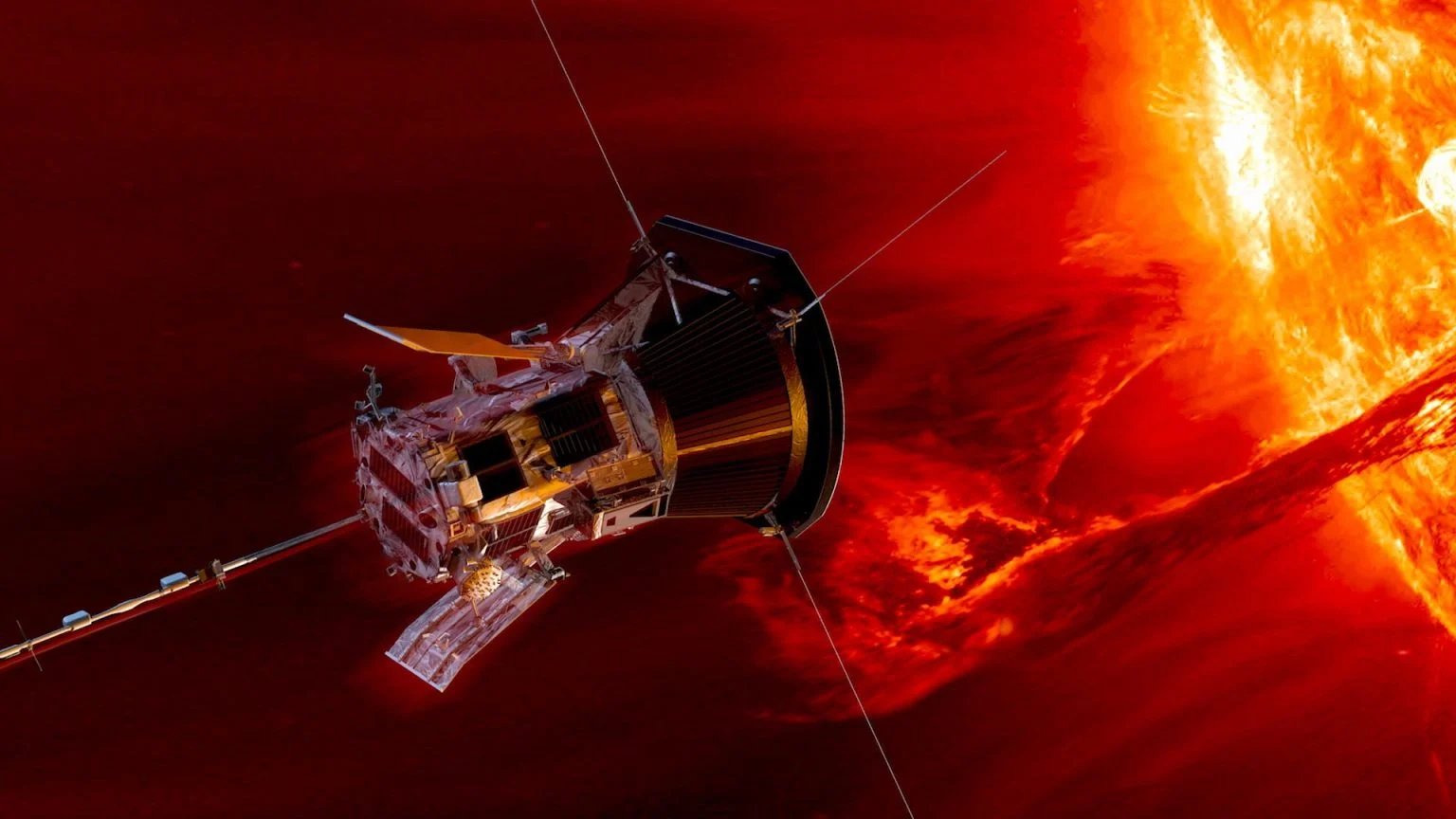
Parker will endure temperatures of about 1,700 degrees Fahrenheit, making it the closest flyby of the Sun of any man-made object in history, Smithsonianmag reported. To protect the spacecraft from the high temperatures, the spacecraft is equipped with a heat shield that keeps its sensitive instruments at just above room temperature, about 85 degrees Fahrenheit.

This 4.5-inch-thick shield was the result of decades of research and includes a water-cooling system, layers of insulating carbon foam, and a bright white ceramic coating that reflects the worst of the heat. In field tests in the lab, the heat shield was designed to withstand temperatures up to 2,500 degrees Fahrenheit.
Parker is a little bigger than a golf cart. To be able to travel in space for seven years, in addition to a small amount of fuel, the probe also received a boost of speed from Venus in a maneuver known as a gravity assist. It flew around the planet «slingshot» — seven times in total, the last time in November — allowing Parker to change its trajectory to an orbital flight around the sun. As the probe circled Venus, it also collected data on the planet’s own scorching atmosphere.
On December 24th, at around 6:53 a.m. Eastern Time, the probe will be just 3.8 million miles from the sun’s surface. And Parker will do it in another record-breaking way: traveling at 430,000 miles per hour. Moving at that speed, you could get from Washington, D.C., to Tokyo in less than a minute. That would make the probe the fastest man-made object ever to travel through the universe.
«It will be in the upper atmosphere of the Sun, literally touching the star,» Nicky Reil, NASA’s associate administrator for heliophysics, tells ABC News' Julia Jacobo and Mary Kekatos.
The probe is expected to answer some key questions about the star, including why the Sun’s outer corona is hundreds of times hotter than its surface and how solar wind particles are generated, CNN’s Ashley Strickland reports.
The corona is the cauldron where coronal mass ejections are produced, but it can only be seen from Earth during a total solar eclipse. A flyby through this outer layer will allow the probe to collect data needed to understand the Sun’s pulse and predict space weather.
The Sun is currently experiencing solar maximum, an explosive peak in an 11-year cycle of activity that will last until 2025. During this frenetic period, the Sun’s magnetic poles will shift, sunspots will bloom on the star’s surface, and it will increase its firepower, spewing ionizing radiation far into the solar system. These flares can cause powerful geomagnetic storms on Earth. In mid-May and October, the Sun produced such flares that the northern lights were visible across the continental United States and as far south as Florida.
«No human-made object has ever passed this close to a star,» says Nick Pinkin, Parker Solar Probe mission manager at the Johns Hopkins University Applied Physics Laboratory. «So Parker will truly be returning data from uncharted territory.»
Since its launch, Parker has made 21 close approaches to the sun, the first of which occurred in 2021. The upcoming 22nd approach, scheduled for before Christmas, will be its closest yet. The previous record holder was the Helios 2 spacecraft, which came within 27 million miles of the sun in 1976. Parker surpassed that number during its first flyby. The probe will also make two more close approaches to the sun, on March 22 and June 19 of next year, before ending its seven-year mission.
People on Earth won’t be able to follow the probe’s movements live. There will be no way to contact the spacecraft while it’s passing through perihelion. Parker is scheduled to make contact on December 27. This signal will only be a check on its overall health—researchers will have to wait until the new year for Parker to transmit its first data on this latest exploit.