Хочете будувати кар’єру в Data Science та AI? Vodafone Big Data Lab відкриває новий набір —>
Марія БровінськаІсторії
13 July 2026, 09:00
2026-07-13
“When a field starts bringing you money, you immediately love it.” The story of an entrepreneur whose Telegram channel was bought by the Ministry of Digital Economy, and now he has the largest network of TG channels about work and is scaling it into the startup Injobe with a valuation of $3 million.
The founder of the startup Injobe.com, Pavlo Mykhalchuk, grew up in a small village in the Khmelnytskyi region and doesn’t remember the moment he decided to become an entrepreneur. He says it all happened naturally. At thirteen, he was breeding rabbits and pigeons, a little later he sold insurance policies at StarLife, and after school he worked as a waiter and assistant cook.
«I was constantly looking for an opportunity to earn money. I tried different things, saw what worked and what didn’t. I was interested not just in making extra money, but in understanding how it all worked,» the man recalls.
When most of his peers were preparing to enter, Pavlo asked his parents not to insist on university. He was not against education as such, but he was convinced that he would learn much more now if he immediately started working and was responsible for his own decisions. «I said that I wanted to build my own life. My parents supported me,» says the 25-year-old entrepreneur.
Now he admits that he is increasingly thinking about business education — not because he felt the need for a diploma, but because he wants to systematize the experience he gained in a completely different way — through his own mistakes, unsuccessful decisions, and dozens of business experiments.
dev.ua talked to an entrepreneur who knows everything about Telegram business and plans to monetize his own HR-tech project.
The founder of the startup Injobe.com, Pavlo Mykhalchuk, grew up in a small village in the Khmelnytskyi region and doesn’t remember the moment he decided to become an entrepreneur. He says it all happened naturally. At thirteen, he was breeding rabbits and pigeons, a little later he sold insurance policies at StarLife, and after school he worked as a waiter and assistant cook.
«I was constantly looking for an opportunity to earn money. I tried different things, saw what worked and what didn’t. I was interested not just in making extra money, but in understanding how it all worked,» the man recalls.
When most of his peers were preparing to enter, Pavlo asked his parents not to insist on university. He was not against education as such, but he was convinced that he would learn much more now if he immediately started working and was responsible for his own decisions. «I said that I wanted to build my own life. My parents supported me,» says the 25-year-old entrepreneur.
Now he admits that he is increasingly thinking about business education — not because he felt the need for a diploma, but because he wants to systematize the experience he gained in a completely different way — through his own mistakes, unsuccessful decisions, and dozens of business experiments.
dev.ua talked to an entrepreneur who knows everything about Telegram business and plans to monetize his own HR-tech project.
Wind of change
Pavlo got into Telegram almost by accident. In 2016, the Ukrainian segment of the messenger was just beginning to take shape, and the largest channels had not yet turned into full-fledged media. Together with his brother, he created a small channel about men’s style and gradually grew it to about 3,000 subscribers. For a schoolboy, this was already an asset that could be sold.
The most vivid memory from that time is not connected with the canal itself, but with the train station in Khmelnytskyi. «I’m sitting at the train station, going to Kyiv for the first time, and I’m thinking: why do I need that Telegram? The capital is ahead, there are opportunities, there is life,» Pavlo recalls with a smile.
Before boarding the train, he opened his phone, put the channel up for sale, and almost forgot about it. A buyer was found within a few days.
«It was bought literally a day or two later. Those were my first days in Kyiv. This money was enough to survive the first month while I was looking for myself,» the entrepreneur says.
At that time, Pavlo was sure that the story with Telegram was over for him. The channel seemed like a small experiment that helped him earn a little money before moving. However, only a year passed, and it was to Telegram that he had to return — he simply did not see any other ways to quickly earn money and repay people the debts accumulated over the year in another business.
Debt as a reason to return to Telegram
Pavlo Mykhalchuk
It seemed to Pavlo that after selling the channel, he had finally found a business that worked — the private loan business was growing rapidly, acquaintances trusted him with their money, he found those who were willing to lend them at a higher interest rate, and the difference became his earnings. Pavlo says that over $80,000 passed through this system in a year. But it so happened that one of the largest borrowers simply stopped getting in touch. The money disappeared with him. «The partner with whom it all started just abandoned everyone. And me too. We had no receipts, no contracts. Just trust,» recalls Pavlo. After that, he owed people about $45,000.
Formally, Pavlo admits that he could have simply walked away from this story. He wasn’t the one who ran away with other people’s money, he wasn’t the one who broke the agreements, and legally, almost nothing forced him to compensate for other people’s losses. But for himself, he decided differently — over the next three or four years, he returned this money at his own expense, gradually paying off his obligations. To do this, he had to return to Telegram.
Pavlo didn’t dream of building a media company or seeing himself as someone who would one day run a network of channels with hundreds of thousands of subscribers. At that time, he was simply looking for a way to make enough money to give back to people what he considered his duty.
«I realized one thing: you need to make money very quickly. And what do I know? To be honest, almost nothing. But I knew people at Telegram. And I knew this market,» he explains.
From previous projects, he managed to collect about $2,000 in start-up capital. With this money, Pavlo bought the educational Telegram channel Factorium, and immediately invested some of it in buying an audience. It was then that he first began to treat Telegram not as an interesting experiment, but as a full-fledged business.
Economy Tg
He carefully analyzed statistics, tested different content formats, calculated the payback of advertising, and gradually realized what he now calls the main mistake of people who look at Telegram only as an easy way to make money. «Everyone thinks that Telegram is passive income. In fact, it is a difficult operational business. If you stop working on the channel, it starts to die,» the entrepreneur says.
After leaving the non-Ukrainian market, Pavlo went into vacancies and business content. Currently, his network has 450,000 subscribers in various projects related to vacancies: MPG Vacancies, Ye Robota, Injobe, Freelance and MPG Business. Another 110,000 are in the TOP-2 channel with a business audience.
Pavlo explained what the real mathematics of Telegram business looks like using his own specific example. «There was an affiliate network of channels that I entered as a smart money player. I invested $20,000. The project lasted 2.5 years, the network grew to 450,000 subscribers. They sold in parts to one buyer. The result was $80,000 from the first exit, $48,000 from the second, plus $25,000 in profit for both of us for the entire time. In total, about $150,000 for both of us. For me personally, it was x4 to the investments in the project where I was not involved operationally,» Mykhalchuk shares his experience.
«When a certain area starts bringing you money, you immediately love it. That’s the whole secret,» the entrepreneur admits.
According to him, the biggest problem in modern Telegram is not even competition, but the constant loss of audience. People unsubscribe from channels as easily as they subscribe to them, so owners of large projects are forced to constantly buy new traffic.
«If you build a large canal from scratch today, you need to be prepared to spend approximately $800,000 to $1 million just on its development. And that doesn’t guarantee success,» Pavlo notes.
From the outside, everything looks simple: a post, an ad, new subscribers. In fact, according to the entrepreneur, behind every large Telegram channel there is daily operational work, dozens of tests, and constant analysis of numbers. That is why Pavlo was always surprised when this business was called passive.
Gradually, a network of various projects began to form around Mikhalchuk’s channels. He created some channels from scratch, bought, developed, and sold others. It was a full-fledged market, where not only the number of subscribers was evaluated, but also the audience’s trust, the quality of content, and the stability of coverage. «You can buy subscribers. Views too. Trust — no,» he says.
It was reputation that gradually became the main asset of his business. The story with debts taught Pavel that in the long run, people remember not only successes, but also how you behave when everything collapses. Over time, his network of channels became so noticeable that not only private entrepreneurs or media managers appeared among the buyers.
The most expensive money is not in politics
Pavlo Mykhalchuk
The bigger Pavlo’s projects became, the more often he received offers that many in his place would hardly have refused. Political campaigns, jeans, hidden agitation, large advertising budgets — the Ukrainian Telegram has long lived by these rules. Pavlo does not hide: it is political channels that often bring in the most money. But for himself, he drew the line quite early.
«If you sell a political order — good or bad — you become an accomplice in what that politician does later,» the entrepreneur explains his position.
According to him, over the years of his work, he regularly received requests for political placements, as well as advertising for gambling or other high-margin niches, and refused because he did not want to trade the audience’s trust for quick money.
Instead, Pavlo relied on what he knew best: information channels, educational projects, regional communities, and a network of vacancies. One of the most important for him was the local channel «Starokostyantyniv 24/7». Before the full-scale war, it was an ordinary city Telegram channel. But after February 24, its role changed dramatically. «During the time I was in the project, the channel managed to collect millions of hryvnias in donations for the military,» he says.
Before the full-scale war, Pavlo had a network of a million subscribers — mostly informative channels, and all of them in the non-Ukrainian segment. When the invasion began, he started publishing information. «Many admins of Ukrainian channels still run Russian Telegram channels. But I left,» he says.
According to him, some of the entrepreneur’s major projects were bought by the Ministry of Digital Economy.
«They had a project back then — they bought up large channels to adapt them to Ukrainian narratives: to show the Russian audience a different picture of reality,» he says.
According to Pavlo, several million dollars were allocated for this.
Pavlo recalls this story without much pathos — as another deal in a market that was rapidly maturing at the time. «It became clear then that Telegram was no longer just a messenger,» he notes.
By the way, he is convinced that Telegram will not be blocked in Ukraine — too much is tied up in the messenger today.
When the media business became insufficient
The fastest growing channel network for Mikhalchuk was the network of channels with vacancies — according to Pavlo, thousands of ads were posted through it every day, employers found people, candidates found jobs, and Pavlo himself increasingly found himself thinking that Telegram was already starting to limit opportunities.
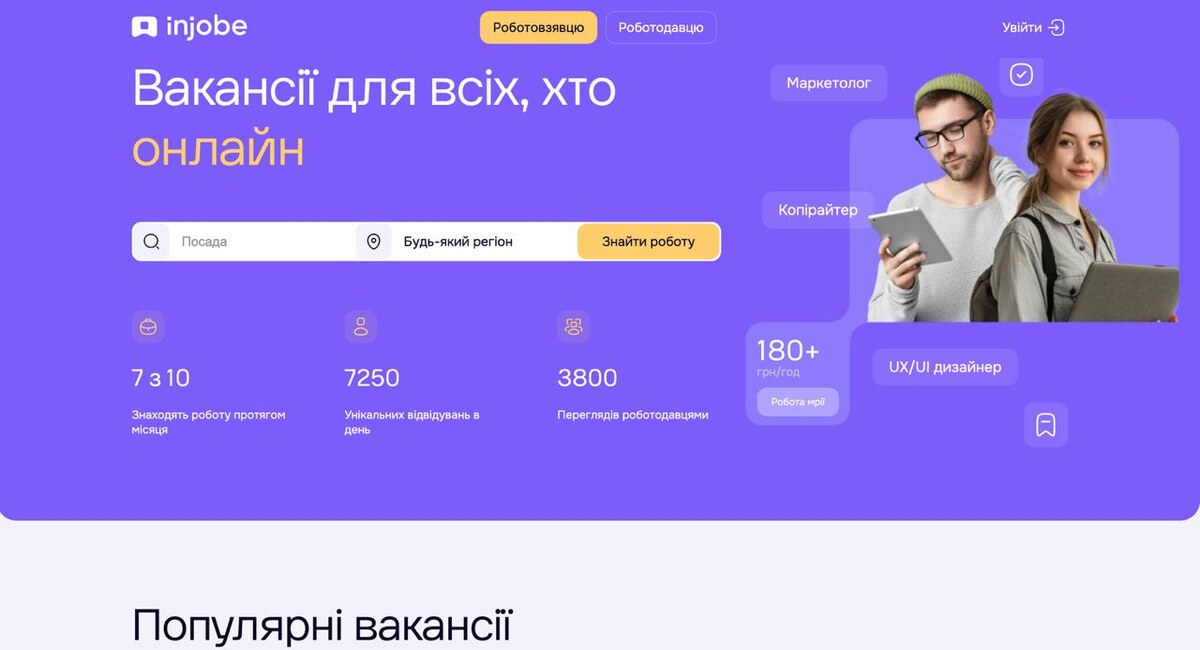
«At some point I realized: we are no longer just bringing people to vacancies. We understand this market very well. So we can do something more,» he says. And it was this thought that gradually led him to the idea of his own product — Injobe.com .
The idea for Injobe, he says, came from a simple question. «We already had an audience. We had employers. We had an understanding of the market. And I thought: why should all this experience stay inside Telegram?»
The project was launched in the fall of 2025, and now has over 16,000 registered users, 2,300+ uploaded resumes, and month-on-month sales growth. According to the founder, more than $70,000 of his own funds have already been invested in the product.
Injobe focuses on digital: IT, marketing, copywriting, everything that works on a laptop. The business model is two tariffs for employers: posting a vacancy for 800 UAH or paying for a thousand unique views for 600 UAH. Resumes for employers are free for now.
«We speak the language of digital. Our tone is for them. We understand their pain,» emphasizes Pavlo.
Among the features of Injobe.com are a built-in chat between the candidate and the employer and a transparent LMS system for the candidate: you can see what each application has responded to and at what stage.
At the same time, Pavlo does not compare himself to Work.ua, Robota.ua, and Djinni — he says they don’t even notice him yet. «We are set for a marathon, not a sprint,» he explains.
The entrepreneur wants to see operational breakeven within 3–5 years. And negotiations are already underway with a potential investor — Mikhalchuk’s HR project ecosystem (channel network + website) has been valued at $3 million.
«If we attract investments, it’s only for development. Not because we want to sell the company,» the entrepreneur says about his plans.
He is convinced that in the early stages of a startup, versatile people are more valuable than narrow specialists. «I like people who can cover several competencies at once. Yes, they are more expensive. But it is cheaper than maintaining a large staff,» he says.
This approach, the entrepreneur explains, was largely born in the Telegram business, where huge projects were often handled by two or three people. Even now, Pavlo is largely responsible for Injobe’s marketing himself. «I would gladly hand over marketing to a stronger specialist than me. My task is not to set up advertising. My task is to build a company,» he admits.
Not a diploma, but skills
Over the years of working with the labor market, Pavlo has seen thousands of resumes and hundreds of hiring stories. And the more he observes how this market is changing, the less he believes in classic selection criteria. In his opinion, a diploma has long ceased to be the main advantage of a candidate. Instead, practical skills, a portfolio, and the ability to work with artificial intelligence are becoming decisive.
«I think in a few years, resumes will change completely. AI is already having a huge impact on how people work and how companies hire,» he says. At the same time, he doesn’t believe in the other extreme—that AI will completely replace people. In his opinion, it’s just changing the rules of the game, and those who learn to use new tools faster than others will win.
«MIT is not looking for diploma collectors, but people who are growing.» The story of an IT guy from Kyiv who joined the elite of American education and is now teaching the next generation of applicants and developing his own startup
Соціальні мережі та штучний інтелект формують глобальні наративи про війну в Україні. Як їх використовують українці та росіяни — аналітика від Foreign Policy
Напередодні вторгнення росії в Україну соціальні медіа слугували полем битви для держав і недержавних діячів, щоби поширювати конкуруючі наративи про війну та зображати поточний конфлікт у своїх власних інтересах. Видання Foreign Policy опублікувало великий аналітичний матеріал, як українці та росіяни використовують соціальні мережі, щоб давати інформацію про війну. Наводимо його адаптований переклад.
Telegram 19 червня запустив Premium-підписку. Скільки вона коштуватиме, які нові функції отримає підписник
Telegram 19 червня запустив Premium-підписку. Вона відкриває доступ до додаткових функцій месенджера. Користувачі платної версії зможуть завантажувати файли об'ємом до 4 ГБ та скачувати їх на максимальній швидкості, використовувати додаткові інструменти для керування чатами та автоматично трансформувати голосові повідомлення у текст.