“Claude can generate test cases for requirements that are not in the product.” Senior QA engineer explained how to use AI to analyze business requirements before creating test cases
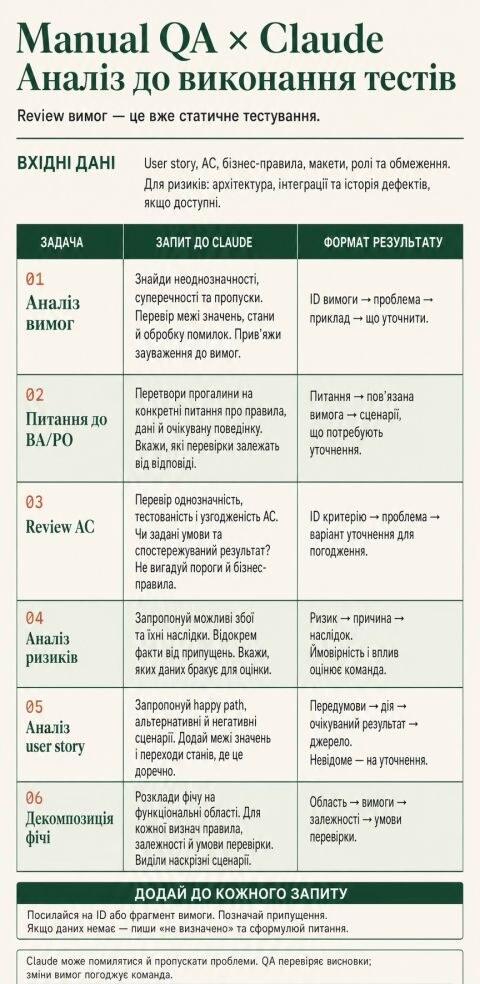
Senior Software QA Engineer Anastasia Dyka advises QA specialists not to start working with Claude and other AIs right away by generating test cases. According to her, the model should first be given the requirements to analyze and asked to find gaps, contradictions, and uncertainties in them. Otherwise, the AI can independently “think up” the product’s business logic, and then write tests for it.
Senior Software QA Engineer Anastasia Dyka advises QA specialists not to start working with Claude and other AIs right away by generating test cases. According to her, the model should first be given the requirements to analyze and asked to find gaps, contradictions, and uncertainties in them. Otherwise, the AI can independently “think up” the product’s business logic, and then write tests for it.
“Claude can easily generate very good test cases for business requirements that are nowhere near present in your product,” notes Dyka.
As an example, she took the following requirement: “The user can cancel the subscription.” At first glance, everything seems clear. However, in practice, questions immediately arise. What exactly does this mean? Does access disappear immediately or only after the end of the already paid period? What will happen with the next charge? Is the money refunded? What if the user clicks “cancel” right when the system is already processing the auto-renewal?
How Anastasia Dyka advises using AI
The model can be asked to look for gaps in requirements. For example, to find situations where the product behavior is not defined. In the case of a subscription, this could be the point at which access is terminated or the refund policy.
Next, the AI assistant can help formulate questions for the business analyst or product owner. For example, what happens if a subscription cancellation coincides with an auto-renewal, and what does this answer depend on: subscription status, payment, or user access?
Then comes the Acceptance Criteria check. Phrasing like “subscription successfully canceled” leaves a lot of room for interpretation. So the AI assistant needs to be asked about the initial state, the user’s action, and the specific result: what status the subscription will receive, when access will end, and what will happen to auto-renewal.
AI can also be used to find potential risks and non-standard scenarios. For example, what would happen if the payment service confirmed the cancellation, but the system did not receive a notification about it. An AI agent can suggest such scenarios, and then it is worth checking whether they are possible given the system architecture.
AI can also suggest additional scenarios. For example, repeated cancellation, timeout, already canceled subscription, or simultaneous auto-renewal. If it is not clear what the expected result should be, this may mean that something is missing in the requirements. And the AI assistant can help break the function into separate parts — for example, subscription management, payments, access rights, and notifications. And then show the dependencies between them.
Dyka also recommends setting clear constraints on the model. For example, asking the agent to reference a specific ID or requirement fragment for each inference, labeling assumptions separately, and not inventing business rules if they are not present in the input data.
And after the business analyst or product owner answers the questions, the updated requirements can be passed back to the AI assistant and asked to determine which test scenarios now need to be changed, added, or removed. This helps to avoid leaving outdated expectations in the tests after changing or clarifying the business logic.
In the comments, Senior Angular Engineer Volodymyr Zaplatinsky also said that he encountered a similar problem.
"Oh, that's right, I encountered exactly this when AI generates tests in order to protect its solution. And not to prevent a possible bug in the code," he said.
In response, Dyka told about a situation where AI once invented business logic that was not in the product, and then generated tests based on its own assumptions. “It is worth stopping such “activity” in a timely manner,” Dyka notes.
Previously, dev.ua interviewed QA specialist Iryna Grabovska, who also talked about how she uses AI in her work. According to her, ChatGPT and Claude help to quickly create checklists, review test cases, and check if nothing is missed, but she does not advise relying entirely on the models' responses.
“QA is not just about clicking buttons. And it’s definitely not an easy job for moms on maternity leave for a couple of hours.” The IT community debates why testing is still misunderstood in the job market
«Навіть для виробників трун і пам’ятників я писав тексти». Як стати game-тестувальником під час війни: історія колишнього металурга, страховика, копірайтера
34-річний Андрій Зубков під час війни увійшов в IT, докорінно змінивши свою кар'єру і буденне життя. Тепер він QA Engineer у компанії Pingle Game Studio — тестує ігри. А до цього працював на металургійному комбінаті, в страхуванні та навіть копірайтером. Свою історію про вхід в нове життя Андрій розповів dev.ua.
«Я вигоріла настільки, що вже не могла дивитися на комп'ютер». Історія QA-інженерки про великі гроші, безглузді купівлі, вигорання та дауншифтинг
Хмельничанка Олена Шеліна ― айтішниця, яка настільки вигоріла на роботі, що вирішила покинути IT-сферу та докорінно змінити своє життя. За 9 років роботи в IT дівчина пройшла всі ступені кар’єрного зростання, змінила кілька компаній і навіть напрямів. Та прокинувшись одного ранку, вирішила, що більше не зможе виконувати свою роботу якісно. Дівчина переїхала в село, завела господарство та повністю змінила професію. Розповідаємо її історію.
Manual QA з Luxoft Ukraine вже три роки приборкує вітер на воді та кайфує від цього. Ось його історія та поради для тих, хто мріє про море та віндсерфінг
«Навколо IT» — нова рубрика, в якій ми збиратимемо все корисне для життя айтішника, яке не стосується його роботи. Виявляється, у айтішників найрізноманітніші хобі. Ми вже писали про айтішників-бігунів, плавців, художників, музикантів, танцівників, і навіть заводчика собак. Сьогодні розповідаємо про програміста, який навчився приборкувати вітер. 39-річний Сергій Костюченко — Manual QA у Luxoft Ukraine — розповів про своє захоплення віндсерфінгом та можливості займатися цим видом спорту для всіх бажаючих.
«Щойно я почув про тестування, усередині щось йойкнуло». Увійти в IT після першої співбесіди можливо: історія QA-інженера, яка це доводить
30-річний Руслан Долиненко — молодий айтішник, який пишається тим, що знайшов роботу з першого разу. Він отримав офер після першої співбесіди, бо, як вважає сам хлопець, ретельно до неї підготувався. Як увійти в IT, минаючи десятки відгуків на вакансії, і в чому секрет Руслана — у матеріалі.
Have important news to share? Message our Telegram bot
Key events and useful links in our Telegram channel