Хочете будувати кар’єру в Data Science та AI? Vodafone Big Data Lab відкриває новий набір —>
Тарас КозаковІсторії
9 November 2026, 14:54
2026-11-09
18 businesses and a new bet on education: a Ukrainian serial entrepreneur is building an international educational platform in the USA. How EDCAPIT works
The serial entrepreneur’s path runs from real estate and Ukraine’s ITCAPITAL group to an international course marketplace. His next challenge is connecting learning with employers’ needs.
The serial entrepreneur’s path runs from real estate and Ukraine’s ITCAPITAL group to an international course marketplace. His next challenge is connecting learning with employers’ needs.
Oleh Podobied is building the international education platform EDCAPIT in Silicon Valley, drawing on experience in real estate, recruitment and software development. Education became part of his business in Ukraine: first through IZIHouse, then through ITCAPITAL, which he founded in 2020 and developed into a group of technology and education ventures.
The startup already operates as a marketplace for courses by independent instructors. The founder’s next planned step is a Career Center: helping graduates prepare to look for work and enabling employers to find candidates. That would add a third group to the platform’s authors and students: companies that are hiring.
“For many people, education and a career remain two separate areas. We want to connect the education market and the labor market,” Podobied explains.
Entrepreneurship before EDCAPIT
According to his biography, Podobied started his own businesses in 2015, including trampoline attractions and mobile coffee outlets. Earlier, he had worked on construction sites in Nikopol and Kyiv, waited tables and worked as a barista. Real estate, recruitment, IT and the MBF Talent media project followed. In total, he counts 18 businesses and projects.
Podobied began developing IZIHouse in 2017 as the real estate agency’s founder and CEO. In 2019, he added online training for agents. According to his biography, he also worked on its franchise model, operating standards and quality control.
The IZIiChar recruitment business added experience in hiring. In his plan for EDCAPIT, Podobied is trying to connect both tasks: preparing someone for a profession and helping an employer find a candidate.
ITCAPITAL: from software development to a group of businesses
In 2020, Podobied founded ITCAPITAL in Ukraine and became its CEO. According to the group’s published history, its first business line was ITCAPITAL Development: software development and business process automation, including websites, mobile applications and business software.
ITCAPITAL School launched in 2021 with programs in IT services sales, recruitment, starting an IT company, building Telegram bots and working in real estate. Podobied says he developed around ten courses over the years with specialists from his companies. The school grew as a separate business line, drawing on the teams’ experience in sales, hiring and management.
ITCAPITAL Invest and the ITCAPITAL Charity Kids charitable project were launched that year as well.
Following Russia’s full-scale invasion of Ukraine in 2022, the group added the ITCAPITAL Charity War volunteer initiative. Its website includes material about providing medicines to military personnel and hospitals, and firewood to heat accommodation for women and children.
U.S. expansion and a platform business model
In 2023, the business gained a U.S. corporate entity, ITCAPITAL USA INC, incorporated in New York. That year, Podobied also began developing Roboasis, a robotics marketplace project intended to connect suppliers and buyers of robotic solutions.
The EDCAPIT brand emerged in 2024, with the platform initially operating within ITCAPITAL USA INC. In 2026, it gained a separate corporate structure, EDCAPIT, Inc., incorporated in Delaware. Podobied now leads his entrepreneurial and product work from the San Francisco Bay Area. He described EDCAPIT’s origins in his full interview in Russian — about his life, business, and the USA on the platform’s channel.
At EDCAPIT, Podobied expanded the education business into a marketplace: independent instructors create courses, and the platform takes a share of sales. Under its published standard collaboration terms, authors receive 67% and the platform 33% of payments after the specified deductions, including applicable taxes and refunds.
According to company figures for early November 2026, the platform contains 208 courses, including material in preparation, with more than 165 already published. EDCAPIT also reports approximately 220 authors. These figures describe the platform’s content and author base. The statistics supplied do not include paid purchases, repeat purchases or revenue.
One outside provider is landscape design school DreamyGarden. In September 2025, the school announced on its own website a course on EDCAPIT for Ukrainians at home and abroad. The program covers plants, spatial planning and creating a garden. The catalog thus extends into practical disciplines beyond IT.
Podobied says he personally sets product development priorities within the current team. As CEO, he combines work on the platform with attracting instructors and investment. EDCAPIT’s guidelines call for reviewing curricula and sample lessons before publication. In this business, demand needs to grow alongside the catalog: sales must provide income for both instructors and the platform.
In February 2026, EDCAPIT announced an investment from entrepreneur Mukhitdin Khayrullaev, who also became an adviser to the company. The SAFE agreement carries a $20 million post-money valuation cap, a ceiling used to calculate the investment’s conversion into shares. This is a deal term that does not, by itself, establish the company’s market value. The announcement did not disclose the amount invested.
Oleh Podobied speaking at GGW Sharks. Photo supplied by Oleh Podobied.
Courses and AI support in a competitive market
The current product lets students choose a course, study at their own pace, track progress and complete the assignments in their chosen program. They receive an EDCAPIT certificate of completion when they finish. Course content and practical work depend on the individual instructor.
An AI assistant is already operating on the platform. According to Podobied, it is available around the clock and has been running for approximately a year, helping people as they use the platform.
Large education services also offer AI support. In January 2026, Udemy described an assistant that answers questions using course materials. For EDCAPIT, the competitive question concerns course quality, how well programs match students’ needs and how the planned career service will help people apply their new skills.
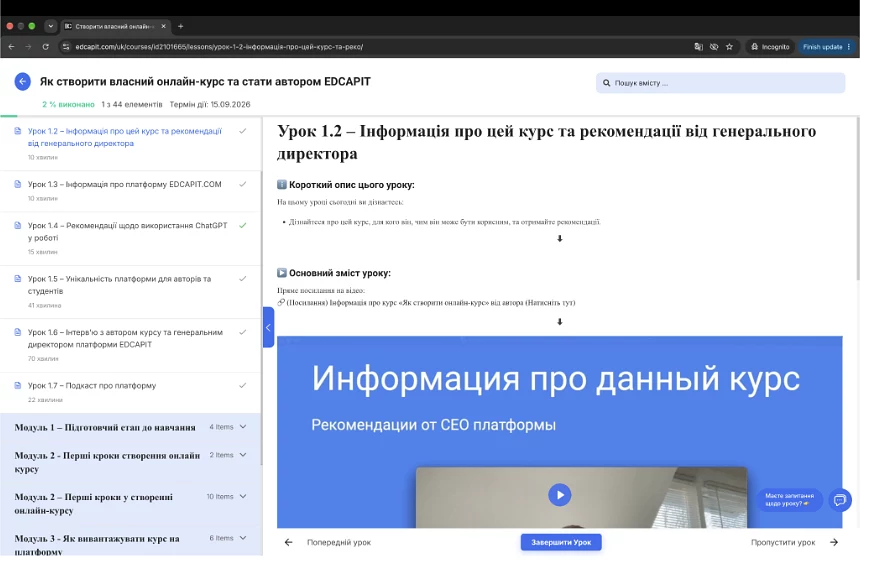
An EDCAPIT lesson page showing navigation and progress tracking. Screenshot supplied by the company.
Career Center: from learning to an interview
The integrated Career Center is in development. Under Podobied’s plan, students would be able to get help preparing to look for work in the field they studied and present their skills to employers after completing a course.
“We are trying to build a single journey from the start of learning to employment,” he says.
In the planned workflow, the system would direct graduates to the Career Center. Recruiters from companies that join the platform would be able to receive information about suitable candidates and invite them to interviews. A job offer would depend on the employer’s requirements and the candidate’s suitability.
For that workflow to function, the team needs to bring in employers and show them which work tasks graduates can perform. The model’s usefulness could be assessed through interview invitations, jobs in the field studied and the time needed to achieve them.
A bet on reskilling in the AI era
There is a broader context for that focus. A 2025 study by the International Labour Organization and NASK found that one in four workers globally is in an occupation with some potential exposure to generative AI. The authors see changes to work tasks as the most likely outcome. This measures potential technological exposure; it does not predict the loss of a quarter of all jobs.
Podobied expects people to need new skills regularly over the next decade. He is building EDCAPIT’s long-term plan around that need: people should be able to return to learning when their work tasks or career goals change. In a conversation with GES Ventures founder Jenny Li published on EDCAPIT’s channel, he also discussed how AI is changing education and its relationship with the labor market.
A separate part of his work is ITCAPITAL Ventures, launched in 2026 with Podobied as founder and president. The venture initiative focuses on Physical AI, including robotics and autonomous systems. He connects that interest with education: automation changes work, and people need ways to acquire new skills.
In Podobied’s entrepreneurial career, education gradually became a business in its own right: from training IZIHouse agents to ITCAPITAL School and, later, the EDCAPIT marketplace. There, he draws on his experience managing service businesses, software development and educational products. The founder’s next task is to test whether the platform can provide sustained demand for instructors’ courses and access to employers for graduates. Those outcomes will show how viable the plan to connect learning with careers is.
“Customers and PMs joked that I shouldn’t rush and relax a bit.” How a developer from Lviv is building an AI-Healthcare system in the US: an interview with a Ukrainian who conquered global IT
“A strong engineer doesn’t ask if it’s possible. He asks how long it will take.” The story of an IT guy from Chernihiv region who builds products for a Silicon Valley company and heads the engineering of an American startup
"I hated programming and never thought IT would become my life." The story of a developer whose career was forced to start at 16. Now 19, he is already a middle manager at his dream company and plans to found his own startup in the US
Мануал для джуна. Що треба знати новачку у frontend-розробці перед співбесідою на проєкт мрії: запитання для інтерв'ю та приклади тестових
Створювати ІТ-продукти можна на різних рівнях і вдосконалювати їх як зсередини, (backend), так і ззовні (frontend). Візьмемо, наприклад, сайт. Спеціаліст може працювати із завданнями «під капотом», а може розвивати інтерфейс сайту, застосунку чи спеціальне програмне забезпечення для бізнесу, щоб вони були зручними, зрозумілими та функціональними.
Останнім якраз займається frontend-інженер. Що ще треба знати джунам про frontend-розробку, що не варто робити перед співбесідою та на які запитання відповісти, щоби бути готовим на 100% — Frontend Engineer у Levi9 Олексій Горбунов розклав все по поличках у цьому матеріалі.
«Після випуску про IT-Generation хочеться зробити тред про те, як IT-школи вас най**ують». Відомий IT-блогер Діма Малєєв розповів, що думає про IT-освіту
Відомий IT-блогер Діма Малєєв розповів своє ставлення до IT-курсів, які наразі продукуються в Україні. «Після сьогоднішнього випуску про IT-Generation, хочеться зробити невеликий тред про те, як IT-школи вас най**ують, продаючи курси, які вам ніяк не допоможуть. І навіть якщо ви виграєте грант від програми — ви просто згаєте час», — написав він у Twitter.
Публікуємо його допис із частковою цензурою.
50 питань та відповідей щодо програмування для підготовки до технічного інтерв'ю
Готуючись до співбесіди, багато програмістів-початківців поняття не мають, яких питань очікувати від інтерв’юрів — чи це співбесіда в стартап, чи в технологічний гігант на кшталт Amazon, Microsoft або Google. У статті на Hacker Noon розробник Джавін Пол зібрав питання, які люблять ставити на таких інтерв’ю, а також відповіді на них та додаткові ресурси для підготовки.