Хочете будувати кар’єру в Data Science та AI? Vodafone Big Data Lab відкриває новий набір —>
Марія БровінськаWork
4 October 2025, 09:00
2025-10-04
Where to develop Manual QA when you hit a professional ceiling? A great conversation with a tester from Lviv who conquered the US market and is moving towards the positions of Staff, Principal and Technology Leader
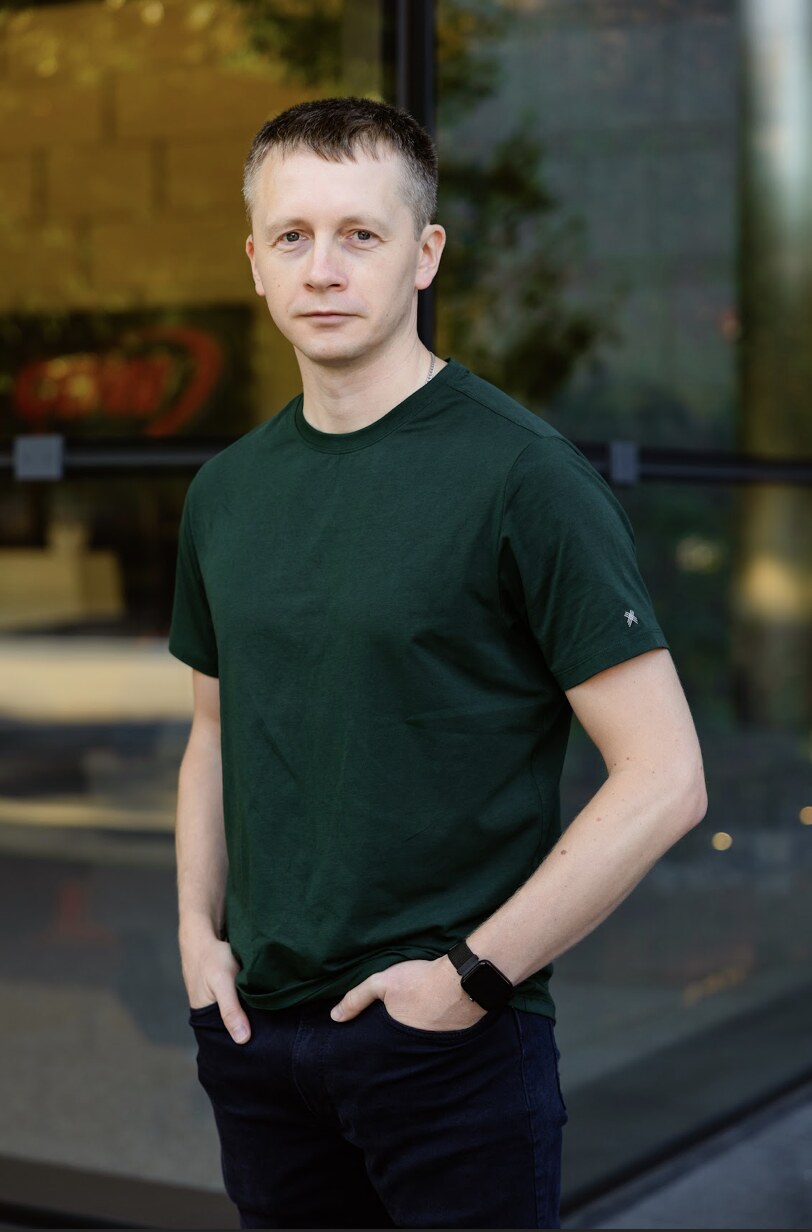
37-year-old Nazar Babiy is a master’s degree in systems programming from the Lviv Polytechnic National University, who is currently building a career in the United States. Nazar’s experience includes work and a professional path that covers Ukrainian and American companies, including products with a global presence. «I not only performed the tasks of an engineer, but also formed holistic approaches to QA automation, integrating cloud technologies and modern approaches,» Babiy shares.
Nazar is an experienced tester who has reached the Senior level and is currently considering which career path to take next — whether to follow the technical path or pursue management. dev.ua spoke with Nazar about his career, the future of the tester profession, and development options for QA professionals who have reached professional heights.
37-year-old Nazar Babiy is a master’s degree in systems programming from the Lviv Polytechnic National University, who is currently building a career in the United States. Nazar’s experience includes work and a professional path that covers Ukrainian and American companies, including products with a global presence. «I not only performed the tasks of an engineer, but also formed holistic approaches to QA automation, integrating cloud technologies and modern approaches,» Babiy shares.
Nazar is an experienced tester who has reached the Senior level and is currently considering which career path to take next — whether to follow the technical path or pursue management. dev.ua spoke with Nazar about his career, the future of the tester profession, and development options for QA professionals who have reached professional heights.
When a QA specialist hits the ceiling: what to do
Nazar showed interest in technology since school. «Since the fifth grade, we had an old black-and-white computer at home, I think it was on an i486 processor with Windows 95, with a two-gigabyte HDD. I played something on it, listened to music, improved it somewhere, added RAM, and often had to tinker with reinstalling the OS. I remember that even Winamp was buggy on it, but it was still interesting to try different things on it, and later to program in Pascal,» says the IT guy.
Nazar received a senior position several years ago, and this transition was natural — behind him there was already a number of successful projects, process building and mentoring for teams. When the IT professional became Senior, it became obvious: development cannot be limited only to completing tasks. «I started looking in directions where I could scale my influence — at the team and company level. I saw options: management, test architecture, deepening in AI and its use for automation, transitioning to strategic roles. But the key for me was combining technical expertise with leadership,» says Nazar.
He understands that in any profession there is a certain ceiling. But it all depends on the specialist’s mindset. If the tester is focused only on routine, functional testing, or purely manual testing, then it is difficult to move on, he adds.
«But if you expand your competencies — master automation, testing architecture, understand business processes, and in general the business of the product being tested — then the boundaries are significantly pushed back,» says the engineer.
«At first, it seemed to me that for a successful career, it was enough to know one programming language and one automation tool well. I really spent a long time building my expertise around a specific stack and felt confident. But over time, I came to understand that the industry is changing extremely quickly, and what seems like a „standard“ today may become obsolete tomorrow. The key breakthrough for me was the realization that development in QA is not about comfort in a familiar environment, but about constant learning, experimentation, and openness to innovation,» recalls Nazar.
He began to learn other languages, compare frameworks, try tools from different ecosystems. He actively participates in global hackathons, the last of which was the development of the QuitQly mobile application, which helps people quit smoking, and Snovyda, a platform for recording, researching, and gaining a deeper understanding of dreams. This gave the specialist a completely different level of thinking: now I am not tied to a specific toolset, but can choose the optimal solution for the task and the product.
«Moreover, I saw that versatility and flexibility are what separates a mid-level engineer from a senior one. That’s when I broke my own „ceiling“ and stopped thinking in terms of ‘one language, one tool.’ Instead, I began to perceive technology as a living system, where there is always something new to explore,» he admits.
And this understanding gave the IT professional the opportunity not only to grow himself, but also to build testing strategies that remain relevant in the long term.
Testing, he says, can also be different and use different tools. For example, security testing, performance testing, and more recently, AI testing. «You can move into management, or you can continue to develop technically to tech-lead positions. In the US, generally after Senior positions, technical development continues to the next positions such as Staff, Principal, and Technology Leader, and it really takes years of work and training,» says Nazar.
Where to go if you have already reached the ceiling in QA
One of the development paths for a manual tester is automation. Nazar sees the development of QA automation not as a separate branch, but as a multidisciplinary field. Another direction is management, where it is important to build teams, shape culture, and scale impact through people. Another development opportunity is testing and automation architecture, which allow you to create systems that work for years and affect the effectiveness of the company’s products. Or the tester can develop into related technical areas, for example, development with a focus on AI and data engineering, where QA can no longer be separated from code.
«For myself, I have chosen the path of an expert who stands on the border of these trajectories: technical depth, strategic thinking, and influence on product quality. This allows me to not just be a „senior tester,“ but, understanding how the system is built and works, to be a quality architect and innovation leader. I think it is these roles that will shape the future of the industry,» says Nazar.
He believes that a «pure QA» can become a unique expert in a domain, such as fintech or healthcare, and be invaluable through a combination of product, domain, and user experience knowledge.
However, in global practice, the IT expert notes, it is becoming increasingly difficult to remain in the role of «pure QA.» The industry expects QA to have an engineering approach, strategic thinking, and the ability to integrate AI and write code.
Nazar says that he has seen that those who limit themselves to «pure QA» sooner or later understand that stopping development in this industry does not bring anything good. «Technologies and tools are developing very quickly and you need to constantly keep up with them. For example, in 2017, when I started with QA automation on JavaScript, it was one of the worst technologies for solving this problem. Almost none of my colleagues understood why I was doing it and why I was interested in it. By 2025, all top QA automation tools will use JavaScript or TypeScript. How things have changed, hasn’t it,» Nazar says proudly.
AI is already a must-have for QA
Today, QA automation is no longer an option, but a mandatory part of the process. Without it, a QA engineer, according to Nazar, will find it difficult to claim the role of a leader or even a strong specialist. «Today, AI is perceived as an auxiliary tool, but in the near future it will become an industry standard. In my practice, I use AI not as something experimental, but as a permanent tool that significantly increases development productivity,» he says. AI allows engineers to cover a wider range with less time and work on forming a culture of continuous quality at different levels of testing, the IT specialist notes. In general, he does not consider artificial intelligence a threat, but calls it a smart ally that allows you to scale expertise.
According to Nazar, AI will not eliminate the QA profession, it will change its format and raise the requirements for specialists. «The tester of the future is an engineer who formulates the right questions for AI and evaluates its results from the point of view of technical correctness and business. Artificial intelligence can analyze millions of data quickly, and for example, build scenarios and scripts based on them, but it does not understand why this particular scenario is important for the user or how an error will affect the brand’s reputation. That is, the engineer is still an indispensable link and will be more of a reviewer and controller of the results of AI’s work, will correct and calibrate them. And this requires deep technical skills on the part of the engineer,» explains Nazar. In the projects that the specialist is currently working on, he observes that the most effective solutions arise when AI and QA work in tandem.
«The human factor — creativity, strategic vision, ethical dimension, professional experience — remain irreplaceable. Therefore, AI is not a ceiling, but rather a new level for the profession,» the IT professional is convinced.
Secrets of effective growth
The transition from «just testing» to the strategic level in QA in Nazar’s case was made possible by several key steps. First of all, he began to look at the product not only as a set of individual features or functionality, but as a business value. «I started analyzing risks, calculating the cost of errors in production, and showing management the financial impact of such errors. We began to learn from them and improve our QA process. This allowed us to change the conversation: from «we found a bug» to «we saved the company a certain amount of money,» says the IT specialist. The second step was the introduction of automation and the use of AI, which not only reduce testing time, but also create a foundation for predicting quality and quick feedback. The third was active mentoring: Nazar was a mentor on the «BE» project, and taught the team to think in categories focused on the product and solving problems that are important to it, rather than simply closing «tasks.» «As a result, the projects gained a more mature QA culture, where testing became an integral part of the entire product development process, and QA engineers became proactive analysts of product needs and the QA process,» says Nazar.
He adds: when communicating with management, the most important thing is the language of facts, figures, and graphs.
«I always show that each defect found has a specific cost: a fix at the development stage is dozens of times cheaper than in production. I also demonstrate how investments in QA accelerate time-to-market and reduce the risks of release disruptions,» says the tester.
In his projects, Nazar has repeatedly proven that the implementation of QA automation and its integration into SI/CD has reduced the cost of unnecessary regression testing by almost 30%, while the number and speed of releases have increased. «Such data is much more convincing than theoretical arguments,» he says.
Another aspect that the IT expert advises to consider is positioning QA as a risk management tool. «Managers think in terms of risks and returns, and it is in this language that it is worth building a dialogue. This turns QA from an ‘expense item’ into a ‘strategic investment,’» he explains.
QA is not just bug finders
In fact, smart and mature teams already realize that they are not just bug hunters, but experts who directly influence the product. According to Nazar, most experienced quality engineers understand perfectly well that their role goes far beyond finding errors. «They feel responsible for the entire product life cycle, from design and requirements to user behavior in a real environment. My task as a leader and mentor is not so much to „convince“ but to reinforce this feeling and translate it into specific actions and strategies,» the specialist shares.
There are several secrets to Nazar’s way of achieving his goal. First, he immerses himself in the business context, or developing a clear understanding of what problems a product or a particular «feature» solves and what the cost of a mistake is. This allows QA engineers to think in terms of value, not defects.
Secondly, involving the team in the early stages of development: requirements analysis, architectural discussions, risk analysis.
«When a quality engineer sees that his voice is taken into account before the code is written, he feels like a true partner in creating the product,» says Nazar.
Another aspect is to show results in business-friendly metrics. According to the specialist, when QA can demonstrate that their actions have reduced the number of incidents in production or saved the company a certain amount of money, the perception of the role automatically changes. «This also gives confidence to the engineers themselves: they see that their work has a direct impact on the success of the product,» Nazar comments.
He argues that the main task of QA is not just to find defects, but to prevent them by using automated testing, ensuring the stability and quality of the product for the end user.
QA in five years — what will they be like?
In five years, the tester profession will become even more integrated with programming and the active use of artificial intelligence, says Nazar. «We are already seeing how AI helps generate test scripts, analyze log files, or predict risks, and this trend will only intensify,» the specialist is convinced.
The tester of the future, according to Nazar, will work in tandem with AI as a powerful tool, not a competitor: it is the QA engineer who will determine what questions to ask the system, how to check the reliability of the results, and where to adjust automated solutions. At the same time, the role of programming in QA will also grow. Without knowledge of programming languages and principles, it will be difficult to remain competitive in the market.
Testers will actually shift even further into «software engineers in test», who not only write automated tests, but also build frameworks, work with infrastructure, integrate AI, and CI/CD pipelines.
«But there is an important nuance: even with the highest level of automation, there will always be some work that cannot be translated into an algorithm. This is strategy, creativity, systems thinking, and understanding of the user experience. AI can suggest which scenarios to test, but it is not able to intuitively feel how a real user will interact with the product and where exactly a critical barrier will arise. Therefore, I am sure that the future of QA is a symbiosis: on the one hand, deep integration with AI and programming, and on the other, preserving the unique role of a person as the one who sets standards, asks the right questions, and controls that technologies truly serve the business and users,» the tester notes.
Fears of young QAs
Working as a mentor, Nazar notices that certain professional stereotypes are emerging among young QA specialists. «One of the stereotypes I’ve noticed is the idea that QA automation is simple, but in the process of performing practical tasks, it dispels,» the man says. It is this stereotype that he, as a mentor, constantly tries to debunk. In general, Nazar sees in his mentee engineers a strong curiosity and desire to understand complex things as quickly as possible. «They want to understand not only how to automate correctly or write clean code, but also what is happening at the architectural level, what business processes are behind the product, and how QA can affect overall quality. This is a very good signal: young specialists show initiative and are not afraid to take on tasks that go beyond their initial role,» says Nazar.
Of course, sometimes IT professionals have doubts about their mentees: for example, whether they have enough technical knowledge for automation, whether they will be able to adapt to the team’s pace, or whether they have chosen the right approach to completing the task. But these questions quickly disappear if you give the young people the right direction and show them that learning is an ongoing process, not a one-time training, says the specialist.
«I always emphasize: the main thing is not to know everything at once, but to be able to ask the right questions, be open to new tools, and want to learn. I especially appreciate their initiative in younger colleagues. They often themselves suggest ideas from new libraries for automation to ways to improve reporting or integrate AI into data validation; they are a source of new knowledge for me too,» says Nazar.
He sees his task as a mentor as ensuring that the enthusiasm of young IT professionals turns into tangible results for the team and the product.
Nazar’s main advice for young testers is not to stop at just testing. «Expand your horizons: study automation, non-functional testing, artificial intelligence, test architecture, business analysis, find what interests you more. Look at the product through the eyes of the user and the eyes of the company at the same time. If you feel stuck, this is a signal: it’s time to leave your comfort zone,» he says and advises looking for opportunities where you can influence processes, not just tasks. Nazar urges: participate in building the QA process, show management the financial effect of your work.
«I studied Data Science since I was 4 years old. Every math lesson was important.» The story of a math genius from a small village in Volyn, who is now creating LLMs for Lyft, Reface, and AppFlame
«Customers and PMs joked that I shouldn’t rush and relax a bit.» How a developer from Lviv is building an AI-Healthcare system in the US: an interview with a Ukrainian who conquered global IT
«I resigned from an American company for the sake of a Ukrainian miltech project.» The story of a KPI graduate who saved an American healthtech startup from collapse, created a mini-competitor to Netflix, and is now preparing an AI defense system against Russian FPV
«Навіть для виробників трун і пам’ятників я писав тексти». Як стати game-тестувальником під час війни: історія колишнього металурга, страховика, копірайтера
34-річний Андрій Зубков під час війни увійшов в IT, докорінно змінивши свою кар'єру і буденне життя. Тепер він QA Engineer у компанії Pingle Game Studio — тестує ігри. А до цього працював на металургійному комбінаті, в страхуванні та навіть копірайтером. Свою історію про вхід в нове життя Андрій розповів dev.ua.
«Я вигоріла настільки, що вже не могла дивитися на комп'ютер». Історія QA-інженерки про великі гроші, безглузді купівлі, вигорання та дауншифтинг
Хмельничанка Олена Шеліна ― айтішниця, яка настільки вигоріла на роботі, що вирішила покинути IT-сферу та докорінно змінити своє життя. За 9 років роботи в IT дівчина пройшла всі ступені кар’єрного зростання, змінила кілька компаній і навіть напрямів. Та прокинувшись одного ранку, вирішила, що більше не зможе виконувати свою роботу якісно. Дівчина переїхала в село, завела господарство та повністю змінила професію. Розповідаємо її історію.
Manual QA з Luxoft Ukraine вже три роки приборкує вітер на воді та кайфує від цього. Ось його історія та поради для тих, хто мріє про море та віндсерфінг
«Навколо IT» — нова рубрика, в якій ми збиратимемо все корисне для життя айтішника, яке не стосується його роботи. Виявляється, у айтішників найрізноманітніші хобі. Ми вже писали про айтішників-бігунів, плавців, художників, музикантів, танцівників, і навіть заводчика собак. Сьогодні розповідаємо про програміста, який навчився приборкувати вітер. 39-річний Сергій Костюченко — Manual QA у Luxoft Ukraine — розповів про своє захоплення віндсерфінгом та можливості займатися цим видом спорту для всіх бажаючих.
«Щойно я почув про тестування, усередині щось йойкнуло». Увійти в IT після першої співбесіди можливо: історія QA-інженера, яка це доводить
30-річний Руслан Долиненко — молодий айтішник, який пишається тим, що знайшов роботу з першого разу. Він отримав офер після першої співбесіди, бо, як вважає сам хлопець, ретельно до неї підготувався. Як увійти в IT, минаючи десятки відгуків на вакансії, і в чому секрет Руслана — у матеріалі.
Have important news to share? Message our Telegram bot
Key events and useful links in our Telegram channel