Хочете будувати кар’єру в Data Science та AI? Vodafone Big Data Lab відкриває новий набір —>
Марія Бровінська
13 August 2026, 09:00
2026-08-13
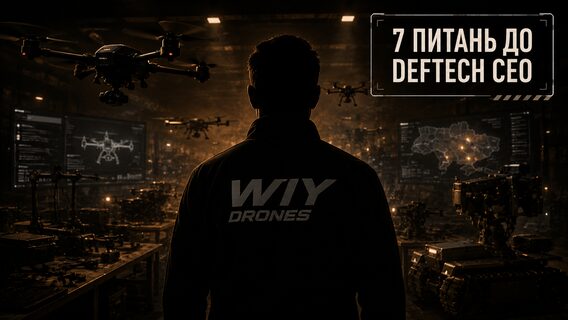
"Modern defense tech is not a Soviet factory." CEO Wiy Drones on the future of DefTech, the shortage of engineers and AI
The next technological advantage in warfare may not be determined by the quantity of technology, but by the speed with which it can be created and adapted. Autonomous systems, AI, unmanned platforms and automated control systems are already changing the nature of warfare. At the same time, behind all these technologies is an acute shortage of people — engineers, developers and production specialists capable of turning ideas into solutions that work in real conditions.
In the new article of the series «7 Questions for the DefTech CEO» — the CEO of Wiy Drones, who for security reasons does not disclose his name. We talk about what Ukrainian miltech lacks the most, which specialists are currently in the greatest shortage, and why the production processes themselves may be more important than high-profile AI solutions.
— What is the biggest problem of Ukrainian miltech now?
The biggest challenge is scaling production and the lack of specialists with practical engineering experience. The industry is growing much faster than the market can train personnel.
— What technology is overrated today? And what is underrated?
«One-size-fits-all AI solutions» that supposedly can completely replace complex engineering work are often overrated. Without quality data, hardware, and integration experience, AI doesn’t work like a magic button.
The following remain underestimated: — production processes — logistics areas — development departments — system integration
It is these areas that often determine the effectiveness of a product in real-world conditions.
— Who is the hardest person to hire?
The most difficult to find are embedded engineers; pilot hardware engineers; CV/AI engineers with practical experience; and production specialists with a high rate of adaptation.
— What skills are most valuable today?
The most valuable are systems thinking; the ability to learn quickly; working in conditions of uncertainty; practical experience and responsibility for the result.
— What does civilian IT misunderstand about miltech?
Many people from classical IT still imagine miltech as something very old, slow and bureaucratic — a conventionally «Soviet factory», where everything works through papers, long approvals and outdated technologies. In fact, modern defense tech looks completely different.
Today, it is one of the fastest and most dynamic technological fields in Ukraine. Here, decisions are often made very quickly, teams work directly with each other, and product development takes place in the shortest possible time. Due to the real needs of the front, companies cannot afford to spend months coordinating each step or wasting time on unnecessary processes.
Also, many people mistakenly think that the defense sector is only about manufacturing equipment and working with hardware. In fact, a huge part of the work now involves programming, automation, data analysis, navigation, communication systems, object recognition, unmanned systems, and artificial intelligence.
Another common myth is that such companies lack modern approaches to work. But most teams have long been using modern task management systems, automated development and testing processes, rapid prototyping, and artificial intelligence tools to speed up work.
And most importantly, here a person is much closer to the result of his work. You see not just a new function in the program, but a real product that is used in practice and helps solve specific problems.
— What will the war be like in 2–3 years?
In 2-3 years, war will become even more technological. It is already clear that not only the number of equipment or people, but also the speed of implementation of new solutions, automation, and the ability to quickly adapt to changes on the battlefield are starting to play a decisive role.
We will see an even greater role for: — autonomous systems; — unmanned platforms; — artificial intelligence; — information recognition and analysis systems; — electronic warfare means; — automated control systems; — cheap mass-produced technological solutions that can be quickly produced and scaled.
Technologies are developing so quickly that the advantage will not be gained by the one who simply has more resources, but by the one who learns faster, changes approaches faster, and improves their products faster.
The role of engineers and technicians will also change dramatically. War is increasingly dependent on programming, communications, automation, data analysis, navigation, and manufacturing. Not only military personnel, but also developers, engineers, operators, production teams, and artificial intelligence specialists already play a major role.
Another important change is the speed of the development cycle. Where it used to take years to create a new solution, products now change literally every week based on real-world user experience. Companies that can quickly test, update, and scale their solutions will have the greatest advantage.
The future war is a war of technology, speed of decisions, and the ability to constantly adapt to new challenges.
— What would you like to say to IT professionals who are hesitant to join deftech?
Many professionals hesitate because they don’t fully understand what it’s like to work inside defense companies. Some people think it’s too complex or unstable, while others think there’s no modern technology or professional development. In fact, it’s the opposite.
Today, the defense industry is one of the few areas where you can work on technologies that have a direct and very rapid impact. Here, the results of your work are visible almost immediately, and engineers and developers get the opportunity to create new solutions practically from scratch.
Yes, this is not an easy field. There is a high pace of work, constant changes, and great responsibility. But at the same time, it is an environment in which people grow very quickly professionally, gain unique experience, and work on truly important things.
The defense industry today is not just about war. It is about the development of Ukrainian technologies, manufacturing, engineering, and new solutions that shape the future of the country.
«Military companies today are like Ukrainian IT companies 15 years ago.» 7 questions for the CEO of Frontline Robotics — about the future of war, FPV, the shortage of engineers and more
«The one who turns data into decisions and decisions into action faster will win.» 7 questions for SKIFTECH CPO about overrated AI, talent shortages, and the war of the future
«I would advise those IT professionals who are hesitant about moving into Defense Tech to change their mindset.» 7 questions for DefTech CEO: owner of SKIF NVK about industry problems, personnel, and product evolution
«We once believed in drones. Now we have to believe in missiles.» BlueBird Tech co-founder on the new stage of Ukrainian miltech, dependence on China and the shortage of engineers — 7 questions for the CEO
«The hardest thing is finding an engineer who can translate a problem into a technical solution.» 7 questions for the CEO of XTI Engineering, which creates demining equipment
«The biggest problem, as well as the biggest opportunity, of the deftech industry is the existence of Russia.» 7 questions for the CEO of HIMERA about technology, the talent shortage, AI and the future of war