Наталя ХандусенкоWork
4 May 2026, 13:15
2026-05-04
In China, courts have ruled that firing employees due to the introduction of AI is illegal
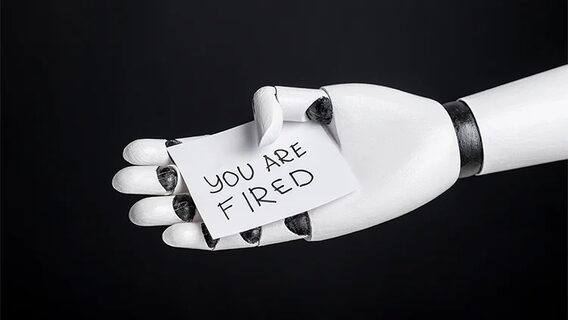
Chinese courts in Hangzhou and Beijing have ruled in two separate cases that companies cannot lay off workers simply to replace them with AI. The courts determined that implementing AI is a strategic business choice, not an unforeseen change of circumstances under China’s Labor Code. The rulings come as 78,000 tech workers worldwide were laid off as of early 2026 (almost half of them due to AI). This stands in stark contrast to the US and EU, where similar legal protections do not exist.
Chinese courts in Hangzhou and Beijing have ruled in two separate cases that companies cannot lay off workers simply to replace them with AI. The courts determined that implementing AI is a strategic business choice, not an unforeseen change of circumstances under China’s Labor Code. The rulings come as 78,000 tech workers worldwide were laid off as of early 2026 (almost half of them due to AI). This stands in stark contrast to the US and EU, where similar legal protections do not exist.
One case brought before the Intermediate People’s Court of Hangzhou involved an employee whose duties included checking the correctness of data generated by large language models, Bloomberg reports .
When his job was automated using AI, the employee refused a demotion and a 40% pay cut, which led to his dismissal.
The court ruled that the company’s reasons for dismissal did not fall within the scope of adverse circumstances such as downsizing or operational difficulties. Furthermore, they did not meet the legal conditions that would make the employee’s continued employment impossible.
In a separate statement, the court noted that companies cannot unilaterally lay off workers or reduce their wages due to technological advances.
According to The Next Web, this decision is based on a precedent set in a landmark case in December 2025, where the plaintiff was a man named Liu, who worked as a simple manual map data collector.
As the company transitioned from manual to fully automated data collection in 2024 and eliminated its navigation products division, Liu was fired, citing a material change in objective circumstances.
However, the court ruled that AI-driven automation did not meet the legal standard for exemption.
The Chinese court rulings create a legal framework that is logical in itself, but poses serious challenges for companies operating in the country. If implementing AI is a strategic business choice, not an unforeseen change in circumstances, and if a strategic business choice cannot justify layoffs, then companies that invest in AI systems to automate existing jobs have a choice. They must either retrain the workers those systems replace, or move them to equivalent positions with similar pay, or continue to retain them in positions that the company has already determined are no longer needed.
Courts have stated that the costs of technological transformation should not fall solely on the shoulders of workers. This means that these costs should be borne by the companies that decide to undertake such a transformation.
Recall that Oracle laid off up to 30,000 employees over the past month. Before the cuts, management required specialists to document their work processes in detail to train internal artificial intelligence systems, which then began to perform their work.
The comparison
The United States has no equivalent protection. American employment law operates on an at-will basis in every state except Montana, meaning employers can terminate workers for any reason that is not specifically prohibited by statute, and being replaced by AI is not a prohibited reason.
A Senate bill has been introduced that would require companies to file quarterly reports to the Department of Labor identifying how many employees were laid off because their functions were automated by AI, but the legislation has not passed and is not expected to in the current Congress. Illinois requires employers to notify workers if AI is used in hiring, discipline, or discharge decisions. Colorado’s AI Act, taking effect in mid-2026, mandates risk management policies and annual assessments of AI’s impact on employment decisions. Neither state has enacted anything resembling what Chinese courts have established: a legal principle that says AI replacement alone is not grounds for firing someone.
The European Union’s AI Act addresses AI in employment by classifying AI systems used for recruiting, screening, performance evaluation, and other workplace decisions as high-risk, subject to requirements for human oversight, worker notification, and logging. The high-risk obligations take full effect in August 2026. But the AI Act does not prohibit AI-driven layoffs. It regulates how AI is used in employment decisions, not whether a company can eliminate positions because of AI.
The European Trade Union Confederation has called for stronger protections, and legal scholars have proposed a European AI Social Compact that would combine employment support, training, and social protections to cushion displacement. None of these proposals have been enacted. The gap between China’s position and the West’s is not that Europe and America are unaware of the problem. It is that they have chosen, so far, not to solve it through the courts or through legislation.
Як нейромережі бачать вільну та незалежну Україну? Тест dev.ua
Нейронні мережі для генерації зображень бачать світ по-своєму, їхню логіку зрозуміти часом зовсім неможливо. Але таки хочеться. На честь Дня Незалежності України редакція dev.ua вирішила провести невеликий експеримент.
Ми задали чотирьом різним нейронним мережам п’ять однакових запитів: «прапор України», «День Незалежності України», «український Крим», «перемога України» та «українці». Отриманими результатами ми ділимося з вами нижче.
У TikTok тепер можна генерувати фон за допомогою нейромережі. Ми протестували її та ділимося результатами
У TikTok з’явилася нова функція «Розумний фон». З її допомогою як фон для тіктоків можна підставляти згенеровані нейромережею зображення. Редакція dev.ua протестувала цю технологію і ділиться своїми враженнями.