Хочете будувати кар’єру в Data Science та AI? Vodafone Big Data Lab відкриває новий набір —>
Вікторія ГорбікWork
20 December 2024, 09:00
2024-12-20
"To prevent burnout, sometimes you have to become a psychologist." One-to-one meetings: a useful tool or a waste of time? We asked team leaders and teams about the practice, deadlines, problems, and effect
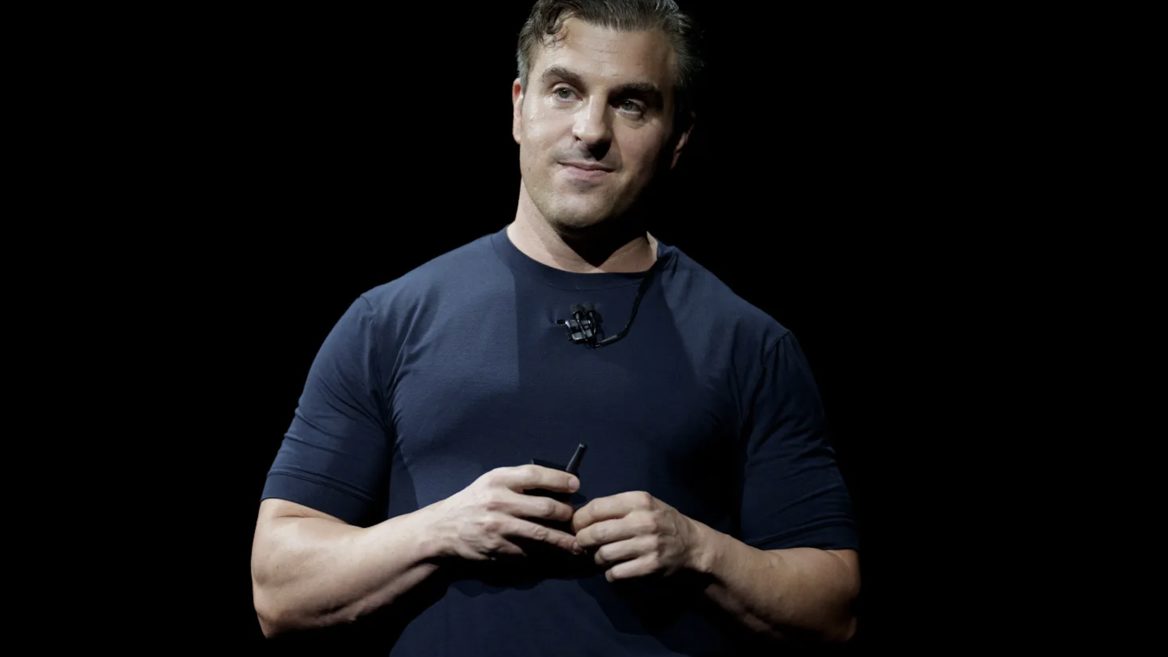
According to Airbnb Co-founder and CEO Brian Chesky, the format of regular one-to-one meetings with direct reports is fundamentally flawed. He avoids regular personal meetings with employees as much as possible because he doesn’t want to be «like their therapist.» However, psychologists emphasize the positive effect of this practice and advise devoting about 25 minutes a week to such communication. Some companies have already adopted this practice. dev.ua decided to ask Ukrainian team leaders how they feel about one-to-one meetings with employees, whether they see an effective result, and whether they don’t mind spending time chatting.
According to Airbnb Co-founder and CEO Brian Chesky, the format of regular one-to-one meetings with direct reports is fundamentally flawed. He avoids regular personal meetings with employees as much as possible because he doesn’t want to be «like their therapist.» However, psychologists emphasize the positive effect of this practice and advise devoting about 25 minutes a week to such communication. Some companies have already adopted this practice. dev.ua decided to ask Ukrainian team leaders how they feel about one-to-one meetings with employees, whether they see an effective result, and whether they don’t mind spending time chatting.
Team leaders about one-to-one
We interviewed about 25 team leaders, of which 11 provided detailed answers, and all of them approve of the practice of personal meetings with employees, use them and see a positive effect. Even some startup teams use the practice of one-to-one meetings. «Our task was to understand what we have well in our processes and where there are problems,» said Eduard Dryga, a web developer, Team Lead and co-founder of MilTech startup Aimedat, talking about the one-to-one meeting that Creative Operations of the startup Aimedat held with the team.
And Tetyana Gashchuk, Product Owner and founder of the startup JunChirp, although she doesn’t like the name one-to-one, because it is associated with «calling the boss to the mat,» emphasizes the importance of personal communication with everyone in the team, as it helps build good trusting relationships.
«One-to-one is not just another regular „call“, it is an opportunity to better understand how a person feels in their place, what challenges, problems, goals and needs they have,» noted Senior Front End Developer Vitaliy Polynyk. He practices one-to-one meetings as a team leader in the team and thinks that this is a very good and necessary tool for the development of each team member.
For Lana Palamarchuk, Product Team Lead at IT product company Welltech, in-person meetings with employees are part of her regular schedule. «I have checkpoints with all my direct reports,» she says.
Lead of Recruitment at the recruitment company FlowJobs, Alyona Kashchuk, believes that one-to-one is THE MUST for a lead. «These meetings provide an understanding of a colleague’s motivation, help determine whether there is a feeling of burnout, or whether there are conflicts with team members. The conversation is about nothing and everything at once. The main thing is to make the employee understand the importance of his contribution to the company and focus on comprehensive support from my side, as a manager, even on non-resource days,» she emphasizes.
The importance of human communication is also emphasized by Mykhailo Ovsyannikov, Lead React Native Developer, who manages a small team of 2-6 mobile developers.
«If we weren’t working remotely, I might even sometimes bring stronger drinks to these meetings,» he says.
«You become like their therapist.» Why Airbnb’s Brian Chesky avoids 1-on-1 meetings and when they can be helpful
How much time do in-person meetings take?
Although all managers who shared their experience with dev.ua about using one-to-one in their management practice emphasize its importance, they consider it necessary to use this practice with varying frequency, from almost daily to once or twice a year. This depends on both the size of the team and the personal perception of the manager.
For a small team, in particular 4-5 people, one-to-ones can take place every day. In the team of Oleg Malyshkin, Lead Automation QA Engineer at the software development company BeskydSoft, there are 4 employees and every day on the daily they share statuses regarding work and not only. «We are quite open to discussions, so we can solve all problems immediately after the daily together or with each person separately,» he adds. However, Oleg also emphasizes that now everything in the team is solved at the request of the employee .
Maria Alipatova, CEO and Co-founder of the startup Solar Optic, also reported on daily personal meetings. She has daily 20-minute meetings with her manager, where they determine priority tasks for the day and discuss updates from stakeholders and partners. She meets with four interns twice a week, where they also discuss plans and tasks.
For Lana Palamarchuk, half an hour a week is enough to discuss all issues.
Weekly meetings are planned and agreed in advance at the recruitment company FlowJobs. As Lead of Recruitment Alyona Kashchuk says, one-to-one meetings are held with an employee every week for 15-20 minutes every Monday after the general team meeting. «So that I have an understanding of who is in what mood for the work week, whether the tasks are clear, what is the implementation plan (providing tactical assistance), what questions remain after the general meeting,» the manager adds.
Product Owner, Oleksandr Sosnovchyk uses 5 hours a week for personal meetings with the team. «To quickly update someone on the situation, ask for an opinion or expert assessment, assess the volume of work, etc. Sometimes give a beating,» he says. And for Valentin Tishchenko, Lead Software Engineer, it is enough to conduct 15-30 minute calls with each team member once a month. However, if there are urgent problems, meetings are planned additionally on an individual basis. Valentin also leaves some «reserve time» each week when colleagues can spontaneously call him to discuss important issues.
Vitaliy Polynyk tries to hold one-to-one meetings once every two weeks or at least once a month, depending on the needs of the team. This meeting usually lasts from 10 minutes to 1 hour. But he does not advise doing this in the morning or at the end of the day. «It seems to me that in this case these calls will be purely «for show,» «he explains.
Eduard Korytsky, Product UX/UI Designer and Founder and CEO at Frorex, adheres to approximately the same meeting schedule, mostly once a week:
For designers, it’s possible 1-2 hours each.
If we take developers and marketers, then 1 hour maximum.
Top management — 1-3 hours.
Mikhail Ovsyannikov, Lead React Native Developer, holds one-on-one meetings with his developers at least once every three months, but tries to do it every two months. Typically, such meetings last from half an hour to an hour and a half, depending on the situation. «I try not to drag out the conversations so that the workflow doesn’t suffer, but I also try not to rush to discuss everything,» the developer says.
Eduard Dryga notes that the startup environment does not allow for one-to-one very often, and so far the team communicates once every 4-6 months. «This allows us to maintain a balance between time for product development and understanding what can be improved in the processes,» the startuper reports.
The world leader in the development of advanced technologies and software, Hilti Group, has made one-to-one meetings a mandatory practice for all developers on the team. As Igor Tikhonov, Lead / Senior Software Developer, reported, they are held twice a year: in June-July and December-January. In addition, such meetings can take place at any time at the initiative of the developer, if there is a need for additional discussion of issues. The standard duration of a one-to-one meeting is about one hour, but it can be adjusted in one direction or another depending on the requests.
Startuper Tetyana Haschuk notes that at the beginning of cooperation, sometimes more time is needed for personal meetings, and later — as needed. «And there is definitely no timing,» she adds. «What is certain is that my favorite team knows that I am always in touch for them.»
What questions to ask in a one-on-one with an employee. 25 examples from an experienced project manager
What do leads talk about in meetings?
Even one one-to-one session helped the startup Aimedat, according to Eduard Dryga, identify difficult points, such as:
One of the team members said that they would like to see clear deadlines for tasks, although Eduard believes that people should estimate and set deadlines for themselves.
Some people want more freedom, etc.
«Everyone has their own cockroaches,» says the startuper.
By structuring one-to-one, Mikhail Ovsyannikov tries to hold meetings with:
Organizational issues. Revisions and everything related to cooperation issues. Of course, such issues are resolved only face-to-face: employee successes, mistakes, problem areas, salary issues, and most importantly for me — feedback.
Problems and conflicts. There were not many conflicts in Mikhail’s practice, but there were enough problems with his employees. Both students with sessions, and problems with children, and even the death of a close relative. It is important to remain human and competently try to help the employee with what we can, as well as adjust the work process in connection with force majeure.
Just to chat. Mykhailo noticed that in teams where there are a minimum of general meetings (planning, retro, and so on), especially when working remotely, people simply lack normal human communication with colleagues. Discuss personal matters, find out a colleague’s opinion on something, etc. «Those who remember office workdays will understand what I’m talking about. And smokers will understand me 100% — the brotherhood of smokers is a separate topic altogether,» he says.
Vitaliy Polynyk notes that sometimes he talks with team members about work issues, but more often one-to-ones turn into informal meetings and this meeting is used to chat on various topics:
that helps to do the job effectively,
what is annoying at work,
Do colleagues receive interesting tasks?
communication within a team or with a customer.
Before the meeting, Vitaliy reviews the tasks in which the person is involved, their progress, and also collects the opinions of other team members. He always asks them to come with their own questions or topics and simply asks them to think about what would be interesting to talk about. «One-to-one is not only about work. You can see the mood of a person in the team or their motivation from the answers. Sometimes you need to „give“ a little charge to colleagues or just motivate them,» he emphasizes.
In addition, the developer and team leader asks about:
general well-being,
workload,
career goals and about
Is the person satisfied with how the processes in the team are structured?
Lana Palamarchuk discusses one-to-one:
growth points,
talks about further growth,
career development vector.
Igor Tikhonov, Lead and Senior Software Developer at Hilti Group, also carefully prepares for meetings. He collects feedback from other team members to get a comprehensive view of the situation. And the meeting is mostly devoted to discussing a wide range of issues that concern the developer in the workflow, as well as finding ways to complete tasks faster and better. As a result, goals are formed for the next period, and decisions can also be made to review the position or salary.
In some teams, the recruiting team handles the in-person meetings, but Vitaliy emphasizes that this is a time to talk to each team member individually and see everything in person. He also notes that the recruiting team often just notes down important points and then simply passes it on as a to-do list. «It’s not always going to be 100% valid,» Vitaliy adds.
15 Lessons a React Native Developer Learned in a Year as a Team Lead. A Must Read for All Managers, and Not Only
What is the effect of personal meetings on a team?
Speaking about why personal meetings are needed, Mikhail Ovsyannikov says that he sees one-to-one not only as a tool for improving the workflow, but also as a great way to get feedback.
«This is very important to me. But the biggest plus that I notice is the employee’s positive attitude towards me, the company, and other colleagues,» says Mikhail Ovsyannikov.
Other managers also summed up similar meetings, in particular, one-to-one allows:
Give constructive feedback and at the same time ask the employee about themselves. Vitaliy Polynyk often directs such meetings to help the person in their professional development. «We discuss what skills they want to improve (for example, a better understanding of TypeScript, performance optimization, or soft skills, such as communication), and how I can help with this. Everyone has their own values, and you need to learn more about what your colleague wants or what motivates the person,» he notes. After each one-to-one, Vitaliy briefly writes down key moments to remember what they worked on and what agreements were reached.
Commercial effect. On the other hand, Vitaliy sees that personal communication with the manager often removes the barrier of conversation with other team members, and even with the customer. «Everyone will personally hear about what is very important to this or that customer, so as not to make a separate call for this,» he notes.
Transparency in team relationships and trust. «This way, everyone understands everything, there is a clear awareness that there could be improvements on the part of management, as well as on the part of the employee,» explains Eduard Dryga. Valentyn Tishchenko believes that personal meetings are a powerful tool for building trust and good relationships. «This increases engagement, reduces anxiety, and creates a feeling that their work is important,» notes Valentyn.
Increased engagement and productivity. «Thanks to regular dialogue, we can quickly respond to challenges, provide support, and create favorable conditions for the growth of each team member,» reports Igor Tikhonov.
Screening, which highlights many small points. «Each employee has their own weaknesses, some have a technical side, some have a problem with building the right communication with the candidate (conducting screening), understanding the vacancy (each employee has their own vacancies) and many more small points. And all this, with the right approach, should lead to a positive result,» says Alena Kashchuk, using the example of recruiting.
To learn about experiences and problems that were not even revealed before in the team. And also to open up to the team leader. Therefore, one-to-one is an effective way to solve problems at the stage when they just arise.
Problems and barriers in the team’s work are identified in a timely manner, which, as Oleksandr Sosnovchyk emphasized , are closed more quickly. «Meetings allow us to better understand the employee’s expectations, outline specific steps for his professional development, and adjust interaction according to the team’s needs,» added Igor Tikhonov.
«Somewhere this manifests itself as trust, somewhere as loyalty, somewhere as understanding. As a result, I get a good result, good relations in the team, trust, high-quality interaction with employees, and good feedback. For me, this means that I am doing everything right,» summed up Mikhail Ovsyannikov.
Working in IT negatively affects the health of IT professionals. What specialists complain about and how they stay in shape: a rating of occupational diseases and effective tips for recovery
Problems that most often arise in one-to-one
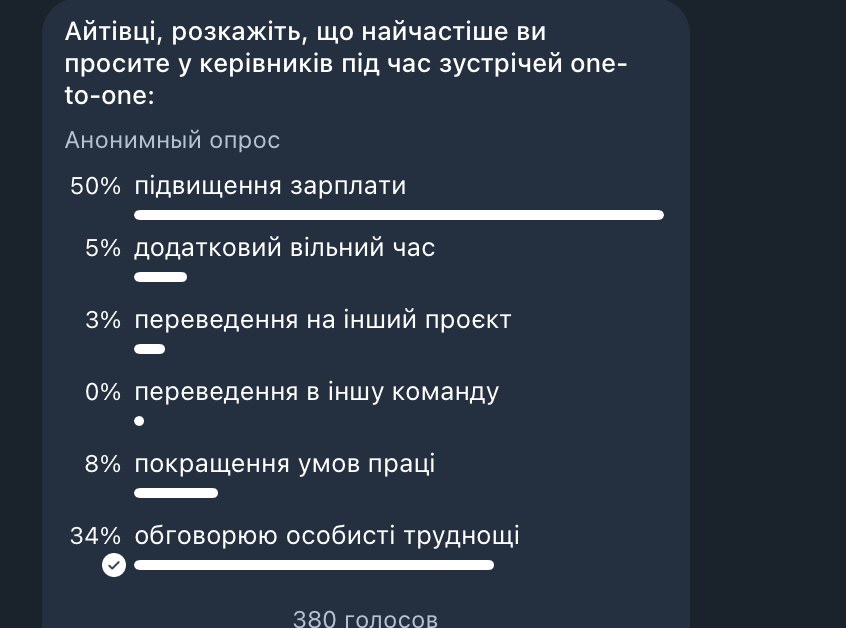
dev.ua asked the IT community what requests they most often make to their managers during personal meetings. Half of the nearly 380 respondents wanted a salary increase, and another 34% discussed personal difficulties. The minority remained requests for improved working conditions (8%), additional free time (5%), and transfer to another project (3%).
Among the problems that Valentyn Tishchenko saw among employees:
Motivation: In a remote format, people often feel isolated or undervalued.
Development: Discussing personal goals, career growth, or learning needs.
Understanding the value of work: Sometimes employees don’t see how their contributions affect the success of a project or company.
In recruiting, Alyona Kashchuk, Lead of Recruitment at FlowJobs, calls the main problem burnout from not getting the desired result. This is what is discussed in personal meetings with employees. Also: technical difficulties, reluctance to change the strategy in searching for candidates, shifting responsibilities (if it’s not funny — to the candidate).
The problem of burnout was also mostly seen by Eduard Korytsky, despite the fact that the team works on a 4-day schedule and everyone seems to have time to rest and be energetic and motivated. He sees the reason for this primarily as stress due to the situation in the country, which he cannot influence. In addition, misunderstanding of some principles in work, banal underestimation of oneself or the idea that the employee is doing something not very important emerges.
And for Maria Alipatova, in-person meetings are a panacea for problems. «This format allows you to constantly stay in touch and be on the same page,» she noted.
«LLMs are slowly putting pressure on the job market.» Is AI replacing workers and what is known about the layoffs of technical specialists being replaced by AI tools
«One in four patients say they use ChatGPT instead of Google to analyze their symptoms.» Dealing with a psychiatrist when AI takes over their job and replaces our brains