Хочете будувати кар’єру в Data Science та AI? Vodafone Big Data Lab відкриває новий набір —>
Марія БровінськаAround IT
30 October 2026, 09:00
2026-10-30
“Another project has appeared on the calendar — school.” How IT parents divide their time between work and remote learning of children: 5 stories of moms and dads who work remotely
Working from home while your child is learning online is not a task that can be solved with just a calendar and good time management. Especially during wartime, when work calls are interrupted by air raid sirens, lessons depend on electricity and the internet, and parents have to be specialists, organizers of learning, and psychological support for their children at the same time.
We asked five IT professionals how they have organized their lives, divided up family responsibilities, and found a balance between work and distance learning. Some have their own rules, Kanban boards, and a clear schedule, others rely on their children’s independence, and some have to literally divide their apartment into workspaces, classrooms, and shelters.
dev.ua publishes five different stories about how families adapt to a reality in which work and study do not stop, but almost never go according to plan.
"Mom is an IT professional — grief in the family": how a Kanban board helps organize children’s affairs
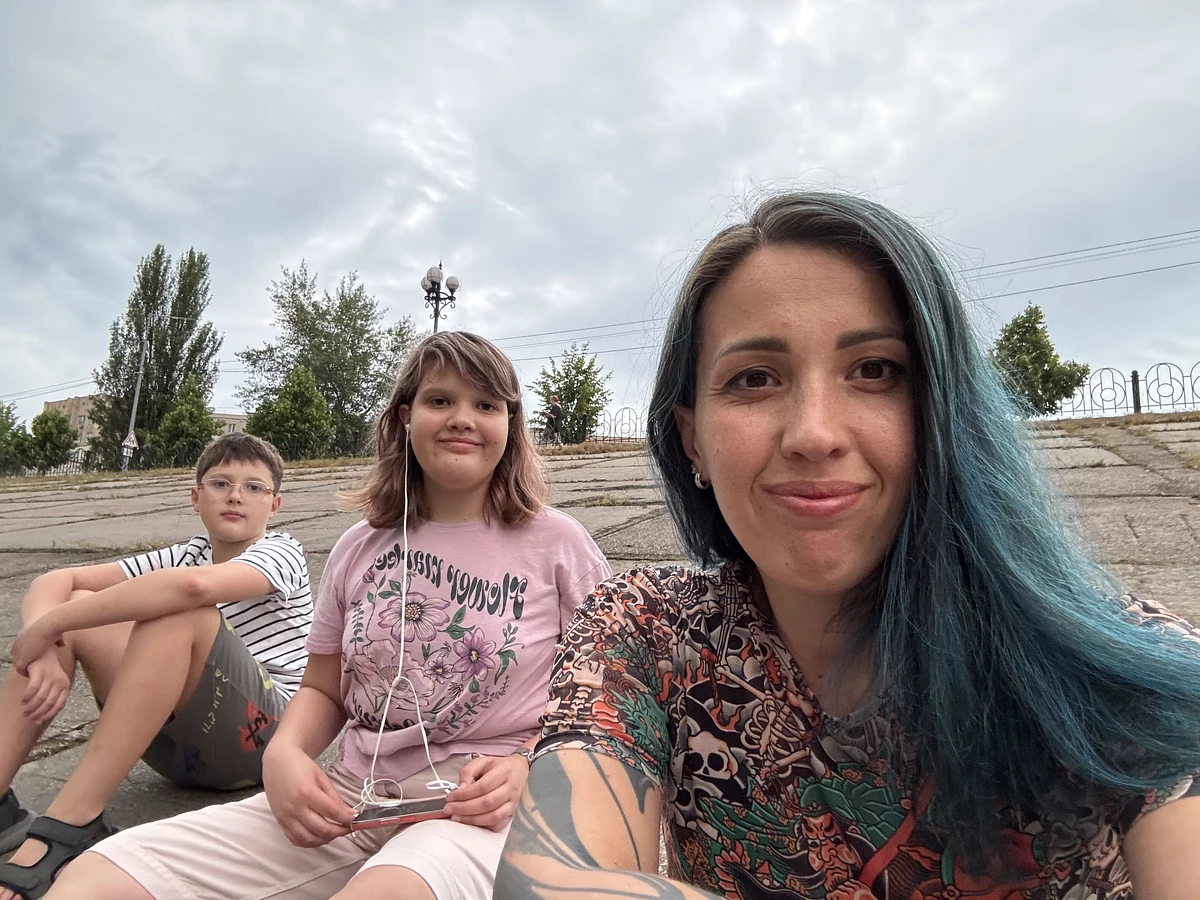
Alla Fedorenko, PM at Pingle Studio, with children
Alla Fedorenko lives in Kyiv, works as a PM at Pingle Studio and has been developing in the gaming industry for ten years. She has two children: 12-year-old Vika and 10-year-old Igor. Both study at the Kyiv State Lyceum — in the sixth and fifth grades. Alla’s husband has been serving as an officer in the Armed Forces of Ukraine for the past two years, so household and school issues mostly fall on her.
There is a clear division of responsibilities in the family: work is Alla’s job, and studying is the children’s area of responsibility. She does not believe that the employer should pay for the time that parents spend on schoolwork. At the same time, she understands that children need support and help, so she hires someone to study with them. This saves time for both her and the children, who do not have to wait for their mother’s working day to end.
The children have hybrid learning: one week online, one week offline. This schedule is not due to the family’s choice, but to the school’s technical capabilities — the bomb shelter cannot accommodate all the students. Online lessons are held on Zoom. If Alla had to sit next to the children, monitor their attention and help with notes, now they connect to the lessons independently.
To do this, each child has a magnetic board with a Kanban schedule, and a letter with links and passwords to the teachers' virtual rooms is attached to the mailbox. Even power outages no longer disrupt the learning process so much: the children have learned to distribute the Internet from their phones to their tablets while their mother connects the charging station.
There are also agreements in everyday life. Everyone cleans up after themselves, and children can take on additional household chores if they wish. Homework must be completed by 8:00 p.m. If a child has forgotten something or has not had time, Alla is ready to help from 6:00 p.m. to 8:00 p.m. Later — no more: sleep is more important for the family than finishing homework at night.
A separate tool is a Kanban board for household chores. It shows the days of the week, main and additional tasks, a schedule, and clubs. For completing household tasks, children receive points — story points. When 50 are accumulated, the board is reset, and the points are converted into pocket money.
Alla also uses parental controls on gadgets and teaches children to work with ChatGPT and Google search: to formulate queries correctly, adapt AI answers, and check information. However, she sometimes notices that because of this, children spend less time on independent thinking.
Distance learning itself, according to Alla, does not affect her productivity. It is much harder emotionally: because of the war, she cannot calmly leave the house, take a walk or drink coffee, leaving the children alone. Alarms, power outages and shelling are constant reminders of danger. At the same time, work helps to regain a sense of control — this is one of the areas where something really depends on her decisions and skills.
"Both are in blended learning, and this is another quest"
Diana Khudiakova, copywriter at ZONE3000
Diana Khudyakova has two daughters, ages 9 and 15. Both study on a mixed schedule, but their level of independence varies. The eldest daughter hardly needs to be supervised, except to wake her up on time if the alarm clock doesn’t go off. It’s more difficult with the youngest: she has to remind her about the start of each lesson, because it’s not easy to keep track of the school schedule during work processes. In addition, the child can quickly switch to her own "important" things and forget to join the lesson.
The organization of education in regional schools also adds additional rules. Recently, it has been changing depending on the level of air alerts, so parents have to constantly keep new conditions in mind.
A separate challenge is a power outage. If the power goes out in the middle of a lesson, you need to quickly switch the power to an alternative source. And after the connection is restored, you can hear that the child did not have time to write something down in the few minutes that he was offline.
Sometimes Diana has to take a break from work to work on a task with her daughter or find colored paper for an art lesson. Sometimes the child is already playing, and the teacher continues to explain a new topic somewhere in the background. Diana cannot and does not want to constantly monitor the process: she believes that it is important for children to learn independence.
At the same time, the family is adapting to new circumstances. Diana admits that there are many nuances in combining work and study, but Ukrainians already have considerable experience in adapting to change.
"Being 'good enough parents' and not demanding the unattainable from yourself"
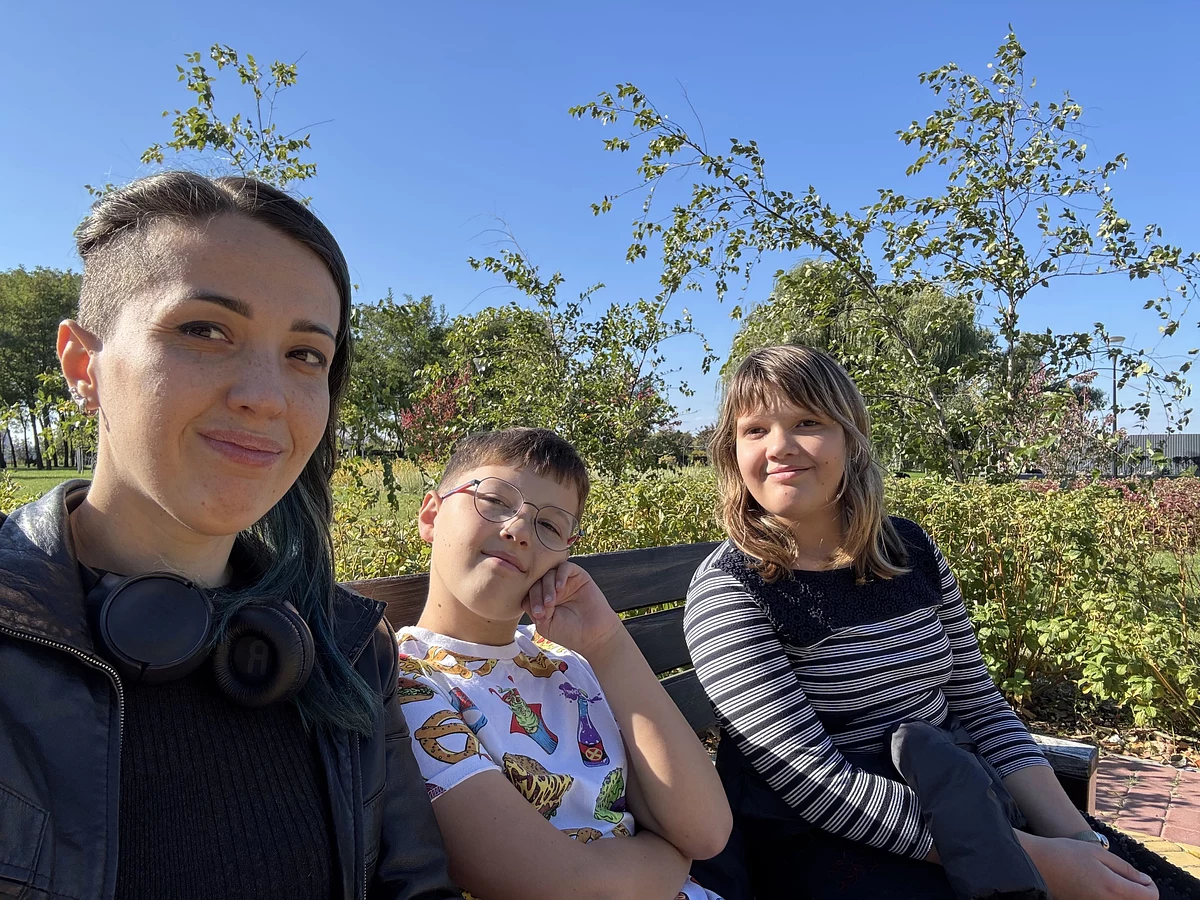
Viktoriya Zabranska, Senior Software Test Automation at EPAM, with her family
Viktoriya Zabranska works as a Senior Software Test Automation at EPAM and is a mother of three children, ages 11, 8, and 1.5 years old. Her family had to go through a lot of changes due to the war: after the full-scale invasion began, they moved from Kyiv to Lviv, and later a rocket hit their Kyiv home.
Victoria tries to combine work and raising three children without setting high expectations for herself. She says that the family copes sometimes better, sometimes worse, but she has decided not to demand the impossible from herself. For example, friends can take their children to clubs five times a week, but her family doesn’t have the resources for such a schedule — and she doesn’t blame herself for it.
Her husband’s support plays an important role. Since they both work in the same industry and understand the specifics of each other’s work, it is easier for them to agree and divide responsibilities. Victoria recalls that the three months of living abroad without her husband were very difficult.
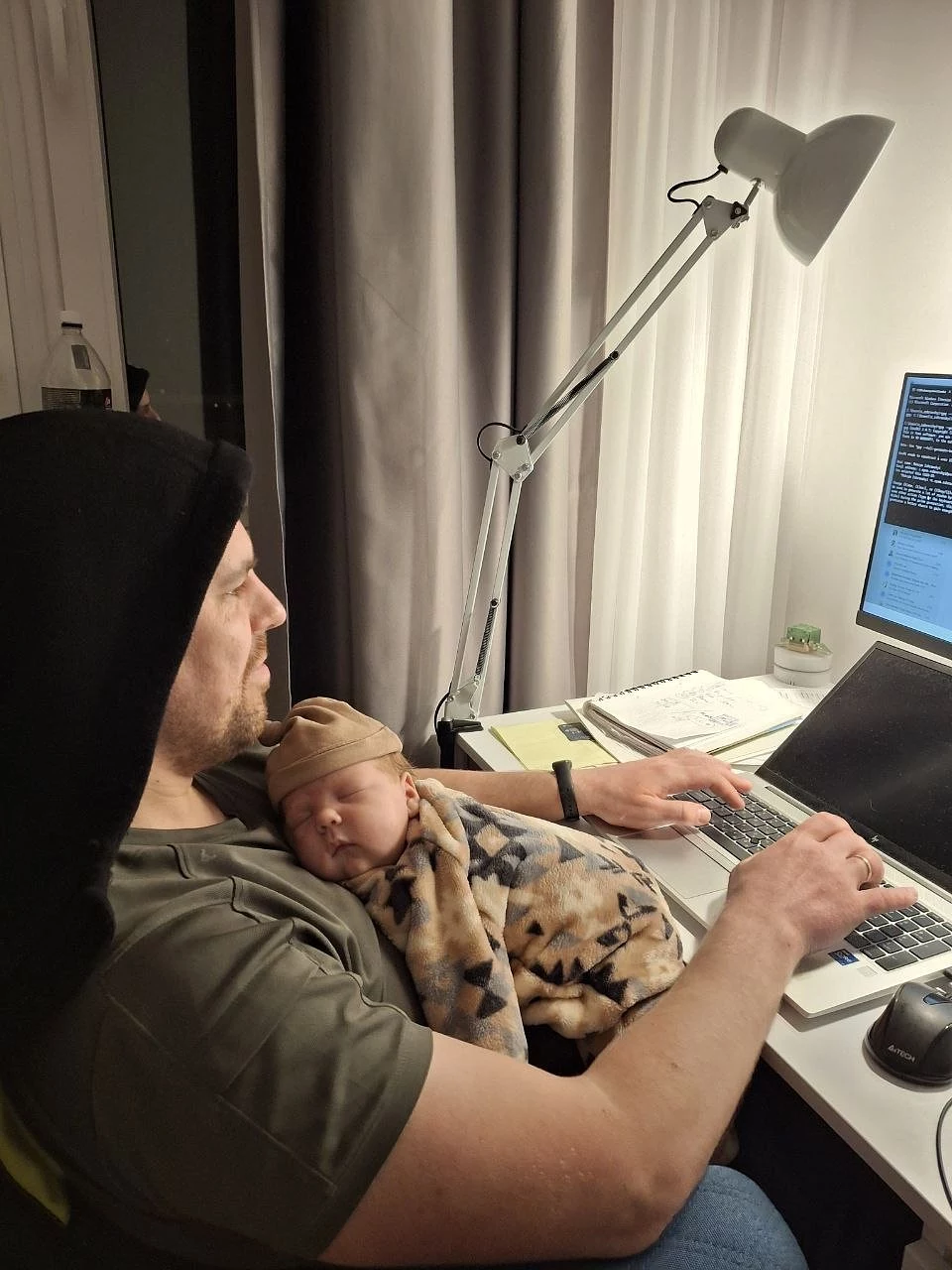
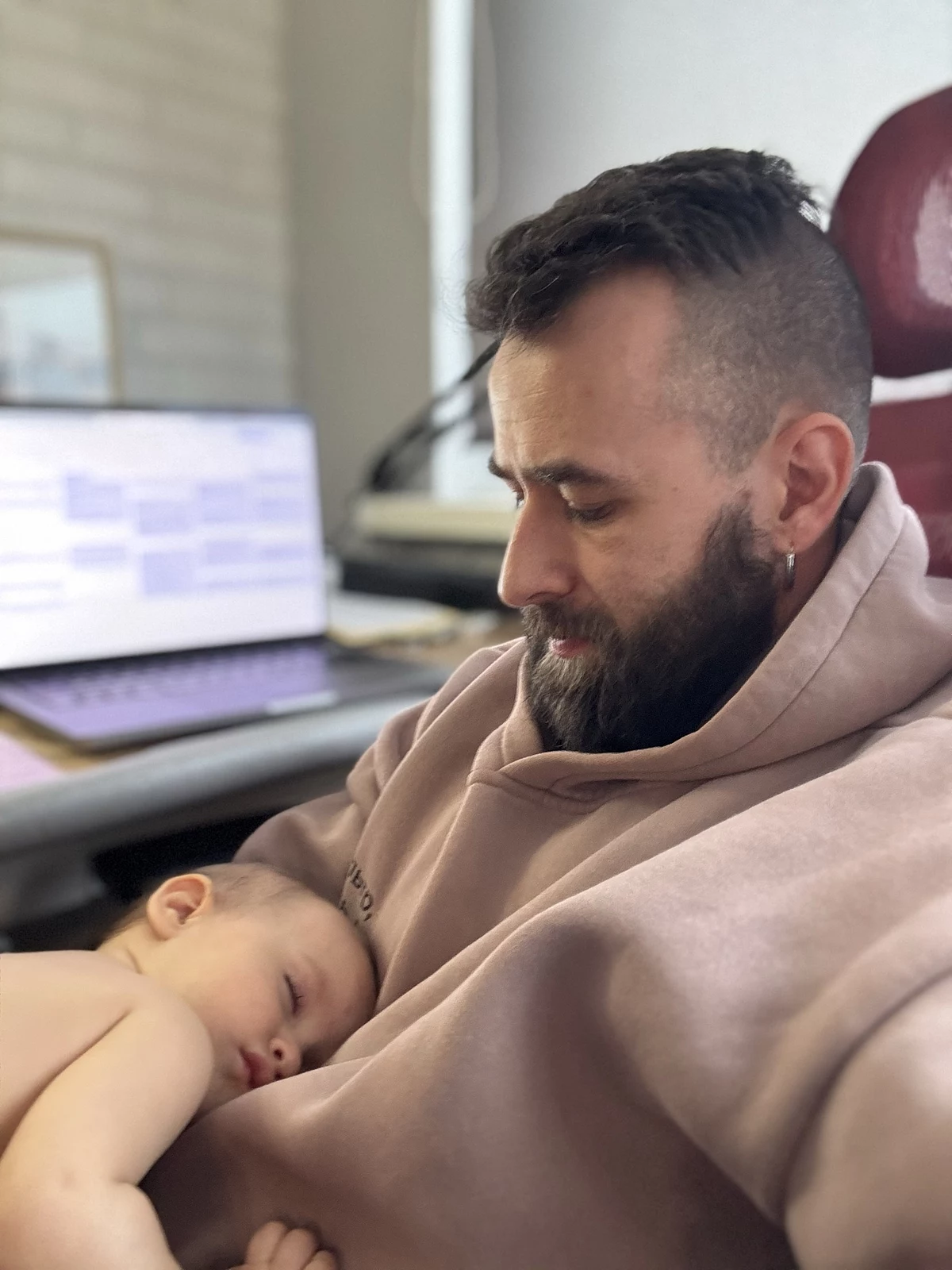
The period after the birth of the youngest child was especially exhausting. Due to a difficult pregnancy, Victoria had almost no full maternity leave, and after the baby was born she had to combine feeding with work meetings. There were no grandparents nearby, so she and her husband agreed: “Whoever doesn’t have a meeting, takes care of the baby.” They managed, but this period was very exhausting.
The education of older children also depends on the security situation. Last year, when the school was damaged by a shock wave, the children studied at home for a week. When they stay at home, parents have to find a quiet place to work, organize classes for their children in advance or ask them to be quiet. Some of the work assignments sometimes have to be completed in the evening, after the little ones have fallen asleep.
Victoria also talks about the significant psychological burden of war. During an air raid, the family must go to a shelter, a parking lot, or at least adhere to the two-wall rule. She explains: unlike adults without children who can decide to stay home on their own, she is responsible for the lives of children who are not yet capable of making such decisions.
"This "suspended" state is the biggest stress for me"
Oleksandr Kulibaba, Head of Internal Communications at EPAM Ukraine, with his family
Oleksandr Kulibaba is the head of internal communications at EPAM Ukraine. He has three children: a 10-year-old son, a seven-year-old daughter, and a two-year-old youngest child. He lives with his parents in a Kyiv apartment, where they also have a cat and a dog.
His workday usually starts at 6:50. While the family is sleeping, Oleksandr manages to make and drink coffee, wakes up the children at 7:20, and at 7:40 they leave for school and kindergarten. After returning, he has breakfast and sits down at the computer. But this schedule only works when there is no morning air alarm.
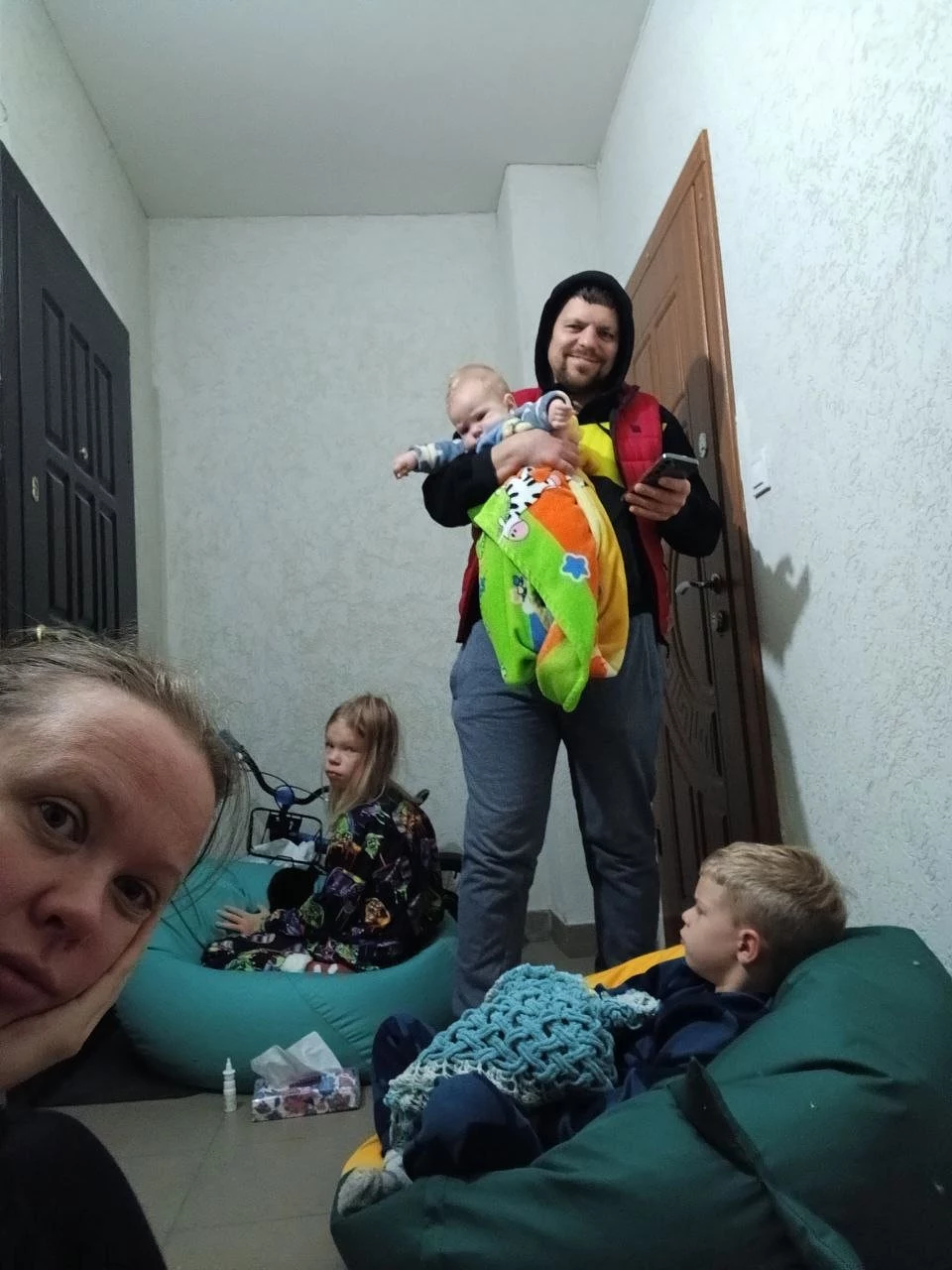
If the alarm ends by 10:00, the children go to in-person classes. If it lasts longer, they switch to online classes. Sometimes Oleksandr finds himself in a situation where he has already gathered the children and is standing in the hallway with their schoolbags, but does not know whether he will have to go to school or stay home. It is this uncertainty that is the greatest stress.
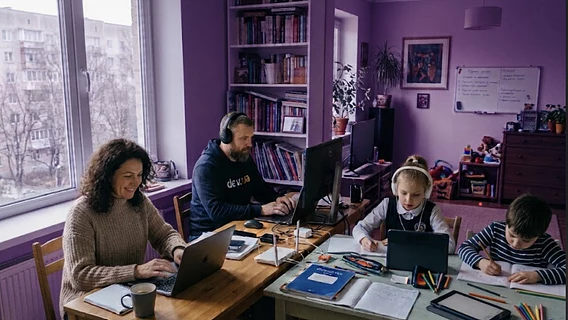
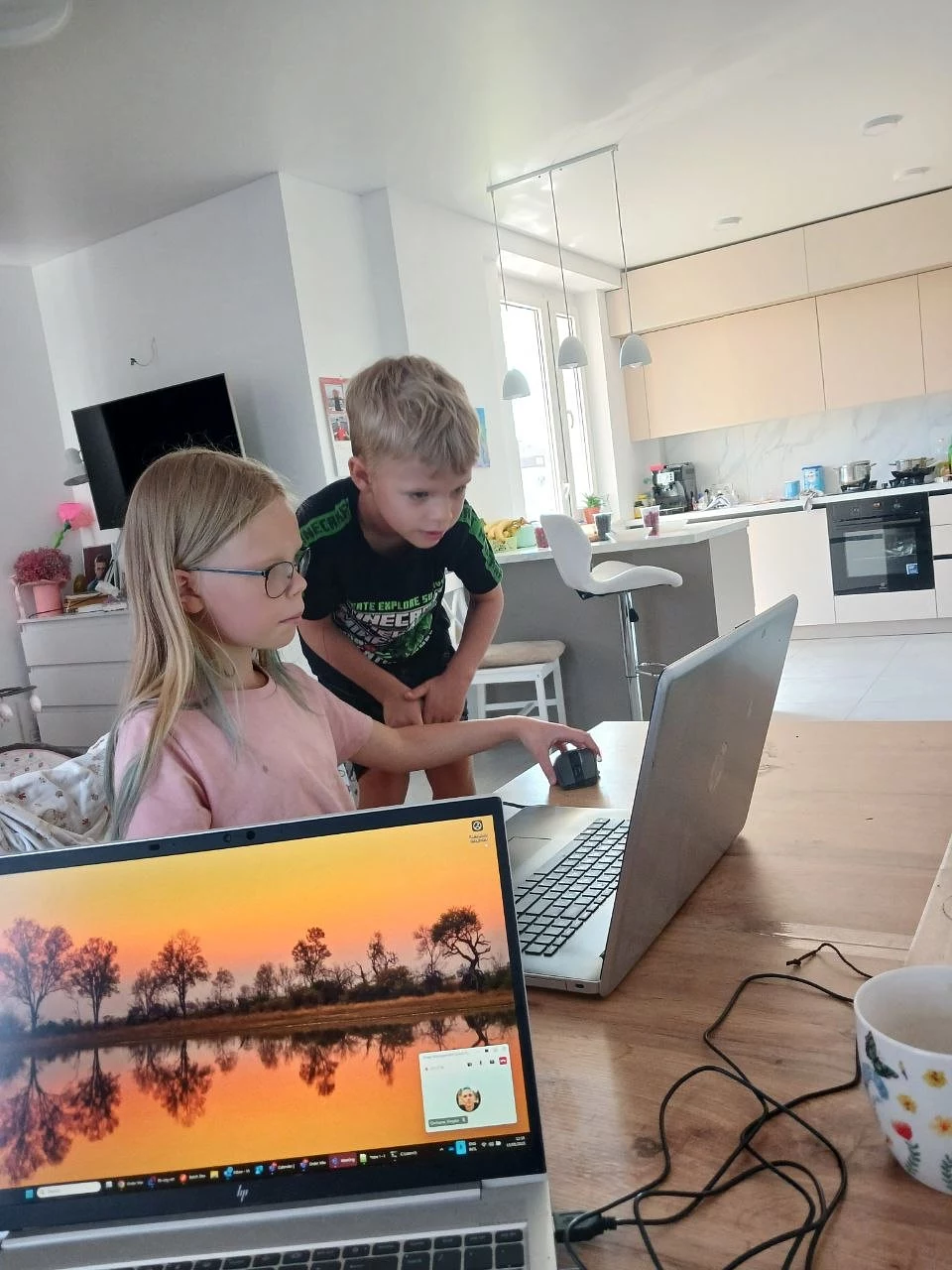
When children study online, the apartment turns into several work zones. The eldest son has a desk in the nursery, the middle daughter — in the hall, and Oleksandr himself works at a desk near the wall and window, fenced off by a curtain. Everyone has their own device: the son has a laptop set up, the daughter was bought a tablet. And after a few funny incidents during work calls, everyone was given headsets.
One day, her daughter was studying online while Oleksandr was on a call with the HR team. The teacher asked her to turn off the microphone because someone was talking loudly in the background. The girl calmly explained, “That’s Dad, he’s just busy right now.” After that, the family conducted additional training on how to use Zoom.
It’s no less difficult with online physical education and music. When her daughter does exercises in front of the camera, Oleksandr has to find a place to avoid being in the frame of her classmates. And when the children play the recorder and synthesizer during his work call, he has to turn off the microphone in time.
But the hardest thing for him is how the children get used to danger. During explosions or machine-gun fire, the eldest son gathers his sisters and takes them to the bathroom, which serves as a shelter behind two walls. The youngest daughter, hearing the alarm outside, points her finger to the sky and asks to go home.
Oleksandr is already preparing for winter and is thinking of moving the children’s workplaces away from the windows — into the dressing room, behind two walls. After all, this year hybrid or fully distance learning may become a reality for months. At the same time, he tries to maintain family evenings: when the work laptop is closed, the family takes out board games, and the dog and cat settle down nearby.
"For me, it’s not a sacrifice, it’s life itself, an investment of time"
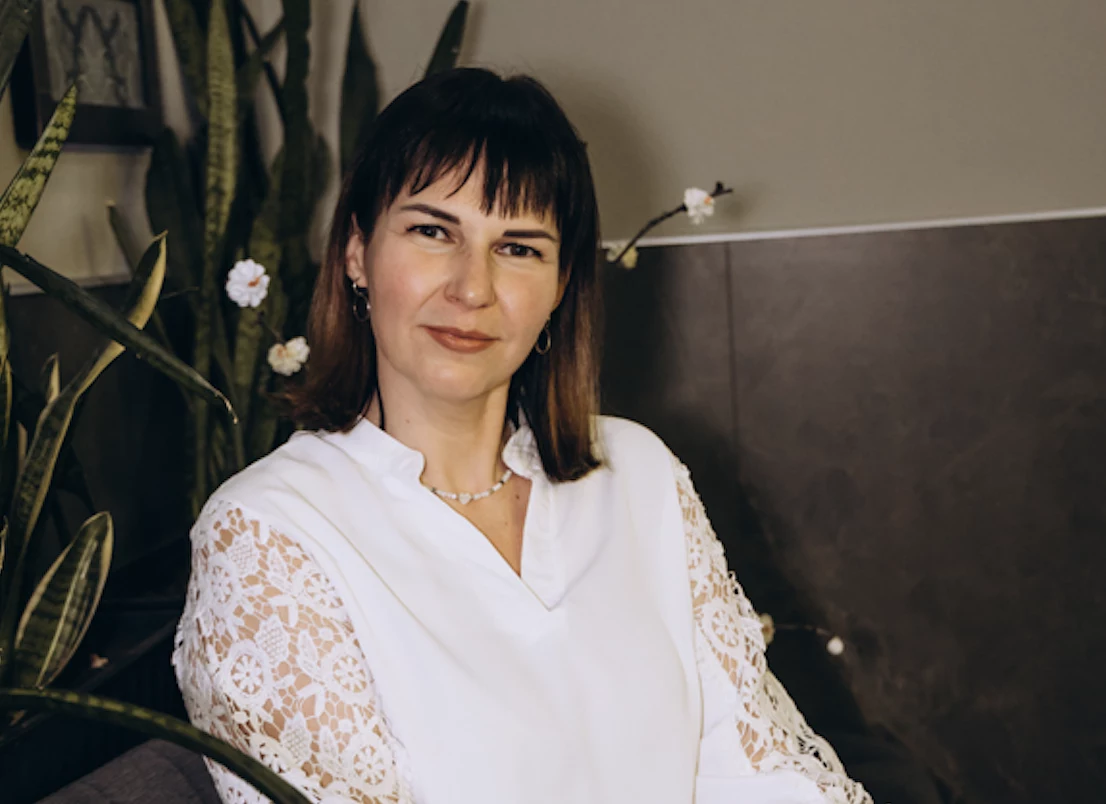
Victoria Kyrychenko, Analytics Product Manager at Railsware
Victoria Kyrychenko has three children. Two still go to kindergarten, and her 12-year-old son Myroslav is in seventh grade at a private online school. The family lived in Boryspil for a long time, but due to the intensification of attacks on the suburbs of the capital, they moved to Chernivtsi. The online format made it possible not to change schools after the move.
Myroslav started first grade during the COVID-19 pandemic, so the distance learning format was familiar to him from the very beginning. His mother immediately agreed on rules with him: not to turn off the camera during lessons, to answer questions, and not just to be present, but to participate in the lesson.
Now the family has clear but flexible arrangements. Viktoriya does not require her son to be an excellent student, but there are minimum scores that he must achieve, homework must be handed in on time, and in classes — to be active. Myroslav tries to do his lessons until the evening, before he is tired.
Parents divide the academic tasks depending on who has time. All completed and uncompleted assignments and grades are available online, so they can be checked once a week. Victoria also plans her workday in blocks: she allocates hours for focused work, and leaves time for children’s tasks in the morning or afternoon. If her son needs attention in the middle of the day, she puts an out of office mark on her calendar.
Switching to a private online school was an important decision for the family. They had previously changed several schools, where they had problems with organization: teachers could not connect, there was no electricity, and the large number of children in online classes prevented them from explaining the material properly. Now their son watches recorded lectures, takes tests, does homework, and can get advice from a teacher if necessary.
Victoria monitors grades and assignments, but tries not to control every step. If she sees that the results have worsened, she figures out what her son didn’t understand. Sometimes she helps with math or motivates him not to rush through assignments in order to rest faster.
Among the household solutions are separate equipment for the child, prior agreements on deadlines and minimum scores, as well as additional classes. Myroslav attends acting classes, plays the piano and violin, and studies Chinese and English. Some of the classes are held online, but the parents also choose offline activities so that their son can meet other children and adults.
Victoria does not perceive the time she devotes to her children as a loss or sacrifice. She says that children want to share successes and failures, and for her this is part of life. At the same time, distance learning does not deprive the child of the need to communicate: therefore, the family consciously looks for clubs and classes where her son can interact with peers.
In her opinion, online schools should add more opportunities for informal communication between students — for example, joint breaks or meetings based on interests. In general, in education, it is important not only to give children knowledge in all subjects, but also to help develop talents, learn to express their own opinions, and acquire financial literacy.
“Motherhood is wonderful, but it’s a 24/7 job.” Eight stories from professionals at SoftServe, Master of Code Global, Ciklum, ZONE3000, Intellias, and Pingle Game Studio who didn’t take long maternity leave and successfully combine work with raising kids